Tulsi Gabbard Key Statements on Iran: Policy Evolution, Nuclear Deal, and Security Views
Tulsi Gabbard’s key statements on Iran reflect a consistent stance against American-led regime-change wars coupled with support for nuclear diplomacy. Over her political career as a U.S. Representative, presidential candidate, and Dire...
Tulsi Gabbard’s key statements on Iran reflect a consistent stance against American-led regime-change wars coupled with support for nuclear diplomacy. Over her political career as a U.S. Representative, presidential candidate, and Director of National Intelligence, she supported the 2015 Iran Nuclear Deal, sharply criticized the 2020 Soleimani strike, and emphasized containment over direct conflict.
Contents
Core Principles Shaping Tulsi Gabbard’s Iran Policy
To understand the specific public statements made by Tulsi Gabbard regarding Iran, it is essential to first understand the overarching foreign policy framework she has promoted throughout her public service. As an Iraq War veteran who served in the Hawaii Army National Guard, Gabbard’s views on Middle Eastern foreign intervention differ markedly from traditional neoconservatives and interventionist liberals.
Her approach to Iran is defined by three fundamental principles:
- Opposition to Regime-Change Wars: Gabbard argues that U.S. military operations aimed at removing foreign regimes lead to catastrophic power vacuums, empower extremist groups, and waste American lives and resources.
- Support for Diplomatic Constraints on Nuclear Proliferation: She has repeatedly asserted that verifiable diplomatic agreements are more effective at preventing nuclear weapon acquisition than unilateral military strikes or indefinite economic sanctions.
- Constitutional Primacy in War Powers: Gabbard maintains that military action against foreign sovereign states, including Iran, requires explicit authorization from the U.S. Congress under Article I of the Constitution.
While critics have at times categorized her views as isolationist, Gabbard defines her stance as "realist" and focused tightly on direct U.S. national security interests. She has consistently acknowledged the threat posed by Iran's government and its regional proxies, but maintains that non-military strategic containment yields safer long-term outcomes for American troops and allies.
The 2015 Iran Nuclear Deal (JCPOA) and 2018 U.S. Withdrawal
The Joint Comprehensive Plan of Action (JCPOA), negotiated in 2015 under President Barack Obama, served as a primary focal point for Gabbard’s statements on Iranian nuclear ambitions.
- 2015: Supports JCPOA Nuclear Agreement
- 2018: Opposes U.S. JCPOA Withdrawal
- 2020: Condemns Unilateral Strike on General Qasem Soleimani
- 2024–2026: DNI Focus on Threat Assessment & Containment
Support for the Original 2015 Agreement
When the JCPOA was finalized between Iran, the P5+1 nations (the United States, United Kingdom, France, China, Russia, and Germany), and the European Union, Representative Gabbard offered qualified support. She emphasized that while the agreement was not flawless, it established an unprecedented inspection regime managed by the International Atomic Energy Agency (IAEA).
In public statements during her tenure in the House of Representatives, Gabbard argued:
- Diplomacy provided the only practical alternative to an escalating nuclear crisis or another costly war in the Middle East.
- Strict IAEA oversight was necessary to verify that Iranian nuclear infrastructure remained designated strictly for civilian energy purposes.
- Unilateral military action would fail to destroy nuclear knowledge and would instead incentivize Iran to rapidly build a deterrent.
Condemnation of the 2018 U.S. Withdrawal
In May 2018, when President Donald Trump announced the U.S. withdrawal from the JCPOA and reinstated aggressive economic sanctions under a "maximum pressure" campaign, Gabbard issued strong public criticism. She characterized the withdrawal as a dangerous error that undermined international credibility and heightened the probability of armed conflict.
Gabbard noted that breaking the agreement without evidence of Iranian non-compliance weakened American diplomatic standing globally. She warned that exiting the deal would remove restrictions on Iran’s enrichment levels and centrifuges, ultimately shortening Iran's breakout time toward weapon-grade uranium—a prediction later corroborated by international intelligence agencies.
The 2020 Strike on General Qasem Soleimani and War Powers Debate
One of the most defining moments in Gabbard’s commentary on Iran occurred in January 2020 following the U.S. drone strike near Baghdad International Airport that killed Qasem Soleimani, commander of Iran’s Islamic Revolutionary Guard Corps (IRGC) Quds Force.
2020 Soleimani Strike Statement
"President Trump's act of war against Iran was illegal, unconstitutional, and reckless. It escalated tensions and put our country on a path toward an unnecessary and devastating war in the Middle East."
-- Tulsi Gabbard, January 2020
Allegations of Unconstitutional Acts of War
Immediately following the assassination, Gabbard condemned the strike as an illegal act of war executed without congressional consent. She stated that while Soleimani was undeniably responsible for the deaths of American military personnel and foreign civilians, target-killing a high-ranking official of a sovereign government without prior legislative authorization violated the U.S. Constitution and the War Powers Resolution of 1973.
Her key arguments during this period included:
- Escalation Risk: Assassinating a major military figure risked provoking a direct war with Iran, which could spiral across Iraq, Syria, and the Persian Gulf.
- Lack of Clear Strategy: The administration lacked a coherent post-strike plan for managing retaliation or protecting U.S. personnel stationed in the region.
- Targeting of Proxies vs. Direct Confrontation: She argued that counter-terrorism efforts should remain focused on non-state threat networks rather than actions that force open warfare with regional sovereign states.
Legislative Initiatives to Block Military Escalation
Following the Soleimani strike, Gabbard co-sponsored legislative efforts in the U.S. House of Representatives designed to prohibit federal funding for unauthorized military operations against Iran. She repeatedly emphasized that the 2001 and 2002 Authorizations for Use of Military Force (AUMF) could not legally be stretched to cover offensive operations against the Iranian state.
Statements on Iranian Proxies and Middle East Regional Dynamics
Gabbard's critique of U.S. foreign policy toward Iran does not equate to support for the regime in Tehran. Throughout her career, she has clearly characterized Iran's leadership as an autocratic, repressive regime and a significant regional adversary.
Views on Iranian Support for Proxy Militias
Gabbard has publicly recognized the destructive role played by Iranian-backed proxy forces, including Hezbollah in Lebanon, Hamas in Gaza, the Houthis in Yemen, and various Shia militias in Iraq. However, her diagnostic focus centered on how U.S. foreign policy choices inadvertently strengthened these networks:
- The Iraq War Impact: She frequently pointed out that the 2003 U.S. invasion of Iraq removed Iran's primary regional counterweight (Saddam Hussein), effectively delivering significant geopolitical influence over Baghdad directly to Tehran.
- Syrian Civil War Interventions: Gabbard argued that U.S. support for anti-Assad rebel groups in Syria destabilized the country, creating opportunities for Iran and Russia to entrench military forces inside Syrian territory.
Gabbard's Assessment of Proxy Networks
- Acknowledges Iran as a state sponsor of terrorism and regional destabilizer.
- Asserts U.S. regime-change interventions (Iraq, Syria) expanded Iranian influence.
- Rejects military intervention as the default response to regional proxy threats.
Key Statements Timeline & Comparative Policy Context
The table below outlines key statements and formal legislative positions taken by Tulsi Gabbard concerning Iran across key milestones in her career.
| Year | Event / Milestone | Primary Statement / Position | Stated Rationale / Objective |
|---|---|---|---|
| 2015 | JCPOA Signing | Supported the multi-nation nuclear agreement | Prevent Iran from acquiring nuclear weapons through verifiable inspection protocols rather than war. |
| 2018 | U.S. JCPOA Withdrawal | Strongly criticized President Trump's decision | Preserved nuclear oversight; warned that exit reduced breakout time and damaged U.S. diplomatic credibility. |
| 2019 | Democratic Debates | Warned against neoconservative pushing for Iran war | Focused on avoiding a catastrophic regional conflict that would cost American lives and trillions of dollars. |
| 2020 | Soleimani Assassination | Condemned strike as an unconstitutional act of war | Asserted that military actions against sovereign officials require explicit authorization from Congress. |
| 2020 | War Powers Resolution | Voted to limit executive military action against Iran | Enforced Constitutional limits on executive branch war powers under Article I. |
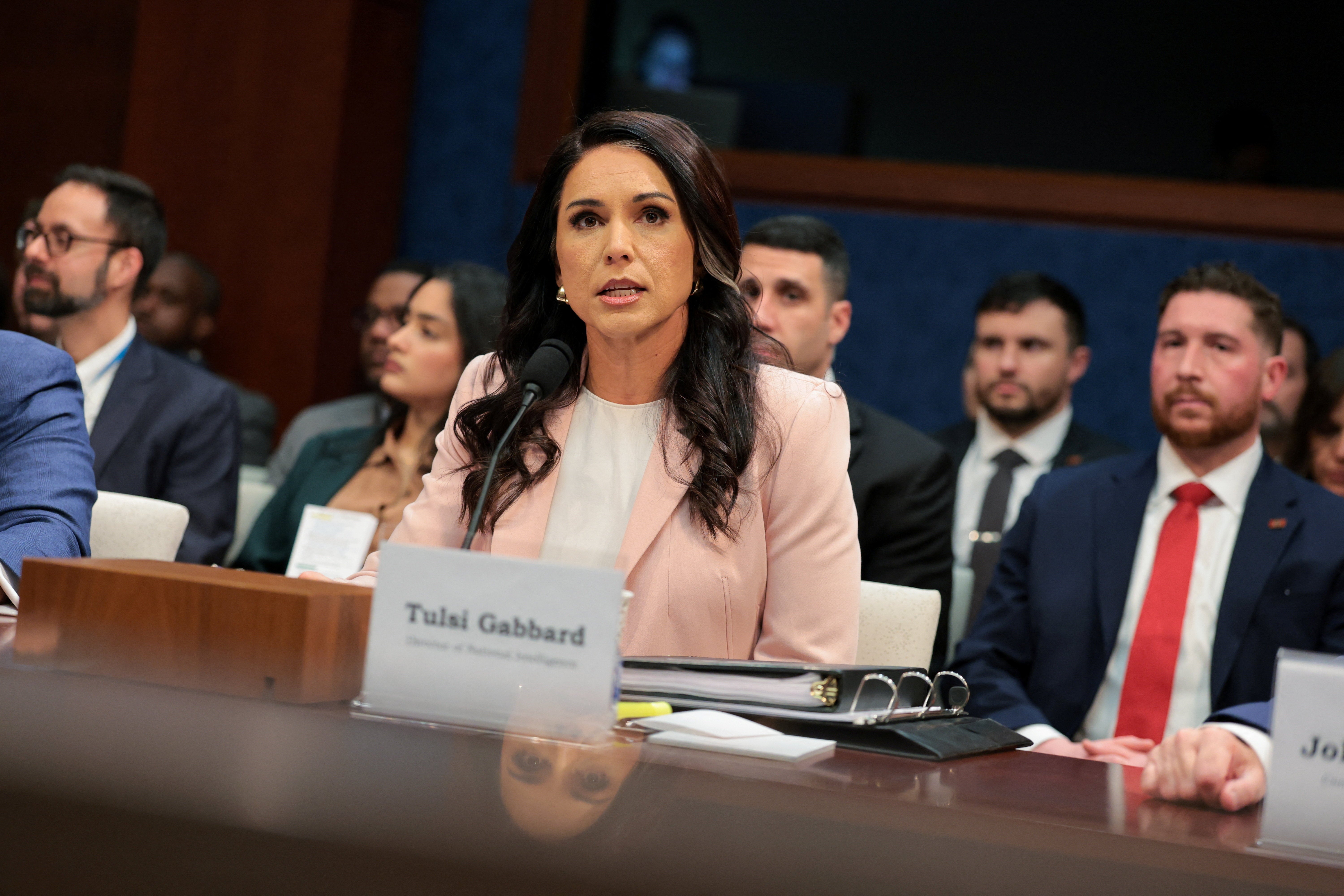
| 2024–2025 | DNI Nomination & Confirmation | Emphasized objective intelligence on Iranian threats | Focused intelligence apparatus on monitoring enrichment, missile development, and cyber threats without politicization. |
Transition to Executive Leadership: DNI Role and Evolving Stance
Following her nomination and confirmation as Director of National Intelligence (DNI), Gabbard shifted from a legislative policy-maker to an intelligence leader responsible for delivering objective assessments to the White House and Congress.
Intelligence Assessment vs. Policy Advocacy
In her role overseeing the Intelligence Community (IC), Gabbard’s public focus shifted toward analytical precision regarding Iran's strategic capabilities:
- Monitoring Enrichment Milestones: Emphasized rigorous, objective data collection on Iran’s stockpile of 60% enriched uranium and technical breakout capabilities.
- Countering Cyber and Proxy Capabilities: Highlighted the growing threat posed by Iranian offensive cyber operations targeting critical infrastructure, as well as grey-zone warfare tactics executed via regional proxies.
- Preventing Miscalculation: Stated that primary intelligence objectives include providing clear, unvarnished threat assessments to ensure U.S. leaders avoid accidental escalation driven by incomplete or flawed intelligence.
Key Takeaways from Gabbard's Iran Statements
Tulsi Gabbard’s record on Iran highlights a distinct strategic perspective within modern American foreign policy:
- Pragmatic Non-Interventionism: She consistently opposes military campaigns directed at regime change, arguing they yield unpredictable violence and empower hostile actors.
- Diplomatic Preference for Non-Proliferation: She favors international treaties with stringent verification mechanisms over unilateral sanctions or preventative military strikes.
- Strict Adherence to War Powers: She insists that any direct military conflict with Iran must be authorized by the United States Congress.
- Threat Recognition Without War Escalation: While rejecting military intervention, she maintains that Iran’s regional proxy networks, ballistic missile programs, and nuclear ambitions represent real strategic challenges requiring clear-eyed intelligence monitoring.
Frequently Asked Questions
Did Tulsi Gabbard support the 2015 Iran Nuclear Deal (JCPOA)?
Yes. Tulsi Gabbard supported the 2015 Joint Comprehensive Plan of Action (JCPOA). She argued that the agreement provided necessary oversight and international inspection mechanisms through the International Atomic Energy Agency (IAEA) to prevent Iran from developing nuclear weapons without dragging the United States into another Middle Eastern conflict.
What was Tulsi Gabbard’s position on the strike that killed Qasem Soleimani?
Gabbard strongly criticized the January 2020 drone strike that killed Iranian General Qasem Soleimani. She described the strike as an illegal, unconstitutional act of war executed without congressional authorization. While acknowledging Soleimani's involvement in violent actions, she warned that target-killing a senior foreign official created grave risks of an all-out military conflict.
Does Tulsi Gabbard consider Iran a security threat to the United States?
Yes. Gabbard has repeatedly stated that Iran’s government acts as an authoritarian regime and a state sponsor of terrorism that threatens regional stability and U.S. assets. However, she argues that military intervention and regime-change strategies exacerbate these threats rather than resolving them.
How do Tulsi Gabbard’s views on Iran compare to traditional neoconservative positions?
Traditional neoconservative policy often supports aggressive deterrence, military readiness for preventative action, maximum economic pressure, and potential regime change. In contrast, Gabbard advocates non-interventionism, diplomatic nuclear management, adherence to congressional war powers, and avoiding U.S. involvement in regional foreign conflicts.
Practical Action and Further Reading
To gain a deeper understanding of U.S.-Iran policy and executive war powers debates, consider the following next steps:
- Review Official Congressional Records: Read the text of the War Powers Resolution of 1973 and House roll-call votes regarding authorizations for the use of military force (AUMF).
- Examine IAEA Reports: Check published reporting from the International Atomic Energy Agency regarding nuclear verification and compliance metrics under international agreements.
- Analyze Intelligence Threat Assessments: Consult annual non-classified threat assessments released by the Office of the Director of National Intelligence (ODNI) for current intelligence evaluations of Middle Eastern security developments.
Image Gallery