What a Life Insurance Contract Contains: Key Provisions and Legal Elements
A life insurance contract contains several essential components including the declarations page, the insuring clause, conditions, exclusions, and mandatory provisions like the grace period and incontestability clause. Legally, it must...
A life insurance contract contains several essential components including the declarations page, the insuring clause, conditions, exclusions, and mandatory provisions like the grace period and incontestability clause. Legally, it must also include an offer, acceptance, consideration, competent parties, and a legal purpose to be considered a valid, enforceable agreement.
Contents
Understanding the specific contents of a life insurance contract is a cornerstone for anyone studying for insurance licensing exams or using tools like Quizlet to master financial literacy. As of 2026, while the delivery of policies has become increasingly digital, the core legal framework and the mandatory provisions required by state regulators remain the foundation of the industry. This guide breaks down these components with the technical depth required for both academic study and professional application.
The Legal Foundations of the Life Insurance Contract
Before examining the specific clauses, it is vital to understand the legal nature of the contract itself. In the United States, insurance contracts are governed by state law, but they all share four universal elements required for any legal contract.
1. Offer and Acceptance
The "offer" is typically made by the applicant when they submit a completed application and the initial premium to the insurance company. "Acceptance" occurs when the insurer’s underwriter approves the application and issues the policy. If the insurer issues the policy at a different rate than applied for (a "rated" policy), this is legally considered a counteroffer, which the applicant must then accept.
2. Consideration
Consideration refers to the value exchanged between parties. For the insured, consideration is the initial premium payment and the statements made in the application. For the insurer, consideration is the promise to pay the death benefit upon the occurrence of the covered event.
3. Competent Parties
All parties involved must have the legal capacity to enter into a contract. This means the applicant must be of legal age (usually 18), mentally competent, and not under the influence of drugs or alcohol at the time of application. The insurer must be licensed to do business in the state where the policy is sold.
4. Legal Purpose
The contract must not involve illegal activity. In life insurance, this is primarily established through insurable interest. The policyowner must have a financial interest in the continued life of the insured at the inception of the contract to prevent the policy from being a mere wagering agreement.
Essential Policy Components and Sections
When you open a life insurance policy in 2026, you will find it organized into several distinct sections. Each serves a specific function in defining the scope of coverage and the duties of the parties involved.
The Declarations Page
Often called the "dec page" or the policy summary, this is the first page of the contract. It provides the personalized details of the coverage, including:
- The policy number.
- The names of the insured and the policyowner.
- The face amount (death benefit).
- The premium amount and frequency (monthly, quarterly, annually).
- The effective date and the expiration date (for term insurance).
- A list of any attached riders.
The Insuring Clause
The insuring clause is the heart of the life insurance contract. It represents the insurer's fundamental promise to pay the death benefit to the named beneficiary upon receiving proof of the insured's death. This clause is usually signed by an officer of the company and identifies the parties to the contract.
The Consideration Clause
This section specifies the amount and frequency of the premium payments required to keep the policy in force. It reinforces that the insured's "consideration" is the premium paid and the truthfulness of the application.
Mandatory Policy Provisions
State laws require life insurance contracts to include certain "standard provisions" that protect the policyowner. These are frequently the subject of Quizlet sets and licensing exam questions.
Entire Contract Clause
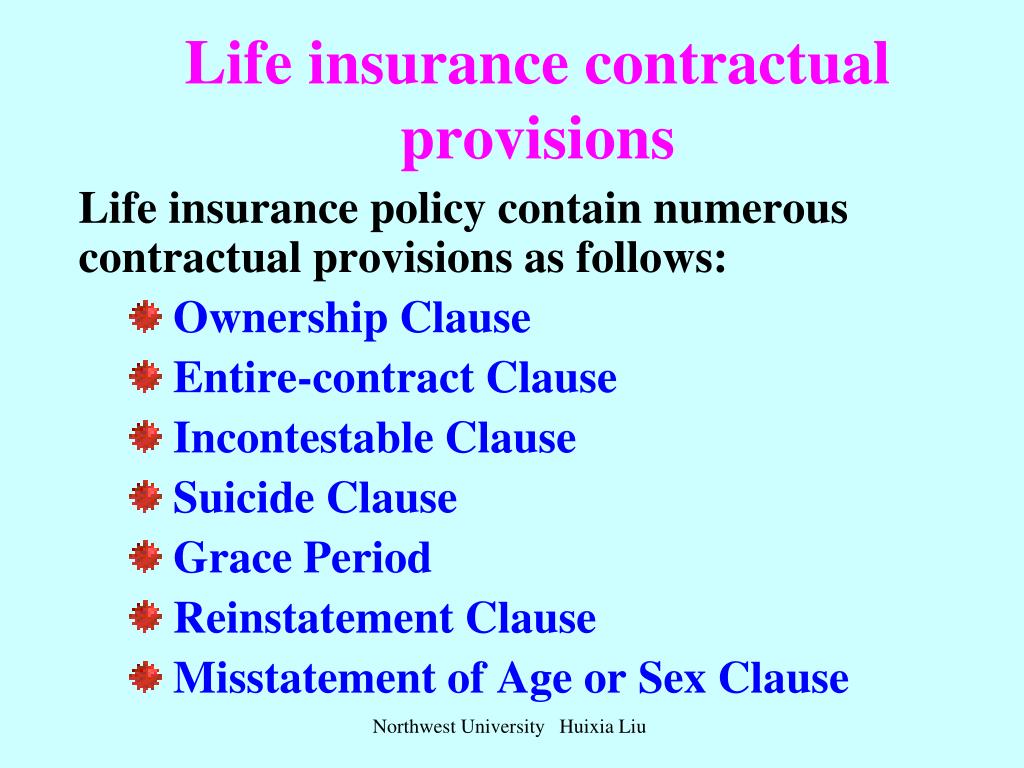
The Entire Contract Clause states that the policy document, any attached riders, and the original signed application constitute the entire agreement between the insurer and the policyowner. This prevents the insurance company from referring to its internal bylaws or other outside documents to deny a claim.
Grace Period
The grace period is a mandatory timeframe (usually 30 or 31 days) after the premium due date during which the policy remains in force even if the premium has not been paid. If the insured dies during this period, the insurer will pay the death benefit minus the overdue premium.
Incontestability Clause
This is a consumer protection provision. It prevents the insurer from contesting the validity of the policy or denying a claim based on misstatements in the application after the policy has been in force for a specific period, typically two years. After this window, the policy is "incontestable" except for non-payment of premiums or, in some jurisdictions, extreme cases of fraud.
Reinstatement Provision
If a policy lapses because the grace period ended without payment, the reinstatement provision allows the owner to put the policy back in force. Generally, this must be done within three to five years. The owner must provide evidence of insurability, pay all back premiums plus interest, and repay any outstanding policy loans.
Misstatement of Age or Gender
Unlike other misrepresentations, a mistake regarding the insured’s age or gender does not allow the insurer to void the policy. Instead, if the error is discovered, the insurer will adjust the death benefit to the amount that the premiums paid would have purchased at the correct age or gender.
Ownership Rights and Beneficiary Designations
The "Owner’s Rights" section outlines what the policyowner (who may or may not be the insured) can do with the policy.
Rights of Ownership
The owner has the exclusive right to:
- Designate and change beneficiaries.
- Select settlement options (how the death benefit is paid).
- Assign the policy to another party.
- Receive policy dividends (in participating policies).
- Exercise cash value options, such as taking a policy loan or surrendering the policy.
Beneficiary Designations
Life insurance contracts distinguish between revocable and irrevocable beneficiaries. A revocable beneficiary can be changed by the owner at any time without the beneficiary’s consent. An irrevocable beneficiary has a vested interest in the policy; the owner cannot change the beneficiary, borrow against the cash value, or surrender the policy without the irrevocable beneficiary’s written permission.
Policy Assignments
There are two primary ways to transfer policy rights:
- Absolute Assignment: A permanent transfer of all rights of ownership to another person or entity.
- Collateral Assignment: A partial, temporary transfer of rights, usually to a bank as security for a loan. Once the loan is repaid, the assigned rights revert to the policyowner.
Exclusions and Limitations
Exclusions are specific risks that the insurance company refuses to cover. While modern 2026 policies are comprehensive, standard exclusions still apply.
The Suicide Clause
To protect against "adverse selection" (someone buying insurance specifically because they intend to end their life), most policies include a suicide clause. If the insured commits suicide within the first two years of the policy, the insurer will not pay the death benefit. Instead, they will refund the premiums paid to the beneficiary. After two years, suicide is covered like any other cause of death.
Common Exclusions Table
The following table summarizes standard exclusions found in life insurance contracts:
| Exclusion Type | Description |
|---|---|
| Aviation | Often excludes coverage for non-commercial pilots or crew members, though commercial "fare-paying" passengers are covered. |
| Hazardous Occupations/Hobbies | May exclude deaths resulting from activities like skydiving, auto racing, or underwater demolition if not disclosed and rated. |
| War or Military Service | Often triggered during active conflict; the "Status Clause" excludes any death while in the military, while the "Results Clause" only excludes death resulting from war. |
| Illegal Acts | Some policies exclude coverage if the insured dies while committing a felony. |
Policy Riders: Adding Customization
Riders are endorsements attached to the original contract that modify its terms or add specific benefits. They allow the policy to be tailored to the insured's needs.
- Waiver of Premium: If the insured becomes totally disabled, the insurer waives the premiums, keeping the policy in force.
- Accidental Death Benefit (Double Indemnity): Pays an additional sum if the death results from an accident, usually doubling the face amount.
- Accelerated Death Benefit: Allows a terminally ill insured to access a portion of the death benefit while still alive to pay for medical care.
- Guaranteed Insurability Rider: Allows the owner to purchase additional coverage at specific intervals without proving health (medical evidence).
Summary of Life Insurance Provisions for Study
| Provision | Quizlet Key Point |
|---|---|
| Free Look Period | Usually 10–30 days to return the policy for a full refund after delivery. |
| Owner’s Rights | The owner, not the insured or beneficiary, holds all contractual "incidents of ownership." |
| Settlement Options | Choices for payout: Lump sum, interest only, fixed period, fixed amount, or life income. |
| Non-Forfeiture Values | Rights to the cash value if a permanent policy is surrendered (Cash, Reduced Paid-Up, or Extended Term). |
Frequently Asked Questions
What is the difference between an "Insuring Clause" and a "Consideration Clause"?
The Insuring Clause is the insurer's promise to pay the death benefit, essentially defining the scope of the coverage. The Consideration Clause defines the "value" given by the applicant—the premium payments and the information provided on the application—which is necessary to make the contract legally binding.
Can an insurance company cancel my life insurance if I get a terminal illness?
No. As long as you continue to pay your premiums, a life insurance company cannot cancel your coverage due to changes in your health. The Incontestability Clause also prevents them from challenging your health statements after the initial two-year period has passed.
What happens if the primary beneficiary dies before the insured?
If the primary beneficiary predeceases the insured, the death benefit will be paid to the contingent beneficiary (also known as the secondary beneficiary). If no contingent beneficiary is named, the proceeds typically go to the insured’s estate, which may subject the funds to probate.
Is the application actually part of the contract?
Yes, under the Entire Contract Clause, a copy of the original application is physically or digitally attached to the policy and becomes a legal part of the agreement. This ensures that any "representations" made by the applicant are documented.
What is the "Free Look" period?
The Free Look period is a consumer protection window, usually lasting 10 to 30 days starting from the date the policy is delivered to the owner. During this time, the owner can review the contract and, if unsatisfied for any reason, return it for a full refund of all premiums paid.
Practical Recommendation
When reviewing a life insurance contract or preparing for an exam, prioritize understanding the Mandatory Provisions. These are the "rules of the road" that dictate how a policy handles late payments (Grace Period), errors in the application (Incontestability and Misstatement of Age), and how to revive a dead policy (Reinstatement). Mastering these definitions will not only help with Quizlet-based study but will also ensure you understand the legal protections afforded to every policyowner in 2026.
Image Gallery