Understanding the RealReal About Data Center Sustainability
Data center sustainability in 2026 is a complex balance between massive AI-driven energy demand and aggressive decarbonization efforts. While hyperscalers often achieve 100% renewable energy matching, the "realreal" involves addressing...
Data center sustainability in 2026 is a complex balance between massive AI-driven energy demand and aggressive decarbonization efforts. While hyperscalers often achieve 100% renewable energy matching, the "realreal" involves addressing Scope 3 embodied carbon, high water consumption for cooling, and the increasing strain on local electrical grids.
Contents
The conversation around data center sustainability has shifted from marketing-driven "green" initiatives to a rigorous, data-backed necessity. As we move through 2026, the industry faces a dual-edged sword: the exponential growth of generative AI and high-performance computing (HPC) requires unprecedented amounts of power, while global regulatory bodies and investors demand transparency and genuine carbon neutrality. To understand the "realreal," we must look beyond Power Usage Effectiveness (PUE) and examine the total lifecycle impact of the digital infrastructure that powers our world.
The Energy Paradox: AI Growth vs. Decarbonization
The most significant challenge to data center sustainability in 2026 is the sheer density of modern workloads. A standard server rack in 2020 might have pulled 5kW to 10kW; today, racks supporting AI training and inference frequently exceed 100kW. This leap in power density has forced a reckoning in how energy is sourced and consumed.
Renewable Matching vs. 24/7 Carbon-Free Energy
For years, the gold standard was "100% renewable matching," where companies purchased enough Renewable Energy Certificates (RECs) or Power Purchase Agreements (PPAs) to equal their annual consumption. However, the "realreal" is that this does not mean the data center runs on green energy every hour of the day. If the wind isn't blowing or the sun isn't shining, the facility draws from the local grid, which may rely on coal or natural gas.
In 2026, the industry is transitioning toward 24/7 Carbon-Free Energy (CFE). This approach requires matching hourly demand with local carbon-free supply. It is a much higher bar to clear, requiring advanced battery storage, geothermal energy, or even Small Modular Reactors (SMRs) to provide consistent baseload power without carbon emissions.
The Efficiency Trap
Power Usage Effectiveness (PUE) remains the primary metric for efficiency, calculated by dividing the total power entering the facility by the power used by the IT equipment. While a "perfect" PUE is 1.0, many modern facilities boast 1.1 or 1.2. However, PUE can be misleading. A facility with a great PUE might still be incredibly wasteful if the servers inside are underutilized or if the "efficient" cooling system consumes massive amounts of water instead of electricity.
The Water Usage Crisis: The Hidden Cost of Cooling
While carbon emissions get the most headlines, Water Usage Effectiveness (WUE) has become a critical metric for 2026. Data centers require cooling to prevent hardware failure, and for years, evaporative cooling was the "green" choice because it reduced electricity consumption (improving PUE).
The "realreal" is that this often results in millions of gallons of water being evaporated daily, often in regions already facing water scarcity. In 2026, many jurisdictions have implemented strict limits on water withdrawals for data centers. This has accelerated the shift toward:
- Closed-loop cooling: Systems that recirculate water rather than evaporating it.
- Liquid cooling: Direct-to-chip or immersion cooling, which is significantly more efficient at removing heat than air-based systems and can operate at higher temperatures, reducing the need for mechanical chilling.
- Dry cooling: Using ambient air and heat exchangers, though this becomes less effective in hot climates.
Scope 3 and the Embodied Carbon Challenge
To truly understand data center sustainability, we must look at the three scopes of emissions defined by the Greenhouse Gas Protocol:
- Scope 1: Direct emissions from on-site sources (e.g., diesel backup generators).
- Scope 2: Indirect emissions from the generation of purchased electricity.
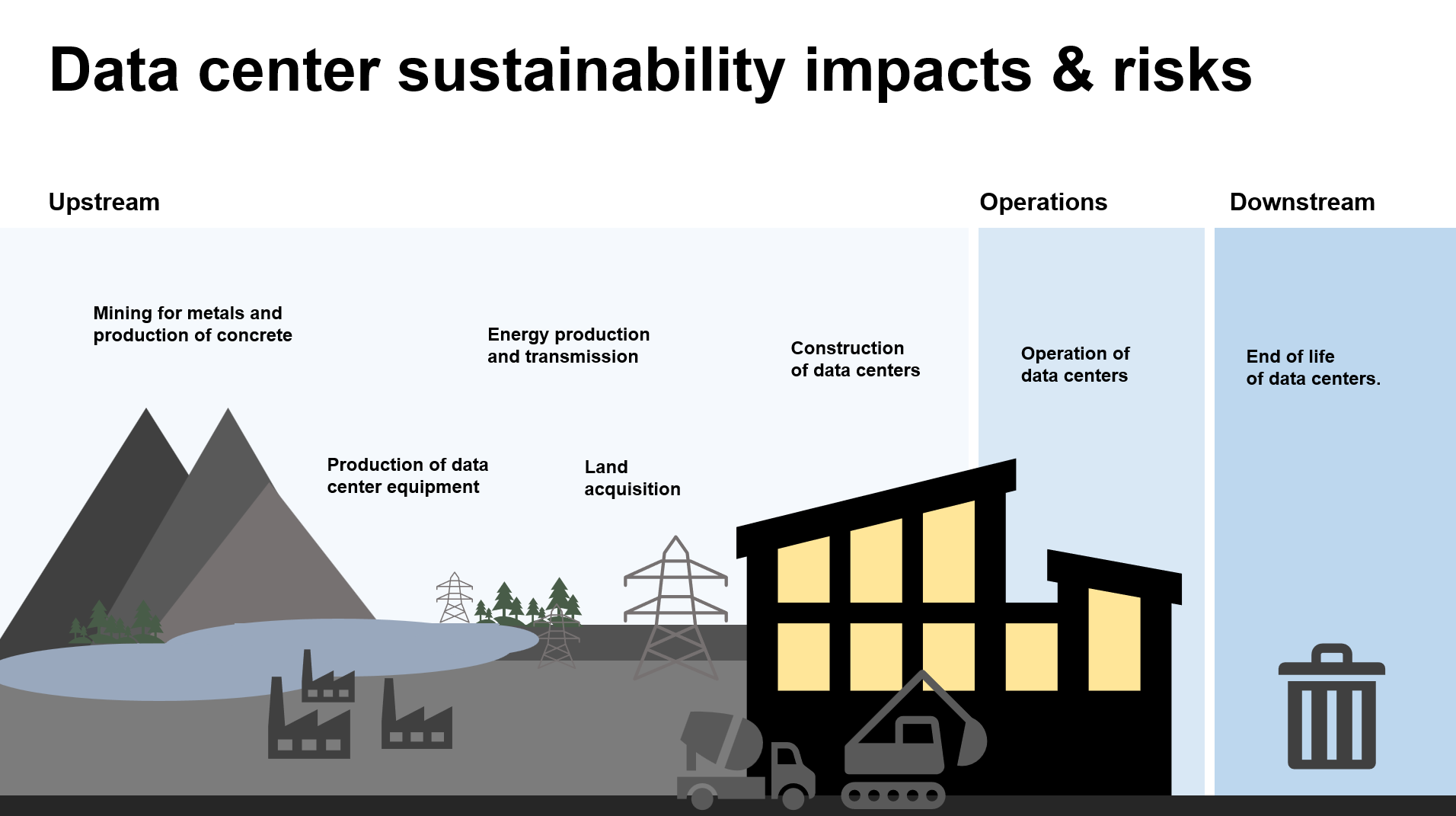
- Scope 3: All other indirect emissions in the value chain, including the "embodied carbon" of the building materials and the IT hardware itself.
In 2026, Scope 3 is where the most difficult work remains. The "realreal" is that building a data center out of concrete and steel, and filling it with thousands of servers containing rare earth minerals, carries a massive carbon footprint before the facility even powers on.
Circular economy initiatives are now essential. This includes extending the lifespan of servers from three years to five or more, and ensuring that at the end of life, components are refurbished or recycled rather than sent to landfills. Companies are now being held accountable for the "decommissioning" phase of their hardware, moving away from the "buy-use-shred" cycle of previous decades.
Regulatory Pressure and the End of "Greenwashing"
The era of vague environmental promises is over. In 2026, data center operators face a sophisticated regulatory environment. In the European Union, the Corporate Sustainability Reporting Directive (CSRD) and the Energy Efficiency Directive (EED) require detailed reporting on energy performance and water usage. In the United States, while federal regulations have fluctuated, state-level mandates in hubs like Virginia, California, and Oregon have forced operators to prove their sustainability claims.
Transparency is no longer optional. Third-party audits and real-time sustainability dashboards are now standard requirements for enterprise customers who need to report their own "digital carbon footprint" as part of their corporate ESG (Environmental, Social, and Governance) goals.
Technical Solutions: How the Industry is Adapting
The industry isn't just reporting on problems; it is engineering solutions. As of 2026, several key technologies have moved from experimental to mainstream.
Waste Heat Recovery
Data centers produce an enormous amount of heat as a byproduct. Rather than venting this into the atmosphere, forward-thinking operators are capturing it. Through district heating projects, data centers are now providing heat for nearby residential areas, greenhouses, or industrial processes. This turns a waste product into a valuable community resource.
Grid Interaction and Battery Storage
Data centers are no longer just passive consumers of power. With massive on-site battery arrays (traditionally used for UPS), data centers can act as "virtual power plants." In 2026, they participate in demand response programs, feeding power back into the grid during peak times or reducing their draw to help stabilize the local utility network.
Comparison of Sustainability Metrics and Trends
The following table outlines the key metrics used to evaluate data center sustainability in 2026 and the industry benchmarks for "Best-in-Class" facilities.
| Metric | Definition | 2020 Standard | 2026 "Best-in-Class" | Why It Matters |
|---|---|---|---|---|
| PUE | Power Usage Effectiveness | 1.5 - 1.6 | < 1.2 | Measures electrical efficiency of the facility. |
| WUE | Water Usage Effectiveness | Not tracked | < 0.2 L/kWh | Measures the liters of water used per kWh of IT energy. |
| CUE | Carbon Usage Effectiveness | Estimated | < 0.1 kgCO2e/kWh | Direct and indirect carbon emissions per kWh. |
| CFE | Carbon-Free Energy Score | Annual matching | 24/7 Hourly matching | Ensures the grid is truly decarbonized in real-time. |
| Circularity | Hardware Reuse Rate | < 10% | > 40% | Measures how much hardware is refurbished/recycled. |
Common Misconceptions About Data Center Sustainability
There are several persistent myths that prevent a true understanding of the industry's environmental impact.
- The "Cloud is Green" Fallacy: While cloud providers are generally more efficient than on-premise server rooms due to higher utilization and better engineering, "the cloud" is still a physical factory that consumes resources. Moving to the cloud doesn't eliminate carbon; it shifts the responsibility.
- The Diesel Myth: Many assume data centers run on diesel. In reality, diesel generators are for emergency backups and typically run only a few hours a year for testing. However, the industry is actively moving toward Hydrotreated Vegetable Oil (HVO) or large-scale batteries to replace diesel entirely.
- Efficiency vs. Conservation: Making a data center more efficient (better PUE) does not always lead to lower energy consumption. Due to Jevons' Paradox, as services become more efficient and cheaper, the demand for those services increases, often leading to higher total energy use.
Frequently Asked Questions
What is the biggest hurdle to achieving 100% sustainable data centers?
The biggest hurdle is grid availability. Data center operators can build efficient buildings and buy renewable energy, but they cannot control the infrastructure of the local utility. Until the global power grid is fully decarbonized and capable of handling high-density loads, data centers will remain partially reliant on carbon-intensive baseload power.
Does AI use more energy than traditional cloud computing?
Yes, significantly. AI workloads, particularly training large language models, require specialized GPUs that consume far more power than traditional CPUs. Additionally, AI chips generate more heat, requiring more advanced (and energy-intensive) cooling solutions if not managed through liquid cooling technologies.
How can a business verify if its data center provider is actually sustainable?
Businesses should look for third-party certifications such as LEED, BREEAM, or ISO 50001. Furthermore, they should request transparent reporting on Scope 1, 2, and 3 emissions and ask for the facility's 24/7 CFE (Carbon-Free Energy) score rather than just an annual renewable matching percentage.
Is liquid cooling better for the environment than air cooling?
Generally, yes. Liquid cooling (direct-to-chip or immersion) is much more efficient at transferring heat. This allows data centers to run at higher temperatures, reducing or eliminating the need for energy-heavy mechanical chillers. It also supports higher rack densities, which reduces the total physical footprint (and embodied carbon) of the building.
What is "Greenwashing" in the context of data centers?
Greenwashing occurs when a company uses deceptive marketing to make its data centers seem more environmentally friendly than they are. Examples include touting "net-zero" status while ignoring Scope 3 emissions or claiming to be "100% renewable" through the purchase of cheap carbon offsets that don't actually fund new renewable energy projects.
Practical Recommendation for 2026
If you are a decision-maker looking to optimize your digital infrastructure for sustainability, the "realreal" is that you must move beyond simple efficiency metrics. Prioritize providers that offer transparency in Scope 3 reporting and those who have committed to 24/7 Carbon-Free Energy rather than annual matching.
Technically, you should audit your software efficiency; poorly optimized code requires more compute cycles, which translates directly to higher carbon emissions. In 2026, sustainability is a full-stack responsibility, ranging from the architectural design of the building to the efficiency of the algorithms running on the servers. Start by requesting a comprehensive carbon footprint report from your current provider that includes water usage and hardware lifecycle data.
Image Gallery