Choosing the Best Mattress for Back Pain Relief in 2026: A Technical Guide
Choosing the right mattress for back pain relief requires balancing spinal alignment with pressure point reduction. Research indicates that a medium-firm mattress typically provides the best support for the majority of sleepers, helpin...
Choosing the right mattress for back pain relief requires balancing spinal alignment with pressure point reduction. Research indicates that a medium-firm mattress typically provides the best support for the majority of sleepers, helping to maintain the spine's natural curve while cushioning the shoulders and hips to prevent localized pain.
Contents
The Biomechanics of Sleep and Back Pain
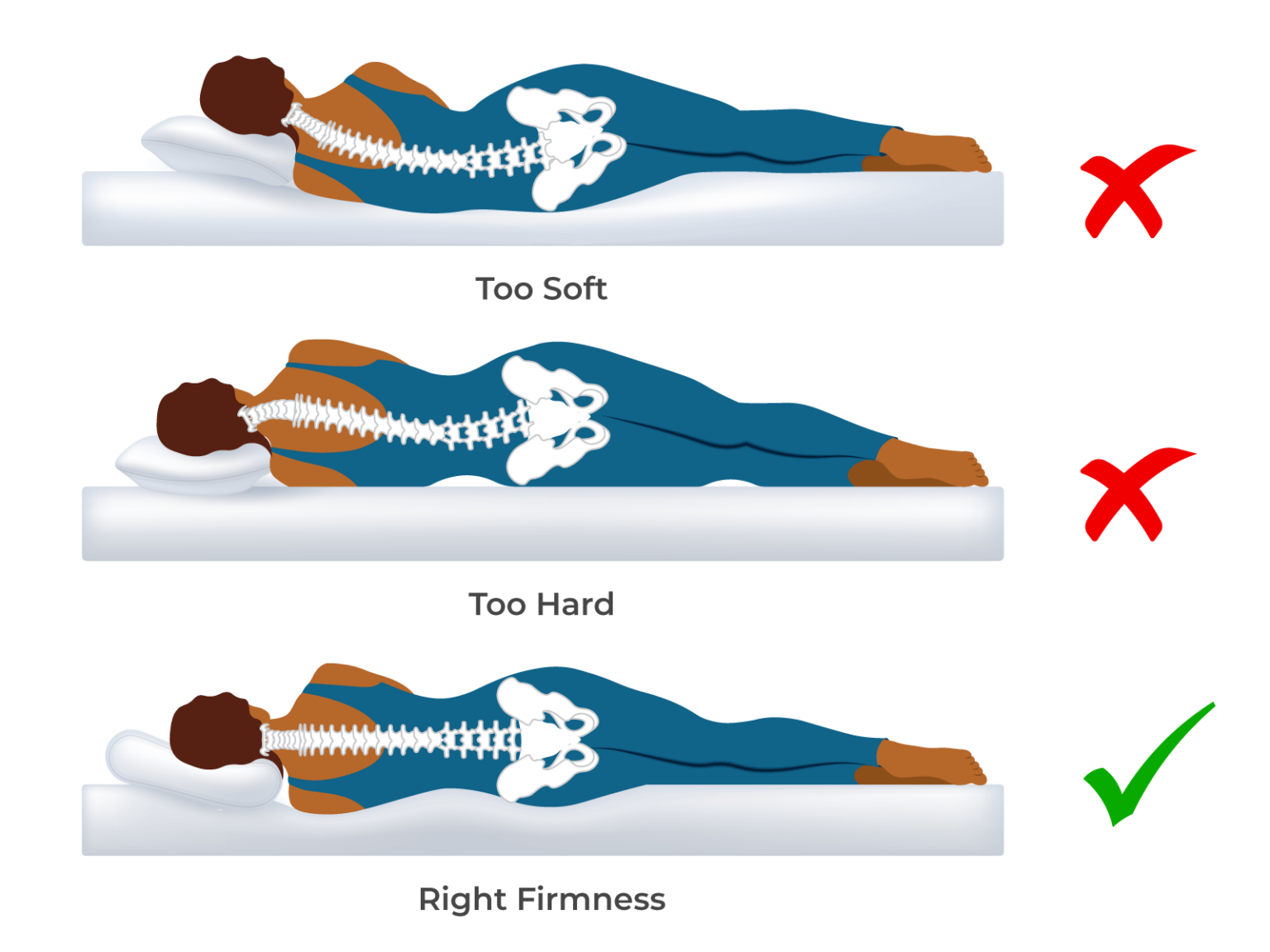
To understand why a specific mattress can alleviate or exacerbate back pain, one must first understand the concept of neutral spinal alignment. When lying down, the spine should maintain the same natural "S" curve it has when standing with good posture. If a mattress is too soft, the heavier midsection of the body sinks too deeply, causing the spine to bow like a hammock. Conversely, a mattress that is too firm creates gaps between the body and the sleep surface, forcing the back muscles to remain active throughout the night to support the skeletal structure.
Back pain is often categorized into two types in a clinical context: acute and chronic. While a mattress cannot "cure" an underlying injury or degenerative condition, it serves as a critical tool for managing mechanical pain—pain caused by abnormal stress and strain on the muscles and vertebral discs. In 2026, sleep science emphasizes pressure redistribution, which is the ability of a surface to spread the body's weight across a larger area, thereby reducing the load on any single joint or vertebrae.
Essential Mattress Materials for Pain Management
Modern mattress construction in 2026 focuses on multi-layered systems. Each material interacts differently with body heat and weight, influencing how the spine is supported over an eight-hour period.
Memory Foam (Viscoelastic Foam)
Memory foam is renowned for its ability to contour to the body's unique shape. By reacting to heat and pressure, it "fills in" the gaps around the lumbar region, providing significant relief for those with lower back issues. However, technical density matters. High-density foams (5 lbs per cubic foot or higher) provide better long-term support than lower-density alternatives, which may sag prematurely. In 2026, most high-end memory foam mattresses incorporate open-cell structures or gel infusions to mitigate the traditional heat retention issues associated with this material.
Latex (Natural and Synthetic)
Latex is often preferred by sleepers who dislike the "sinking" feeling of memory foam. It is naturally buoyant and responsive, meaning it pushes back against the body rather than just absorbing it. This "lift" is particularly beneficial for keeping the hips and shoulders level. For individuals with chronic back pain, Talalay latex is often recommended for its softer, more pressure-relieving top layers, while Dunlop latex serves as a denser, more supportive base layer.
Innerspring and Hybrid Systems
Traditional innerspring mattresses rely on a network of wire coils. For back pain relief, the industry has shifted toward pocketed coils. Unlike interconnected Bonnell coils, pocketed coils move independently. This allows the mattress to contour more precisely to the body and prevents "motion transfer," which is vital for those whose back pain is aggravated by a partner's movements. Hybrid mattresses, which combine a significant layer of foam or latex with a pocketed coil base, are currently considered the "gold standard" for back pain relief as they provide both deep compression support and surface-level pressure relief.
Matching Firmness to Sleep Position
Firmness is subjective, usually measured on a scale of 1 to 10 (with 1 being feather-soft and 10 being hard as a floor). The "right" firmness is dictated almost entirely by your primary sleep position.
- Side Sleepers: This is the most common position but also the most prone to pressure point buildup in the hips and shoulders. Side sleepers generally require a medium-soft to medium mattress (4-6 on the scale). This allows the shoulders to sink enough to keep the neck and lower spine aligned.
- Back Sleepers: This position distributes weight most evenly. A medium-firm mattress (6-7 on the scale) is typically ideal. It provides enough "give" for the buttocks to sink slightly while maintaining the natural curve of the lower (lumbar) spine.
- Stomach Sleepers: This is often the worst position for back pain as it tends to overextend the lumbar spine. If you must sleep on your stomach, a firm mattress (7-8 on the scale) is necessary to prevent the pelvis from sinking, which would otherwise pull the spine out of alignment.
Technical Specifications Comparison
When evaluating a mattress for back pain relief, compare the following technical specifications to ensure the product meets long-term durability and support standards.
| Feature | Memory Foam | Latex | Pocketed Coil Hybrid |
|---|---|---|---|
| Spinal Alignment | High (Contouring) | High (Buoyant) | Excellent (Targeted) |
| Pressure Relief | Superior | Moderate-High | High |
| Durability | 7–10 Years | 12–20 Years | 8–12 Years |
| Responsiveness | Low (Slow recovery) | High (Bouncy) | Moderate-High |
| Edge Support | Low to Moderate | Moderate | High (Reinforced) |
| Heat Retention | Potential (unless gel-cooled) | Low (Breathable) | Low (Airflow through coils) |
The Role of Zoned Support Technology
A significant advancement in 2026 mattress design is Zoned Support. Manufacturers now vary the firmness of the mattress across different horizontal sections. For example, the middle third of the mattress (where the heavy torso and hips rest) is reinforced with firmer foam or higher-gauge coils, while the head and foot sections remain softer.
This targeted support is particularly effective for back pain because it addresses the fact that the human body is not a uniform weight. Zoned systems help prevent the "mid-body sag" that is a leading cause of morning back stiffness. When shopping, look for "3-zone" or "5-zone" ergonomic designs, as these are engineered specifically to keep the spine in a neutral position regardless of body weight distribution.
Common Mistakes When Choosing a Mattress for Back Pain
- Equating "Firm" with "Supportive": For decades, the advice was to sleep on a very hard surface for back pain. Modern clinical studies, including those published in The Lancet, have debunked this, showing that medium-firm mattresses result in less disability and better pain outcomes than extra-firm ones.
- Ignoring the Base/Foundation: A high-quality mattress placed on a sagging box spring or an incompatible slatted frame will not perform as intended. Most foam and hybrid mattresses require a solid platform or slats no more than 3 inches apart to maintain their structural integrity.
- Falling for "Orthopedic" Marketing: The term "orthopedic" is not a regulated medical designation in the mattress industry. Any manufacturer can use it. Instead of relying on labels, look for certifications like CertiPUR-US for foam safety or GOLS/GOTS for organic materials, and focus on the technical specs of the support layers.
- Overlooking the Trial Period: It takes the body approximately 21 to 30 days to adjust to a new sleep surface. Ensure your mattress comes with at least a 90-night sleep trial. If your back pain increases after the initial "break-in" period, the mattress is likely the wrong firmness for your needs.
Maintenance and Replacement Indicators
Even the best mattress for back pain will eventually lose its ability to support the spine. In 2026, most high-quality mattresses last between 7 and 10 years. Signs that it is time for a replacement include:
- Visible Sagging: Any permanent indentation deeper than 1.5 inches (or 1 inch for foam) indicates that the support core has failed.
- Morning Stiffness: If you wake up with back pain that dissipates after 30 minutes of moving around, your mattress is likely failing to provide neutral alignment.
- Edge Compression: If you feel like you are rolling off the bed when sitting on the edge, the internal structure is compromised.
To extend the life of your mattress, rotate it 180 degrees every six months. This prevents localized wear patterns where your heaviest body parts rest. Note that most modern one-sided mattresses should not be flipped.
Frequently Asked Questions
Can an adjustable base help with back pain?
Yes, an adjustable base can be a significant asset for back pain relief. By slightly elevating the head and knees—often called the "Zero Gravity" position—you can reduce the gravitational pressure on your lower back. This position flattens the back against the mattress and can improve circulation, making it a highly recommended addition for those with sciatica or herniated discs.
How much should I spend on a mattress for back pain relief?
In 2026, a high-quality queen-sized mattress engineered for back support typically ranges from $1,200 to $2,500. While budget options exist, they often use lower-density foams that may sag within 2–3 years, potentially worsening back pain in the long run. Investing in a higher-tier hybrid or natural latex mattress generally offers a lower "cost per year" due to increased durability.
Is a mattress topper enough to fix back pain?
A mattress topper is a compensatory measure, not a permanent solution. A topper can add pressure relief to a mattress that is too firm, but it cannot fix a mattress that is sagging or lacks support. If the underlying support core of your mattress has failed, adding a topper will simply follow the dip in the mattress, providing no benefit to your spinal alignment.
Does body weight affect mattress choice for back pain?
Absolutely. Sleepers weighing under 130 lbs often find medium-firm mattresses too hard, as they don't have enough mass to compress the layers and get pressure relief. They should look for "medium-soft." Sleepers over 230 lbs require thicker comfort layers and higher-gauge coils (thicker wire) to prevent bottoming out against the base, usually necessitating a "firm" or "extra-firm" designation to achieve a "medium-firm" feel.
What is the best mattress for lower back pain vs. neck pain?
Lower back pain is usually a support issue (the core of the mattress is too soft or too firm), whereas neck pain is frequently a pillow and upper-alignment issue. For lower back relief, focus on the mattress's support layers. For neck relief, ensure the mattress allows your shoulders to sink enough so that your pillow can hold your head in a neutral position relative to your spine.
Recommendation for Next Actions
If you are currently experiencing back pain, begin by identifying your primary sleep position and your body weight. Seek out a mattress that offers zoned support and a medium-firm feel, as this combination has the highest success rate in clinical observations. Prioritize retailers that offer at least a 100-night trial period to allow your musculoskeletal system to adapt. Before purchasing, verify that your existing bed frame meets the manufacturer's warranty requirements for support to ensure your new investment performs optimally.
Disclaimer: This guide is for informational purposes and does not substitute for professional medical advice. If you have chronic pain or a diagnosed spinal condition, consult with a healthcare provider or physical therapist before making a significant change to your sleep environment.
Image Gallery