How to Know Your Ford Explorer Bolt Pattern
Knowing your Ford Explorer bolt pattern is essential when upgrading wheels, purchasing winter tires, or replacing damaged factory rims to ensure a safe, flush, and vibration-free fit. To determine the exact bolt pattern of a Ford Explo...
Knowing your Ford Explorer bolt pattern is essential when upgrading wheels, purchasing winter tires, or replacing damaged factory rims to ensure a safe, flush, and vibration-free fit.
Contents
To determine the exact bolt pattern of a Ford Explorer, you must identify the vehicle's model year generation, count the number of lug nuts per wheel, and measure the diameter of the imaginary circle—known as the Pitch Circle Diameter (PCD)—formed by the center of the lug holes. Across different model years, the Ford Explorer has transitioned between several distinct wheel configurations, requiring careful verification before purchasing aftermarket hardware.
Understanding Ford Explorer Bolt Pattern Fundamentals
A vehicle's bolt pattern—frequently referred to as the lug pattern—is designated by two primary numbers: the total count of lug holes on the wheel hub and the diameter of the circular path on which those holes sit. For example, a specification written as 5x4.5 indicates a 5-lug arrangement positioned on a 4.5-inch diameter circle.
When replacing wheels, matching this numerical specification is non-negotiable. Installing a wheel with an incorrect bolt pattern creates extreme mechanical stress on the wheel studs, can lead to uneven torque distribution, and risks wheel detachment while driving. Beyond the basic bolt pattern, you must also pay attention to secondary wheel dimensions, including center bore diameter and wheel offset, which dictate how deeply the wheel sits within the fender well and whether it clears the braking assembly.
Ford Explorer Bolt Pattern Specifications by Generation
The Ford Explorer has evolved significantly since its debut as a 1991 model, shifting platform architectures from a compact utility vehicle to a rugged body-on-frame mid-size SUV, and eventually into a unibody crossover. These structural shifts directly influenced factory wheel hubs and bolt patterns.
The table below outlines the factory bolt patterns, thread pitches, and center bore specifications across all primary Ford Explorer generations:
| Generation | Model Years | Bolt Pattern (PCD) | Thread Pitch | Center Bore (mm) |
|---|---|---|---|---|
| First Generation | 1991–1994 | 5x4.5 in (114.3 mm) | 1/2"-20 | 70.5 |
| Second Generation | 1995–2001 | 5x4.5 in (114.3 mm) | 1/2"-20 | 70.5 |
| Third Generation | 2002–2005 | 5x4.5 in (114.3 mm) | 1/2"-20 | 70.5 |
| Fourth Generation | 2006–2010 | 5x4.5 in (114.3 mm) | 1/2"-20 | 70.5 |
| Fifth Generation | 2011–2019 | 5x4.5 in (114.3 mm) | M12 x 1.5 | 63.4 |
| Sixth Generation | 2020–Present | 5x4.5 in (114.3 mm) | M12 x 1.5 | 63.4 |
Analyzing Structural Consistency and Evolution
An important observation from the historical data above is that the Ford Explorer has maintained a consistent 5x4.5-inch (114.3 mm) bolt pattern throughout its entire production lifecycle.
However, mechanics and owners must exercise caution regarding minor changes between generations:
- Thread Pitch Changes: First through fourth-generation models utilize standard 1/2"-20 wheel studs, whereas fifth and sixth-generation models transitioned to metric M12 x 1.5 studs. Lug nuts from older generations will not thread correctly onto newer hubs.
- Center Bore Variations: While the bolt circle diameter remained identical, the center bore changed from 70.5 mm on older models to 63.4 mm starting with the 2011 fifth generation. A wheel designed for an older Explorer will slide onto a newer hub (though it will be "lug-centric" rather than "hub-centric" without a hub ring), but a newer wheel will physically not fit over the larger hub lip of a pre-2011 model.
Step-by-Step Guide to Measuring Your Explorer's Bolt Pattern Manually
If you suspect your Explorer has modified hubs, aftermarket axle swaps, or if you simply want to verify factory specifications with absolute physical certainty, you can measure the bolt pattern manually using a standard tape measure or a specialized bolt pattern gauge.
Step 1: Safely Access the Wheel Hub
Park the Ford Explorer on level ground, engage the parking brake, and loosen the lug nuts on the wheel you intend to measure. Safely lift the vehicle using a hydraulic floor jack and secure it with sturdy jack stands. Remove the wheel entirely to expose the bare wheel hub or the back of the detached wheel. Measuring directly from the wheel hub or the rear mounting pad of the wheel yields the most accurate results.
Step 2: Count the Lug Holes
Count the total number of stud holes on the hub or wheel. For every generation of the standard Ford Explorer, this number will be five.
Step 3: Measure the Pitch Circle Diameter (PCD)
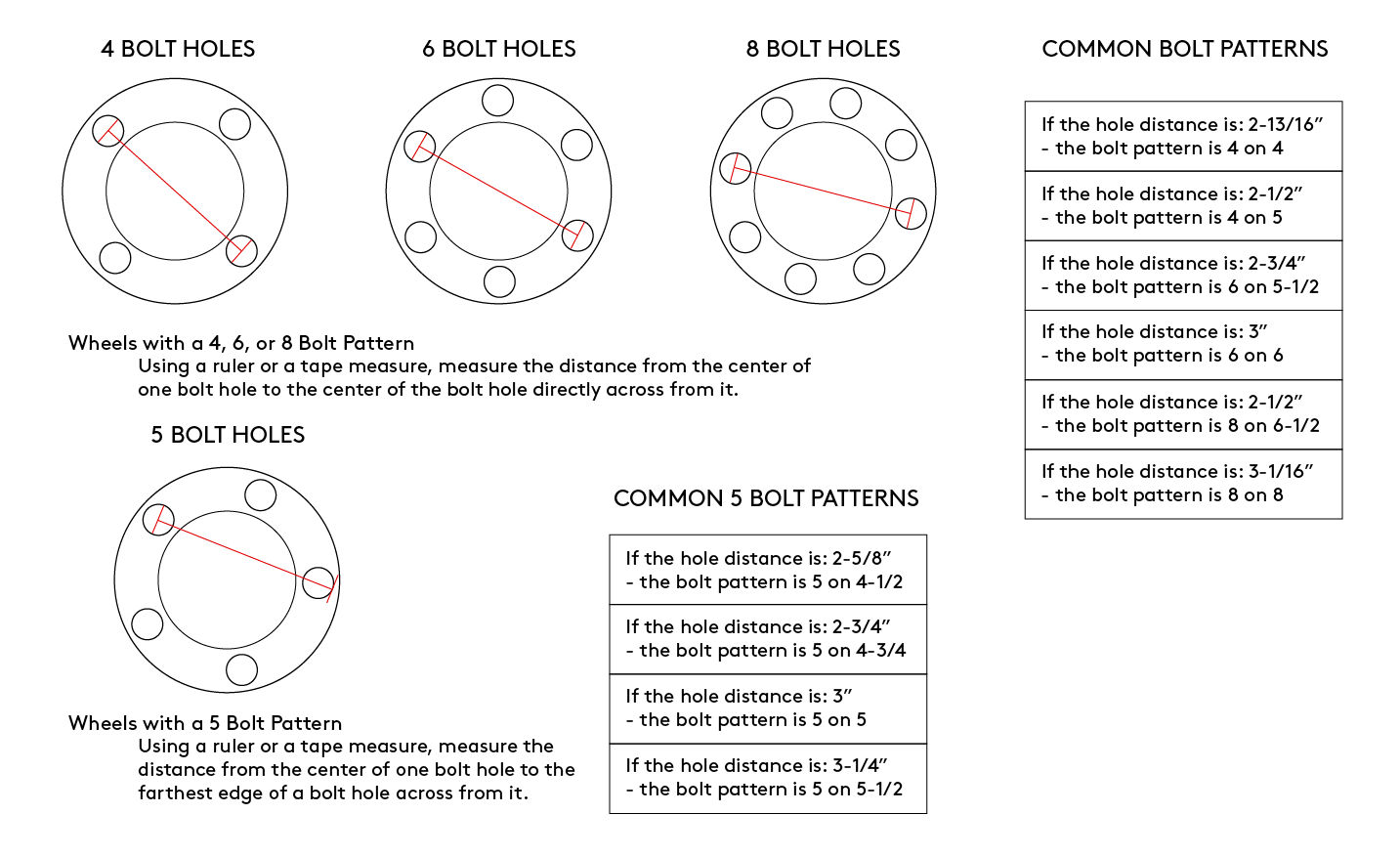
Because the Explorer uses an odd-numbered five-lug pattern, measuring across opposite holes does not pass directly through the exact center point. Follow these specific measurement techniques depending on your tools:
- For 5-Lug Patterns (Center-to-Edge Method): Measure from the outer edge of one stud hole straight across the hub to the center of the second hole skipping one hole in between. This measurement will align directly with standard fractional or metric wheel sizing (such as 4.5 inches or 114.3 mm).
- Using a Bolt Pattern Gauge: Slide a universal slide-caliper bolt pattern tool over the studs or holes. The tapered prongs will seat into the holes, instantly displaying the correct measurement on the sliding scale without manual calculation.
Critical Factors Beyond the Bolt Pattern
Knowing that your Ford Explorer features a 5x4.5 bolt pattern is only the first step in successful wheel selection. Ignoring accompanying geometric specifications can result in severe mechanical binding, steering scrub, or structural failure.
1. Wheel Offset and Backspacing
Wheel offset measures the distance from the mounting surface of the wheel to its true centerline. The Ford Explorer relies on specific factory offsets to keep the tire centered within the steering axis. Installing wheels with an aggressive negative offset pushes the tires outward, which can cause the rubber to rub against the inner fender liners or suspension components during sharp turns.
2. Hub-Centric vs. Lug-Centric Fitment
Factory Ford Explorer wheels are hub-centric, meaning the central hole of the wheel matches the exact diameter of the raised lip on the vehicle's brake rotor hub. This ensures the wheel centers itself perfectly on the axle. If you purchase aftermarket wheels with a larger center bore, you must use hub-centric rings to prevent high-speed steering wheel vibrations and excessive load on the lug studs.
Frequently Asked Questions
Will wheels from a Ford Mustang fit a Ford Explorer?
While both vehicles share a common 5x4.5 (114.3 mm) bolt pattern, you cannot automatically interchange their wheels. Mustang wheels frequently feature entirely different offsets and narrower load ratings compared to a heavy mid-size utility vehicle like the Explorer, which can lead to suspension rub or premature wheel bearing failure under heavy loads.
Can I use universal wheel adapters to change my Explorer's bolt pattern?
Universal wheel adapters are strongly discouraged for daily-driven SUVs like the Explorer. Adapters introduce additional structural failure points, alter the effective vehicle track width, and place excessive shearing forces on factory wheel studs, increasing the risk of wheel detachment.
Do police interceptor Explorers have a different bolt pattern?
No. The Ford Explorer Police Interceptor Utility utilizes the exact same 5x4.5-inch bolt pattern as civilian models of the same generation. However, police interceptors frequently feature heavy-duty steel wheels designed to handle aggressive curb impacts and higher gross vehicle weight ratings.
What tools do I need to measure a bolt pattern at home?
You can accurately measure a 5-lug pattern using a standard metal tape measure, a digital caliper, or a dedicated plastic multi-lug pattern gauge available at most automotive parts stores. Always measure from the outer edge of one hole to the center of the second hole over for a 5-lug layout.
Summary and Next Actions
To successfully determine your Ford Explorer's bolt pattern, reference your model year against the standard 5x4.5-inch (114.3 mm) specification, or physically measure the distance between the lug holes if your vehicle has custom components. When purchasing replacement wheels or winter setups, always verify that the replacement wheels match not only the 5x4.5 bolt pattern, but also the correct thread pitch, center bore, and load rating required for a safe installation.
Image Gallery