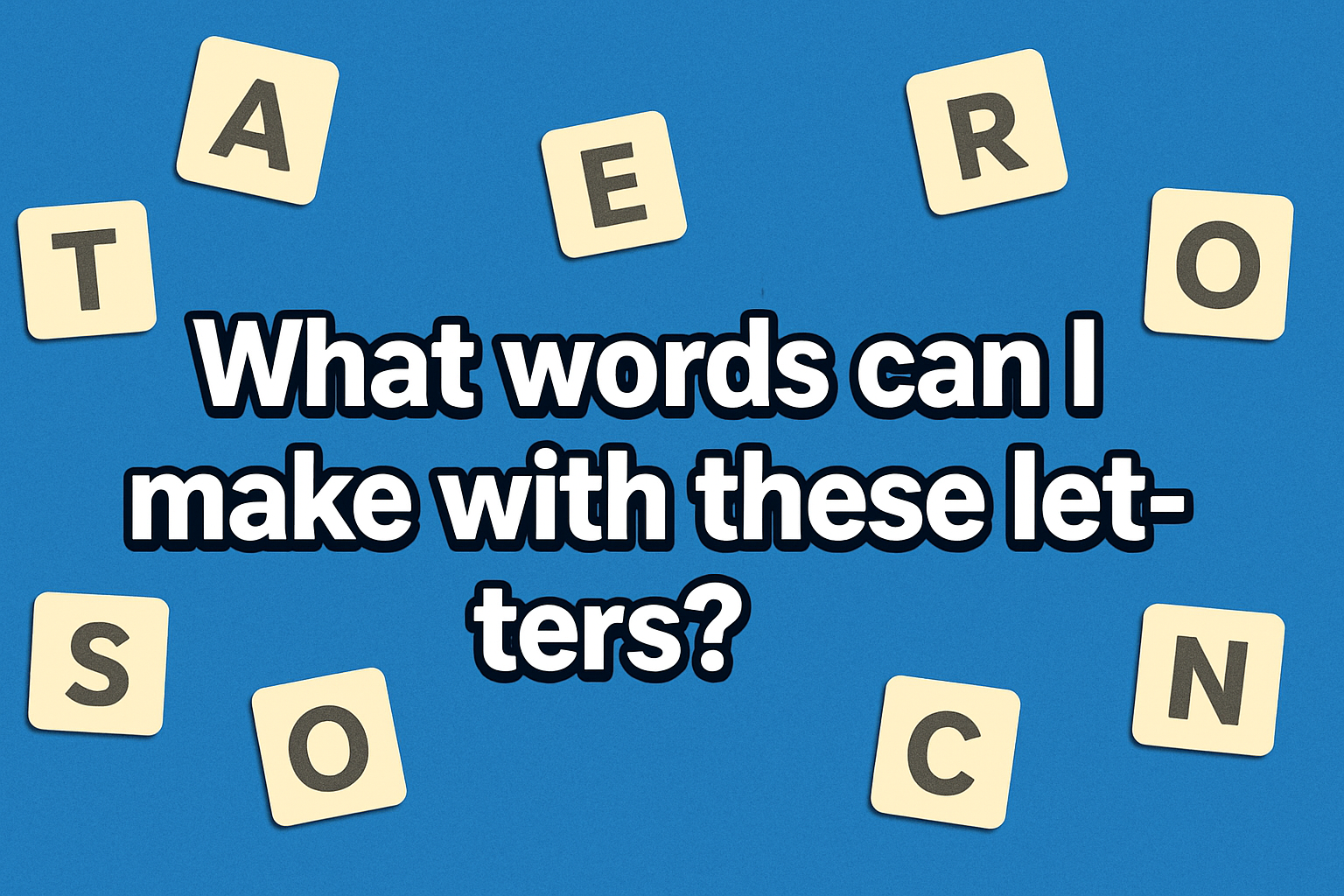
How to Effectively Make Words With These Letters: Advanced Anagram Strategies
Generating valid words from a specific set of letters is a linguistic challenge that combines combinatorial mathematics with deep lexical knowledge. Whether you are solving a complex grid for a competitive word game or looking to impro...
Generating valid words from a specific set of letters is a linguistic challenge that combines combinatorial mathematics with deep lexical knowledge. Whether you are solving a complex grid for a competitive word game or looking to improve your vocabulary, the process relies on identifying root patterns, managing vowel-to-consonant ratios, and utilizing systematic permutation techniques to exhaust all potential linguistic possibilities.
Contents
The Mathematical Foundation of Anagram Construction
At its core, creating words from a fixed set of characters is a permutation problem. When you are provided with a "rack" of letters, the number of possible combinations grows factorially with the number of characters. For a standard set of seven letters, there are 5,040 possible permutations before considering whether those combinations actually form valid English words recognized by authoritative dictionaries like the Merriam-Webster or the Oxford English Dictionary.
To approach this systematically, you must categorize your letters into three distinct groups:
- High-frequency vowels (A, E, I, O, U) which act as the structural anchors.
- High-frequency consonants (R, S, T, L, N) which facilitate common prefixes and suffixes.
- Low-frequency or "power" consonants (J, Q, X, Z) which require specific placement to achieve maximum point value or structural validity.
Systematic Methods for Building Words
To move beyond trial and error, professional puzzle solvers and linguists employ structured patterns. By grouping your letters into known morphological structures, you reduce the cognitive load required to find valid words.
1. Identify Common Morphological Building Blocks
Most English words are constructed from predictable foundations. Focus your initial efforts on identifying these segments:
- Prefixes: DIS-, PRE-, RE-, UN-, SUB-, MIS-
- Suffixes: -ING, -ED, -TION, -ERS, -NESS, -ABLE
If your letter set includes an "I," "N," and "G," you should immediately anchor these letters together as a potential suffix, leaving you with the remaining letters to find a valid root word.
2. The Vowel-Consonant Ratio Analysis
An effective strategy involves assessing the "phonetic potential" of your letters. A set with too many consonants often points toward words with complex clusters (like "STRENGTH"), while a set heavy in vowels suggests words with multiple syllables (like "AERATION").
3. Structural Permutation Matrix
Use the following approach to organize your thought process when faced with a static set of letters:
| Step | Action | Focus Area |
|---|---|---|
| 1 | Vowel Isolation | Separate all vowels to determine syllable capacity. |
| 2 | Consonant Cluster Identification | Identify pairs like SH, TH, CH, or BL, CL, FL. |
| 3 | Suffix Filtering | Check if any letters form standard endings like -ED or -ING. |
| 4 | Root Word Search | Attempt to build a 3-4 letter base word first. |
| 5 | Complexity Expansion | Add prefixes or suffixes to the base word found in step 4. |
Digital Tools and Lexical Standards in 2026
In 2026, the standard for verifying whether a sequence of letters forms a valid word remains the tournament-sanctioned word lists. If you are playing competitively, you must adhere to the specific dictionary version mandated by your platform (e.g., the TWL or SOWPODS word lists).
Relying on Algorithmic Solvers
When human intuition fails, algorithmic anagram solvers utilize a "trie" data structure—a prefix tree that stores the entire dictionary in a memory-efficient way. When you input your letters, the engine performs a depth-first search to traverse all possible branches of the tree that match your input, returning results in milliseconds. This is the most efficient way to ensure 100% accuracy in word validation.
Overcoming Cognitive Barriers
One of the most common mistakes is "mental fixation," where the brain gets stuck on a specific word shape or phonetic sound. To break this cycle:
- Re-sort the physical tiles: If working with physical letters, physically rearrange them to change the visual pattern.
- Switch the focus: If you are trying to find long words, stop and attempt to find 2-letter or 3-letter words first. This clears the mental slate.
- Identify the "Power" Letter: If you have an 'X' or 'Z', build the word around that specific letter first, as its placement options are statistically limited.
Frequently Asked Questions
Why can I not find any words with the letters I have?
You may be experiencing a lack of vowel anchors or a reliance on overly complex letter combinations. Try identifying the shortest possible valid words (two or three letters) first to open up your options for longer, more complex constructions.
Which dictionary should I use to verify my words?
For general purposes, the Merriam-Webster Collegiate Dictionary is the industry standard. However, for competitive gaming, refer to the North American Scrabble Players Association (NASPA) official word list or the CSW (Collins Scrabble Words) list for international play.
Does the order of letters matter in an anagram?
In a pure anagram, the order does not matter; however, in word games, your ability to group letters into phonetically valid segments—like "ING" or "TION"—is the primary factor in your success. Focus on clusters rather than individual characters.
What is the most efficient way to practice?
Practice by taking a random 7-letter word, scrambling it, and timing how long it takes you to reconstruct the original word. This trains your brain to recognize letter patterns rather than just individual characters.
Can computers always find better words than humans?
Yes, because computers utilize exhaustive search algorithms that check every possible permutation against a database of hundreds of thousands of words. Humans rely on pattern recognition, which is faster for common words but less exhaustive for obscure, high-scoring terms.
Strategic Recommendations for Improvement
To maximize your performance, treat word construction as a disciplined technical process rather than a guessing game. Spend time studying "high-probability" combinations; for instance, learn all 2-letter and 3-letter words that contain rare letters like J, Q, X, and Z. This allows you to "dump" those letters onto the board efficiently when you encounter difficult sets of letters that otherwise lack structural integrity. By building a robust mental library of short, valid words, you provide yourself with the foundation needed to expand into longer, higher-scoring vocabulary.
Image Gallery