Understanding Chimpanzee Eyes: Anatomy, Vision, and Evolutionary Significance
Chimpanzee eyes share remarkable anatomical similarities with human eyes, including trichromatic color vision, high central visual acuity, and frontally aligned orbits that enable depth perception. However, unlike humans, chimpanzees t...
Chimpanzee eyes share remarkable anatomical similarities with human eyes, including trichromatic color vision, high central visual acuity, and frontally aligned orbits that enable depth perception. However, unlike humans, chimpanzees typically possess dark-pigmented sclera rather than white sclera. This distinct pigmentation serves an evolutionary purpose, disguising gaze direction from rivals and predators while maintaining high visual acuity suited for complex forest habitats.
Contents
Anatomical Structure of the Chimpanzee Eye
The eye of the chimpanzee (Pan troglodytes) is a sophisticated sensory organ adapted for an arboreal and semi-terrestrial lifestyle in tropical Africa. As fellow hominids, chimpanzees possess an ocular architecture that closely mirrors human ocular anatomy, yet several distinct morphological features differentiate the two species.
| Feature | Description |
|---|---|
| Sclera | Typically dark brown/tinted (gaze camouflage) |
| Iris | Ranging from hazel to dark amber |
| Vision Type | Trichromatic (S, M, L cones) & Stereoscopic (Binocular) |
| Tapetum | Absent (Diurnal haplorhine adaptation) |
The Sclera and Iris Pigmentation
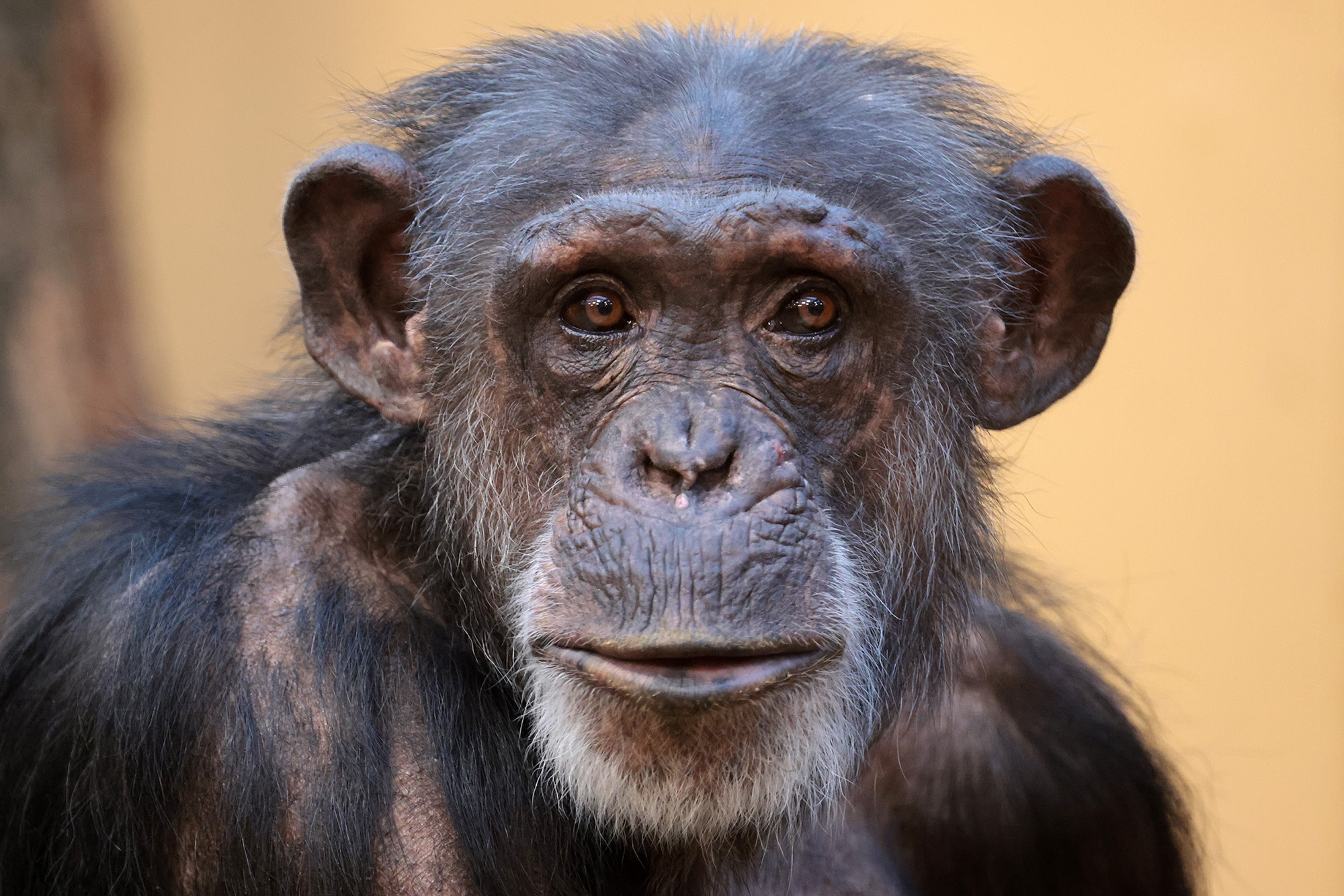
The most visible distinction between human and chimpanzee eyes lies in the sclera—the tough, fibrous outer layer of the eyeball. In the vast majority of humans, the exposed sclera is depigmented and bright white. In contrast, chimpanzees generally exhibit heavily pigmented sclera, which range in shade from light brown and olive to deep espresso or black.
The iris of a chimpanzee usually displays warm tones, such as amber, golden-brown, or deep chocolate. Because the dark iris blends visually with the surrounding dark sclera, it can be difficult for an observer to discern the exact position of the pupil from a distance. This physical blending creates a visually uniform sphere, which plays a major role in social interaction and visual signaling.
Internal Retinal Architecture
Internally, the chimpanzee retina contains both rod and cone photoreceptors:
- Rods: Highly sensitive to low levels of light, providing visual awareness in dim forest understories and during twilight hours.
- Cones: Concentrated in the central region of the retina, responsible for high-resolution vision and color discrimination.
Chimpanzees feature a distinct fovea centralis, a small pit within the macular region of the retina packed with dense cone cells. The presence of a fovea enables sharp central visual acuity, allowing chimpanzees to inspect small food items, identify facial expressions, and pick out parasites during social grooming.
Eyelids, Eyelashes, and Ocular Protection
Chimpanzees possess upper and lower eyelids equipped with thick eyelashes. These lashes act as a primary defense against airborne debris, rain, dust, and insects in the forest canopy. Like humans, chimpanzees lack a functional nictitating membrane (third eyelid); instead, they retain a vestigial remnant known as the plica semilunaris in the inner corner of the eye. Tear glands (lacrimal glands) keep the cornea lubricated, flushing out foreign particles and maintaining clear optical performance.
Absence of the Tapetum Lucidum
Unlike many nocturnal mammals—such as cats, dogs, or prosimian primates like lemurs and bushbabies—chimpanzees do not possess a tapetum lucidum. The tapetum lucidum is a reflective layer of tissue located behind the retina that reflects light back through the photoreceptor layer, enhancing night vision and producing the characteristic "eye-shine" seen in headlights or flashlights.
Because chimpanzees belong to the suborder Haplorhini (which includes tarsiers, monkeys, apes, and humans), their evolutionary ancestors transitioned to a predominantly diurnal (daytime) lifestyle millions of years ago. As a result, haplorhines lost the tapetum lucidum.
Without this reflective layer:
- Chimpanzees have reduced vision in total darkness compared to nocturnal predators like leopards.
- Chimpanzee eyes do not glow or reflect bright light at night.
- Their visual system prioritizes daytime spatial acuity and detail over nocturnal sensitivity.
Consequently, chimpanzees construct arboreal sleeping nests high in trees before dusk to avoid terrestrial predators when their visual system is at its greatest disadvantage.
Visual Acuity, Spatial Perception, and Color Vision
The visual capabilities of chimpanzees are fine-tuned for navigating dense three-dimensional canopy environments, evaluating fruit ripeness, and interpreting fine social cues.
Trichromatic Color Vision
Chimpanzees share our trichromatic color vision system. Their retinas contain three distinct types of opsin proteins housed within cone cells, tuned to specific wavelengths of light:
- S-cones (Short wavelength): Peak sensitivity in the blue spectrum.
- M-cones (Medium wavelength): Peak sensitivity in the green spectrum.
- L-cones (Long wavelength): Peak sensitivity in the red spectrum.
This trichromatic vision evolved primarily alongside frugivory (fruit-eating). In a dense green rainforest canopy, being able to distinguish red, yellow, and orange fruits against a background of green leaves provides a significant foraging advantage. Studies published in journals such as the Proceedings of the Royal Society B show that trichromacy allows primates to evaluate not only the presence of fruit, but also its maturation state, sugar content, and nutritional value based on subtle color shifts.
- Cone Photoreceptors:
- S-Cone: Blue
- M-Cone: Green
- L-Cone: Red
- Trichromatic Perception:
- Foraging Advantage: Detecting ripe fruit against dense green forest background
- Social Signaling: Identifying skin flushing, arousal, and emotional state
Depth Perception and Spatial Acuity
Chimpanzees feature forward-facing, frontally aligned orbits (eye sockets). This cranial structure yields a wide field of binocular vision where the visual fields of both eyes overlap by approximately 130 to 140 degrees.
This binocular overlap enables stereopsis (true 3D depth perception). When moving through tree canopies, accurate depth perception is crucial for estimating distances between branches, jumping safely, and capturing moving prey, such as colobus monkeys during group hunts.
| Visual Feature | Chimpanzee Specification | Functional Advantage |
|---|---|---|
| Color Perception | Trichromatic (Blue, Green, Red) | Identifies ripe fruit and foliage; reads skin flushing |
| Binocular Overlap | ~130° – 140° | Enables precise 3D depth perception for canopy movement |
| Total Visual Field | ~180° – 190° | Provides broad peripheral awareness for predator detection |
| Spatial Acuity | High (fovea centralis present) | Allows detailed close-up inspection during grooming |
| Night Vision | Low (no tapetum lucidum) | Limits nighttime activity; requires elevated nesting |
The Evolutionary Role of Gaze Direction: Camouflage vs. Communication
One of the most active areas of research in primatology and cognitive science concerns why human sclera are white while chimpanzee sclera are predominantly dark. This morphological difference forms the basis of the Cooperative Eye Hypothesis.
| Subject | Visual Characteristics | Outcome |
|---|---|---|
| Human Eye | White Sclera / High Contrast / Dark Pupil / Iris | Gaze direction is easily tracked by others (Cooperative) |
| Chimpanzee Eye | Dark Sclera / Low Contrast / Dark Pupil / Iris | Gaze direction is hidden from rivals/predators (Camouflage) |
The Cooperative Eye Hypothesis
Proposed by researchers including Michael Tomasello, the Cooperative Eye Hypothesis suggests that humans evolved depigmented (white) sclera to make the direction of gaze easily visible to conspecifics. In humans, high visual contrast between the white sclera and the colored iris makes it effortless to see where someone is looking, even from a distance or at sharp angles. This feature supports joint attention, cooperative foraging, complex communication, and language learning.
In contrast, the dark sclera of the chimpanzee creates gaze camouflage. Because the dark iris blends into the surrounding dark sclera, it is difficult for onlookers to determine precisely where a chimpanzee is looking without observing the orientation of its entire head.
The Survival Value of Gaze Camouflage
In chimpanzee societies, gaze camouflage offers distinct evolutionary benefits:
- Competitive Advantage: Chimpanzees live in dynamic, hierarchical social groups where competition for food, mates, and dominance is intense. Concealing gaze direction allows an individual to monitor a high-ranking rival or desirable food source without revealing interest or intent.
- Tactical Deception: Subordinate individuals can glance toward hidden food or potential allies without alerting dominant individuals.
- Predator Concealment: Hiding pupil movement reduces the likelihood of revealing awareness to stalking predators, such as leopards.
Modern Scientific Perspectives and Variations
While the Cooperative Eye Hypothesis remains influential, recent primatological studies have nuanced this view. Research examining wild and captive populations has revealed that scleral pigmentation in chimpanzees is not entirely uniform. Some individual chimpanzees display lighter or mottled sclera, and chimpanzees remain adept at reading intent by tracking head posture and overall body orientation rather than relying solely on iris position.
Comparative Analysis: Chimpanzee Eyes vs. Human Eyes
Although chimpanzees and humans share more than 98% of their DNA sequence identity, small genetic differences produce key distinctions in eye morphology and social function.
| Trait | Chimpanzee Eye | Human Eye |
|---|---|---|
| Scleral Color | Dark brown/pigmented | Depigmented (White) |
| Gaze Signal | Concealed (Camouflage) | Exposed (Cooperative) |
| Primary Gaze Cue | Head orientation | Eye movement / Iris |
| Color Vision | Trichromatic | Trichromatic |
| Tapetum Lucidum | Absent | Absent |
| Binocular Overlap | ~130°–140° | ~140° |
Visual Tracking Mechanics
Because human sclera provide high visual contrast, humans can communicate direction silently using eye movements alone. Chimpanzees rely more heavily on head angle and body posture to infer where group members are directing their attention. Laboratory experiments demonstrate that while human infants automatically follow another person's eye movements (even if the head remains still), chimpanzees are far more responsive to shifts in head orientation.
Ocular Health and Common Pathologies in Chimpanzees
In both wild habitats and managed environments (such as accredited sanctuaries and research facilities), chimpanzees experience age-related and environmental eye conditions similar to those found in humans.
Age-Related Changes
As chimpanzees reach advanced age (typically 40 to 50+ years in sanctuary settings), their eyes undergo predictable degenerative changes:
- Cataracts: Clouding of the crystalline lens, leading to reduced visual acuity, blurred vision, and eventual functional blindness if left untreated. Veterinary ophthalmologists frequently perform cataract removal surgeries on aging captive chimpanzees using techniques adapted from human medicine.
- Nuclear Sclerosis: A normal hardening and bluing of the lens core that occurs with age. While it alters lens clarity slightly, it does not impair vision as severely as advanced cataracts.
- Presbyopia: Age-related loss of lens flexibility, reducing the eye's ability to focus on immediate objects (such as small seeds or fine grooming tasks).
Environmental and Infectious Conditions
Chimpanzees in forest environments face risks from physical trauma and pathogens:
- Corneal Ulcers and Abrasion: Caused by sharp foliage, thorns, or aggressive social interactions.
- Conjunctivitis: Bacterial or viral inflammation of the conjunctiva, often transmitted within social groups through close contact and grooming.
- Parasitic Infections: In certain regions of sub-Saharan Africa, filarial worms and other parasites can infect ocular tissue, leading to localized inflammation.
Veterinary teams at accredited sanctuaries regularly conduct non-invasive visual screening during routine health checkups, utilizing handheld ophthalmoscopes and visual tracking tasks to evaluate cognitive and visual health.
Frequently Asked Questions
Do chimpanzees ever have white sclera like humans?
While the vast majority of chimpanzees have dark brown or pigmented sclera, natural variations exist. Some individual chimpanzees possess depigmented or mottled sclera that appear light brown, tan, or occasionally pale. However, human-like stark white sclera remain extremely rare in wild populations.
Can chimpanzees see in total darkness?
No. Chimpanzees lack a tapetum lucidum, the reflective tissue layer that enhances night vision in nocturnal animals like cats and owls. While their rod cells allow them to navigate under moonlight, chimpanzees have poor vision in total darkness and rely on arboreal nests for protection during the night.
Do chimpanzees see the same colors that humans do?
Yes. Chimpanzees possess trichromatic color vision powered by three types of cone photoreceptors (S, M, and L cones), enabling them to perceive the same visible spectrum as humans—from short-wavelength blues to long-wavelength reds.
How do chimpanzees know where another chimpanzee is looking?
Because dark sclera make pupil tracking difficult, chimpanzees rely primarily on head direction and body orientation to infer visual attention. They also observe subtle facial movements and postural cues to determine what another individual is focusing on.
Do wild chimpanzees need vision tests or eye care?
In the wild, chimpanzees rely on natural behaviors, grooming, and immunity to manage ocular health, though severe eye injuries or age-related blindness can reduce survival rates. In accredited sanctuaries and zoos, veterinary ophthalmologists perform eye exams, administer eye drops, and conduct cataract surgeries when necessary.
Summary and Key Takeaways
Understanding chimpanzee eyes provides valuable insights into evolutionary biology, cognitive science, and primate conservation.
- Anatomical Parallels: Chimpanzees share fundamental visual features with humans, including trichromatic color vision, stereoscopic depth perception, and high foveal visual acuity.
- Scleral Pigmentation: The dark sclera of chimpanzees provides gaze camouflage, protecting individuals in competitive social hierarchies and hiding intent from rivals.
- Diurnal Adaptation: The absence of a tapetum lucidum confirms that chimpanzees evolved for daytime activity, making them reliant on secure nests at night.
- Comparative Insight: Examining differences between human and chimpanzee eyes illuminates how visual structures evolved alongside unique social structures, cooperative traits, and foraging behaviors.
Whether in evolutionary research or sanctuary management, studying the primate eye underscores the close connection between physical anatomy, survival strategy, and social behavior.
Image Gallery