How Much Does It Cost to Work with a Life Insurance Agent?
Working with a licensed life insurance agent costs most consumers $0 out of pocket. Insurance agents earn their income through commissions paid directly by the insurance carriers after a policy is issued. The price you pay for your mon...
Working with a licensed life insurance agent costs most consumers $0 out of pocket. Insurance agents earn their income through commissions paid directly by the insurance carriers after a policy is issued. The price you pay for your monthly or annual policy premium remains identical whether you buy through an agent, a broker, or directly from an insurance company’s website.
Contents
Why Working with a Life Insurance Agent Usually Costs Nothing Upfront
When you consult a life insurance agent to explore policy options, calculate your coverage needs, or submit an application, you will not receive an invoice, hourly bill, or consultation fee. Life insurance distribution relies on a carrier-paid commission model established to simplify access for consumers.
Insurance companies factor sales distribution costs—including agent compensation—into their overall actuarial pricing structures. State insurance regulators review and approve these premium rate schedules before policies reach the market. Because these rates are fixed by law for every specific risk profile (based on your age, health, gender, and coverage amount), an insurance carrier cannot charge you a higher premium simply because you used an agent, nor can they offer you a discount on the base policy for applying without one.
The primary exception to this zero-cost model occurs when hiring a fee-only financial planner or registered investment advisor (RIA) who operates under a fee-for-service agreement rather than accepting sales commissions.
How Life Insurance Agents Get Paid
Understanding how agents receive compensation helps clarify why their services are free to consumers and reveals potential incentives behind product recommendations.
- Policyholder Premium Payment
- Life Insurance Carrier
- Carrier Retains Premium Revenue (Underwriting & Reserves)
- Carrier Pays Agent Commission (First-Year + Renewals)
First-Year Commissions
The vast majority of an agent’s earnings come from a first-year commission, paid by the insurance company once your policy becomes active and the initial premium is collected. For term life insurance, this commission typically ranges from 40% to 90% of the first year’s premium.
For permanent policies (such as whole life or universal life), the first-year commission generally spans 60% to 100%+ of the baseline annual premium (often referred to as the target premium).
For example, if you purchase a term life policy with an annual premium of $1,000, the issuing insurance company might pay the selling agent a first-year commission of $600 to $800. This payment comes out of the insurer's marketing and acquisition budget, not as an added surcharge on your statement.
Renewal Commissions (Residuals)
In subsequent policy years, agents may receive smaller residual commissions, usually ranging between 2% and 10% of the annual premium for term life, and 1% to 5% for permanent policies. These ongoing payments incentivize agents to provide continuous customer service, assist with beneficiary updates, and help prevent policy lapses.
Agent Types and Fee Structures Compared
Not all life insurance professionals operate under the exact same compensation framework. The table below outlines how different types of insurance representatives function, what they cost out of pocket, and how their compensation model affects product availability.
| Professional Type | Out-of-Pocket Cost to You | Compensation Source | Product Selection | Primary Fiduciary Duty |
|---|---|---|---|---|
| Captive Insurance Agent | $0 | Commission paid by single carrier | Limited to one specific insurer’s catalog | Represents the insurer |
| Independent Insurance Broker | $0 | Commission paid by carrier selected | Broad access across multiple insurance companies | Represents the client/consumer |
| Fee-Only Financial Planner (CFP/RIA) | $150–$450/hour or flat fee ($1,000+) | Hourly fee or project fee paid directly by you | Unbiased across carriers (may recommend low-load policies) | Strict fiduciary to client |
| Direct-to-Consumer (Online Aggregator) | $0 | Built-in carrier distribution margin | Varies by platform partner network | Platform operation |
Captive Insurance Agents
Captive agents work exclusively for one insurance company (such as State Farm, Northwestern Mutual, or Farmers). They are authorized to sell only their employer's products.
- Cost to you: $0 out of pocket.
- Pros: Deep, specialized knowledge of their company's internal underwriting guidelines, riders, and administrative procedures.
- Cons: Cannot shop around with competing carriers if another insurer offers significantly lower rates for your specific medical profile.
Independent Insurance Brokers
Independent brokers maintain contracts with dozens of competing life insurance companies. They use specialized software to compare rates, medical underwriting guidelines, and policy features across multiple insurers simultaneously.
- Cost to you: $0 out of pocket.
- Pros: Ability to shop the open market to find the lowest premium for your age, health condition, or high-risk lifestyle.
- Cons: Commission structures vary across carriers, which requires consumers to verify that recommendations are driven by policy value rather than commission size.
Fee-Only Financial Advisors
Fee-only financial planners (often Certified Financial Planners or Registered Investment Advisors) do not accept commissions from insurance companies. Instead, they charge an upfront fee to evaluate your broader financial picture, calculate your exact insurance needs, and guide you toward appropriate policy types.
- Cost to you: Hourly rates (typically $150–$450 per hour) or comprehensive financial plan fees ($1,500–$5,000+).
- Pros: Completely unbiased recommendations free from commission-driven conflicts of interest. They can direct you toward "no-load" or "low-load" policies that reduce administrative charges within permanent policies.
- Cons: Requires direct out-of-pocket payment regardless of whether you end up purchasing coverage.
Do You Save Money by Buying Life Insurance Online Without an Agent?
A common myth is that skipping the agent and buying life insurance directly online saves you money. For standard individual life insurance policies, buying direct does not lower your monthly premium.
Under state insurance laws enforced by bodies like the National Association of Insurance Commissioners (NAIC), life insurance companies must charge identical premiums for the same product, coverage amount, and risk classification regardless of the sales channel. If Company X offers a 20-year term policy for $45 per month to a 35-year-old non-smoker, that policy will cost $45 per month whether bought through:
- An independent broker in an office setting.
- A captive agent over the phone.
- The insurance company's direct website.
- An online comparison tool.
When you purchase a policy direct online without an agent, the insurance company simply retains the portion of the premium that would have otherwise paid an agent commission to offset their digital marketing, platform infrastructure, and online customer support overhead.
- Total Approved Premium Rate (Fixed by State Regulation)
- Purchase Via Agent
- Underwriting Risk Pool
- Administrative Costs
- Agent Commission
- = Same Monthly Cost to You
- Direct Online Purchase
- Underwriting Risk Pool
- Administrative Costs
- Digital Marketing Overhead (Carrier retains margin)
- = Same Monthly Cost to You
- Purchase Via Agent
Potential Conflicts of Interest and Hidden Costs
While you do not pay direct upfront fees to work with an agent, the commission framework can introduce subtle indirect costs or misaligned incentives if you work with an unvetted producer.
1. Steering Toward Permanent Life Over Term Life
Permanent life insurance policies (whole life, universal life, variable universal life) carry substantially higher annual premiums than term life insurance. Because agent commissions are calculated as a percentage of the annual premium, an agent earns considerably more selling a permanent policy than a term policy.
- Example: A $1,000,000 term policy for a healthy 30-year-old might cost $400 per year, yielding a first-year agent commission around $280 to $360.
- Contrast: A $1,000,000 whole life policy for the same individual could cost $10,000 per year, yielding a first-year commission around $6,000 to $9,000.
If an agent strongly advocates for complex cash-value insurance when your primary goal is affordable income replacement for your family, seek a second opinion. Term insurance is sufficient for the vast majority of consumer risk protection needs.
2. Unlawful Administrative or Charging Fees
In most jurisdictions, life insurance agents are legally prohibited from charging consumers additional administrative fees, document preparation fees, or consultation surcharges on top of the policy premium.
Some states permit licensed independent brokers to charge an explicit fee, but only under strict statutory conditions: the agreement must be put in writing, signed by the client prior to policy issuance, and explicitly state that the fee is separate from the policy premium. If an agent asks for cash upfront, an application fee, or a consulting fee without clear, state-mandated written disclosures, report the activity to your state's Department of Insurance.
3. Policy Fees Built into Premiums
Most life insurance policies include a modest annual policy administrative fee (often called a "policy fee" or "per-policy charge"), typically ranging between $30 and $90 annually. This fee covers account maintenance and mailings. It is established by the carrier, integrated directly into your billing statement, and charged regardless of whether an agent assisted with the sale.
Medical Exams and Underwriting Costs
When applying for life insurance through an agent, you may need to undergo a paramedical exam. This process typically involves a basic physical exam, blood draw, urine sample, and blood pressure reading.
- Who pays for the exam? The insurance carrier pays 100% of the cost for paramedical examinations, blood panels, and attending physician statements (APS) requested during underwriting.
- Cost to the applicant: $0. Neither the agent nor the applicant pays for these medical requirements.
How to Work Effectively with a Life Insurance Agent
To get maximum value from an agent without incurring unexpected hassle or misaligned policy choices, follow these structured steps:
- Calculate Your Need First: Determine your coverage amount before contacting an agent. A basic rule of thumb is 10x to 12x your annual income, plus outstanding debt obligations (such as a mortgage) and future education costs.
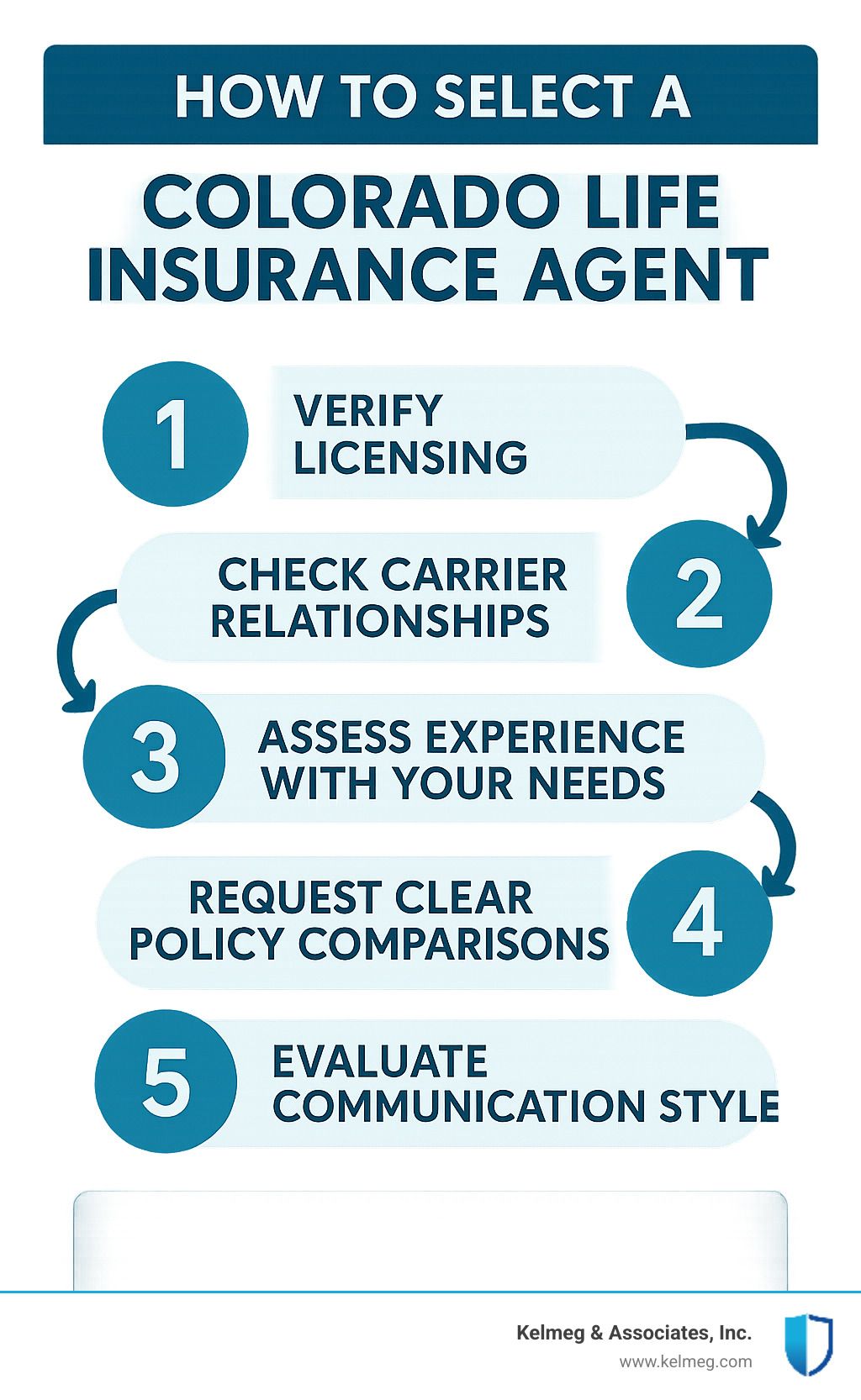
- Verify Licensing: Use the policy lookup tools provided by your state’s insurance department or the NAIC Consumer Insurance Search to confirm the agent holds an active license in good standing with no regulatory actions.
- Ask About Carrier Access: Ask independent agents how many insurance companies they actively write policies with. A broader panel of carriers increases the likelihood of securing favorable health-rate classifications.
- Clarify Fee Structure: Ask directly: "Do you receive a commission from the carrier for this sale, or are there any fees I am expected to pay directly?"
- Demand Multi-Carrier Quotes: Request written illustrations showing comparison quotes across at least three separate carriers for identical term lengths and coverage amounts.
- Review Policy Details: Carefully verify policy riders (such as waiver of premium or accelerated death benefits) to ensure you are not paying extra premium dollars for features you do not need.
Frequently Asked Questions
Can a life insurance agent charge a consultation fee?
In standard life insurance sales, agents do not charge consultation fees. In almost all states, licensed agents are prohibited from charging consumers out-of-pocket fees for individual life insurance applications. Only fee-only financial planners (who operate under investment advisory licenses) or specific state-authorized brokers under formal written contracts charge direct consulting fees.
Is life insurance cheaper if you buy directly from the company online?
No. Insurance rates are regulated at the state level. Carriers must offer the exact same policy rate to individuals with matching risk profiles, regardless of whether the policy is purchased online, over the phone, or through a local agent.
Why do some agents push whole life insurance over term life?
Whole life and permanent policies carry much higher premiums than term policies, resulting in higher absolute commission payments for the agent. While permanent insurance can be useful for high-net-worth estate planning or special needs trusts, simple term insurance meets the financial protection requirements of most individuals at a fraction of the cost.
What happens if I cancel a policy shortly after working with an agent?
If you cancel a policy during the initial "free look period" (usually 10 to 30 days after delivery depending on state law), you receive a full refund of any paid premiums. If a policy lapses or is canceled within the first 12 to 24 months, the insurance company typically imposes a "chargeback," forcing the agent to return part or all of their earned commission to the carrier.
Do I pay an agent if I adjust or update my policy years later?
No. Policy modifications—such as changing your beneficiary, updating your payment method, reducing your coverage amount, or converting a term policy to a permanent policy—are provided at no cost. Agents receive small renewal commissions from the carrier to handle ongoing service requests.
Final Recommendation: Next Steps
Because working with an agent costs nothing out of pocket and does not inflate your policy premium, leveraging an experienced, independent broker is usually the most efficient way to shop the market.
To start the process efficiently:
- Work with an independent agent or broker who can compare underwriting guidelines across at least 5 to 10 top-rated carriers.
- Request side-by-side term life comparisons before evaluating permanent cash-value products.
- Verify any agent's license status through your state's Department of Insurance website prior to sharing personal medical information or submitting an application.
EDITORIAL CATEGORY METADATA:
Image Gallery