Understanding Inelasticity in Economics: Definitions, Formulas, and Real-World Examples
In economics, inelasticity refers to a situation where the quantity demanded or supplied of a good or service remains relatively static despite changes in its price. When a product is inelastic, a 1% change in price results in a less t...
In economics, inelasticity refers to a situation where the quantity demanded or supplied of a good or service remains relatively static despite changes in its price. When a product is inelastic, a 1% change in price results in a less than 1% change in the quantity demanded or supplied, indicating low sensitivity to price fluctuations.
Contents
The concept of elasticity is a cornerstone of microeconomic theory, providing a framework for understanding how consumers and producers react to market shifts. While "elastic" goods are highly sensitive—think of a specific brand of cereal where a small price hike sends shoppers to a competitor—inelastic goods are those that people continue to buy in nearly the same quantities regardless of the cost. This resistance to change typically stems from a lack of substitutes, the essential nature of the product, or habitual consumption patterns.
The Mathematical Framework of Inelasticity
To determine whether a good is inelastic, economists calculate the Price Elasticity of Demand (PED) or the Price Elasticity of Supply (PES). The formula for PED is the percentage change in quantity demanded divided by the percentage change in price.
The Elasticity Coefficient
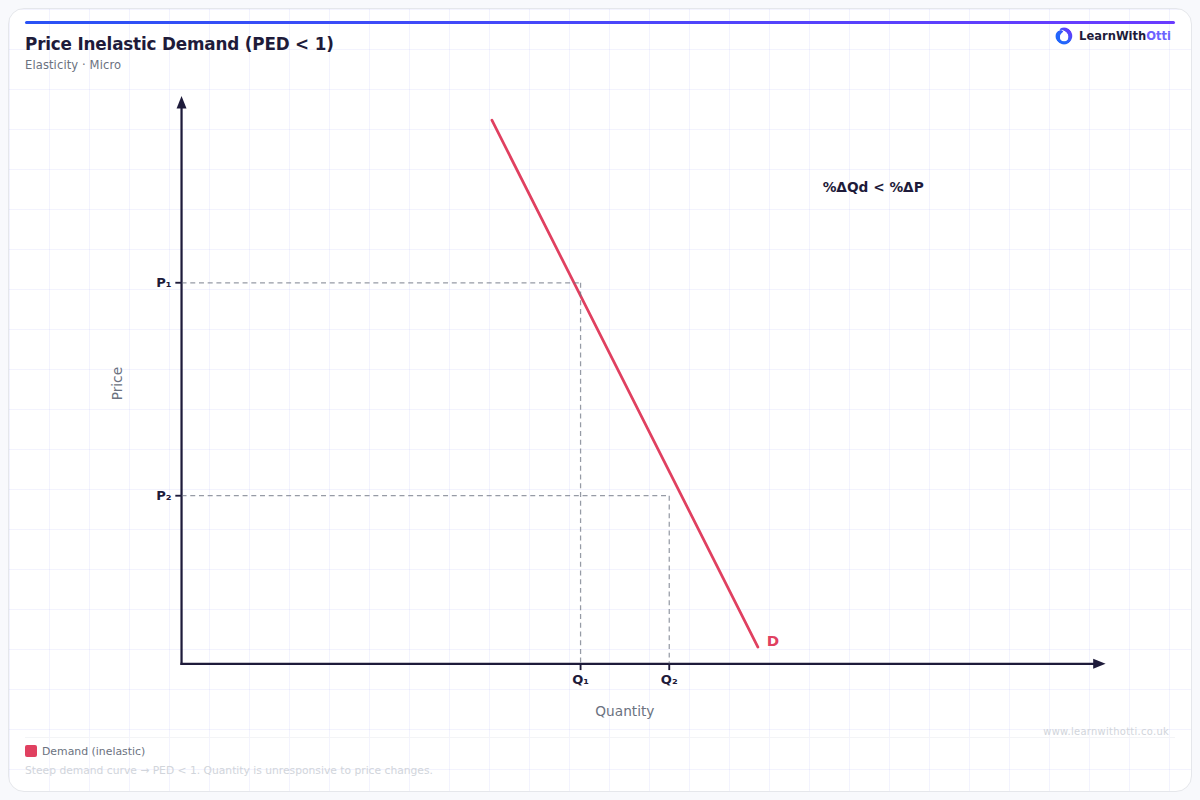
The result of this calculation is known as the elasticity coefficient. For demand to be considered inelastic, the absolute value of this coefficient must be less than one (|$E$| < 1).
- Perfectly Inelastic (E = 0): This is a theoretical extreme where quantity does not change at all, regardless of price. On a graph, this appears as a vertical line. A real-world approximation might be a life-saving medication with no alternative.
- Relatively Inelastic (0 < E < 1): The quantity demanded changes by a smaller percentage than the price change. Most "inelastic" goods fall into this category, such as gasoline or electricity.
- Unit Elastic (E = 1): The percentage change in quantity is exactly equal to the percentage change in price.
The Midpoint Method
In professional economic analysis, the Midpoint Method is often used to calculate elasticity between two points on a curve. This ensures that the elasticity remains the same whether the price is increasing or decreasing. The formula is:
$$Price \ Elasticity = \frac{(Q2 - Q1) / [(Q1 + Q2) / 2]}{(P2 - P1) / [(P1 + P2) / 2]}$$
Using this method prevents the mathematical "direction" bias that occurs with standard percentage change calculations, providing a more stable metric for business decision-making and government policy.
Key Determinants of Inelastic Demand
Why do some products remain popular even as prices soar? Several factors dictate whether a product will exhibit inelastic demand. Understanding these determinants is vital for businesses when setting prices and for governments when implementing taxes.
1. Availability of Substitutes
The most significant driver of inelasticity is the lack of viable alternatives. If a consumer needs a specific product and there are no close substitutes available, they have little choice but to pay the market price. For instance, while a specific brand of bottled water is elastic (you can just buy another brand), the broader category of "water" is perfectly inelastic because there is no substitute for hydration.
2. Degree of Necessity
Goods that are considered necessities—items required for survival or basic functioning in society—tend to be inelastic. Medical treatments, basic groceries, and home heating are classic examples. In 2026, as digital connectivity has become a fundamental requirement for employment and education, high-speed internet access has moved further into the inelastic category for most households.
3. Proportion of Income
If a product represents a very small fraction of a consumer's total budget, they are less likely to notice or care about a price increase. For example, if the price of a box of toothpicks doubles from $1.00 to $2.00, the 100% increase is unlikely to change consumer behavior because the total impact on their wallet is negligible. Conversely, expensive items like cars or houses are much more elastic because even a small percentage change in price represents a significant amount of money.
4. Time Horizon
Elasticity often changes over time. In the short term, demand is typically more inelastic because consumers need time to adjust their habits or find alternatives. If gasoline prices spike tomorrow, you still have to drive to work. However, in the long term, you might buy a more fuel-efficient car, join a carpool, or move closer to your workplace, making your demand more elastic over a multi-year period.
5. Brand Loyalty and Habit
Addictive substances, such as tobacco or alcohol, are famously inelastic. Consumers with a physical or psychological dependence on a product will continue to purchase it despite aggressive taxation or price hikes. Similarly, strong brand loyalty can create "artificial" inelasticity, where a consumer refuses to switch to a cheaper competitor due to perceived quality or status.
Inelastic Supply: When Producers Cannot Pivot
While most discussions of inelasticity focus on demand, Price Elasticity of Supply (PES) is equally important. Inelastic supply occurs when producers cannot easily increase or decrease the quantity they bring to market in response to a price change.
Several constraints lead to inelastic supply:
- Capacity Limits: A stadium has a fixed number of seats. No matter how high ticket prices go, the "supply" of seats for a specific event cannot increase.
- Production Time: Agricultural products are often inelastic in the short term. If the price of corn doubles in July, farmers cannot instantly grow more corn to take advantage of the price; they must wait for the next planting season.
- Resource Scarcity: If a product requires a rare mineral or highly specialized labor, increasing production is difficult and slow, regardless of how much buyers are willing to pay.
Comparing Elastic and Inelastic Goods
The following table summarizes the fundamental differences between elastic and inelastic market behaviors.
| Feature | Inelastic (Demand/Supply) | Elastic (Demand/Supply) |
|---|---|---|
| Price Sensitivity | Low; quantity stays relatively stable. | High; quantity changes significantly. |
| Elasticity Coefficient | Less than 1 ( | $E$ |
| Substitutes | Few or no substitutes available. | Many alternatives exist. |
| Type of Good | Necessity, addictive, or low-cost. | Luxury, optional, or expensive. |
| Revenue Impact | Price increase leads to higher revenue. | Price increase leads to lower revenue. |
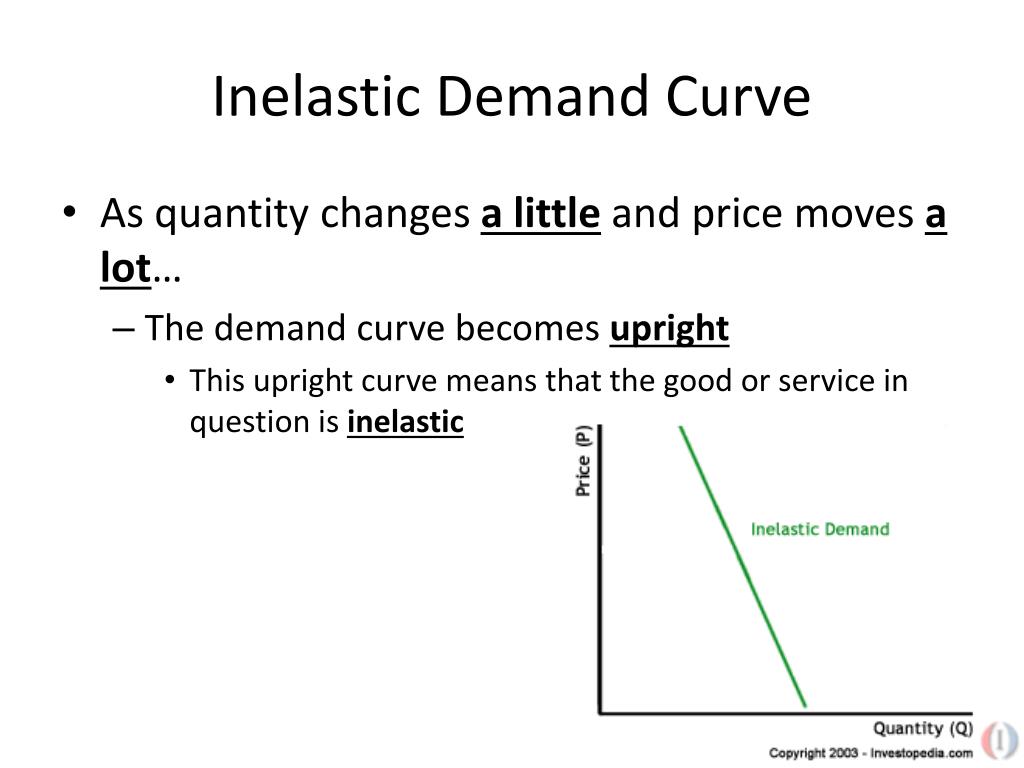
| Curve Shape | Steeper (approaching vertical). | Flatter (approaching horizontal). |
Business Implications: The Total Revenue Test
For a business, knowing whether their product is inelastic is the difference between profit and loss. This is analyzed through the Total Revenue Test.
- Inelastic Demand: If demand is inelastic, a price increase will lead to an increase in total revenue. This happens because the percentage decrease in the number of units sold is smaller than the percentage increase in the price per unit. Companies with high market power often look for ways to make their products appear more inelastic (through branding) so they can raise prices without losing their customer base.
- Elastic Demand: If demand is elastic, a price increase will lead to a decrease in total revenue. In this scenario, the loss of customers outweighs the extra money made per sale.
In 2026, data analytics allows firms to measure elasticity in real-time, adjusting "dynamic pricing" models based on how inelastic demand becomes during peak hours or specific seasonal events.
Government Policy and "Sin Taxes"
Inelasticity plays a vital role in public policy, particularly regarding taxation. Governments often choose to tax goods with inelastic demand—such as tobacco, alcohol, and carbon emissions—for two reasons:
- Revenue Generation: Since consumers will continue to buy these products even as the price rises due to taxes, the government can generate a stable and predictable stream of revenue.
- Behavioral Modification: While the demand is inelastic, it is not perfectly inelastic. High taxes (often called "sin taxes") are designed to slowly discourage consumption over time, even if the immediate impact is small.
However, taxing inelastic necessities can be regressive. Because lower-income individuals spend a larger percentage of their earnings on necessities like utilities and basic transport, price increases in these inelastic sectors hit them harder than they hit the wealthy.
Common Misconceptions About Inelasticity
It is a common mistake to assume that "inelastic" means "unchanging." In reality, very few things are perfectly inelastic.
Another misconception is that inelasticity is a permanent trait of a product. In 2026, technological disruption frequently turns inelastic markets into elastic ones. For example, for decades, local cable companies enjoyed highly inelastic demand because they were the only providers of television. The rise of satellite, fiber-optic, and various streaming technologies introduced a wealth of substitutes, significantly increasing the price elasticity of the home entertainment market.
Furthermore, a product can be inelastic at one price point but highly elastic at another. If the price of a loaf of bread rises from $2 to $3, demand might remain inelastic. If that same loaf rises to $20, consumers will eventually find alternatives or reduce consumption, demonstrating that the elasticity "curve" is rarely a straight line.
Frequently Asked Questions
Is gasoline considered inelastic or elastic?
In the short term, gasoline is highly inelastic. Most people have fixed commutes and established vehicle types, meaning they must buy gas regardless of price fluctuations. However, in the long term, gasoline becomes more elastic as consumers switch to electric vehicles or public transportation in response to sustained high prices.
How does inelasticity affect inflation?
Inelastic goods often drive "cost-push" inflation. If the price of an inelastic raw material—like oil or semiconductors—rises, businesses must pay the higher cost because they cannot easily find substitutes. To maintain profit margins, they pass these costs on to consumers, leading to broader price increases across the economy.
Why is the demand for life-saving medication perfectly inelastic?
Demand for life-saving medication is often near-perfectly inelastic because the alternative to purchasing the product is death or severe illness. Since there is no "substitute" for staying alive, the consumer's willingness to pay is limited only by their total available resources, not by the price of the medication itself.
Can a luxury good ever be inelastic?
While rare, a luxury good can be inelastic if it functions as a "Veblen good" or a status symbol. In some cases, a price increase can actually make a product more desirable to a certain demographic, though this technically moves into the realm of "upward-sloping demand" rather than standard inelasticity. More commonly, a luxury brand with extreme loyalty (like certain high-end watches) may find their customers are indifferent to price changes.
Practical Recommendation for 2026
For professionals and investors in 2026, identifying industries with inelastic characteristics is a primary strategy for hedging against market volatility. In a high-inflation or recessionary environment, companies that provide inelastic goods (utilities, healthcare, and essential technology infrastructure) typically outperform those in elastic sectors (luxury retail, travel, and high-end dining). When evaluating a business, always look at their "pricing power"—the ability to raise prices without a significant drop in volume—as this is the ultimate real-world measure of inelasticity.
Image Gallery