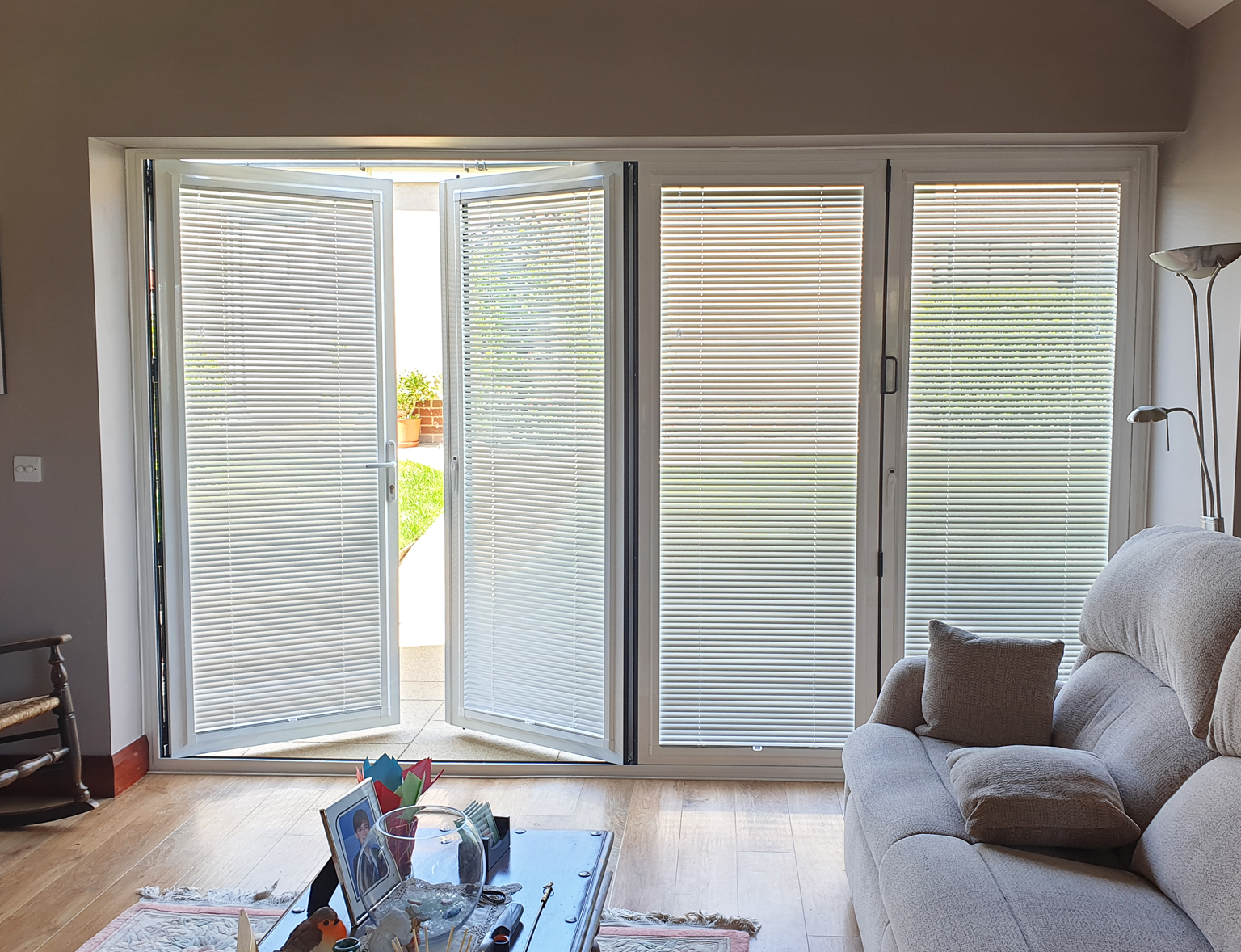
Bi-Fold Door Blinds: Comprehensive Guide to Types, Fitting Options, and Performance
Selecting the right bi-fold door blinds requires balancing spatial constraints, thermal performance, and light management without obstructing the sliding and folding operation of the door leaves. Frame-fitted clip-in blinds, sealed int...
Selecting the right bi-fold door blinds requires balancing spatial constraints, thermal performance, and light management without obstructing the sliding and folding operation of the door leaves. Frame-fitted clip-in blinds, sealed integral unit blinds, and overhead track systems represent the primary architectural solutions. Evaluating clearance depths, handle projections, and glass bead measurements ensures a seamless fit.
Contents
Understanding the Unique Challenges of Bi-Fold Door Window Treatments
Bi-fold doors consist of multiple hinged glass panels (leaves) that slide and fold concertina-style along a top and bottom track. While they provide expansive garden views and maximize natural light, their mechanical operation introduces specific window-treatment challenges that standard blinds, curtains, or shades cannot address:
- Leaf Stacking Clearance: When bi-fold doors fold fully open, the individual door leaves stack tightly against one another. Standard surface-mounted blinds or bulky cassette headers create physical barriers, preventing the leaves from concertinaing flat and placing strain on hinges and locking hardware.
- Handle Projections: Bi-fold leaf handles typically project 30 mm to 50 mm from the face of the frame. Blinds mounted directly over the glass must clear these handles during daily operation without catching, dragging, or suffering fabric damage.
- Thermal Dynamics and Solar Gain: Large expanses of glazing act as thermal conduits. In summer, direct sunlight causes excessive solar heat gain; in winter, radiant heat escapes through the glass. Blinds must offer verified thermal barriers without adding unnecessary thickness to the assembly.
- Vibration and Door Movement: Because bi-fold leaves move frequently, free-hanging blinds can swing, bang against the frame, or become damaged when doors are operated. Fixed-tension or bead-attached systems prevent movement during leaf motion.
Primary Types of Bi-Fold Door Blinds
Modern window treatments designed for bi-fold doors fall into three distinct structural categories: frame-fitted clip-in systems, integral (in-glass) units, and overhead tracking systems.
| Frame-Fitted (Clip-In / Bead-Mounted) | Integral (In-Glass Units) | Overhead (Track-Mounted / Wall-Hung) |
|---|---|---|
| • Fits within frame profile• Moves with each door leaf• No drilling required | • Sealed inside double glazing• Zero spatial encroachment• Requires glass unit replacement | • Covers entire aperture from above frame• Must stack clear of door leaves when open• Ideal for full blackout or acoustic control |
1. Frame-Fitted Clip-In Blinds (Perfect Fit and INTU Systems)
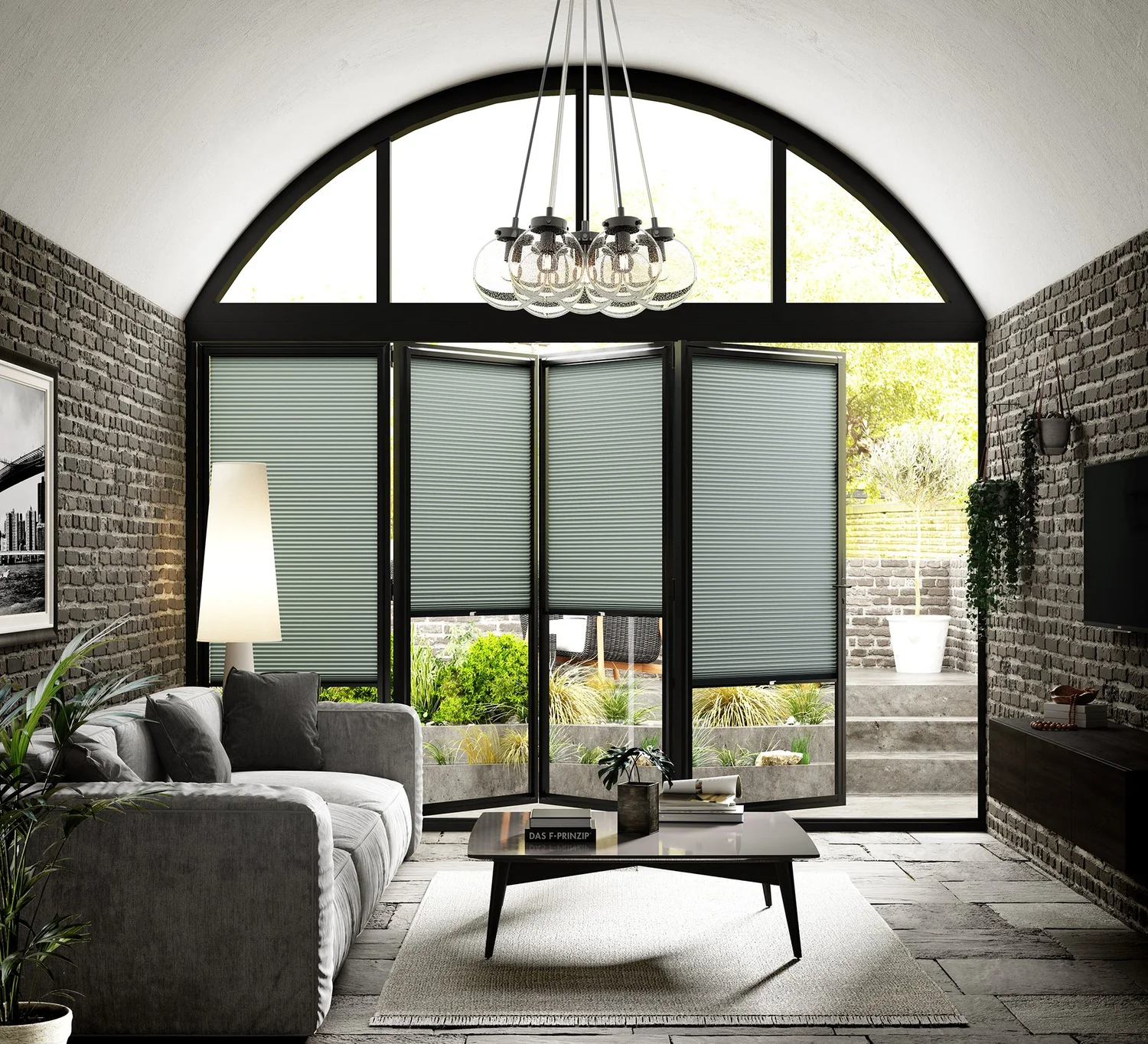
Frame-fitted clip-in systems attach directly to individual door panels using slim bracket clips that slide beneath the rubber glazing bead. This approach creates a self-contained window treatment on each leaf, moving fluidly with the door as it opens or folds.
- Operating Mechanism: Flexible polycarbonate or stainless steel brackets slip under the rubber gasket around the edge of the glass panel. The blind frame or side guide wires mount into these brackets without screws or adhesives, leaving the underlying UPVC or aluminum frame intact.
- Tensioning Systems: Side guide cables or side-channel rails hold the fabric taut against the glass at all operating angles, preventing movement when doors swing open.
- Profile Depths: Frame-fitted designs feature low-profile side channels ranging from 14 mm to 22 mm deep, allowing most concertina doors to fold back without interference.
2. Integral Blinds (In-Glass Sealed Units)
Integral blinds (or in-glass blinds) are permanently sealed inside the insulated glass unit (IGU) cavity between two panes of toughened glass. They operate via external magnetic sliders, wall switches, remote controls, or smart home integration hubs.
- Zero Spatial Impact: Because the blind sits entirely within the sealed argon-filled double- or triple-glazing unit, it adds no physical depth to the door frame, preserving 100% of the leaf-stacking clearance.
- Maintenance Requirements: The enclosed design eliminates dust, dirt, moisture, and mechanical wear from external environment exposure.
- Thermal Enhancements: Hermetically sealed inside the unit, integral blinds reduce radiant heat loss and solar heat gain, optimizing overall thermal efficiency. However, retrofitting integral blinds requires replacing the glass units rather than simply installing new window coverings.
3. Overhead Track and Wall-Mounted Systems
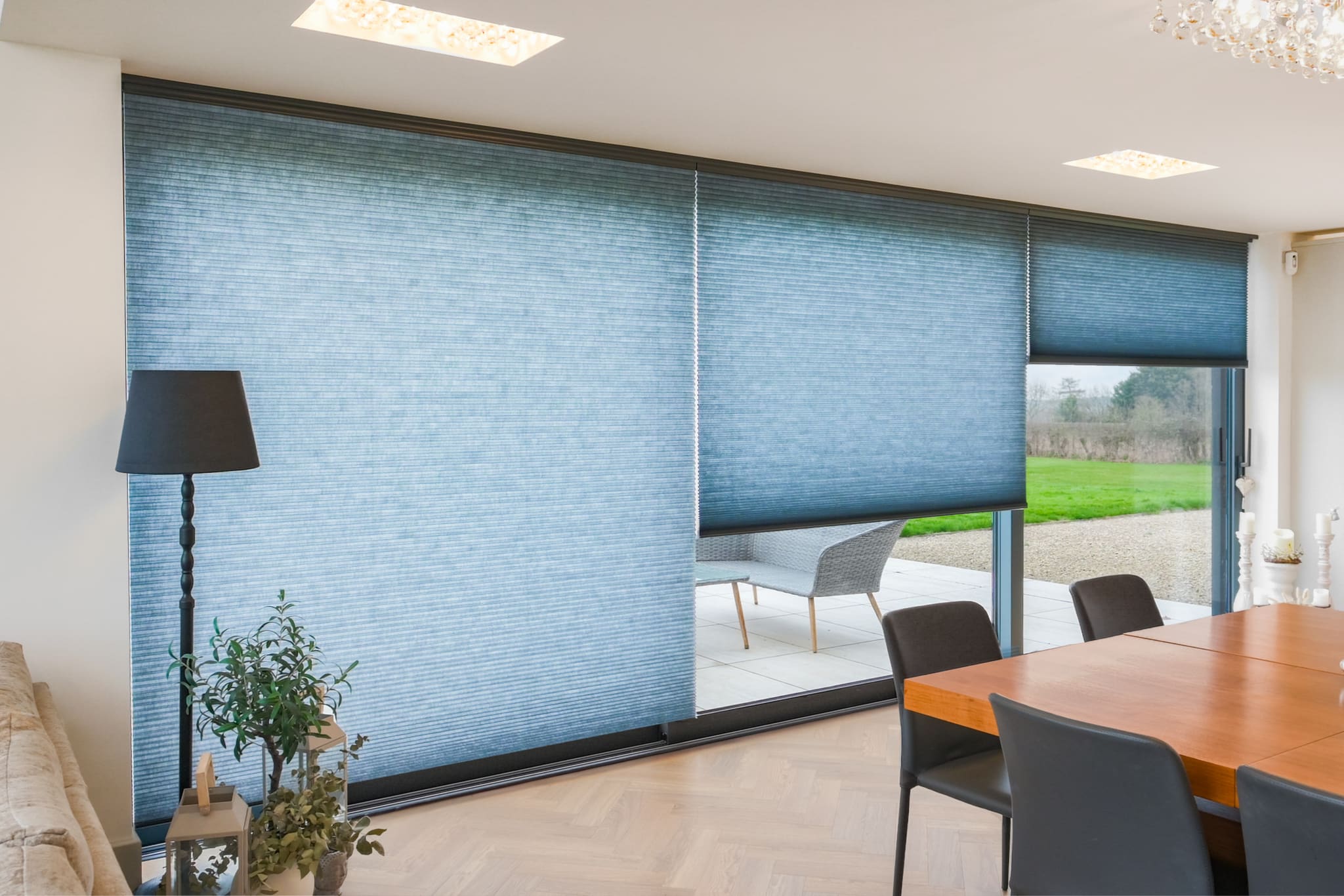
Overhead systems fix to the ceiling, lintel, or wall area above the bi-fold door aperture. Rather than mounting to individual door leaves, these wide-span treatments cover the entire opening when closed.
- Wave Curtains and Panel Glide Systems: Fabric panels move smoothly along ceiling-mounted tracks. When opening the doors, the drapery or panels glide to one side, stacking past the folding leaf footprint.
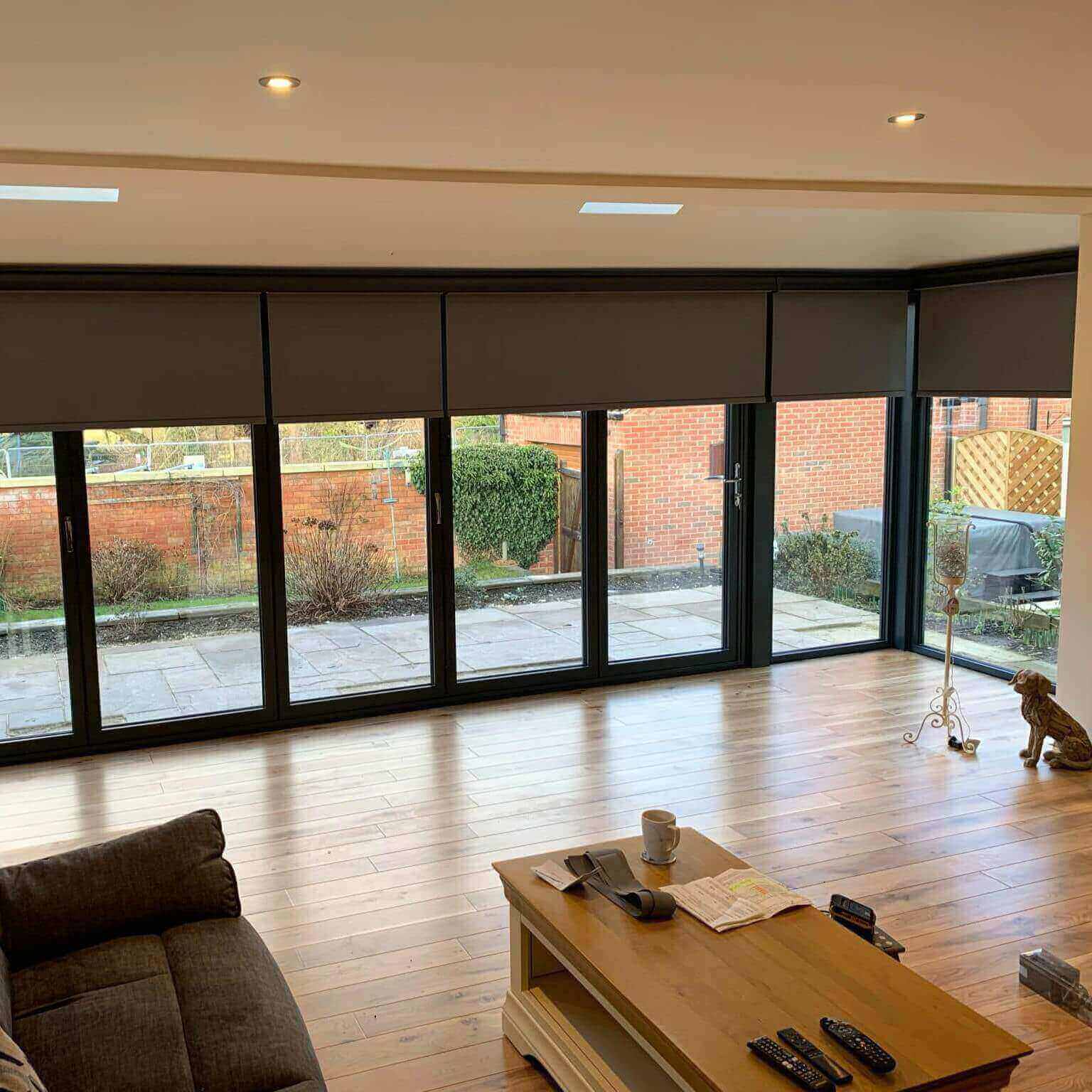
- Motorized Cassette Roller Blinds: Mounted high above the door frame, a single wide-span cassette houses an engineered fabric blind. When raised, the entire aperture remains completely clear. Care must be taken to ensure the cassette bottom rail sits high enough so that door leaves clear it when swinging open.
Technical Comparison of Bi-Fold Door Blind Options
| System Type | Mounting Location | Drilling Required | Panel Stacking Impact | Thermal Insulation (U-Value Impact) | Relative Cost |
|---|---|---|---|---|---|
| Perfect Fit Pleated / Cellular | Glazing Bead | No | Negligible (15–20mm profile) | High (Cellular design) | Moderate |
| INTU Micro Bead Blinds | Glazing Bead / Frame | No | Minimal (14–18mm profile) | Moderate to High | Moderate |
| Micro Venetian Blinds (16mm) | Bead Mounted | No | Minimal (Slight slat protrusion) | Low to Moderate | Low to Moderate |
| Integral In-Glass Blinds | Inside Sealed IGU | No (Requires pane replacement) | None (0mm clearance needed) | High | High to Premium |
| Overhead Wave Curtains | Lintel / Ceiling Track | Yes | High (Requires side stacking area) | Moderate | Moderate to High |
| Wide-Span Motorized Rollers | Wall / Lintel | Yes | None when retracted | Moderate | High |
Measuring and Assessing Bi-Fold Doors for Blinds
Precise measurements ensure chosen blinds fit your doors without obstructing mechanical movement or damaging door finishes.
- Cross-Section: Glazing Bead & Rubber Gasket
- Door Frame (Aluminum / UPVC)
- Glazing Bead Depth (mm)
- Rubber Gasket
- Glass Pane
- Door Frame (Aluminum / UPVC)
Step 1: Measure Glazing Bead Depth
For clip-in bead systems (Perfect Fit / INTU), measure the depth from the outer face of the door frame profile down to the surface of the glass pane.
- Standard bead depths measure 18 mm, 20 mm, 24 mm, or 30 mm.
- Select a bracket size matching this exact bead depth to ensure the blind frame sits flush against the door profile without loose movement or over-compression of the rubber gasket.
Step 2: Calculate Panel Stacking Distance (Clearance)
Fold all bi-fold leaves completely open into their fully stacked position. Measure the gap between adjacent door frames at the tightest clearance point.
- If the gap between stacked doors is less than 20 mm, standard framed clip-in systems may catch. Micro-pleated options, recessed clip systems, or integral blinds should be used instead.
- If the gap exceeds 25 mm, standard clip-in framed systems usually operate without rubbing against adjacent leaves.
Step 3: Account for Handle Clearance and Throw
Identify the side of each panel where handles, master latches, or key cylinders project.
- Measure the projection distance of the handle lever from the frame face.
- Ensure frame-fitted blinds finish clear of the handle mechanism. Split-frame or cut-out solutions may be necessary if handles sit directly over the glass sightline.
Step 4: Verify Visible Glass Dimensions
For frame-fitted options, take three horizontal measurements (top, middle, bottom) and three vertical measurements (left, center, right) of the visible glass panel. Record the smallest dimension to the nearest millimeter to account for slight squareness tolerances in the door frame manufacture.
Material Selection, Light Control, and Thermal Performance
Selecting appropriate materials ensures bi-fold door blinds deliver the right balance of privacy, glare reduction, and temperature regulation.
- Single-Cell Fabric
- Air
- Air
- Double-Cell Fabric
- Air Traps Dual
Cellular Honeycomb Fabrics
Cellular (honeycomb) fabrics feature a hexagonal cell construction that traps air inside isolated chambers, creating an insulating thermal barrier over the glass pane.
- Thermal Loss Reduction: Double-cell cellular fabrics can improve window insulation values, reducing radiant winter heat loss through single-pane or older double-glazed doors by up to 40%.
- Solar Reflection: White or silvered exterior-facing backings reflect summer heat away from the building, controlling internal solar gain.
Micro Aluminum Venetians
Micro Venetian blinds feature slim 16 mm aluminum slats housed within a framed clip-in boundary.
- Directional Light Control: Slats tilt to redirect incoming daylight while preserving privacy.
- Durability: Aluminum resists moisture, humidity, and UV exposure, making it well-suited for high-traffic patio access zones.
Solar Protective Coatings (SPC) and Blackout Fabrics
For South- and West-facing glazing exposed to direct afternoon sun, specify fabrics treated with Solar Protective Coatings (SPC). These metallic or ceramic coatings bounce solar radiation away before it penetrates the living space. If bi-fold doors are situated in bedrooms or media rooms, blackout-laminated fabrics block up to 99% of incoming visible light.
Installation, Maintenance, and Common Mistakes
Installation Protocols
For Clip-In Bead Systems
- Clean the glass perimeter and rubber gasket using a non-abrasive degreaser to clear dust or installation lubricants.
- Lubricate the lip of the bracket tool with mild soapy water.
- Slide the stainless steel mounting brackets between the rubber gasket and glass bead, placing them approximately 50 mm to 75 mm from each corner.
- Line up the outer frame or guide wire connectors with the bracket pins and press firmly until they click into place.
- Check handle operation and confirm leaves stack without obstruction.
For Lintel-Mounted Systems
- Confirm structural lintel composition (steel catnic, reinforced concrete, or timber header) before selecting anchors.
- Ensure brackets sit far enough out from the wall so that extended curtains or roller blinds hang clear of projecting door handles.
- Clearance Check: Overhead Mounting
- Lintel / Ceiling
- Blind Cassette
- Drop Line
- Projected Handle (Clearance Gap > 15mm)
- Door Panel Frame
- Drop Line
- Blind Cassette
- Lintel / Ceiling
Common Installation Mistakes to Avoid
- Over-compressing Gaskets: Inserting oversized clip brackets into narrow bead spaces can distort the neoprene or EPDM weather seal, potentially allowing moisture infiltration around the glass pane.
- Ignoring Thermal Expansion: Aluminum bi-fold frames expand and contract under severe temperature swings. Clip-in blinds must have 1–2 mm of expansion allowance within their mounting brackets to avoid buckling in hot weather.
- Failing to Measure Handle Projection: Installing framed blinds without calculating handle clearance can lead to scratching or denting when operating the handle.
Maintenance and Cleaning Guidelines
- Fabric Maintenance: Dust pleated and cellular shades using a soft-brush vacuum attachment on low suction. Spot clean stains using a damp microfiber cloth with neutral detergent; avoid saturating thermal backing layers.
- Aluminum Slats: Wipe 16 mm Venetian slats with a damp cloth or antistatic duster. Avoid bending individual slats during cleaning.
- Guide Cables and Side Channels: Keep side tracks clean of dust build-up. Spray dry silicone lubricant sparingly along track channels annually to ensure smooth, quiet operation.
Frequently Asked Questions
Do clip-in bi-fold door blinds void door manufacturer warranties?
Clip-in systems (such as Perfect Fit or INTU) use non-invasive brackets that slip behind rubber glazing gaskets without drilling into UPVC or aluminum profiles. Because they leave the frame undamaged, they generally do not void door system warranties. However, always review your door manufacturer’s specific warranty terms before installation.
Can blinds be fitted to aluminum bi-fold doors with narrow beads?
Yes. Specialized micro-pleated blinds and clip systems feature bracket depths designed for slim aluminum glazing profiles (ranging down to 14–18 mm). Ensure you measure both the glass depth and gasket flexibility before ordering.
What is the most effective thermal blind for bi-fold doors?
Cellular honeycomb clip-in blinds offer excellent thermal performance among surface treatments. Their enclosed air pockets create an insulating barrier that slows heat transfer across the glass. For permanent installation, integral in-glass blinds provide similar insulation while protecting the fabric inside the sealed unit.
Are integral blinds repairable if the internal control mechanism fails?
If an integral blind's internal mechanism fails, repairing it typically requires replacing the sealed glass unit, as the blind sits inside a hermetically sealed argon-filled cavity. Most reputable manufacturers provide multi-year warranties covering magnetic slider and mechanical drive components.
How much clearance gap do bi-fold doors need to stack flat with clip-in blinds?
Clip-in blind frames generally require 15 mm to 22 mm of clearance between adjacent door panels when fully folded. If your door leaves stack tighter than 15 mm, select ultra-slim micro blinds or consider integral in-glass blinds.
Recommendations and Next Steps
To select and install the right blinds for your bi-fold doors, follow this implementation checklist:
- Verify Your Spatial Limits: Measure the gap between fully stacked door panels to determine whether frame-fitted clip-in blinds or zero-clearance integral units are required.
- Check Your Bead Profile: Use a depth gauge or ruler to measure from the front edge of the door frame down to the glass pane. Match this dimension to available bracket depth options (e.g., 18 mm, 20 mm, 24 mm).
- Assess Solar Exposure: For South- or West-facing doors subject to direct heat, choose cellular fabrics with Solar Protective Coatings (SPC). For privacy with variable light control, select micro-slat aluminum Venetians.
- Order Physical Samples: Request fabric swatches and frame color samples to verify how the materials look against your door finish under room lighting conditions.
- Confirm Handle Clearances: Ensure chosen blind profiles allow door handles to rotate fully without catching on the blind frame or fabric.
Image Gallery