How Much Do Delta Airlines Pilots Earn in 2026?
As of 2026, a Delta Air Lines pilot's total compensation is determined by a combination of seniority, aircraft type, and total flight hours. A new First Officer typically earns a starting base salary of approximately $110,000, while a...
As of 2026, a Delta Air Lines pilot's total compensation is determined by a combination of seniority, aircraft type, and total flight hours. A new First Officer typically earns a starting base salary of approximately $110,000, while a senior Captain flying widebody international routes can exceed $480,000 in base pay. When including profit sharing and retirement contributions, total compensation for top-tier pilots often surpasses $550,000 annually.
Contents
The compensation structure for pilots at Delta Air Lines is governed by a comprehensive Pilot Working Agreement (PWA). This contract, which saw a historic ratification in 2023 and has continued to roll out scheduled increases through 2026, positions Delta pilots among the highest-paid commercial aviators in the world. To understand the true earning potential of a Delta pilot, one must look beyond a simple salary figure and examine the complex interplay of hourly rates, monthly guarantees, and industry-leading retirement benefits.
The Foundation of Delta Pilot Pay: Hourly Rates and Guarantees
Unlike traditional salaried corporate roles, Delta pilots are paid an hourly rate for time spent "block-to-block"—from the moment the aircraft pushes back from the gate until it arrives at its destination. In 2026, these rates reflect the final year of the cumulative pay increases negotiated in the last major contract cycle.
The 75-Hour Monthly Guarantee
Delta pilots are generally guaranteed a minimum of 75 flight hours per month, regardless of whether they actually fly that amount. This "minimum guarantee" ensures income stability. However, many pilots choose to fly more or pick up "premium" trips that pay at 1.5x or 2x the standard rate.
- Lineholders: These are pilots with enough seniority to have a set schedule. They often fly 80 to 90 hours per month.
- Reserve Pilots: Junior pilots who are "on call" to cover trips. They receive the 75-hour guarantee even if they are not called into work, though they are often utilized heavily in the current high-demand environment.
Hourly Rate Variations by Equipment
The size and complexity of the aircraft significantly impact the hourly rate. Delta categorizes its fleet into different pay tiers. Flying a flagship widebody aircraft like the Airbus A350 or the Boeing 330neo commands a higher rate than flying narrowbody aircraft like the Boeing 737 or the Airbus A220. This is because larger aircraft involve more responsibility, longer international routes, and higher levels of technical certification.
Seniority: The Engine of Career Earnings
At Delta, seniority is the single most important factor in a pilot's career. It dictates not only pay but also the quality of life, including the ability to bid for preferred routes, specific aircraft types, and vacation time.
First Officer vs. Captain
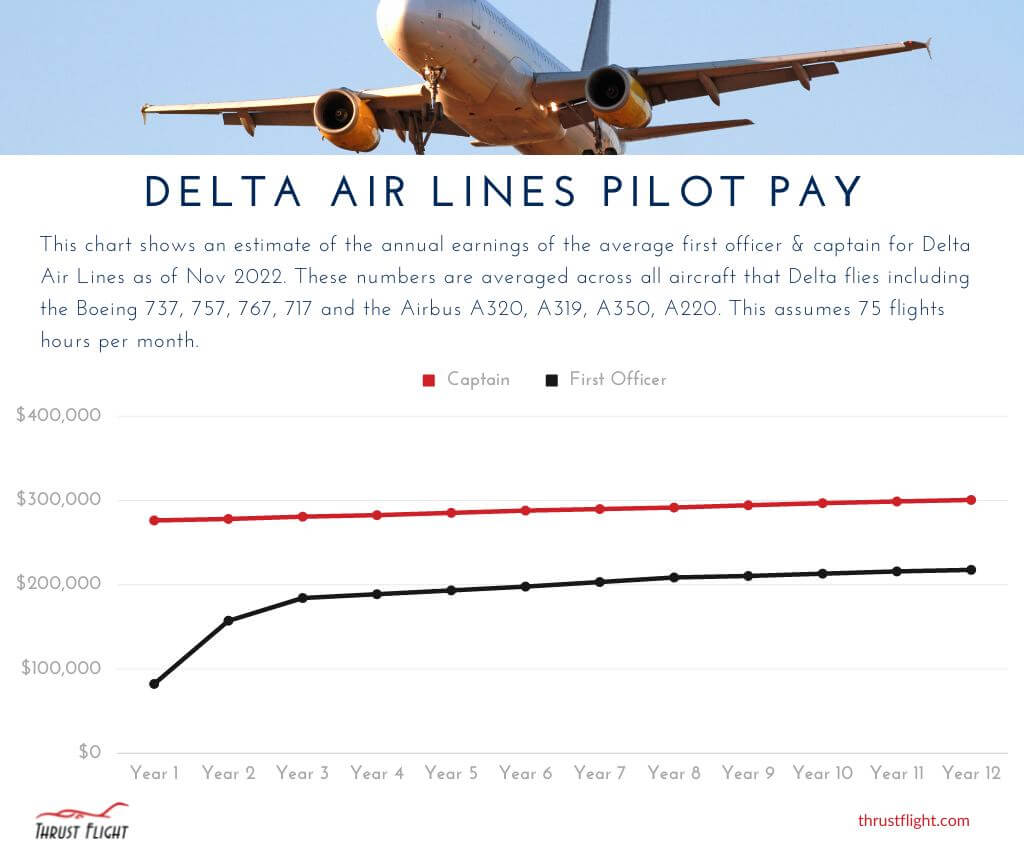
The jump from the right seat (First Officer) to the left seat (Captain) is the most significant financial milestone. In 2026, a mid-level First Officer on a narrowbody aircraft might earn between $200,000 and $250,000. Once that same pilot upgrades to Captain, their hourly rate nearly doubles, often pushing their base pay well above $350,000.
The "Step" Increases
Pilots receive automatic pay raises every year they remain with the company, up to 12 years. These longevity steps are independent of contract negotiations. For example, a 5th-year First Officer earns significantly more than a 2nd-year First Officer, even if they are flying the same aircraft. By the time a pilot reaches "Year 12" pay, they have reached the top of the scale for their specific rank and equipment.
Estimated Annual Pay Scales for 2026
The following table provides a projected look at annual base earnings for Delta pilots in 2026. These figures assume a standard 75-hour monthly guarantee (900 hours per year) and do not include overtime, per diem, or profit sharing.
| Rank & Seniority | Narrowbody (e.g., A320, B737) | Widebody (e.g., A350, A330) |
|---|---|---|
| Year 1 First Officer | $108,000 - $115,000 | N/A (Junior pilots start on narrowbody) |
| Year 5 First Officer | $195,000 - $215,000 | $225,000 - $245,000 |
| Year 12 First Officer | $230,000 - $250,000 | $265,000 - $285,000 |
| Year 1 Captain | $320,000 - $345,000 | $380,000 - $410,000 |
| Year 12 Captain | $375,000 - $400,000 | $460,000 - $495,000 |
Note: Figures are estimates based on the 2023-2026 PWA compounding increases and standard industry bidding patterns.
Additional Compensation and Benefits
Base pay is only one part of the total "Delta Pilot" financial package. In 2026, Delta continues to lead the industry in secondary compensation metrics.
Profit Sharing
Delta Air Lines is famous for its profit-sharing program, which distributes a portion of the company's pre-tax profits to employees. In successful years, pilots have historically received bonuses ranging from 5% to 15% of their annual earnings. For a senior Captain, this single check can exceed $50,000.
Retirement: The 17% Direct Contribution
One of the most valuable aspects of Delta's pilot contract is the retirement benefit. Delta provides a 17% direct contribution to a pilot’s 401(k) plan. Importantly, this is not a "match"—the pilot does not have to contribute a penny of their own money to receive this 17%. For a pilot earning $300,000, Delta is depositing an additional $51,000 per year into their retirement account (subject to IRS limits, with excess often going into a Market-Based Cash Balance Plan).
Per Diem and International Overrides
Pilots receive an hourly "per diem" for every hour they are away from their home base to cover the cost of meals and incidental expenses. While this is intended as a reimbursement, it can add $500 to $1,000 of tax-free income to a monthly paycheck. Additionally, pilots flying international routes often receive an "international override," which is a small hourly premium added to their base rate.
The Cost of Becoming a Delta Pilot
While the earnings are high, the path to the Delta flight deck is long and expensive. Delta typically requires a Bachelor's degree (though this requirement is sometimes waived for candidates with exceptional experience) and thousands of hours of flight time.
Most pilots spend several years at regional airlines (such as Endeavor Air, Republic, or SkyWest) before being hired by a "Major" like Delta. During those years, earnings are significantly lower, often starting in the $60,000 to $90,000 range. Pilots also face the ongoing cost of maintaining their FAA First Class Medical Certificate and passing rigorous semi-annual simulator training sessions.
Frequently Asked Questions
Do Delta pilots get paid for time spent at hotels or during layovers?
Pilots do not receive their full hourly flight pay during layovers. Instead, they receive a "per diem" (typically between $2.50 and $3.50 per hour) for every hour they are away from their home base. This covers meals and incidental expenses. However, Delta provides and pays for high-quality hotel accommodations at all layover locations.
How often do Delta pilots receive pay raises?
Delta pilots receive two types of raises. First, they receive a "longevity" raise every year on their hire-date anniversary, until they reach year 12. Second, they receive "contractual" raises negotiated by the Air Line Pilots Association (ALPA). The current contract cycle included significant annual increases through 2026.
What is the maximum a Delta pilot can earn?
In 2026, a very senior Captain who maximizes their schedule by flying "green slip" (overtime) trips on widebody aircraft can earn in excess of $600,000. When adding the 17% retirement contribution and potential profit sharing, the total value of the compensation package can approach $700,000 per year.
Is pilot pay the same for all domestic routes?
Yes, the hourly pay rate is determined by the aircraft type and the pilot’s rank/seniority, not the specific destination. A pilot flying from Atlanta to New York earns the same hourly rate as a pilot flying from Atlanta to Los Angeles, provided they are on the same aircraft type.
What happens to a pilot's pay if they are grounded for medical reasons?
Delta provides short-term and long-term disability insurance for pilots. Because a pilot’s livelihood depends on their FAA medical certificate, Delta’s contract includes robust "Loss of License" insurance, which typically pays a percentage of the pilot's average salary until they can return to flight status or reach retirement age.
Recommendation for Aspiring Pilots
If you are evaluating a career at Delta Air Lines in 2026, focus on the long-term "total compensation" rather than just the starting salary. While the first year of pay is modest compared to the training investment, the steep trajectory of the pay scale and the 17% retirement contribution create a wealth-building engine that is nearly unmatched in other professions.
Prospective pilots should prioritize gaining flight hours through a reputable flight school or military service and aim for a regional airline with a "flow" agreement or a strong hiring pipeline to Delta. Monitoring the Air Line Pilots Association (ALPA) updates regarding the next contract negotiation cycle (post-2026) is also essential for understanding the future direction of pilot compensation.
Image Gallery