Best High Jumpers in the World: All-Time Legends and Modern Champions
The title of the world's best high jumper belongs to a rare group of elite track and field athletes who combine explosive vertical power, extreme flexibility, and flawless technical execution. Historically, Javier Sotomayor holds the m...
The title of the world's best high jumper belongs to a rare group of elite track and field athletes who combine explosive vertical power, extreme flexibility, and flawless technical execution. Historically, Javier Sotomayor holds the men’s world record at 2.45 meters (8 feet 0.5 inches), while Yaroslava Mahuchikh holds the women’s world record at 2.10 meters (6 feet 10.67 inches).
Contents
The Highest Flying Athletes: Men's All-Time High Jump Leaders
The men’s high jump has produced incredible athletic feats, with only a small number of men in human history clearing the elusive 2.40-meter (7 feet 10.5 inches) barrier. Reaching this height requires a combination of sprinting speed, muscular elasticity, and precise spatial awareness during the plant and takeoff phases.
| Athlete | Height | Year | Notes |
|---|---|---|---|
| Javier Sotomayor (Cuba) | 2.45m | 1993 | Men's World Record |
| Mutaz Essa Barshim (Qatar) | 2.43m | 2014 | |
| Patrik Sjöberg (Sweden) | 2.42m | 1987 | |
| Bohdan Bondarenko (Ukraine) | 2.42m | 2014 |
Javier Sotomayor: The Unrivaled King of Height (2.45m)
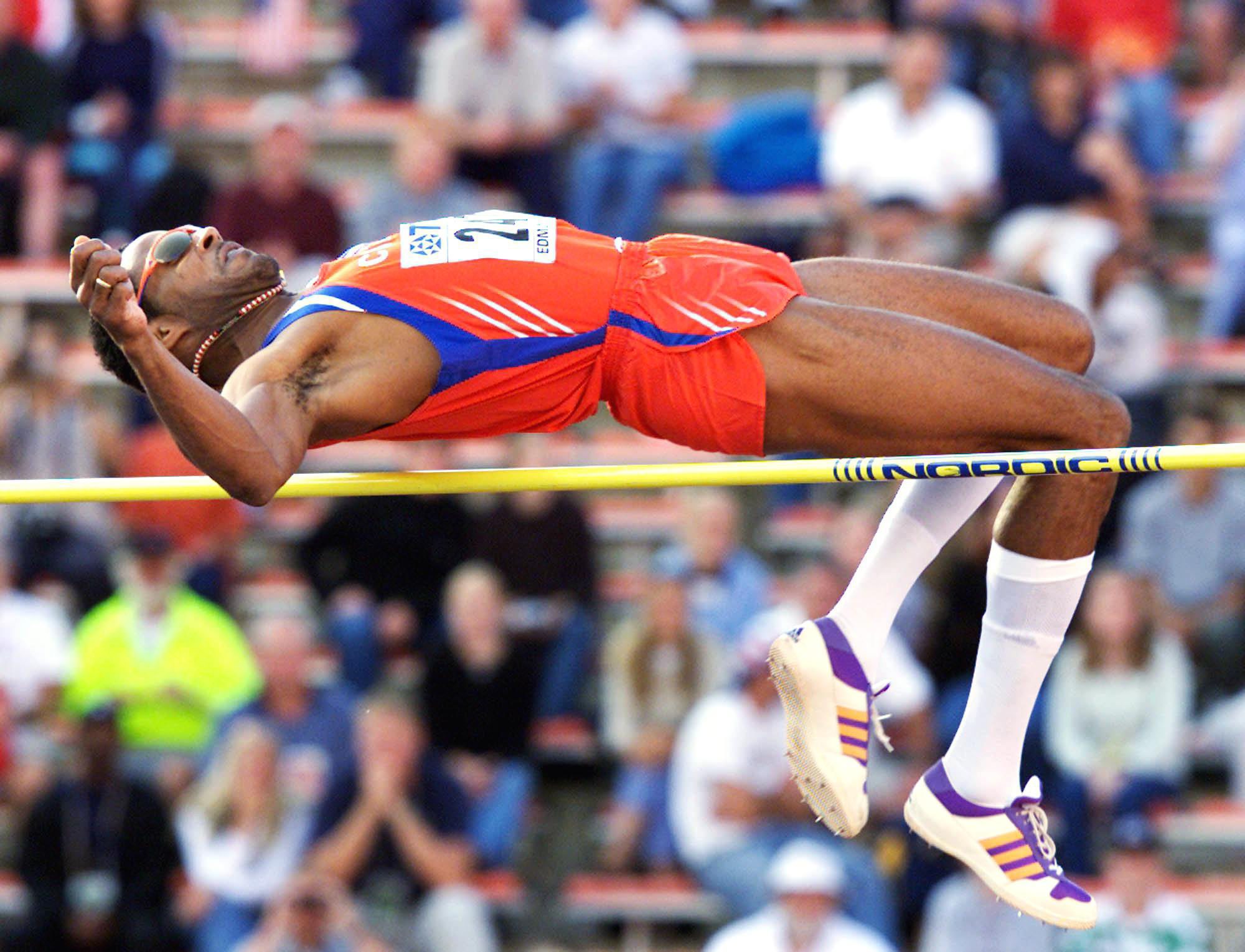
Cuba’s Javier Sotomayor is universally acknowledged as the greatest high jumper in history. Standing 1.95 meters (6 feet 5 inches) tall, Sotomayor possessed an unparalleled blend of approach velocity and explosive takeoff force.
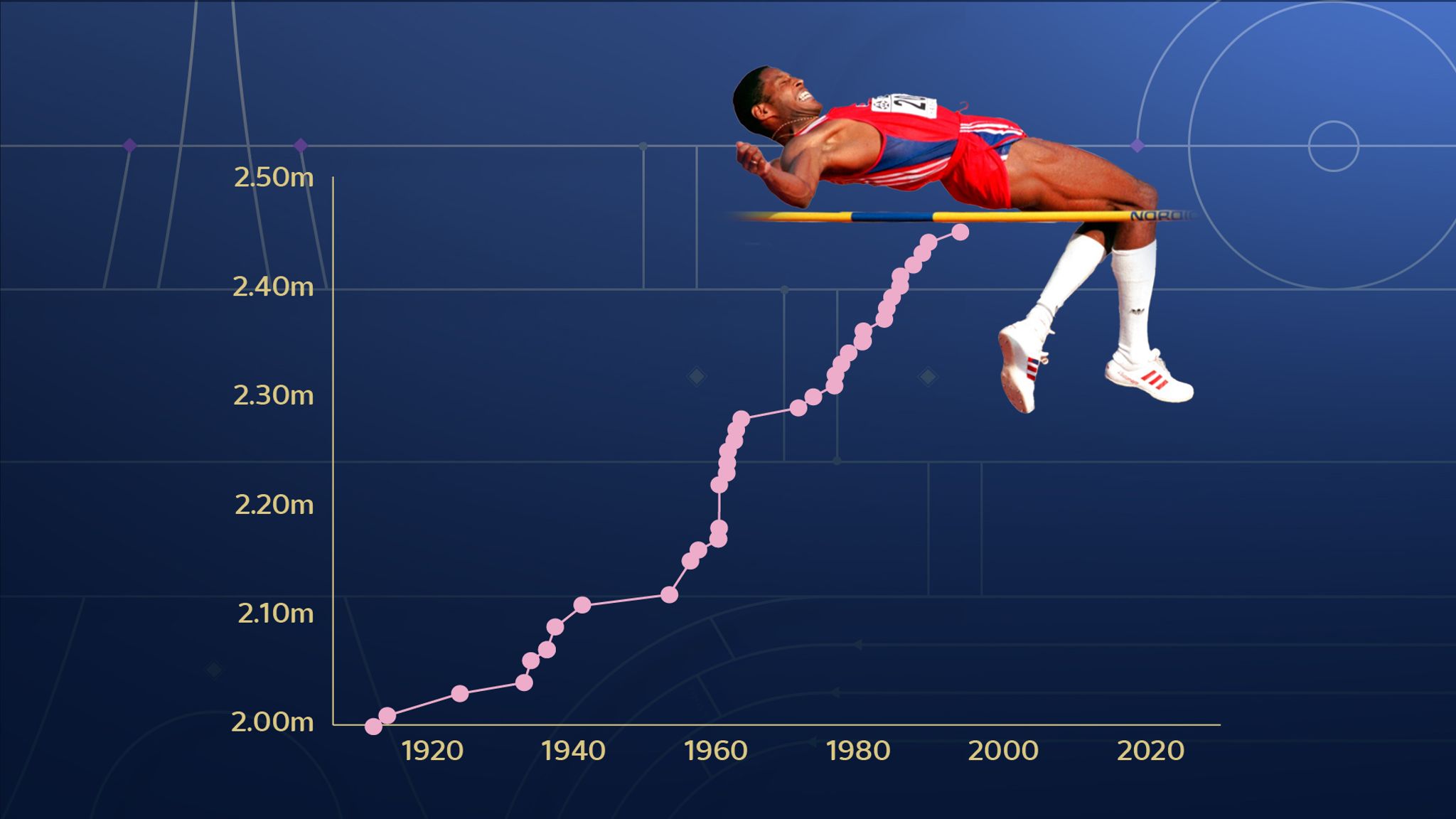
In 1988, Sotomayor set his first world record of 2.43 meters in Salamanca, Spain. He subsequently broke his own mark twice, reaching 2.44 meters in San Juan in 1989 and setting the standing world record of 2.45 meters on July 27, 1993, in Salamanca. Sotomayor also holds the indoor world record of 2.43 meters, set in Budapest in 1989. His world record of 2.45 meters remains the only human leap over eight feet in height. Official historical rankings maintained by World Athletics Men's High Jump All-Time List document that Sotomayor cleared 2.40 meters or higher in 21 separate competitions during his career—more than all other jumpers in history combined.
Mutaz Essa Barshim and the 2.40m+ Elite Club
Qatari athlete Mutaz Essa Barshim stands as the premier male jumper of the 21st century. With a personal best of 2.43 meters cleared at the Brussels Diamond League meeting in 2014, Barshim sits second on the all-time list alongside Sweden’s Patrik Sjöberg (who cleared 2.42 meters outdoors in 1987).
Barshim’s technique features an unusually fast approach curve and extreme ankle stiffness, allowing him to convert linear horizontal velocity into vertical lift with minimal energy loss. His resume includes three consecutive World Outdoor Championship titles (2017, 2019, 2022) and multiple Olympic medals, cementing his status among the sport's all-time greats.
Joining Sotomayor and Barshim in the 2.40m+ outdoor club are:
- Patrik Sjöberg (Sweden): Cleared 2.42 meters in 1987; three-time Olympic medalist.
- Bohdan Bondarenko (Ukraine): Cleared 2.42 meters in 2014 during a historic era of competition against Barshim.
- Igor Paklin (USSR): Cleared 2.41 meters in 1985, setting a world record at the time.
- Charles Austin (USA): Cleared 2.40 meters in 1991 and set the Olympic record of 2.39 meters at the 1996 Atlanta Games.
- Derek Drouin (Canada): Cleared 2.40 meters in 2014 and won gold at the 2016 Rio Olympics using a distinct, high-power plant step.
Gianmarco Tamberi and Modern Olympic Pioneers
Italy's Gianmarco Tamberi has defined the modern competitive era alongside Barshim. Known for his dramatic energy and competitive resilience, Tamberi cleared a personal best of 2.39 meters before sharing a legendary co-gold medal with Barshim at the Tokyo Olympics. Tamberi added a World Championship gold in 2023 and European Championship titles, proving that tactical mastery and emotional focus under pressure are as vital as raw leap metrics.
Record Breakers: Women's All-Time High Jump Leaders
Women’s high jump has experienced extraordinary technical progression over the past four decades. The discipline requires exceptional body control to arch over bars set significantly higher than the jumpers' own heads.
Yaroslava Mahuchikh: Breaking a 37-Year-Old World Record (2.10m)
On July 7, 2024, at the Paris Diamond League, Ukrainian star Yaroslava Mahuchikh redefined female high jumping history. Clearing 2.10 meters (6 feet 10.67 inches) on her first attempt, Mahuchikh broke the long-standing record of 2.09 meters set by Bulgaria’s Stefka Kostadinova in 1987.
Mahuchikh, born in 2001, established herself early by winning the European Championship, World Championship, and Olympic titles. Her technical approach stands out for its high acceleration through the final three steps of the J-curve, creating enormous centrifugal acceleration that lifts her hips over the bar before arching. Her 2.10-meter clearance ended a 37-year span where Kostadinova's mark seemed unassailable.
Stefka Kostadinova and Blanka Vlašić: Decades of Dominance
Prior to Mahuchikh's record leap, Stefka Kostadinova of Bulgaria ruled the high jump record books. Kostadinova cleared 2.09 meters at the 1987 World Athletics Championships in Rome. Over her career, she cleared 2.00 meters or higher in more than 190 competitions, earned Olympic Gold in 1996, and won two World Outdoor Championships.
Croatia's Blanka Vlašić dominated the late 2000s, reaching a peak height of 2.08 meters in 2009. Vlašić's combination of tall stature (1.93 meters) and rhythm-driven approach run allowed her to win two World Outdoor Championships (2007, 2009) and clear 2.00 meters in over 100 competitions. Complete career progressions for female jumpers are logged on the World Athletics Women's High Jump All-Time List.
Modern Elite Performers: Nicola Olyslagers and Maria Lasitskene
- Maria Lasitskene (Authorized Neutral Athlete / Russia): A three-time World Outdoor Champion (2015, 2017, 2019) and Tokyo Olympic gold medalist. Lasitskene holds a personal best of 2.06 meters and was virtually unbeaten between 2016 and 2020.
- Nicola Olyslagers (Australia): Possessing a personal best of 2.03 meters, Olyslagers won back-to-back Olympic silver medals (Tokyo and Paris) and an indoor World Championship title. Her meticulous notebook entries after every jump are a hallmark of her analytical approach to the event.
- Kajsa Bergqvist (Sweden): Holds the women's indoor world record at 2.08 meters, set in Arnstadt, Germany, in 2006, along with an outdoor personal best of 2.06 meters.
Evolution of High Jump Technique: From Straddle to Fosbury Flop
The performances achieved by modern high jumpers are built upon decades of technical evolution. Early high jumpers used vertical styles like the Scissors kick, followed by the Eastern Cut-off and Western Roll.
- Scissors Jump
- Western Roll
- Straddle Technique
- Fosbury Flop (Current Standard)
The Straddle Technique Era
In the mid-20th century, the Straddle technique was the dominant global style. Athletes crossed the bar face down, rotating their body around the crossbar. Soviet athlete Valeriy Brumel utilized this method to dominate the early 1960s, setting six world records and reaching a peak of 2.28 meters in 1963. The straddle required exceptional abdominal strength and hip flexibility to clear the trailing leg without displacing the bar.
The Fosbury Flop Revolution
The sport changed permanently at the 1968 Mexico City Olympics when American athlete Dick Fosbury introduced a head-first, back-to-the-bar jumping style known as the Fosbury Flop. Official Olympic historical archives maintained by the International Olympic Committee highlight how Fosbury used deep foam landing pits to safely land on his upper back, a surface adaptation that was unavailable in earlier decades when athletes landed in sand or wood shavings.
The biomechanics of the Fosbury Flop rely on key physics principles:
- Centripetal Force: Running a curved approach (the "J-run") forces the athlete to lean inward, lowering their center of mass.
- Angular Momentum: As the jumper plants their outside foot and drives the inside knee upward, horizontal momentum is converted into vertical lift and back-to-bar rotation.
- Center of Mass Manipulation: By arching the back dramatically over the bar, an athlete's center of mass can actually pass beneath or through the crossbar while their physical body segments clear over it.
All-Time High Jump Records Comparison
The following table summarizes the highest clears in high jump history for both men and women across outdoor and indoor disciplines.
| Athlete Name | Country | Height (Meters) | Height (Feet/Inches) | Location / Event | Date |
|---|---|---|---|---|---|
| Javier Sotomayor | Cuba | 2.45 m (Outdoor WR) | 8' 0.5" | Salamanca, Spain | July 27, 1993 |
| Javier Sotomayor | Cuba | 2.43 m (Indoor WR) | 7' 11.5" | Budapest, Hungary | March 4, 1989 |
| Mutaz Essa Barshim | Qatar | 2.43 m | 7' 11.5" | Brussels, Belgium | September 5, 2014 |
| Patrik Sjöberg | Sweden | 2.42 m | 7' 11.25" | Stockholm, Sweden | June 30, 1987 |
| Bohdan Bondarenko | Ukraine | 2.42 m | 7' 11.25" | New York, USA | June 14, 2014 |
| Yaroslava Mahuchikh | Ukraine | 2.10 m (Outdoor WR) | 6' 10.67" | Paris, France | July 7, 2024 |
| Stefka Kostadinova | Bulgaria | 2.09 m | 6' 10.25" | Rome, Italy | August 30, 1987 |
| Blanka Vlašić | Croatia | 2.08 m | 6' 9.75" | Zagreb, Croatia | August 31, 2009 |
| Kajsa Bergqvist | Sweden | 2.08 m (Indoor WR) | 6' 9.75" | Arnstadt, Germany | February 4, 2006 |
| Maria Lasitskene | ANA / Russia | 2.06 m | 6' 9" | Ostrava, Czech Republic | June 20, 2019 |
Key Factors That Define Elite High Jumpers
Elite performance in the high jump is governed by biomechanics, physical structure, and psychological focus.
- Elite High Jump Performance Triad:
- Biomechanical Mechanics (Velocity & Elasticity)
- Mental Resiliency & Strategy (Attempt Management)
Biomechanical Profile and Power-to-Weight Ratio
Modern high jumpers share specific physical characteristics optimized for vertical flight:
- Height and Lever Length: A tall height (typically 1.85m to 1.98m for men; 1.78m to 1.93m for women) places the athlete's natural center of mass higher off the ground before takeoff even begins.
- Tendon Stiffness and Reactive Strength: Jumpers require extreme Achilles tendon stiffness to handle ground impact forces equal to 6 to 8 times their body weight during the plant step. This allows energy to be stored and released rapidly in fractions of a second.
- Low Body Fat Percentage: Excess non-functional mass penalizes vertical acceleration. Jumpers maintain high power-to-weight ratios to maximize height gain against gravity.
Mental Toughness and Attempt Management
High jump competitions are tactical battles decided by decision-making under stress:
- Passing Heights: Jumpers can choose to pass lower heights to conserve physical energy, but missing a higher height after passing increases pressure significantly.
- Countback Rules: If two athletes clear the same height, the athlete with fewer misses at that height (or fewer overall misses throughout the competition) wins.
- Handling Failed Attempts: A jumper who misses two attempts at a height has only one remaining shot to stay in the competition. Managing heart rate and maintaining spatial memory under this pressure separates champions from contenders.
Frequently Asked Questions
Who is the highest male high jumper in history?
Javier Sotomayor of Cuba is the highest male high jumper in history. He holds the world record of 2.45 meters (8 feet 0.5 inches), set in Salamanca, Spain, on July 27, 1993, as well as the indoor world record of 2.43 meters set in 1989.
Who holds the women's high jump world record?
Yaroslava Mahuchikh of Ukraine holds the women’s world record at 2.10 meters (6 feet 10.67 inches). She set this mark on July 7, 2024, at the Paris Diamond League, breaking Stefka Kostadinova’s previous world record of 2.09 meters, which had stood since 1987.
What is the Fosbury Flop, and why is it used by all elite high jumpers today?
The Fosbury Flop is a high jump technique where the jumper approaches along a curved path, takes off from the foot furthest from the bar, rotates in the air, and crosses the bar headfirst with their back facing down. It is universally used because it allows the athlete's body to curve around the bar, allowing their physical body to clear heights while their center of mass stays at or below bar level.
Has anyone ever cleared 8 feet in the high jump?
Yes, but only one person: Javier Sotomayor of Cuba. His world record of 2.45 meters equals 8 feet 0.5 inches. No other athlete in recorded history has cleared 8 feet outdoors or indoors.
How high can women jump compared to men in elite competition?
The elite women's world record stands at 2.10 meters, while the men's world record is 2.45 meters—a difference of 35 centimeters (approx. 13.8 inches). This height differential stems primarily from natural biological differences in muscle mass, bone lever acceleration, and power output during the takeoff plant step.
How to Follow Elite High Jump Competitions
To analyze modern high jumpers and follow upcoming world record attempts, leverage these reliable steps:
- Track Diamond League Meetings: Watch World Athletics Diamond League events, where top jumpers compete in high-stakes environments throughout the outdoor season.
- Review Official Rankings: Consult the World Athletics top lists regularly to view world leads, verified height clearances, and historical statistical updates.
- Analyze Technical Video Footage: Study high-speed side and front video recordings of jumpers like Yaroslava Mahuchikh and Mutaz Essa Barshim to observe plant angles, stride frequency, and rotational velocity over the crossbar.
Image Gallery