Total Net Worth Portfolio Planner: How to Build and Track Your Complete Asset Allocation Strategy
A total net worth portfolio planner is a comprehensive financial framework—implemented via specialized software or structured spreadsheets—that unifies all illiquid assets, investment accounts, cash reserves, real estate holdings, and...
A total net worth portfolio planner is a comprehensive financial framework—implemented via specialized software or structured spreadsheets—that unifies all illiquid assets, investment accounts, cash reserves, real estate holdings, and outstanding liabilities into a single dashboard. It calculates true net worth, monitors overall asset allocation drift, evaluates balance sheet liquidity, and models long-term financial independence projections.
Contents
The Fundamentals of Total Net Worth Planning
Most investors begin their wealth-building journey by evaluating isolated accounts: a brokerage statement here, a 401(k) balance there, and an estimated home value on a real estate portal. However, managing individual accounts in silos creates blind spots. A high balance in a retirement account might mask low short-term liquidity, or heavy exposure to real estate across personal and commercial holdings might unknowingly concentrate risk in a single regional economy.
A total net worth portfolio planner solves this by treating your entire financial life as a single corporate balance sheet. Rather than asking how a single stock or mutual fund is performing, the planner answers broader strategic questions:
- What is my consolidated economic net worth after accounting for all liabilities and deferred tax liabilities?
- How is my total capital allocated across risk classes, liquidity tiers, and geographies?
- Am I overexposed to illiquid assets that cannot easily be converted to cash during a market downturn?
- Is my asset allocation drifting away from my target risk tolerance as specific asset classes appreciate?
By aggregating cash, taxable equities, tax-deferred accounts, tax-free Roth structures, physical real estate, private equity, alternative investments, and liabilities into one central model, you gain complete visibility over your financial position.
Disclaimer: This guide is provided for educational and informational purposes only and does not constitute professional financial, legal, or tax advice. Personal balance sheets, tax obligations, and risk profiles vary significantly. Always consult a Certified Financial Planner (CFP®) or licensed CPA before executing major financial decisions.
Anatomy of a Net Worth Portfolio Planner
To build or select an effective planning system, you must understand how asset and liability categories fit into a holistic balance sheet. A comprehensive total net worth planner categorizes financial line items by asset class, liquidity, and tax treatment.
| ASSETS | LIABILITIES |
|---|---|
| Liquid Capital (Cash, Money Market) | Primary Mortgage Balance |
| Public Equities (Taxable & Retirement) | Investment Property Loans |
| Fixed Income (Treasuries, Corporate) | Personal Lines of Credit / Debt |
| Real Estate (Primary & Investment) | |
| Private Holdings / Business Equity |
NET BALANCE = Consolidated Assets - Consolidated Liabilities
1. Assets: Liquid, Semi-Liquid, and Illiquid
Assets should be sub-categorized by how quickly and predictably they can be converted to legal tender without sacrificing baseline value:
- Tier 1 (High Liquidity): Cash, checking accounts, high-yield savings accounts, money market funds, and short-term U.S. Treasury bills. These serve as emergency reserves and short-term spending buffers.
- Tier 2 (Moderate Liquidity): Publicly traded stocks, exchange-traded funds (ETFs), mutual funds, and liquid corporate bonds held in taxable brokerage accounts. These can be liquidated within standard settlement windows (T+1), though selling may trigger capital gains taxes or market risk.
- Tier 3 (Restricted Liquidity): Tax-advantaged retirement accounts, such as traditional 401(k)s, Traditional IRAs, and Roth IRAs. While market-traded, early withdrawals prior to age 59½ may trigger tax penalties and tax implications under Internal Revenue Service rules.
- Tier 4 (Illiquid Assets): Primary residential real estate, commercial property investments, private equity, venture syndicates, business equity, artwork, and collectibles. Converting these into cash requires significant time, transaction costs, and valuation negotiation.
2. Liabilities: Short-Term and Long-Term Obligations
Net worth calculations are incomplete without an exact accounting of outstanding obligations. Liabilities should be recorded as principal balances owed:
- Short-Term Obligations: Credit card balances settled monthly, short-term personal notes, and accrued taxes.
- Long-Term Debt: Fixed-rate primary home mortgages, investment property mortgages, auto loans, and student loans.
3. Calculating Consolidated Net Worth
The core calculation of any total net worth portfolio planner relies on basic accounting identities:
$$\text{Total Net Worth} = \text{Total Assets} - \text{Total Liabilities}$$
However, advanced financial planning requires calculating Liquid Net Worth:
$$\text{Liquid Net Worth} = (\text{Tier 1 Assets} + \text{Tier 2 Assets}) - \text{Short-Term Liabilities}$$
Tracking Liquid Net Worth prevents "asset-rich, cash-poor" vulnerability, ensuring you retain operational flexibility even during prolonged market contractions or real estate illiquidity.
Spreadsheet vs. Software: Choosing Your Planning Method
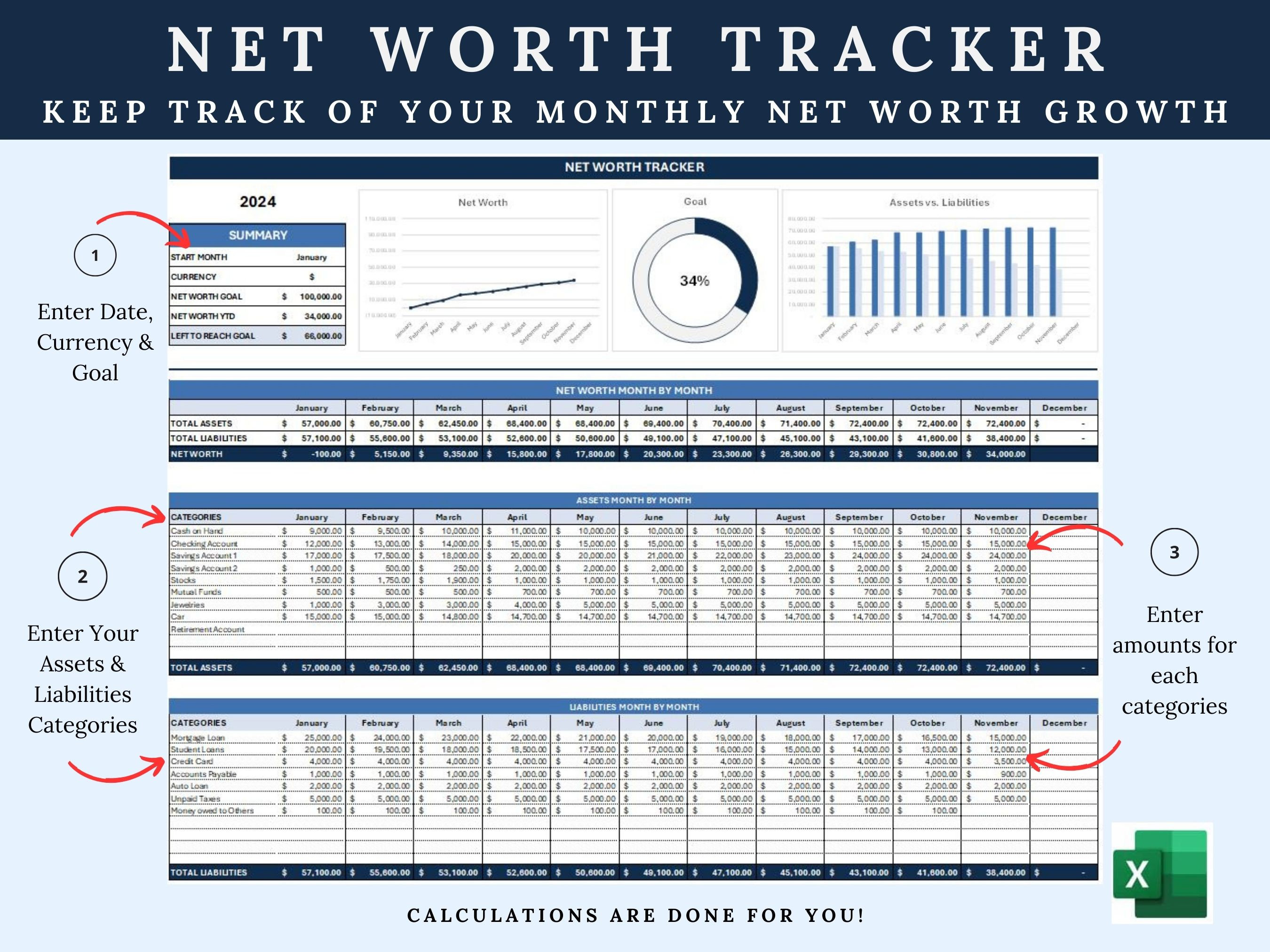
When establishing a total net worth portfolio planner, individuals generally choose between self-built spreadsheets (such as Microsoft Excel or Google Sheets) and automated financial aggregation software. Both approaches offer unique trade-offs regarding privacy, customization, and automation.
Self-Built Spreadsheets
Custom spreadsheets remain the preferred option for high-net-worth investors, financial privacy advocates, and individuals with complex, non-standard assets (such as real estate partnerships or private business equity).
- Pros: Complete control over calculations, total privacy (no third-party data aggregators accessing banking credentials), customized asset class categories, and unlimited scenario modeling.
- Cons: Requires manual maintenance, manual price updates for illiquid assets, and custom scripting or functions (such as
GOOGLEFINANCE) to fetch stock tickers automatically.
Automated Financial Aggregation Platforms
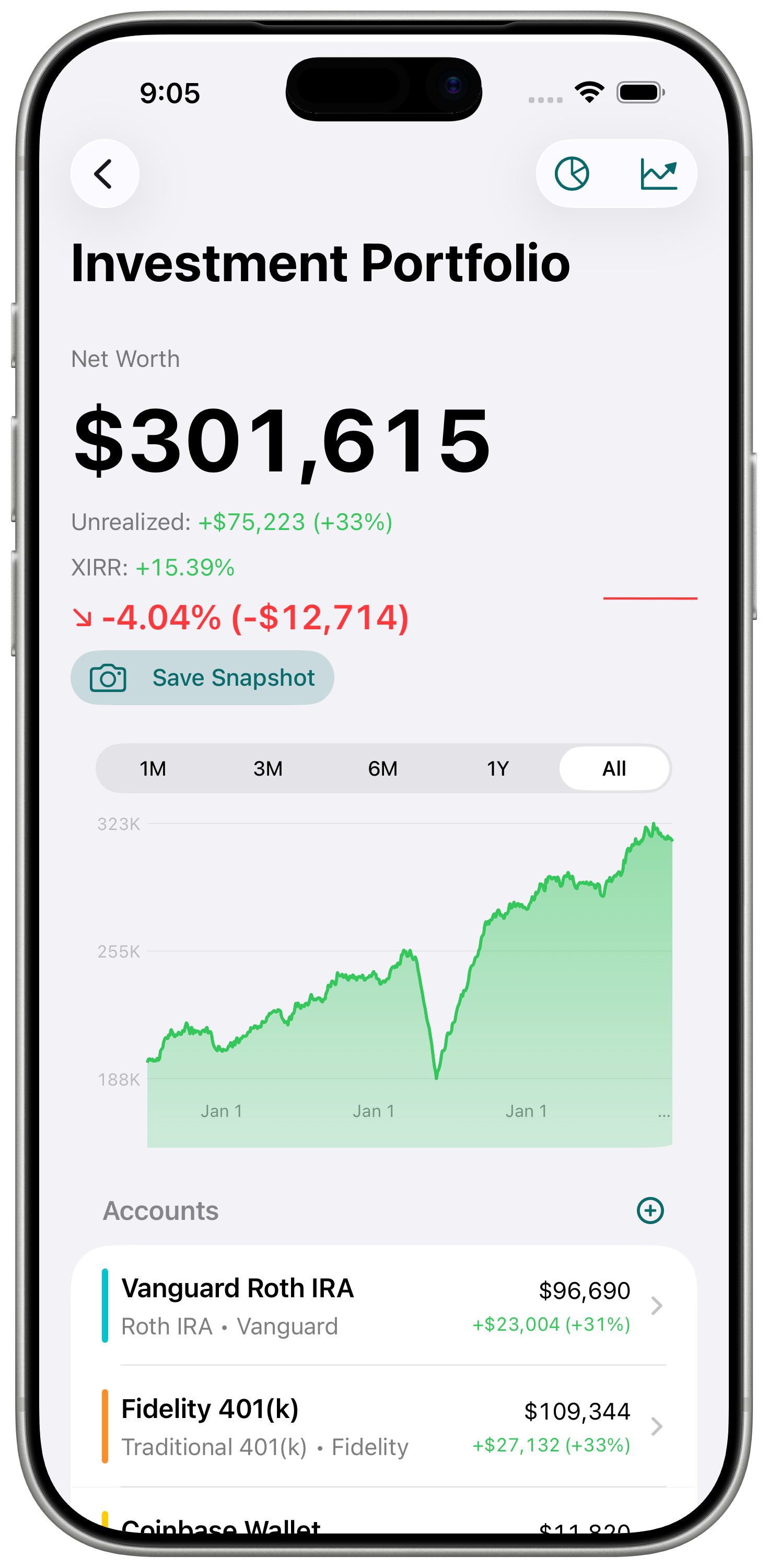
Software tools use API integrations and banking aggregators to sync account balances automatically across financial institutions.
- Pros: Real-time data sync for bank accounts and public brokerages, automated transaction tagging, minimal manual maintenance, and built-in reporting graphs.
- Cons: Frequent API connection breaks, security risks associated with aggregating credentials, poor handling of illiquid real estate debt schedules, and rigid allocation categories that cannot adapt to non-traditional investments.
Method Comparison Matrix
The following table compares the primary methods used to build and manage a total net worth portfolio planner:
| Feature / Metric | Custom Spreadsheet (Excel/Google Sheets) | Automated Aggregation Software | Hybrid System (Spreadsheet + API Plugins) |
|---|---|---|---|
| Data Privacy & Control | Maximum (Stored locally or secure cloud) | Medium (Third-party server access) | High (User-controlled API keys) |
| Setup Complexity | High (Requires custom formulas) | Low (Plug-and-play account sync) | Moderate (Initial configuration needed) |
| Illiquid Asset Support | Excellent (Custom valuation logic) | Poor to Moderate (Basic manual additions) | Excellent (Custom manual inputs) |
| Market Data Refresh | Semi-Automated (Formula-driven Tickers) | Fully Automated (Real-time account fetch) | Fully Automated or On-Demand |
| Tax-Adjusted Modeling | Fully Customizable | Limited (Standardized tax assumptions) | Customizable via custom scripts |
| Ongoing Maintenance | 15–30 minutes monthly | Low (Periodic connection fixes) | 5–15 minutes monthly |
| Ideal For | High-net-worth & private equity investors | Early-stage accumulators & liquid-only | Advanced DIY financial planners |
Step-by-Step Guide: Implementing Your Portfolio Planner
Setting up an effective total net worth portfolio planner requires a structured workflow to collect data, establish target asset allocations, and maintain system integrity over time.
- STEP 1: Audit & Inventory Assets and Liabilities
- Collect account statements, real estate appraisals, mortgage balances
- STEP 2: Define Asset Allocation Categories & Risk Weights
- Group assets into Cash, Fixed Income, Equities, Real Estate, Alternatives
- STEP 3: Establish Target Allocations & Rebalancing Thresholds
- Set baseline allocation percentages and drift triggers (e.g., ±5%)
- STEP 4: Factor in Asset Location & Tax Liabilities
- Discount pre-tax balances for future taxes; assign high-yield to IRAs
- STEP 5: Establish a Monthly or Quarterly Maintenance Schedule
- Review performance, log capital calls, and execute rebalancing trades
Step 1: Conduct a Comprehensive Asset and Liability Audit
Gather the latest balance statements across every account you hold. Create a master registry containing:
- Account Identifier: Financial institution name and last four digits of the account number.
- Current Balance: Exact nominal dollar value on the audit date.
- Asset Class: Equities, fixed income, cash, real estate, or private business equity.
- Tax Status: Taxable, Tax-Deferred (Traditional IRA/401(k)), Tax-Exempt (Roth), or Non-Qualified.
- Ownership Structure: Individual, Joint Tenants, Trust, or Corporate entity.
Step 2: Establish Your Target Asset Allocation Framework
Asset allocation—the distribution of capital across equities, bonds, real estate, and cash—is the primary driver of overall portfolio return and volatility. According to core asset allocation research published by the U.S. Securities and Exchange Commission (SEC), selecting an appropriate mix of asset classes aligns your investments with your specific timeline and risk tolerance.
Define your macro-allocation targets based on your financial goals. For example:
- US Total Stock Market: 40%
- International Developed & Emerging Stocks: 20%
- Fixed Income & US Treasuries: 15%
- Real Estate Equity: 15%
- Cash Reserve & Money Market: 10%
Your planner should automatically compare your Actual Allocation Percentage against your Target Allocation Percentage to highlight variances.
Step 3: Implement Tax-Location Optimization Rules
Not all dollars on a net worth statement carry the same economic value. A $1,000,000 balance in a Traditional 401(k) does not equal $1,000,000 in a Roth IRA. When funds are withdrawn from a tax-deferred traditional 401(k) during retirement, ordinary income tax must be paid on every dollar.
To account for this in a total net worth planner, sophisticated financial modelers apply an estimated deferred tax liability factor:
$$\text{After-Tax Value of Tax-Deferred Account} = \text{Nominal Account Balance} \times (1 - \text{Estimated Retirement Tax Rate})$$
For instance, assuming an estimated combined federal and state income tax rate of 22% during retirement, a $1,000,000 Traditional IRA should be entered into long-term independence models at an after-tax value of $780,000.
Furthermore, use the planner to optimize Asset Location:
- Place high-tax, dividend-heavy, or high-turnover fixed income assets inside tax-advantaged traditional IRAs.
- Hold high-growth equities with high long-term capital appreciation potential inside tax-free Roth accounts.
- Hold broad-market, tax-efficient index ETFs in taxable brokerage accounts to benefit from lower long-term capital gains tax rates.
Step 4: Define Rebalancing Drift Triggers
As market prices fluctuate, your portfolio's actual asset allocation will naturally drift away from your strategic target. A net worth planner should include automated conditional formatting that alerts you when an asset class strays beyond acceptable boundaries (such as a absolute 5% drift from baseline).
For example, if your baseline target for international equities is 20%, a rebalancing trigger should fire if market gains push the allocation above 25% or drop it below 15%. Rebalancing can be achieved by:
- Directing new cash savings exclusively into underweighted asset classes.
- Reallocating portfolio dividends toward underweighted categories.
- Executing asset sales in tax-advantaged accounts to avoid tax events.
Advanced Analytical Metrics for Total Net Worth Tracking
A basic net worth calculator only displays a single snapshot total. A professional-grade total net worth portfolio planner tracks dynamic financial ratios that reveal balance sheet strength, inflation resilience, and progress toward financial independence.
1. Liquid-to-Total Net Worth Ratio
$$\text{Liquidity Ratio} = \frac{\text{Liquid Net Worth}}{\text{Total Net Worth}}$$
This ratio measures your financial flexibility. A healthy liquidity ratio ranges between 15% and 40%, depending on your career stage and real estate footprint. If this ratio drops below 10%, you risk becoming cash-constrained during personal or market liquidity shocks, forcing high-cost debt financing or distressed asset sales.
2. Debt-to-Asset Ratio
$$\text{Debt-to-Asset Ratio} = \frac{\text{Total Liabilities}}{\text{Total Assets}}$$
This leverage metric indicates how much of your total asset base is financed through leverage. Data from macroeconomic balance sheet assessments by the Federal Reserve Board emphasizes the importance of managing personal household leverage to sustain economic shocks.
- High Risk: $> 50%$ debt-to-asset ratio (common in early-stage home purchases).
- Moderate Risk: $20% - 50%$.
- Low Risk / Conservative: $< 20%$.
3. Financial Independence (FI) Coverage Ratio
$$\text{FI Coverage Ratio} = \frac{\text{Investable Portfolio Value} \times \text{Safe Withdrawal Rate (e.g., 4%)}}{\text{Annual Baseline Living Expenses}}$$
When this ratio reaches 1.0 (or 100%), your investable capital produces sufficient recurring investment income to cover your living costs without relying on active employment income.
Common Pitfalls in Net Worth Portfolio Planning
Even carefully constructed portfolio planners can yield misleading outputs if built on flawed assumptions. Avoid these frequent analytical mistakes:
Overestimating Real Estate Values
Relying on unadjusted, optimistic automated valuation models (AVMs) from public real estate websites inflates net worth. Real estate values should reflect estimated net realizable value by deducting hypothetical selling costs (typically 6% to 8% for broker commissions, closing costs, and prep transfer fees).
Ignoring Deferred Tax Liabilities
Failing to account for future income tax obligations on pre-tax retirement accounts overstates your spendable net worth. Always distinguish between gross nominal net worth and after-tax net worth.
Double-Counting Home Equity and Housing Expenses
If you count your primary residence's full equity toward your financial independence target, you must also account for continuous housing expenses (property taxes, maintenance, insurance, and HOA fees) in your long-term cash flow budget. A primary home produces no dividend cash flow and cannot fund day-to-day living expenses unless downsized or liquidated.
Updating Capital Values Too Frequently
Tracking public equity values daily or weekly induces behavioral stress and encourages over-trading. Because wealth accumulation relies on long-term compound growth, update your total net worth portfolio planner on a fixed monthly, quarterly, or semi-annual schedule.
Frequently Asked Questions
What should be included in a total net worth calculation?
A complete net worth calculation includes all liquid accounts (checking, savings, money market), taxable investment accounts, retirement balances (401(k), IRA, Roth IRA), real estate properties, business equity, market values of vehicles, and personal holdings of material value. Subtract all debt obligations, including primary mortgages, investment property loans, student loans, auto financing, and credit card balances.
Should my primary home be included in my net worth portfolio planner?
Yes, your primary home should be included in your total net worth balance sheet as an asset, balanced against its remaining mortgage debt as a liability. However, because primary housing equity is illiquid and generates no operating cash flow, it should be excluded when calculating your Liquid Net Worth and Investable Net Worth for early retirement or financial independence planning.
How often should I update my net worth planner?
Updating your planner on a monthly or quarterly basis provides sufficient tracking granularity while preventing overreaction to short-term market volatility. Quarterly reviews are ideal for rebalancing asset allocation and assessing debt reduction progress.
How do I handle tax-deferred accounts like 401(k)s in a net worth planner?
Record tax-deferred accounts at their full face balance for official net worth statements, but create an after-tax tracking view that discounts these balances by your expected marginal income tax rate during retirement (such as 15% to 25%). This provides an accurate representation of usable retirement capital.
What is the difference between total net worth and investable net worth?
Total net worth subtracts all liabilities from all assets, including illiquid items such as primary real estate, vehicles, personal property, and private equity. Investable net worth includes only liquid and semi-liquid financial assets (stocks, bonds, mutual funds, cash, and liquid ETFs) that can be actively allocated and converted to cash to generate sustainable investment income.
Strategic Next Steps
To implement your own total net worth portfolio planner, take these immediate operational steps:
- Audit All Financial Accounts: Create a central inventory listing every active banking, brokerage, retirement, real estate, and loan balance.
- Select Your Platform: Choose a self-built Google Sheets or Microsoft Excel model for complete data privacy and tax-adjustment customization, or an automated aggregation tool for convenience.
- Establish Asset Allocation Targets: Define your target percentages across equities, fixed income, real estate, and cash reserves based on your risk tolerance and investment horizon.
- Schedule Periodic Reviews: Set a calendar reminder to update account valuations, monitor allocation drift, and execute rebalancing trades on a quarterly basis.
For complex financial structures involving multiple real estate holdings, private business equity, or estate trusts, consider reviewing your overall portfolio plan with a qualified Certified Financial Planner (CFP®) or CPA.
Image Gallery