What is the Role of the Workers Compensation Underwriter?
A workers' compensation underwriter is an insurance professional responsible for evaluating the risk profiles of businesses to determine their eligibility for coverage. By analyzing safety records, financial health, and industry classi...
A workers' compensation underwriter is an insurance professional responsible for evaluating the risk profiles of businesses to determine their eligibility for coverage. By analyzing safety records, financial health, and industry classifications, they ensure that the premiums charged align with the potential for workplace injury claims and the insurer's risk appetite.
Contents
The workers' compensation underwriter acts as a primary gatekeeper for insurance carriers, balancing the need for profitability with the legal requirement to provide coverage for employees. In 2026, this role has evolved significantly, integrating advanced predictive analytics and real-time safety data with traditional risk assessment techniques. Understanding the specific duties of these professionals is essential for business owners, insurance brokers, and risk managers seeking to secure favorable terms and ensure workplace safety compliance.
The Strategic Foundation of Risk Selection
The primary role of a workers' compensation underwriter is risk selection, often referred to as "front-line underwriting." This involves determining whether a specific business fits within the insurance company’s predetermined "risk appetite." Every insurance carrier has a set of guidelines that dictate which industries they are comfortable insuring and which are deemed too hazardous.
When a submission arrives from an insurance broker, the underwriter conducts a comprehensive review of the applicant’s operations. They do not merely look at the industry name; they investigate the specific tasks performed by employees. For instance, a "roofing contractor" might specialize in residential asphalt shingles or industrial high-rise metal roofing—two vastly different risk profiles. The underwriter must identify these nuances to decide if the account is a "profitable" risk for the company’s portfolio.
Analyzing the Loss History
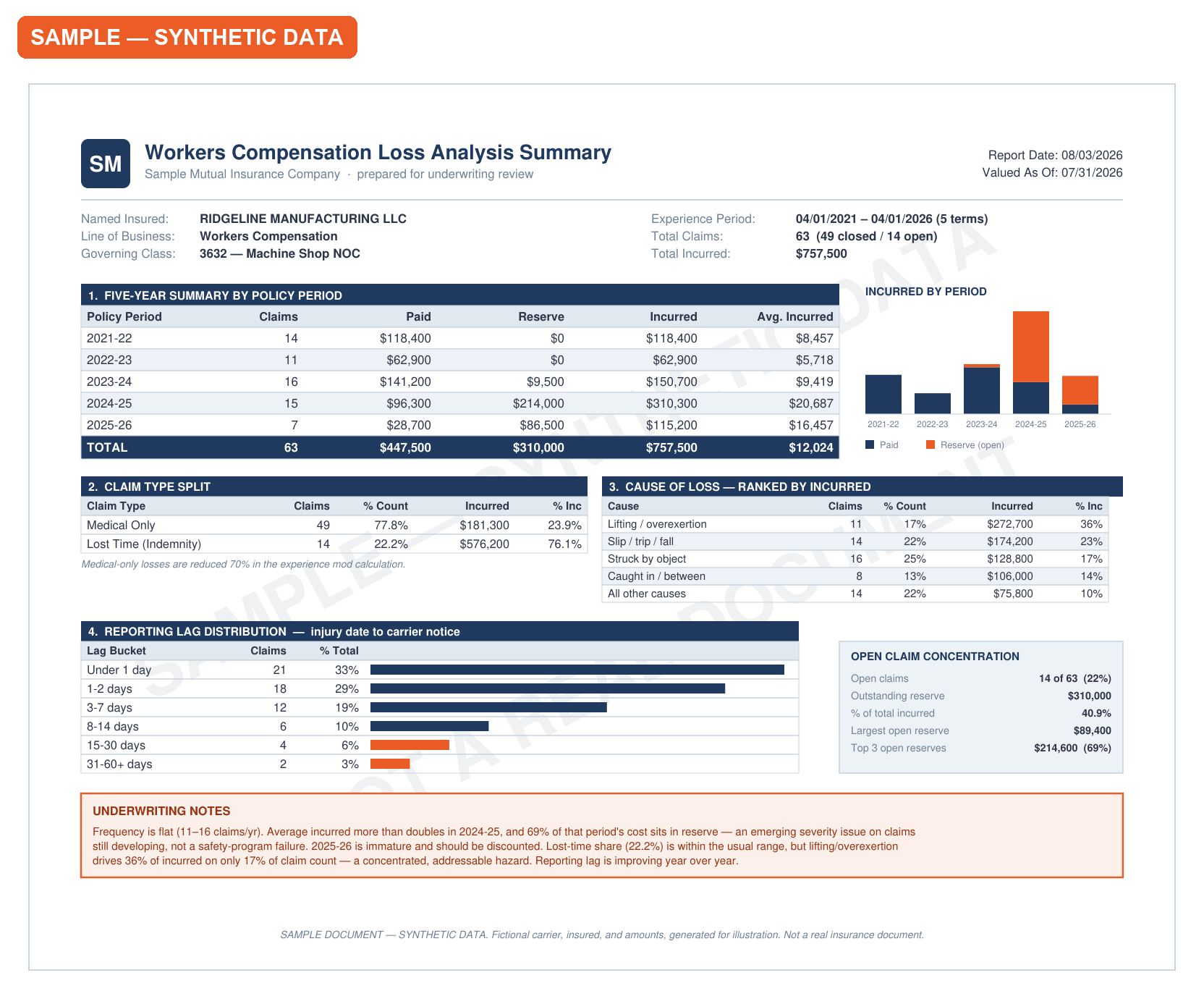
A critical component of risk selection is the review of "loss runs," which are reports detailing the insurance claims history of a business over the previous three to five years. Underwriters look for patterns in these reports. They differentiate between "frequency" (many small claims) and "severity" (one or two catastrophic claims). High frequency often indicates a systemic lack of safety protocols, which is a major red flag. Conversely, a single severe claim might be an anomaly in an otherwise safe environment. By 2026 standards, underwriters also utilize AI-driven tools to benchmark these loss runs against industry averages to see if the applicant is an outlier.
Determining Accurate Industry Classifications
Workers' compensation is unique because it relies heavily on a standardized system of classification codes. In most U.S. states, these are managed by the National Council on Compensation Insurance (NCCI), though some states use their own bureaus. One of the most technical aspects of an underwriter's job is ensuring that every employee is assigned to the correct class code.
Class codes represent the level of hazard associated with a specific job. For example, a clerical office worker (Class Code 8810) has a much lower premium rate than a structural steel worker. If an underwriter misclassifies a business, it can lead to two major problems:
- Premium Leakage: The insurer does not collect enough premium to cover potential losses.
- Audit Disputes: At the end of the policy year, an auditor may discover the error, leading to a massive, unexpected bill for the policyholder.
The underwriter must be an expert in the "Scope" of these codes, understanding the various inclusions and exclusions that apply to complex business models, such as hybrid retail-manufacturing operations.
The Calculation and Interpretation of the Experience Modification Rate
Perhaps no tool is more central to the workers' compensation underwriter than the Experience Modification Rate (EMR or E-Mod). This is a numerical factor that represents a company’s claims history compared to other businesses of similar size in the same industry.
An E-Mod of 1.0 is considered the industry average. An E-Mod of 0.80 means the company is 20% safer than average, resulting in a 20% discount on their manual premium. An E-Mod of 1.20 means they are 20% more dangerous, resulting in a 20% surcharge.
The underwriter’s role is to look beyond the number. They investigate why the E-Mod is high. Is the company trending toward improvement? Have they implemented a new safety program since their last major claim? Underwriters have the authority to apply "schedule credits" or "debits"—additional discretionary discounts or surcharges—based on their subjective assessment of the company’s management quality and safety culture.
Financial Stability and Operational Viability
Underwriters are also part-time financial analysts. Because workers' compensation claims can remain open for decades (especially in cases of permanent disability), the insurer needs to be certain that the policyholder is a stable entity that will cooperate throughout the life of a claim.
Underwriters review financial statements, credit scores, and business longevity. They are particularly wary of "lapse in coverage" scenarios. If a business went uninsured for a period, the underwriter must determine why. Was it a financial struggle, or a failure to comply with state laws? In the current 2026 economic landscape, underwriters also monitor for "ghost policies"—policies taken out by subcontractors with no intention of covering employees, purely to provide a certificate of insurance to a general contractor. Identifying these fraudulent schemes is a vital part of protecting the insurer’s solvency.
Underwriting Workflow and Decision Matrix
The following table outlines the typical stages an underwriter follows when processing a new workers' compensation application.
| Stage | Action Performed | Key Objective |
|---|---|---|
| Triage | Initial screening for industry eligibility. | Quickly filter out "prohibited" risks. |
| Validation | Verifying FEIN, payroll, and entity structure. | Ensure legal and administrative accuracy. |
| Risk Analysis | Reviewing loss runs and safety manuals. | Identify patterns of injury and safety gaps. |
| Classification | Assigning NCCI or state-specific class codes. | Establish the base rate for the premium. |
| Pricing | Applying E-Mod, credits, and debits. | Tailor the price to the specific risk level. |
| Quoting | Issuing a formal offer via a broker. | Present terms, conditions, and pricing. |
| Binding | Finalizing the policy and issuing certificates. | Formally initiate the insurance contract. |
Collaboration with Loss Control and Claims
An underwriter does not work in a vacuum. They rely heavily on Loss Control Representatives (safety engineers). If a risk is large or complex, the underwriter will request a "physical survey." The loss control rep visits the job site, inspects machinery, evaluates PPE (Personal Protective Equipment) usage, and interviews supervisors.
The underwriter then uses the loss control report to set "recommendations." For example, an underwriter might agree to provide coverage only if the business installs a specific ventilation system or implements a "Return to Work" program within 60 days.
Similarly, the underwriter communicates with the claims department. If a major injury occurs during the policy period, the underwriter analyzes the claim to see if it was a freak accident or a failure of the safety measures promised during the application process. This ongoing monitoring determines whether the policy will be renewed the following year.
The Impact of Technology and AI in 2026
In 2026, the role of the workers' compensation underwriter has been transformed by the "InsurTech" revolution. While the fundamental goals remain the same, the methods have shifted:
- Predictive Modeling: Underwriters now use machine learning models that analyze millions of data points to predict which businesses are likely to have a "jump claim" (a minor claim that unexpectedly turns into a multi-million dollar settlement).
- Wearable Data: In high-risk industries like warehousing or construction, some underwriters now offer "telematics-based pricing." Businesses that use wearable sensors to track employee lifting techniques or fatigue levels can share that data with the underwriter for significant premium discounts.
- Real-Time Audits: Instead of waiting for a year-end audit, 2026 underwriting systems often integrate directly with a company's payroll software (e.g., ADP or Workday), allowing the underwriter to see payroll fluctuations in real-time and adjust the risk profile accordingly.
Despite these advancements, the "human" element of underwriting remains irreplaceable. A computer can identify a high loss ratio, but a human underwriter can talk to a broker, understand that a company has just hired a new safety director from a top competitor, and decide that the risk is improving and worth taking.
Interaction with Brokers and the Market
The underwriter serves as the primary point of contact for insurance agents and brokers. This relationship is a delicate balance of negotiation. A broker's job is to get the best possible price for their client, while the underwriter’s job is to protect the carrier's bottom line.
Successful underwriters are known for their "responsiveness" and "consistency." Brokers prefer working with underwriters who clearly explain why a risk was declined or why a specific price was set. In the 2026 "hard market" (a period where insurance is expensive and hard to find), the underwriter’s ability to find creative solutions—such as higher deductibles or specialized endorsements—is what differentiates a top-tier professional from a basic "order taker."
Frequently Asked Questions
What is the difference between an underwriter and a claims adjuster?
The underwriter works on the "front end" of the policy, evaluating risk and setting the price before an accident happens. The claims adjuster works on the "back end," managing the medical care and financial payouts after an injury has occurred. The underwriter uses the data provided by the adjuster to decide whether to continue insuring the business.
How can a business owner improve their standing with an underwriter?
Business owners should focus on "documented safety." An underwriter is much more likely to provide credits if the business can provide written safety manuals, evidence of regular safety meetings, and a formal "Return to Work" (light duty) program. Transparency regarding past claims and the steps taken to prevent recurrence is also vital.
Do underwriters handle all types of business insurance?
While some underwriters are "generalists," workers' compensation is a highly specialized field due to its heavy regulation and the complexity of medical/legal issues. Most medium-to-large carriers have dedicated workers' compensation underwriting units that focus solely on this line of business.
Why did my underwriter request a premium audit?
Underwriters initiate audits because workers' compensation premiums are "estimated" at the start of the policy based on projected payroll. The role of the audit is to ensure the final premium reflects the actual payroll and the actual work performed during the year. The underwriter reviews the audit results to see if the risk profile has changed significantly.
Can an underwriter cancel my policy mid-term?
In most states, an underwriter can only cancel a workers' compensation policy for specific reasons, such as non-payment of premium, material misrepresentation (lying on the application), or a significant increase in the hazard insured. They cannot usually cancel a policy simply because a claim occurred; however, they can choose "non-renewal" at the end of the policy term.
Practical Recommendation for Navigating Underwriting
If you are a business owner or a broker, the best way to interact with a workers' compensation underwriter is through early and comprehensive submission. In 2026, underwriters are inundated with data; providing a "clean" submission that includes a detailed description of operations, a narrative explaining any large past claims, and a list of current safety initiatives will put your application at the top of the pile.
Remember that the underwriter is looking for a reason to say "yes" to a good risk. By demonstrating that your business is proactive about safety and financially stable, you provide the underwriter with the justification they need to offer competitive rates and favorable terms.
Image Gallery