7 Ways the Eb5 Chord Guitar Can Shift Your Playing
The Eb5 chord, or E-flat power chord, shifts your playing by providing a darker tonal alternative to the standard E5 and enabling seamless integration into E-flat standard tuning. It serves as a bridge for playing in horn-heavy keys an...
The Eb5 chord, or E-flat power chord, shifts your playing by providing a darker tonal alternative to the standard E5 and enabling seamless integration into E-flat standard tuning. It serves as a bridge for playing in horn-heavy keys and creates a foundation for modern heavy metal and blues-rock textures through reduced string tension.
Contents
The Eb5 chord—composed of the root note E-flat (Eb) and its perfect fifth, B-flat (Bb)—is a powerhouse in the guitarist’s vocabulary. While beginners often cling to the "open" keys of E, A, and G, mastering the Eb5 chord represents a pivotal transition toward intermediate and professional fluency. In 2026, as digital modeling and hybrid-scale guitars dominate the market, understanding how this specific interval interacts with the fretboard is more relevant than ever.
Beyond being just a "half-step lower than E," the Eb5 chord alters the physical feel of the instrument and the harmonic possibilities of your songwriting. Here are seven ways integrating the Eb5 chord into your repertoire can fundamentally shift your guitar playing.
1. Mastering the Tonal Shift of E-Flat Standard Tuning
One of the most immediate shifts occurs when a guitarist moves from Standard E tuning to E-flat Standard (Eb-Ab-Db-Gb-Bb-Eb). In this context, the Eb5 chord becomes the new "home base," replacing the traditional E5. This tuning has been a staple for legends like Jimi Hendrix, Stevie Ray Vaughan, and Slash, but the technical reasons for its use go beyond mere imitation.
When you tune down a half-step to access the Eb5 as an open-string power chord, the physical tension of the strings decreases. This reduction in "pounds per square inch" on the neck allows for wider vibrato, easier string bending, and a "slacker" feel that encourages a more aggressive attack. For a player, this shift is transformative; it changes how you interact with the strings physically. By focusing on the Eb5 chord as your tonal center, you gain a resonance that sounds thicker and more "vintage" than the brightness of standard E tuning.
2. Bridging the Gap for Horn-Heavy Keys
In the worlds of jazz, blues, and funk, guitarists frequently collaborate with saxophone and trumpet players. These instruments are often "transposing instruments" keyed in Bb or Eb. Consequently, many compositions in these genres are written in E-flat major or C minor. For a guitarist used to the guitar-friendly keys of G or D, these "flat keys" can be intimidating.
Learning to deploy the Eb5 chord effectively allows you to navigate these keys without relying solely on complex jazz voicings. The Eb5 chord acts as a "neutral" harmonic foundation. Because it lacks a third (neither major nor minor), you can use it to outline the tonic of an Eb major blues or an Eb minor funk groove. This technical shift allows you to maintain the rhythmic driving force of a power chord while staying perfectly in tune with a brass section. It moves you away from "guitar-centric" thinking and toward "ensemble-centric" musicianship.
3. Expanding Your Modal Vocabulary
The Eb5 chord is a gateway into more exotic modal playing, particularly the Phrygian and Aeolian modes. If you are playing in the key of E minor (standard tuning), the Eb5 chord (or D#5) acts as the "leading tone" or a chromatic neighbor. However, when you treat Eb5 as the tonic, you open up the world of Eb Phrygian—a favorite in flamenco and heavy metal.
By shifting your focus to Eb5, you begin to see the fretboard differently. You start to recognize the relationship between the root at the 6th fret of the A string and the surrounding scale degrees. This shift encourages the use of the "darker" intervals, such as the minor second (Fb/E) and the minor sixth (Cb/B). For players stuck in the "pentatonic box," centering a practice session around the Eb5 chord forces a break from muscle memory, demanding that you find new melodic pathways that accommodate that specific Eb-Bb interval.
4. Enhancing Songwriting via Chromatic Tension
In songwriting, the move from E5 to Eb5 (or vice versa) is one of the most powerful tools for creating tension and release. This half-step movement is a hallmark of "doom metal," "grunge," and "hard rock." By incorporating the Eb5 chord guitar shapes into your transitions, you can create an "uneasy" or "heavy" atmosphere that standard diatonic chords cannot achieve.
Consider the physical movement: sliding a power chord shape from the 7th fret (E5) down to the 6th fret (Eb5) on the 5th string. This minor second interval is naturally dissonant to the human ear. Shifting your playing to intentionally utilize this dissonance allows you to write more evocative riffs. It moves your songwriting away from "happy" major progressions and into the "cinematic" and "moody" territories used by bands like Alice in Chains or Black Sabbath.
5. Optimized Fingerings for Technical Speed
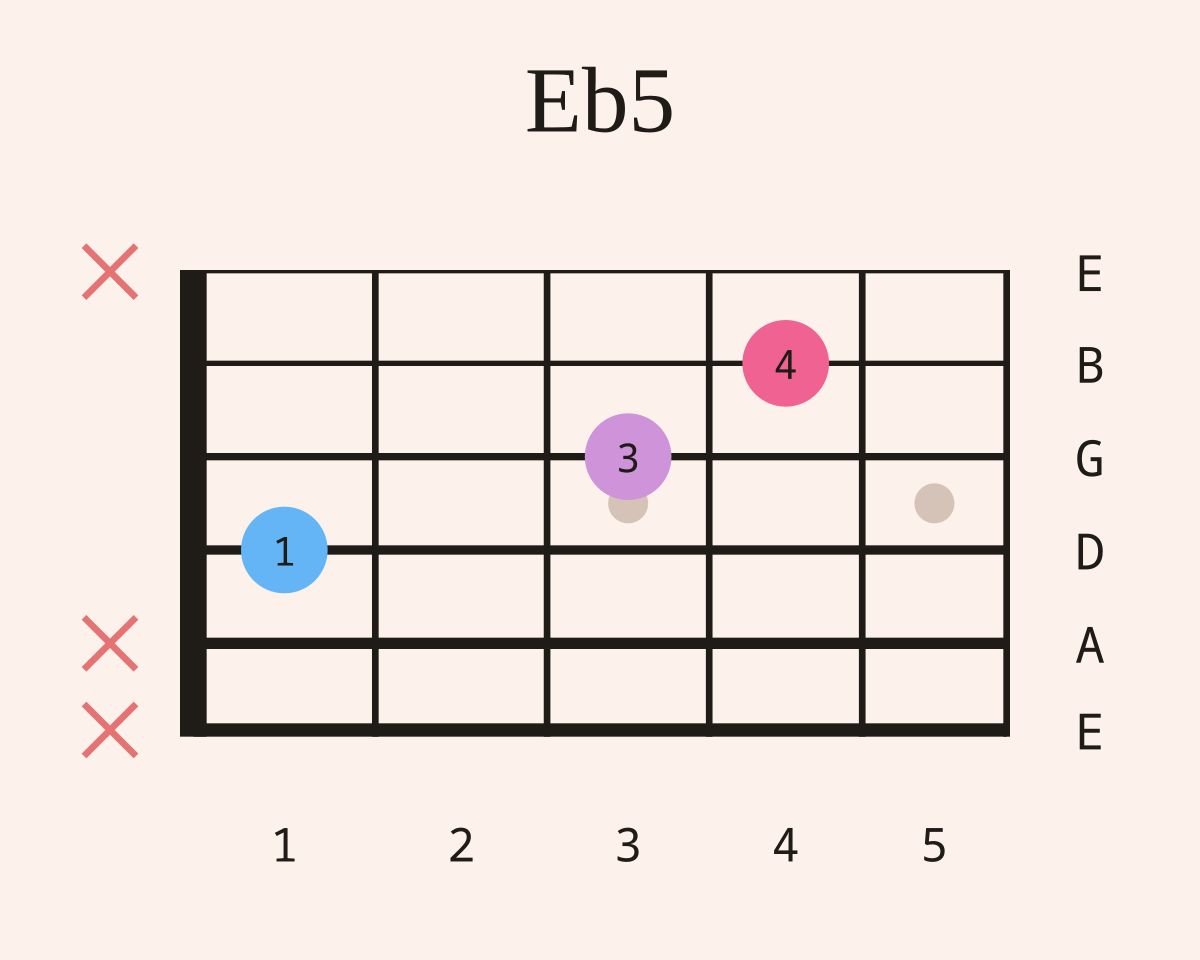
The Eb5 chord can be played in several positions, each offering a different mechanical advantage. Shifting between these positions improves your fretboard navigation and economy of motion.
| Position Name | Fret Location (Root) | String Set | Best Use Case |
|---|---|---|---|
| Low-Position | 11th Fret | E (6th) String | Heavy, thick riffs with maximum low-end. |
| Mid-Position | 6th Fret | A (5th) String | Fast transitions and melodic integration. |
| Octave-Position | 1st Fret | D (4th) String | Lead fills and higher-register rhythm work. |
| Drop Tuning | 1st Fret | Low D (6th) | Only in Drop Db/C# tuning for one-finger power chords. |
By mastering the Eb5 in all three primary locations, you shift from being a "positional" player to a "horizontal" player. For example, using the Eb5 at the 6th fret of the A string allows you to easily reach the Ab5 and Bb5 chords, which are the IV and V chords in the key of Eb. This geometric understanding of the Eb5 chord makes your playing more efficient and less reliant on looking at your hands.
6. Leveraging "Neutral" Harmony for Creativity
Because a "5" chord (power chord) does not contain a major or minor third, it is harmonically ambiguous. This ambiguity is a secret weapon for modern guitarists. When you play an Eb5 chord, you are not committing to a specific mood. You can overlay Eb major scales, Eb minor scales, or even more "outside" scales like the Half-Whole Diminished.
This shifts your playing by demanding more from your melodic ear. If the rhythm guitar is holding an Eb5 drone, the lead guitarist has the freedom to shift the "flavor" of the song on the fly. In your own practice, using a looper to play a steady Eb5 rhythm and then soloing over it with different scales will rapidly improve your ability to hear modal changes. It teaches you that the Eb5 is a canvas rather than a finished painting.
7. Adaptation to Modern Extended Range and Baritone Guitars
In the 2026 gear landscape, many players are moving toward 7-string and baritone guitars. On these instruments, the Eb5 chord takes on a new life. On a 7-string guitar tuned to B standard, the Eb5 is found further up the neck, providing a mid-range punch that cuts through a mix without getting lost in the "mud" of the low B string.
Furthermore, for those using digital pitch-shifting technology (like the DigiTech Whammy or modern neural plugins), the Eb5 is often the target for "virtual" down-tuning. Understanding the fingering and theory of the Eb5 allows you to use these technologies more effectively. You learn where the "sweet spots" are for tracking and latency, shifting your technical approach to accommodate the digital processing of your signal.
Common Pitfalls to Avoid
When shifting your playing toward the Eb5 chord, avoid these common mistakes:
- Intonation Issues: Because Eb5 often involves tuning down or playing on the lower frets of the A string, ensure your guitar's intonation is set correctly. A slightly sharp Bb will make the chord sound sour.
- Over-reliance on One Shape: Don't just play the Eb5 on the 6th fret of the A string. Practice the 11th fret of the E string to understand how the lower frequency response affects your amp settings.
- Neglecting the Third: While the power chord is powerful, remember that eventually, you may need to add the major or minor third to fully define the key. Use the Eb5 as a tool, not a crutch.
FAQ
What notes are in an Eb5 chord? The Eb5 chord consists of two notes: E-flat (the root) and B-flat (the perfect fifth). In a standard guitar voicing, these notes are often doubled to create a fuller sound, such as Eb-Bb-Eb.
Is Eb5 the same as D#5? Harmonically, yes. Eb and D# are enharmonic equivalents, meaning they are the same pitch. However, in musical theory, the name depends on the key signature. In the key of Bb major, it is Eb; in the key of E major (as a passing chord), it might be referred to as D#.
Why does Eb5 sound "heavier" than E5? Scientifically, the lower the frequency, the "heavier" the perception of the sound. By dropping 100 cents (one semi-tone) from E to Eb, you are moving the fundamental frequency lower. Additionally, the decreased string tension allows the string to vibrate with a larger amplitude, creating more harmonic overtones when distorted.
Can I play Eb5 on an acoustic guitar? Absolutely. While power chords are most common on electric guitars, the Eb5 is frequently used in "Unplugged" sessions, especially by bands that tune down a half-step. It provides a resonant, open sound that works well for percussive acoustic playing.
How do I tune my guitar to play an open Eb5? To play an Eb5 using the "open E" shape, you must tune every string down one half-step: Eb-Ab-Db-Gb-Bb-Eb. Once tuned, playing a standard open E shape will result in an Eb major chord, and an E5 power chord shape will result in an Eb5.
Final Recommendation
To truly let the Eb5 chord shift your playing, begin by re-tuning one of your guitars to E-flat standard for a week. Force yourself to play your entire repertoire in this new tuning. You will notice that your fingers move differently, your ears become more sensitive to the "darker" flat keys, and your bends become more expressive due to the loosened tension. Whether you are chasing the bluesy soul of the 1970s or the mechanical precision of 2026’s progressive metal, the Eb5 chord is an essential bridge to a more sophisticated level of guitar mastery.
Image Gallery