2019 Ford GT Specs Overview: Performance, Engineering, and Aerodynamics
The 2019 Ford GT represents the pinnacle of American supercar engineering, pairing a carbon-fiber monocoque chassis with a mid-mounted 3.5-liter twin-turbocharged EcoBoost V6 engine that generates 647 horsepower, achieving a top speed...
The 2019 Ford GT represents the pinnacle of American supercar engineering, pairing a carbon-fiber monocoque chassis with a mid-mounted 3.5-liter twin-turbocharged EcoBoost V6 engine that generates 647 horsepower, achieving a top speed of 216 mph.
Contents
Introduction to the Second-Generation Ford GT
The second-generation Ford GT is a homologation-inspired masterpiece that translates endurance racing dominance into a road-legal package. When Ford revived the legendary GT nameplate, the objective was not merely to evoke nostalgia for the 1960s Le Mans-winning GT40s, but to showcase the absolute limit of the company's lightweight materials, powertrain development, and active aerodynamics. The 2019 model year sits firmly in the middle of this limited-run production lifecycle, carrying forward the brutal performance of the twin-turbo V6 while benefiting from continuous refinement in suspension dynamics and aerodynamic tuning.
Understanding this vehicle requires looking beyond standard specifications and examining how its race-derived architecture functions in practice. From its pushrod-actuated suspension to its dramatic flying buttresses, every component serves a specific aerodynamic or structural purpose. For collectors, automotive historians, and performance enthusiasts, analyzing the 2019 Ford GT specifications provides a clear window into modern hypercar engineering where computational fluid dynamics and lightweight composites intersect.
Powertrain and Engine Performance Architecture
At the heart of the 2019 Ford GT is a high-output 3.5-liter EcoBoost V6 engine, an architectural choice that initially surprised enthusiasts accustomed to the V8 layout of its predecessor. However, this powerplant shares a direct lineage with the engine used in the Ford GT Le Mans race cars, prioritizing high specific output, minimal turbo lag, and optimized thermal efficiency.
The engine produces 647 horsepower at 6,250 rpm and 550 lb-ft of torque at 5,900 rpm. Induction is managed by twin turbochargers operating alongside an advanced port and direct-injection fuel system. To combat turbo lag and maintain throttle response during aggressive cornering, Ford implemented an anti-lag system derived from racing applications. This system keeps the throttle open when the driver lifts off the accelerator, maintaining turbine speed and boost pressure so power is delivered instantly upon re-application of the throttle.
Power is routed to the rear wheels through a Getrag 7-speed dual-clutch automatic transmission. Controlled via steering-wheel-mounted paddle shifters, this gearbox executes lightning-fast gear changes designed to match the rapid power delivery of the EcoBoost V6.
Aerodynamics and Active Chassis Dynamics
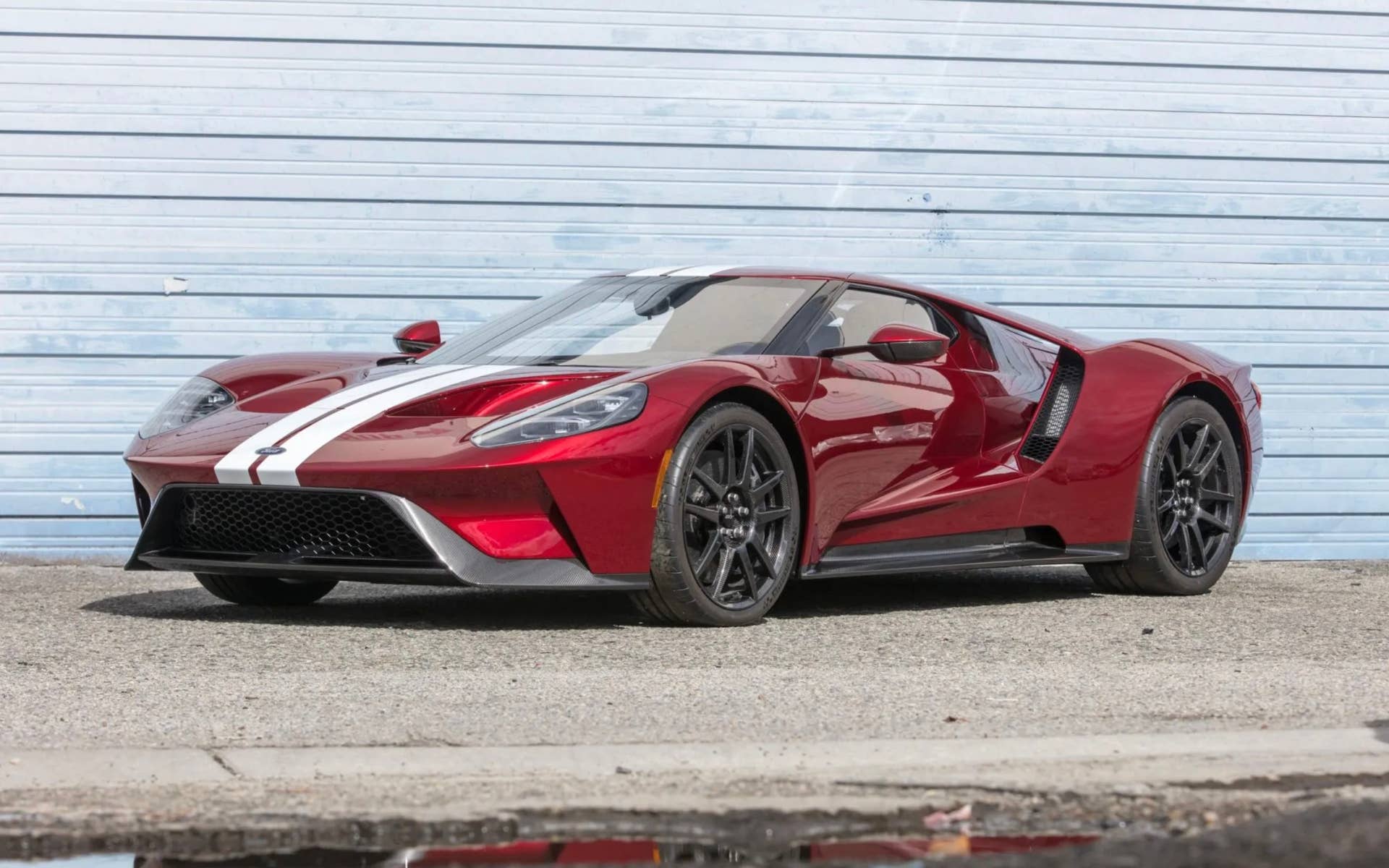
The defining visual and functional characteristic of the 2019 Ford GT is its aggressive aerodynamic profile. The bodywork is sculpted entirely from carbon fiber, featuring deep channels and aerodynamic tunnels that manage airflow over, under, and through the car to maximize downforce and minimize drag.
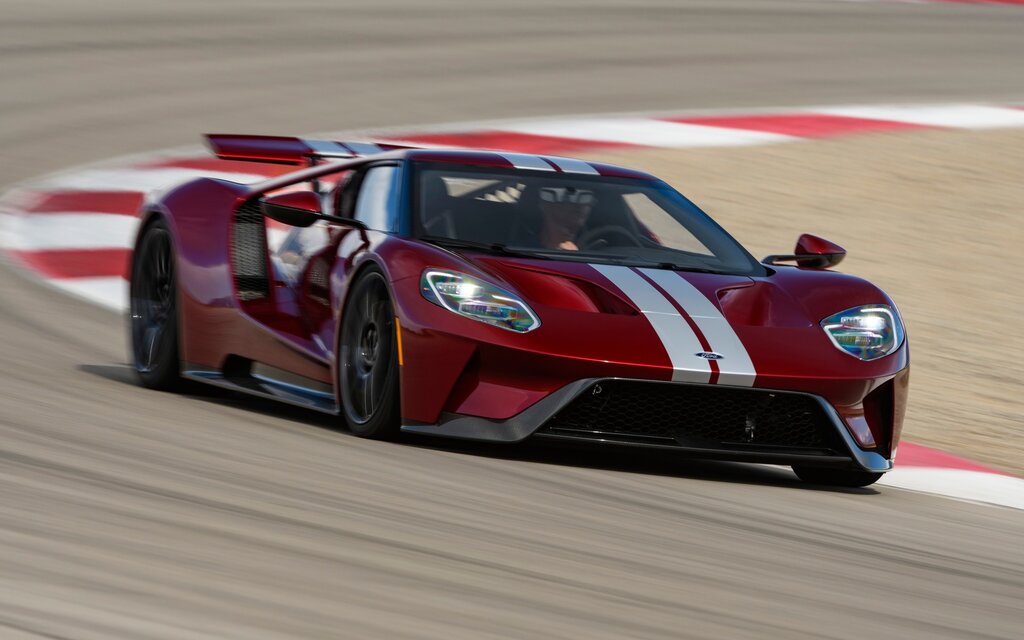
Central to this aerodynamic strategy is the active dynamic system, which alters the vehicle's ride height and aerodynamic configuration based on the selected drive mode. When transitioning from normal street driving to Track Mode, hydraulic actuators compress the suspension, lowering the ride height by nearly 50 millimeters. Simultaneously, the multi-position rear wing deploys and adjusts its angle of attack, and gurney flaps extend to create massive downforce for high-speed cornering stability.
| Parameter | Specification |
|---|---|
| Engine Type | 3.5L Twin-Turbocharged EcoBoost V6 |
| Horsepower | 647 hp @ 6,250 rpm |
| Torque | 550 lb-ft @ 5,900 rpm |
| Transmission | 7-Speed Dual-Clutch Automatic |
| Top Speed | 216 mph |
| 0-60 mph Acceleration | Approx. 3.0 seconds |
| Dry Weight | 3,054 lbs |
| Chassis | Carbon-Fiber Monocoque with Aluminum Subframes |
Suspension, Braking, and Handling Characteristics
To harness the substantial power output and aerodynamic forces, the 2019 Ford GT employs a competition-derived suspension layout. It utilizes an independent double-wishbone setup with pushrod-actuated torsion bars and dampening. This design separates the spring and damping functions from the wheel carriers, allowing for precise control over wheel movement and weight transfer. The system also features hydraulic ride-height adjustment, allowing the driver to raise the front axle slightly to clear speed bumps or steep driveways in street mode.
Stopping power is provided by Brembo carbon-ceramic matrix brakes paired with monoblock calipers. The front discs measure 15.5 inches, while the rear discs measure 14.1 inches, providing exceptional fade resistance under repeated heavy braking from triple-digit speeds. The car rides on lightweight carbon-fiber wheels wrapped in Michelin Pilot Sport Cup 2 tires, custom-developed specifically for the Ford GT chassis to maximize mechanical grip across varying track temperatures.
Interior Design, Ergonomics, and Driver Interface
The interior of the 2019 Ford GT is strictly driver-focused, stripping away conventional luxury amenities in favor of weight savings and functional ergonomics. Because the carbon-fiber tub is tightly proportioned, the driver's seat is fixed directly to the floor structure. Instead of adjusting the seat position, drivers adjust the steering column and pedal box to achieve their optimal driving position.
The steering wheel is a race-inspired, rectangular yoke wrapped in Alcantara, integrating essential controls such as turn signals, drive mode selectors, and digital display toggles. Instrumentation is delivered entirely through a customizable 10.1-inch digital instrument cluster that displays critical telemetry, gear selection, and engine metrics. Climate control and basic media functions are integrated cleanly into the central console, maintaining a minimalist cockpit aesthetic that prioritizes forward visibility and driver concentration.
Maintenance, Operational Considerations, and Ownership Realities
Operating a low-volume carbon-fiber supercar requires specialized care and adherence to strict maintenance schedules. The 2019 Ford GT demands climate-controlled storage to protect its exposed carbon-fiber bodywork and sophisticated composite structures from extreme environmental fluctuations.
Servicing the 3.5-liter EcoBoost engine and its dual-clutch transmission requires certified technicians equipped with proprietary diagnostic tools. Fluid changes, clutch calibrations, and aerodynamic system checks must be performed at authorized service centers. Furthermore, owners must account for the high consumable costs associated with track-focused supercars, including periodic replacement of the carbon-ceramic brake rotors, specialized Michelin tires, and high-performance synthetic engine lubricants.
Frequently Asked Questions
What is the top speed of the 2019 Ford GT?
The 2019 Ford GT has an officially verified top speed of 216 mph. This velocity is achieved in top-tier track configurations where active aerodynamics reduce drag coefficients while maintaining necessary high-speed rear downforce.
How much horsepower does the 2019 Ford GT produce?
The vehicle produces 647 horsepower at 6,250 rpm and 550 lb-ft of torque at 5,900 rpm from its 3.5-liter twin-turbocharged EcoBoost V6 engine, utilizing advanced turbo anti-lag technology for immediate throttle response.
Is the 2019 Ford GT street legal?
Yes, the 2019 Ford GT is fully street-legal in global markets where it was officially homologated, though its track-focused design features a very low ride height, minimalist interior, and a race-derived carbon-fiber tub.
What transmission does the 2019 Ford GT use?
It uses a 7-speed Getrag dual-clutch automatic transmission controlled via steering-wheel-mounted aluminum paddle shifters, offering near-instantaneous gear changes tailored for both street driving and circuit use.
Why did Ford choose a V6 instead of a V8 for this generation?
Ford selected the 3.5-liter EcoBoost V6 because its compact packaging allowed for a more aerodynamic rear body profile and lower center of gravity, while its high specific output mirrored the endurance racing powertrain used in the factory racing program.
Conclusion and Final Recommendations
The 2019 Ford GT stands as a remarkable engineering achievement, successfully bridging the gap between endurance racing prototypes and road-going supercars. For prospective buyers, collectors, and automotive enthusiasts evaluating its performance metrics, understanding its carbon-fiber construction, twin-turbo V6 power delivery, and active aerodynamic capabilities is essential. When evaluating or maintaining a vehicle of this caliber, always consult certified technicians and original manufacturer documentation to preserve its structural integrity, mechanical performance, and long-term collectible value.
Image Gallery