Why Online Competency-Based Degree Programs Matter for Busy Adults
Online competency-based degree programs provide a flexible, personalized pathway to higher education by allowing students to earn credit based on their existing knowledge and skills rather than the traditional requirement of logging sp...
Online competency-based degree programs provide a flexible, personalized pathway to higher education by allowing students to earn credit based on their existing knowledge and skills rather than the traditional requirement of logging specific hours in a classroom. For busy adults balancing professional and personal responsibilities, this model offers a path to faster, more cost-effective credential attainment.
Contents
The Shift from Seat Time to Demonstrated Mastery
Traditional academic models are built on the "Carnegie Unit" or "seat time" philosophy. In this framework, credit hours are calculated based on the number of hours a student spends in a lecture hall or performing course-related activities over a standard 15- or 16-week term. For a working professional with years of industry experience, this model often feels redundant; spending months reviewing concepts they already apply daily at work is a suboptimal use of time.
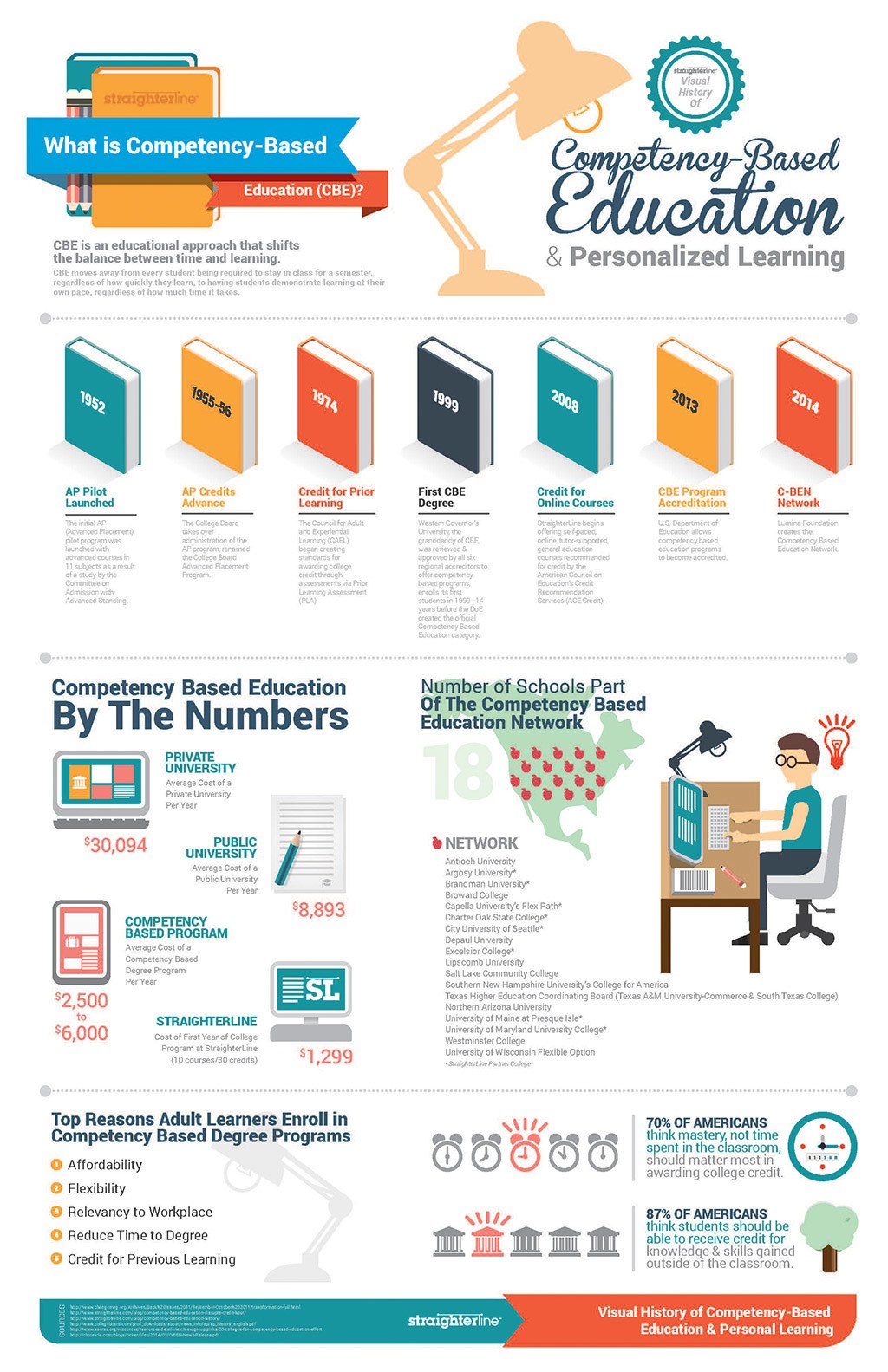
Competency-based education (CBE) upends this by prioritizing mastery over duration. In an online CBE program, the curriculum is organized into competencies—discrete skills or knowledge sets that a student must demonstrate. A student can move through these modules as quickly as their proficiency allows. If a learner already understands the core concepts of a subject, they can test out of that module immediately, focusing their efforts only on areas where they lack knowledge. This creates a bespoke educational trajectory that respects the learner’s existing professional expertise.
Why Flexibility Is the Primary Driver for Working Professionals
The primary obstacle for most adults returning to school is not intellectual capacity, but time scarcity. Between full-time employment, family obligations, and community commitments, the rigid synchronous schedules of traditional programs—where students must be online at specific times for live lectures—often lead to burnout or attrition.
Online competency-based programs typically utilize asynchronous delivery. Students access course materials, submit assessments, and engage with faculty on their own schedules. Whether a student has two hours available at 5:00 AM before the workday starts or prefers to tackle projects on Saturday mornings, the program remains accessible. This environment removes the artificial barriers of the academic calendar, allowing adults to integrate education into their lives rather than forcing their lives to conform to an academic schedule.
Cost-Efficiency and the "All-You-Can-Learn" Model
One of the most significant financial advantages of competency-based education is its potential for reduced tuition costs. Many institutions offering CBE programs utilize a subscription-based pricing model rather than a per-credit-hour fee.
In a subscription model, students pay a flat rate for a six-month term. During that time, they can complete as many competencies as they are capable of finishing. A highly motivated or experienced student who completes 30 credits in a single term pays significantly less than a student who takes the traditional two-term route to complete the same credits. This creates an inherent financial incentive to work efficiently, rewarding the student’s speed and mastery with a lower total cost for the degree.
Comparison of Degree Delivery Models
| Feature | Traditional Degree Model | Competency-Based Model |
|---|---|---|
| Primary Metric | Seat time (Credit Hours) | Demonstrated Proficiency |
| Pace | Fixed (Semester-based) | Self-paced (Variable) |
| Cost Structure | Per-credit or per-course | Subscription-based (Flat fee) |
| Progression | Lockstep with peers | Individualized mastery |
| Assessment | Midterms/Finals/Participation | Performance-based projects/exams |
The Role of Rigor and Accreditation
A common misconception is that competency-based programs are "easier" or less rigorous than traditional degrees. In reality, CBE often requires a higher level of critical thinking. Because students cannot "attend" their way to a passing grade through participation points or simple attendance, they must prove their competency through rigorous, performance-based assessments.
These assessments are typically developed in collaboration with industry experts to ensure that the skills being measured align with current labor market demands. Accreditation remains the gold standard for verifying the quality of these programs. Before enrolling, students should ensure the institution is accredited by an agency recognized by the U.S. Department of Education or the Council for Higher Education Accreditation (CHEA). An accredited competency-based degree carries the same legal and professional weight as a traditional degree, ensuring that the credential is recognized by employers and licensing bodies.
Prerequisites and Preparation
Successfully navigating a competency-based program requires a specific set of skills, primarily self-discipline and time management. Because there is no professor lecturing three times a week to keep the student on track, the burden of motivation rests entirely on the learner.
Before enrolling, potential students should:
- Self-Assess: Be honest about your current skill level. If you have been in a field for ten years, you are a prime candidate for accelerating through foundational coursework.
- Review Program Requirements: Understand how many "competencies" make up the degree and how they are assessed (e.g., proctored exams vs. long-form research papers).
- Verify Employer Support: Some employers offer tuition reimbursement. Check if your human resources department recognizes CBE programs for these benefits.
- Prepare the Workspace: Since the education is online, a reliable high-speed internet connection and a dedicated space for deep work are essential to minimize distractions.
Overcoming Common Challenges
While the benefits are clear, students should be prepared for the specific challenges of this model. The "loneliness" of independent learning can be a hurdle. Without the social reinforcement of a physical cohort, some students may struggle with isolation. Most institutions mitigate this by providing access to faculty mentors or student success coaches. These individuals do not "teach" in the traditional sense; rather, they facilitate the student’s progress, help troubleshoot technical or academic issues, and provide the accountability necessary to reach the finish line.
Another challenge is "assessment anxiety." In a system where you are graded solely on your ability to demonstrate mastery, there is no place to hide. If you fail an assessment, you must revise and resubmit until you reach the standard of proficiency required. This iteration process is a core component of professional learning, as it mirrors the real-world feedback loops found in high-performing workplaces.
Frequently Asked Questions
Are competency-based degrees respected by employers? Yes. Because these programs are accredited just like traditional universities, the degrees are viewed as equivalent. Many employers appreciate graduates from CBE programs because the curriculum is often mapped directly to industry-standard skills.
Can I transfer credits from a traditional college to a CBE program? In most cases, yes. Institutions will evaluate your previous transcripts to see which courses align with their competency requirements. However, once you enter a CBE program, your future progression will be based on your mastery of new material rather than credit hours.
How does financial aid work for these programs? Financial aid is typically calculated based on the "credit equivalency" of the competencies you complete. You should speak with a financial aid counselor at your chosen institution to determine how your specific program’s academic calendar affects your eligibility for federal grants or loans.
Is this format suitable for everyone? No. If you thrive on the social interaction, structured timelines, and direct lecture-based instruction of a traditional classroom, a competency-based program may feel isolating or overly demanding. It is most suitable for independent, goal-oriented, and busy adults.
Next Steps for Prospective Students
If you are a busy professional looking to advance your career without putting your life on hold, the next step is to conduct an audit of your own goals. Identify the specific skills needed for your desired promotion or career pivot, and then search for institutions that offer competency-based degrees in those specific disciplines. Contact the admissions departments of three potential schools to request a "transfer credit evaluation" or a "degree audit." This will give you a clear picture of how much of your prior experience will count toward the degree and exactly how much time you might save, providing a tangible roadmap for your educational future.
Image Gallery