Conversion SEO: Turning Visitors into Customers through Intent-Driven Optimization
Conversion SEO is the strategic integration of search engine optimization and conversion rate optimization (CRO) to ensure that high-ranking traffic actually performs a desired action. By aligning keyword intent with user experience an...
Conversion SEO is the strategic integration of search engine optimization and conversion rate optimization (CRO) to ensure that high-ranking traffic actually performs a desired action. By aligning keyword intent with user experience and persuasive content, businesses can transform passive searchers into active customers, maximizing the return on investment from organic search visibility.
Contents
While traditional SEO focuses heavily on visibility and traffic volume, the landscape in 2026 demands a more nuanced approach. Generating a million visitors is a vanity metric if none of those visitors subscribe, purchase, or inquire. Conversion SEO bridges the gap between "getting found" and "getting paid." It acknowledges that a user’s journey does not end with a click on a Search Engine Results Page (SERP); rather, that click is the beginning of a high-stakes interaction where the website must prove its value immediately.
The Fundamental Shift from Traffic to Revenue
Historically, SEO professionals were satisfied with ranking for high-volume keywords. However, as search algorithms have become more sophisticated—incorporating deep learning and user interaction signals—the distinction between a "good" search result and a "converting" search result has narrowed. Search engines now prioritize pages that satisfy user intent, which is a core component of conversion.
Conversion SEO involves analyzing the psychology of the searcher. When someone types a query into a search engine, they have a specific problem or need. If your page ranks for that query but fails to address the need or provide a clear path to a solution, the user will bounce. This high bounce rate signals to search engines that your content is not the best answer, eventually leading to a decline in rankings. Therefore, optimizing for conversions is inherently optimizing for long-term SEO health.
Aligning Keyword Intent with the Marketing Funnel
To turn visitors into customers, you must understand where they are in the buyer's journey. Not every searcher is ready to buy immediately, and forcing a hard sell on an informational seeker is a common mistake that kills conversions.
Top of the Funnel (TOFU): Informational Intent
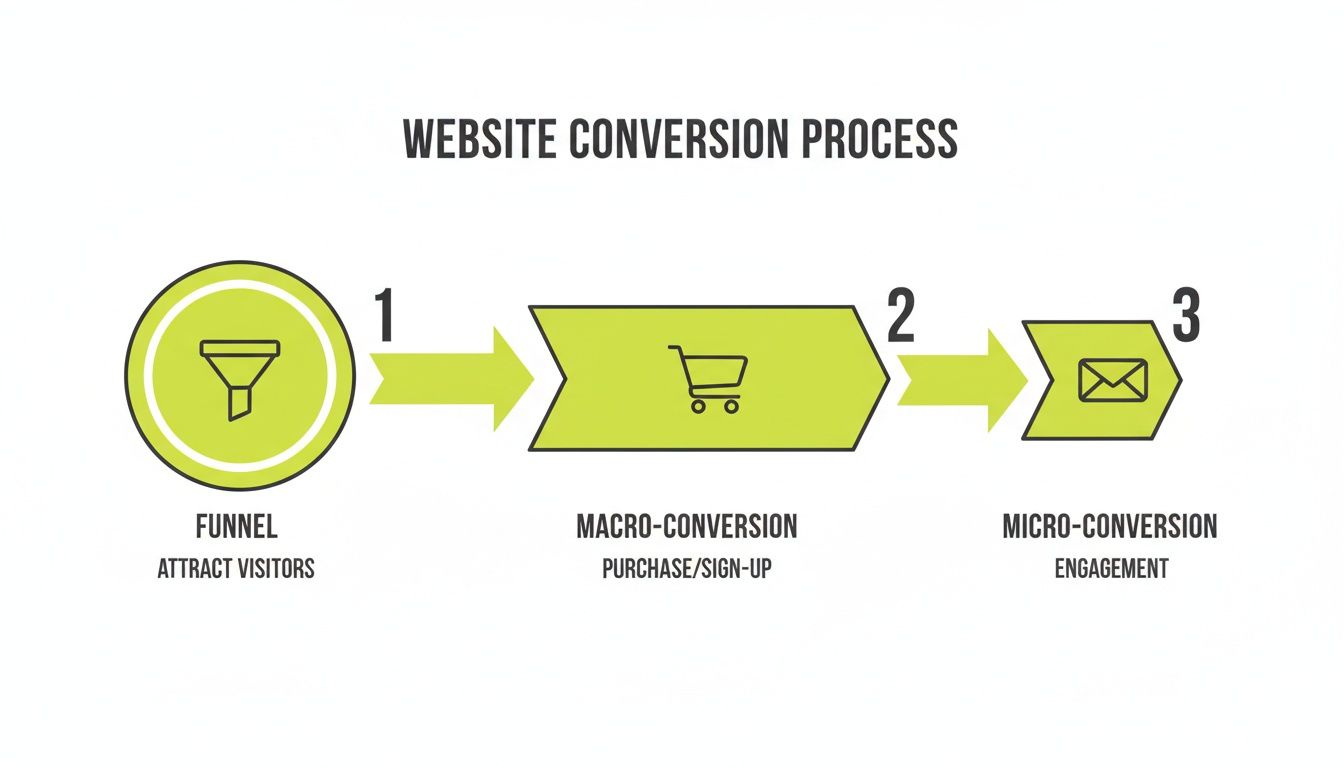
At this stage, users are looking for answers, guides, or troubleshooting tips. Keywords often include "how to," "what is," or "tips for." The goal of Conversion SEO here is not an immediate sale but a "micro-conversion," such as a newsletter signup or a whitepaper download. By providing immense value, you establish the brand as an authority, making the user more likely to return when they move toward a purchase decision.
Middle of the Funnel (MOFU): Commercial Investigation
Users are comparing options or looking for the best solution to their specific problem. Keywords include "best," "reviews," "top 10," or "comparison." Here, Conversion SEO requires detailed product comparisons, case studies, and transparent pricing. The goal is to move the user from "evaluating" to "deciding."
Bottom of the Funnel (BOFU): Transactional Intent
These are the "money keywords." Users search for "buy [product]," "[service] near me," or "discount code for [brand]." The landing page must be hyper-optimized for speed, trust, and ease of transaction. Any friction at this stage—such as a complex checkout process or lack of payment options—will result in a lost customer.
Technical Foundations of Conversion SEO
Technical SEO is often viewed as a backend task, but it has a direct impact on how users perceive a brand. In 2026, user experience (UX) signals are primary ranking factors. If a site is technically flawed, it cannot convert.
- Core Web Vitals and Interaction to Next Paint (INP): Speed is a prerequisite for conversion. Research consistently shows that every fractional second of delay in page load time leads to a measurable drop in conversion rates. High INP scores ensure that the site feels responsive to user inputs, such as clicking a "Add to Cart" button.
- Mobile-First Architecture: With the majority of global search traffic originating from mobile devices, a "responsive" site is no longer enough. The site must be "mobile-optimized," featuring thumb-friendly navigation, legible font sizes, and streamlined forms that are easy to fill out on a small screen.
- Secure Socket Layer (SSL) and Trust Protocols: Security is a major psychological barrier to conversion. Browsers now aggressively flag non-secure sites. Ensuring valid HTTPS and displaying recognized trust badges (like ISO certifications or industry-specific seals) reduces the perceived risk for the visitor.
On-Page Elements That Drive Actions
Once the technical foundation is set, the on-page content must do the heavy lifting of persuasion. Conversion SEO requires a departure from "writing for bots" toward "writing for humans while being indexed by bots."
Descriptive and Compelling Metadata
The title tag and
The Power of the H1 and Hero Section
The "above the fold" area is the most valuable real estate on your website. Within three seconds, a visitor should know what you offer, how it benefits them, and what to do next. A strong H1 should address the user's primary pain point identified during keyword research.
Strategically Placed Calls to Action (CTAs)
A common failure in SEO-focused content is burying the call to action at the very bottom of a 2,000-word article. Conversion SEO utilizes "anchor CTAs" or "sidebar CTAs" that remain visible or appear at logical transition points in the text. The language of the CTA should be action-oriented and benefit-driven, such as "Start Your Free Trial" rather than "Submit."
Comparison: Traditional SEO vs. Conversion SEO
The following table illustrates the key differences in focus between a standard SEO approach and an integrated Conversion SEO strategy.
| Feature | Traditional SEO Focus | Conversion SEO Focus |
|---|---|---|
| Primary Metric | Keyword Rankings & Traffic Volume | Conversion Rate & Customer Lifetime Value |
| Keyword Strategy | High Search Volume | High Purchase Intent & Relevance |
| Content Goal | Information & Keyword Density | Persuasion, Trust, & Action |
| User Experience | Crawlability & Indexing | Usability, Speed, & Friction Reduction |
| Landing Pages | Generic Category Pages | Intent-Matched Solution Pages |
| Success Indicator | Appearing on Page 1 | Generating a Lead or Sale |
| CTA Usage | Minimal or Secondary | Integrated & Optimized |
Building Trust through E-E-A-T
In 2026, Google’s emphasis on Experience, Expertise, Authoritativeness, and Trustworthiness (E-E-A-T) is central to both ranking and converting. Users are increasingly skeptical of AI-generated fluff and anonymous claims.
To turn a visitor into a customer, you must prove that you are a legitimate entity. This is achieved through:
- Author Bylines: Showing that content is written by a verifiable human expert with a history in the field.
- Social Proof: Integrating real-time reviews, testimonials, and "as seen in" media logos.
- Detailed About Us Pages: Humanizing the brand by showing the people and the mission behind the business.
- Citing Sources: Linking to authoritative studies or official documents to back up claims made in the copy. For instance, citing the Federal Trade Commission (FTC) regarding consumer protection or Google Search Central for technical standards.
Measuring Success Beyond the Rank
Tracking is the "intelligence" phase of Conversion SEO. Without data, you are merely guessing what turns visitors into customers.
- Heatmapping and Session Recordings: Tools that show where users click, how far they scroll, and where they get stuck. If users are clicking on a non-linked image, that is a friction point that needs to be addressed.
- A/B Testing: Systematically testing two versions of a headline, CTA button color, or page layout to see which yields a higher conversion rate.
- Form Analytics: Identifying which field in a contact form causes the most users to abandon the process. Often, removing one unnecessary field (like "Company Phone Number") can increase conversions significantly.
- Attribution Modeling: Understanding that a customer might find you via an informational SEO post, leave, and then return days later via a direct search to buy. Properly attributing that initial organic visit is crucial for calculating SEO ROI.
Common Pitfalls in Conversion SEO
Even with the best intentions, certain mistakes can sabotage the transition from visitor to customer. One major issue is "Keyword Over-Optimization," where the text becomes unreadable or feels robotic. This immediately destroys trust. Another is "Analysis Paralysis," where a page provides too many options or links, leading the user to click away rather than follow a specific path.
Furthermore, failing to update content is a significant risk. In 2026, searchers expect real-time accuracy. If a "Best of" list features products that are discontinued or pricing that is two years out of date, the brand's credibility is instantly lost.
FAQs
How long does it take to see results from Conversion SEO?
While traditional SEO can take 3 to 6 months to show ranking improvements, Conversion SEO improvements can often be seen much faster. If you already have existing traffic, changing a CTA or improving page speed can result in an immediate uptick in sales or leads, even before your rankings change.
Can Conversion SEO hurt my current rankings?
If done correctly, no. However, if you drastically remove large amounts of keyword-rich content in favor of a "minimalist" conversion design, you might lose some keyword footprints. The key is to optimize the existing content for readability and action without stripping away the topical relevance that search engines rely on.
Is Conversion SEO only for e-commerce sites?
Not at all. Conversion SEO is critical for B2B lead generation, SaaS signups, non-profit donations, and even ad-supported informational sites (where the "conversion" might be a click on a high-value internal link or a newsletter subscription). Any site with a goal can benefit.
Do I need a developer to implement Conversion SEO?
Some aspects, like improving Core Web Vitals or implementing advanced Schema markup, usually require a developer. However, many Conversion SEO tasks, such as rewriting copy, adding testimonials, and changing CTA placements, can be managed by content editors or marketers using modern Content Management Systems (CMS).
What is the relationship between SEO and CRO?
SEO gets the user to the door (the SERP), while CRO invites them inside and shows them where to buy. Conversion SEO is the strategy that ensures the door and the interior are perfectly aligned, so the visitor feels they are in the right place the moment they arrive.
Final Recommendation
For businesses looking to scale in 2026, the focus must shift from "more traffic" to "better traffic." Start by auditing your top 10 highest-traffic pages. Analyze the bounce rate and the specific intent of the keywords bringing people to those pages. If those pages aren't contributing to your business goals, implement the Conversion SEO principles of intent alignment, trust-building, and friction reduction. The goal is a seamless experience where the search engine’s promise (the snippet) matches the website’s delivery (the landing page).
Image Gallery