Workers Compensation Death Benefits for Children in Texas: Eligibility and Calculation Guide
In Texas, children of workers who suffer a fatal job-related injury or illness are entitled to workers' compensation death benefits to replace a portion of the deceased parent's lost income. These benefits generally equal 75% of the wo...
In Texas, children of workers who suffer a fatal job-related injury or illness are entitled to workers' compensation death benefits to replace a portion of the deceased parent's lost income. These benefits generally equal 75% of the worker’s average weekly wage, distributed among eligible beneficiaries, and typically continue until the child reaches age 18, or age 25 if enrolled full-time in an accredited educational institution.
Contents
The loss of a parent is an emotionally devastating event, and the financial uncertainty that follows can jeopardize a child's stability and future opportunities. The Texas workers' compensation system, overseen by the Texas Department of Insurance, Division of Workers' Compensation (TDI-DWC), provides a structured safety net designed to provide long-term financial support to minor children and certain adult children of deceased workers. Understanding the nuances of the Texas Labor Code is essential for ensuring that these dependents receive the full measure of support allowed under the law.
The Legal Framework for Death Benefits in Texas
Workers' compensation death benefits in Texas are governed primarily by Texas Labor Code Chapter 408, Subchapter G. This statute dictates who is eligible to receive benefits, how much they will receive, and the duration of those payments. Unlike a wrongful death lawsuit, workers' compensation is a "no-fault" system. This means that beneficiaries do not need to prove the employer was negligent to receive benefits; they only need to prove that the death occurred within the "course and scope" of employment.
As of 2026, the system continues to prioritize the financial protection of legal beneficiaries, which includes surviving spouses, minor children, and in some cases, grandchildren or other dependent family members. For children, these benefits act as a vital substitute for the financial support the deceased parent would have provided.
Eligibility Criteria for Children
Not every child related to a deceased worker automatically qualifies for benefits. The Texas Labor Code establishes specific categories of "eligible children" who have a legal claim to death benefits.
Minor Children
Any natural child, adopted child, or stepchild of the deceased worker who is under the age of 18 is automatically considered an eligible beneficiary. Dependency is generally presumed for minor children, meaning they do not have to prove they relied on the parent for financial support.
Full-Time Students
A child who is at least 18 years old but under the age of 25 may continue to receive benefits if they are enrolled as a full-time student in an accredited educational institution. This includes:
- High schools.
- Vocational or technical schools.
- Colleges and universities.
To maintain eligibility, the student must provide periodic proof of enrollment to the insurance carrier. If a child drops below full-time status or withdraws from school, benefits typically cease.
Children with Disabilities
A child who is over 18 and was dependent on the deceased worker at the time of death due to a physical or mental disability may be eligible for benefits. In these cases, the benefits may continue for as long as the disability persists and the child remains incapacitated. This provision ensures that adult children who cannot support themselves due to significant health challenges are not left without resources.
Grandchildren
Grandchildren may qualify for benefits only if their own parents are not alive at the time of the worker’s death and if the grandchild was at least 20% dependent on the deceased grandparent for financial support. This is a higher evidentiary bar than that required for direct children.
Calculating the Benefit Amount
The total death benefit is calculated based on the deceased worker’s Average Weekly Wage (AWW). The AWW is typically determined by taking the total wages earned by the employee during the 13 weeks immediately preceding the injury and dividing by 13.
The 75% Rule
Under Texas law, the total weekly death benefit is 75% of the deceased worker’s AWW. However, this amount is subject to state-mandated maximums and minimums.
Maximum and Minimum Benefit Caps
The TDI-DWC sets the maximum and minimum weekly benefit rates every year, based on the state average weekly wage.
- Maximum Benefit: The benefit cannot exceed 100% of the state average weekly wage.
- Minimum Benefit: The benefit cannot be less than 15% of the state average weekly wage.
For 2026, it is crucial to verify the specific rate effective from October 1st of the preceding year, as these caps change annually to reflect inflation and economic shifts in Texas.
Distribution of Benefits Between Beneficiaries
When a worker dies, the 75% AWW benefit is not necessarily paid in full to the children if there is a surviving spouse. The law requires a specific distribution of the funds.
Scenario 1: Surviving Spouse and Children
If there is a surviving spouse and one or more eligible children, the benefit is split equally. The spouse receives 50% of the total benefit, and the children share the remaining 50% equally among themselves.
Scenario 2: Children Only
If there is no surviving spouse, or if the spouse is disqualified (for example, if they remarried and opted for a lump-sum payout), the eligible children receive 100% of the death benefit, divided equally among them.
Scenario 3: Remarriage of a Spouse
If a surviving spouse remarries, they are entitled to a final lump-sum payment equal to 104 weeks of benefits. After this payment, the spouse’s share of the ongoing weekly benefits ends, and their portion is redistributed to the eligible children. This ensures the total benefit remains within the family as long as there are eligible dependents.
Benefit Distribution Summary Table
| Beneficiary Composition | Spouse’s Share | Children’s Combined Share | Notes |
|---|---|---|---|
| Spouse + 1 Child | 50% | 50% | Child receives half of the total weekly benefit. |
| Spouse + 3 Children | 50% | 50% | Each child receives 16.66% of the total benefit. |
| Children Only (No Spouse) | 0% | 100% | Total benefit divided equally among all eligible children. |
| Spouse Remarries | 104-week lump sum | 100% (After lump sum) | Children’s share increases to 100% after the spouse's transition period. |
The Application Process: Filing for Benefits
Securing death benefits is not an automatic process. Beneficiaries or their legal guardians must take proactive steps to notify the insurance carrier and the state.
1. Form DWC-042
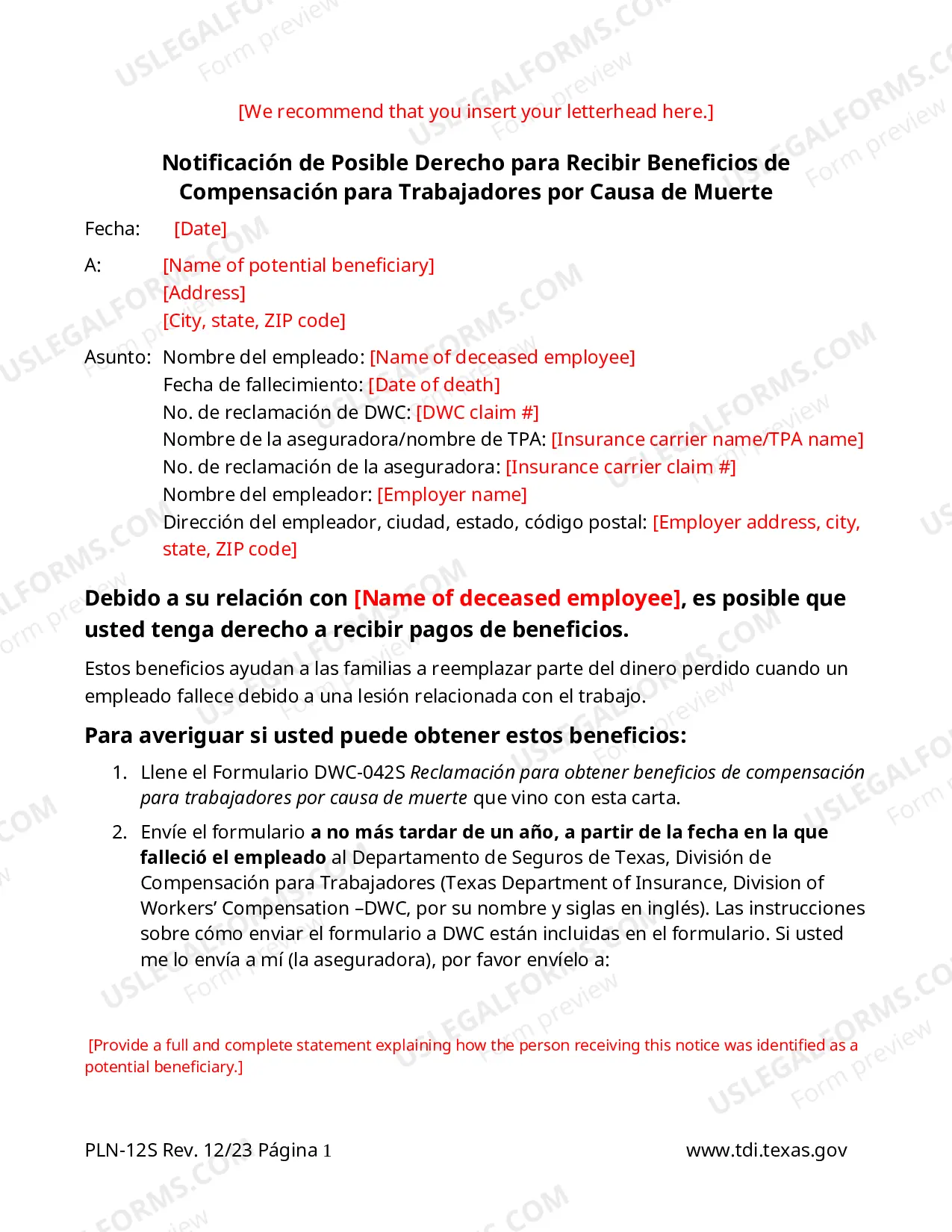
To claim benefits, the beneficiary or their representative must file DWC Form-042, Beneficiary Claim for Death Benefits. This form must be submitted to the TDI-DWC.
2. Statutory Deadlines
In most cases, the claim for death benefits must be filed within one year of the date of the worker's death. Failure to file within this timeframe can result in a permanent loss of benefits unless there is a legal justification for the delay (such as the beneficiary being a minor without a legal guardian).
3. Documentation Requirements
The insurance carrier will require several documents to verify eligibility, including:
- The worker’s death certificate.
- Marriage certificates (for spouses).
- Birth certificates for all children.
- Adoption records or proof of stepchild status.
- For students over 18, current enrollment verification from their school.
- Medical records for children claiming disability status.
Burial Benefits
In addition to weekly income replacement, the Texas workers' compensation system provides a burial benefit. This is a separate payment intended to cover funeral and interment expenses.
As of 2026, the insurance carrier is liable for the actual costs of burial, up to a maximum of $10,000. If the worker's family has already paid for the funeral, they can seek reimbursement from the insurance carrier by submitting receipts and proof of payment. If the expenses have not been paid, the carrier may pay the funeral home directly.
Common Challenges and Disputes
While the system is designed to be streamlined, disputes often arise between families and insurance carriers. Common points of contention include:
- Course and Scope: The insurance company may argue that the death was not work-related (e.g., a heart attack that they claim was due to pre-existing conditions rather than workplace stress).
- Dependency Disputes: In cases involving stepchildren or grandchildren, the carrier may challenge whether the child was truly dependent on the deceased.
- Wage Calculation: Disputes often occur over what should be included in the Average Weekly Wage, such as overtime, bonuses, or non-pecuniary advantages like a company car.
If a claim is denied or if there is a dispute over the amount, beneficiaries have the right to request a Benefit Review Conference (BRC) or a Contested Case Hearing through the TDI-DWC.
Duration of Benefits: When Do Payments Stop?
For children, death benefits are not permanent. They are designed to support the child until they reach self-sufficiency.
- At Age 18: Benefits stop on the child's 18th birthday unless they are a full-time student or disabled.
- At Age 25: For full-time students, benefits stop on their 25th birthday or when they cease to be a full-time student, whichever comes first.
- Marriage: If a child marries before age 18 (or 25 if a student), their eligibility for benefits ends immediately.
- Death of the Beneficiary: If an eligible child passes away, their share of the benefits is redistributed to the remaining eligible beneficiaries (siblings or spouse).
Frequently Asked Questions
What happens if the deceased worker had children from a previous marriage?
Children from a previous marriage have the same legal standing as children from a current marriage. The 50% share allocated to children is divided equally among all eligible biological and adopted children, regardless of which household they reside in.
Can a child receive a lump-sum settlement instead of weekly payments?
In Texas, death benefits for children cannot be "cashed out" as a lump-sum settlement. The law requires these benefits to be paid weekly to ensure the long-term financial stability of the minor. The only exception is the remarriage of a surviving spouse, which allows the spouse—not the children—to receive a 104-week lump sum.
Does the child's guardian receive the money?
Yes. For children under 18, the payments are typically issued to the surviving parent or legal guardian "for the use and benefit" of the child. In some complex cases involving large sums or lack of a natural guardian, the DWC may require the appointment of a legal guardian of the estate or a trustee.
Are workers' compensation death benefits taxable?
Generally, workers' compensation benefits, including death benefits paid to children, are not subject to federal income tax. This allows the full amount of the calculated benefit to be used for the child's needs.
What if the employer didn't have workers' compensation insurance?
If the employer is a "non-subscriber" (does not carry workers' comp insurance), the family cannot claim benefits through the TDI-DWC system. Instead, they must file a wrongful death lawsuit against the employer. In such cases, they must prove the employer's negligence caused the death, but they are not subject to the benefit caps imposed by workers' compensation law.
Next Steps for Beneficiaries
If you are a guardian of a child who has lost a parent in a workplace accident, your first step is to ensure the employer has reported the death to the insurance carrier. You should then immediately file Form DWC-042 with the Texas Department of Insurance.
Because the rules regarding student status and redistribution of benefits can be complex, many families find it helpful to consult with a qualified workers' compensation attorney. Legal fees in these cases are strictly regulated by the state and are typically deducted from the benefit payments, meaning there are no out-of-pocket costs to the family to secure representation.
Image Gallery