Will Eli Manning Make the Pro Football Hall of Fame? Analyzing the Case for Induction in 2026
Eli Manning is widely projected to be inducted into the Pro Football Hall of Fame, having reached eligibility for the Class of 2025 and moving into the 2026 voting cycle. His candidacy rests on two Super Bowl MVPs, his role in ending t...
Eli Manning is widely projected to be inducted into the Pro Football Hall of Fame, having reached eligibility for the Class of 2025 and moving into the 2026 voting cycle. His candidacy rests on two Super Bowl MVPs, his role in ending the New England Patriots' undefeated season, and ranking in the top 10 of major passing categories at the time of his retirement.
Contents
The debate surrounding Eli Manning’s Hall of Fame (HOF) credentials is one of the most polarizing in modern American sports history. Unlike his brother Peyton, whose induction was a mathematical certainty, Eli Manning presents a unique challenge for the Pro Football Hall of Fame Selection Committee. As we look at the landscape in 2026, the discussion has transitioned from hypothetical projections to a rigorous evaluation of his career against the standards of the modern era.
To understand why Manning is likely to receive a gold jacket, one must look beyond the standard box scores and examine the specific historical impact he had on the National Football League, the durability he displayed over 16 seasons, and the "clutch" factor that defined his postseason legacy.
The Timeline of Eligibility and the Class of 2025 Precedent
Eli Manning retired following the 2019 NFL season. Under the Pro Football Hall of Fame's bylaws, a player must be retired for five full seasons before becoming eligible for induction. This placed Manning’s first year of eligibility in 2025.
By the time the 2026 selection process began, the football world had already spent a year dissecting every interception and every game-winning drive. In 2026, Manning remains a central figure in HOF discussions because he represents a "litmus test" for how the committee values postseason peak performance versus regular-season efficiency. The precedent for quarterbacks with multiple Super Bowl rings is exceptionally strong; historically, every retired quarterback with two or more Super Bowl victories as a starter has eventually been inducted, with the exception of Jim Plunkett.
The "Giant Slayer" Narrative: Super Bowls XLII and XLVI
The cornerstone of Eli Manning’s Hall of Fame case is his performance in the biggest moments. Manning did not just win two Super Bowls; he won them against the greatest dynasty of the 21st century—the New England Patriots coached by Bill Belichick and led by Tom Brady.
Super Bowl XLII and the 18-1 Season
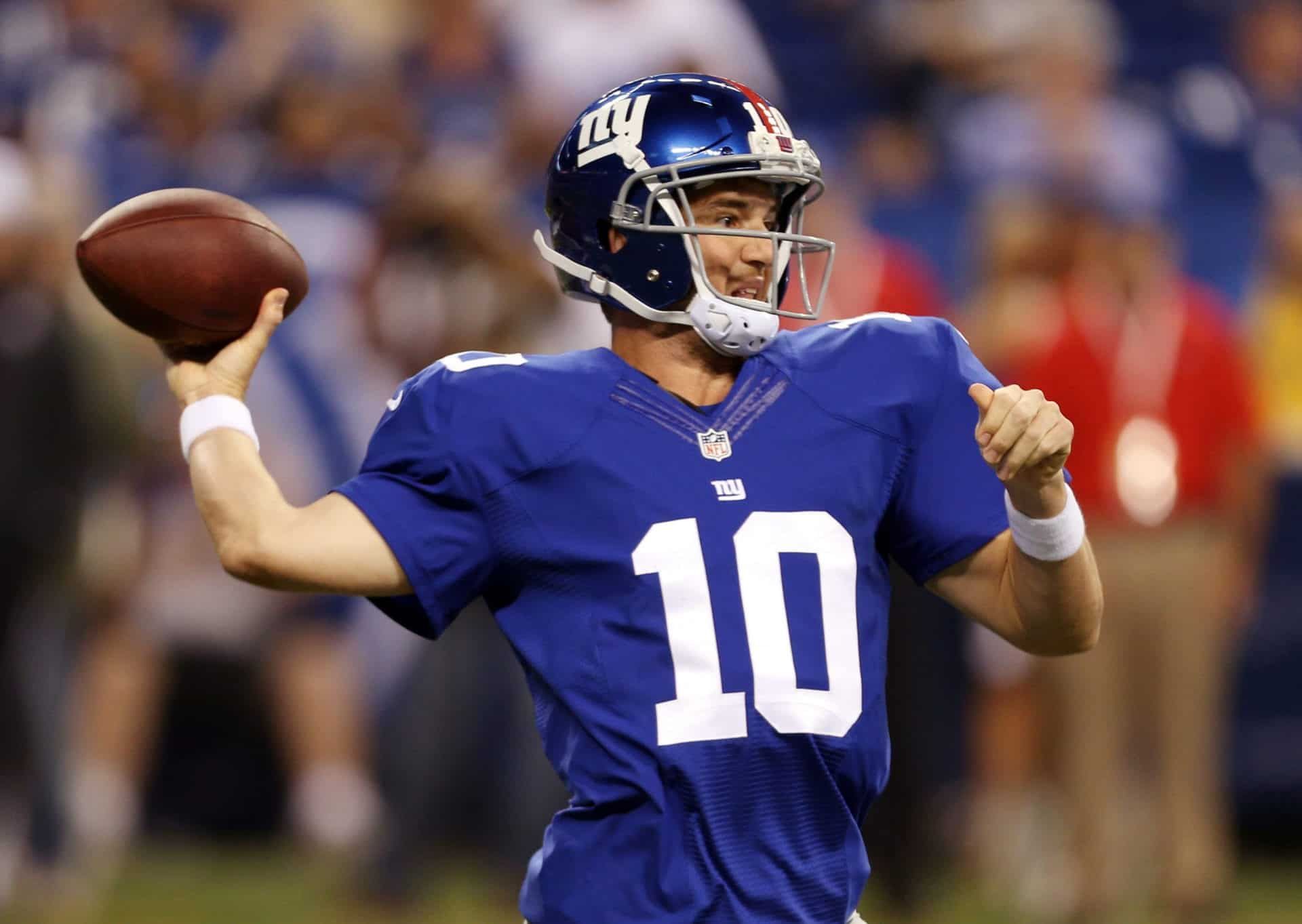
In the 2007-2008 season, the Patriots arrived at Super Bowl XLII with a perfect 18-0 record. Manning’s performance in the fourth quarter of that game is the stuff of legend. The "Helmet Catch" play, where Manning escaped a certain sack to find David Tyree, remains one of the most iconic sequences in NFL history. By leading the Giants to a 17-14 victory, Manning secured his first Super Bowl MVP and prevented the first perfect season since the 1972 Dolphins.
Super Bowl XLVI and Consistency in the Clutch
Four years later, Manning proved the first title was no fluke. During the 2011 season, Manning set an NFL record for the most fourth-quarter touchdown passes in a single season (15). In Super Bowl XLVI, he delivered a pinpoint 38-yard sideline pass to Mario Manningham that sparked the game-winning drive. Again, he was named Super Bowl MVP. Winning two Super Bowl MVPs puts Manning in an elite group that includes Joe Montana, Tom Brady, Terry Bradshaw, Bart Starr, and his brother Peyton.
Statistical Legacy and the "Volume" Argument
Critics of Manning’s candidacy often point to his efficiency metrics, but his career totals are difficult to ignore. When Manning retired, he was one of the most prolific passers in the history of the game.
- Passing Yardage: Manning finished his career with 57,023 passing yards. At the time of his retirement, this ranked him 7th all-time.
- Touchdown Passes: With 366 career touchdowns, he sat in the top 10 of that category as well.
- Iron Man Durability: One of Manning's most significant "stats" is his 210 consecutive starts. Between 2004 and 2017, he never missed a game due to injury. This reliability is a technical marvel in a high-impact sport and allowed him to accumulate the volume stats that bolster his HOF resume.
While his career completion percentage (60.3%) and passer rating (84.1) are lower than many of his contemporaries, Manning played in a cold-weather, outdoor stadium (MetLife Stadium) and often functioned in vertical passing offenses that prioritized high-risk, high-reward plays over short, efficient completions.
Comparing Eli Manning to Hall of Fame Peers
To determine if a player belongs in Canton, voters often use the "peer comparison" method. The following table compares Eli Manning to several modern-era Hall of Famers and eligible contemporaries.
| Player | Super Bowl Titles | SB MVPs | Career Passing Yards | Career TDs | Pro Bowls |
|---|---|---|---|---|---|
| Eli Manning | 2 | 2 | 57,023 | 366 | 4 |
| Peyton Manning | 2 | 1 | 71,940 | 539 | 14 |
| Ben Roethlisberger | 2 | 0 | 64,088 | 418 | 6 |
| John Elway | 2 | 1 | 51,475 | 300 | 9 |
| Jim Kelly | 0 | 0 | 35,467 | 237 | 5 |
| Troy Aikman | 3 | 1 | 32,942 | 165 | 6 |
As the table illustrates, Manning exceeds several existing Hall of Famers (like Kelly and Aikman) in pure volume stats, though he trails his brother and Roethlisberger in efficiency and Pro Bowl nods. The two Super Bowl MVPs serve as the ultimate "tiebreaker" in this comparison.
The Counter-Argument: The .500 Record and Interceptions
No Hall of Fame discussion is complete without addressing the weaknesses in a candidate's profile. For Eli Manning, there are two primary hurdles:
Regular Season Win-Loss Record
Manning finished his career with a regular-season record of 117-117. Critics argue that a Hall of Fame quarterback should be a "winner" in the regular season, not just a .500 player. However, proponents argue that win-loss records are a team statistic and that Manning’s ability to elevate the Giants during the postseason (where he went 8-4) is a better indicator of his individual greatness.
Interceptions and Lack of Peak Dominance
Manning led the league in interceptions three times (2007, 2010, and 2013). He was never named a First-Team or Second-Team All-Pro, meaning he was never considered one of the two best quarterbacks in the league during any single season. In an era dominated by Tom Brady, Peyton Manning, Drew Brees, and Aaron Rodgers, Eli was often viewed as a "second-tier" star.
The "New York" Factor and Character
The Pro Football Hall of Fame selection process is not purely mathematical. Voters consider leadership, character, and the "story of the game." Eli Manning spent his entire 16-year career with the New York Giants, one of the league's flagship franchises. Navigating the intense New York media market for nearly two decades without a single off-field scandal or locker-room issue is a feat in itself.
Furthermore, Manning was the co-winner of the Walter Payton NFL Man of the Year award in 2016. This award recognizes a player's excellence on and off the field, and while it isn't a primary voting criterion for Canton, it reinforces the "exemplary character" that many HOF voters value when looking at a candidate's total impact on the league.
Why the "Clutch" Factor Wins Out
Ultimately, the Pro Football Hall of Fame exists to tell the story of the NFL. It is impossible to tell the story of the NFL in the 21st century without Eli Manning. His role as the only quarterback to beat the peak-era Tom Brady/Bill Belichick Patriots twice in the Super Bowl is a historical achievement that carries immense weight.
In the eyes of many voters, the Hall of Fame is for players who reached the highest possible "peak." Manning’s peak occurred on the world’s biggest stage. While he may not have been the most consistent quarterback in October or November, his ability to execute under pressure in February is nearly unmatched in the history of the sport.
Frequently Asked Questions
Is Eli Manning a first-ballot Hall of Famer?
While Manning is a strong candidate, the "first-ballot" designation is usually reserved for players who were undisputed best-in-league at their position (like Peyton Manning or Tom Brady). Eli's .500 record and high interception totals led some voters to hesitate in 2025, but his eventual induction is considered a near-certainty by most NFL analysts.
How does Eli Manning's Hall of Fame case compare to Philip Rivers or Ben Roethlisberger?
Ben Roethlisberger is generally considered to have a stronger case due to a better win-loss record and higher volume stats. Philip Rivers has better efficiency stats and more Pro Bowls but lacks the Super Bowl rings and iconic postseason moments that define Eli Manning’s career. In the HOF hierarchy, Manning’s rings typically put him ahead of Rivers in the eyes of the committee.
Did Eli Manning's career interceptions hurt his chances?
Yes, they are the primary point of contention. Manning threw 244 interceptions in his career. However, the committee often balances high turnover rates against a player's "clutch" ability and longevity. Brett Favre, for example, is the all-time leader in interceptions but was a first-ballot inductee because of his overall impact and greatness.
What is the most important factor in Eli Manning's HOF bid?
The two Super Bowl MVPs. Only five other players in NFL history have won that award twice. Every single one of them who is eligible is in the Hall of Fame. This "club" is perhaps the most exclusive in football and is the strongest indicator of a player's HOF worthiness.
How do voters decide who gets into the Hall of Fame?
The selection is made by a 50-person committee consisting mostly of media members from every NFL city. To be elected, a finalist must receive at least 80% of the vote from the committee during their annual meeting.
Final Recommendation for Fans and Collectors
If you are a collector of sports memorabilia or a historian of the game, treating Eli Manning as a future Hall of Famer is the safest bet. His induction is not a matter of "if," but "when." As the 2026 cycle progresses, his legacy continues to age well, as modern passing offenses make his durability and postseason achievements seem even more rare. For those following the process, expect the announcement of his induction to be a defining moment for the New York Giants franchise and a validation of "clutch" performance over regular-season statistics.
Image Gallery