Carolina Marín Badminton Profile: Career, Playing Style, Titles, and Technical Breakdown
Carolina Marín is a legendary Spanish badminton player widely recognized as one of the greatest women's singles competitors in history. As an Olympic champion, three-time World Champion, and seven-time European Champion, her left-hande...
Carolina Marín is a legendary Spanish badminton player widely recognized as one of the greatest women's singles competitors in history. As an Olympic champion, three-time World Champion, and seven-time European Champion, her left-handed aggressive attacking style, psychological tenacity, and unprecedented European dominance revolutionized a sport historically dominated by Asian athletes.
Contents
Athlete Overview and Core Profile
Carolina María Marín Martín was born on June 15, 1993, in Huelva, Spain. Standing 1.72 meters (5 feet 8 inches) tall, the left-handed singles specialist fundamentally altered the physical and tactical standards of women's badminton. Before entering badminton full-time, Marín trained in traditional flamenco dancing, a background often credited with developing her exceptional footwork, ankle mobility, and rhythmic kinetic balance on the court.
| Specification / Attribute | Profile Detail |
|---|---|
| Full Name | Carolina María Marín Martín |
| Date of Birth | June 15, 1993 |
| Place of Birth | Huelva, Andalusia, Spain |
| Height | 1.72 m (5 ft 8 in) |
| Plays | Left-handed (Singles) |
| Highest World Ranking | No. 1 (First achieved June 2015) |
| Head Coach | Fernando Rivas |
| Primary Equipment Partner | Yonex |
| Olympic Games High Mark | Gold Medal (Rio 2016) |
| World Championship Titles | 3 Gold (2014, 2015, 2018), 1 Silver (2023) |
| European Championships | 7 Gold Titles (2014, 2016, 2017, 2018, 2021, 2022, 2024) |
Marín left her hometown at age 14 to join the Joaquín Blume National Sports Center in Madrid. Under the direction of head coach Fernando Rivas, she underwent a structured, data-driven developmental regimen designed to build an elite European athlete capable of dismantling the entrenched training paradigms of East Asian powerhouses such as China, Japan, and South Korea.
Tactical Breakdown and Playing Style Analysis
Carolina Marín's tactical blueprint introduced a hyper-aggressive, high-tempo template to women's singles. Historically, women's singles relied heavily on patient baseline rallies, fluid drop shots, and counter-pushing tactics designed to induce unforced errors. Marín disrupted this meta by adopting men's singles mechanics: aggressive front-court interception, steep jump smashes, and immediate pressure off the return of serve.
Tactical Phase Sequence:
- Aggressive Low Serve / Deep Lift
- Pushes Opponent to Rear Court Corners
- Steep Left-Handed Cross-Court Smash or Half-Smash Interception
- Rapid Net Rush to Seal Point via Tight Kill/Spinning Net Shot
1. Left-Handed Angles and Biomechanics
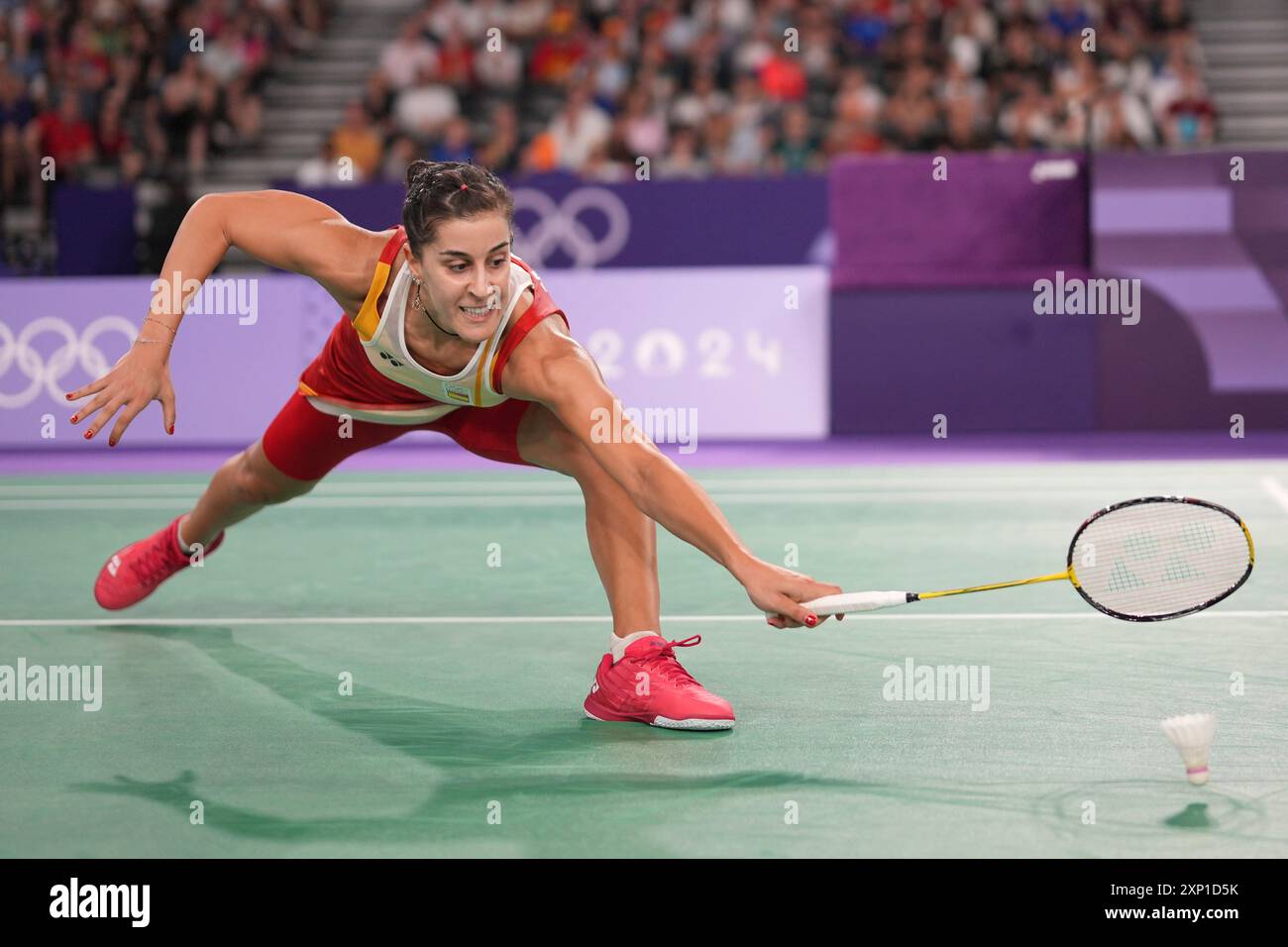
Being left-handed provides Marín with distinct natural tactical advantages. Her cross-court forehand smash cuts across the court at acute angles that right-handed opponents rarely encounter with such velocity. She utilizes a fast wrist snap at the point of impact, producing a steep downward shuttle trajectory. Her stroke biomechanics allow her to disguise overhead clears, reverse slice drop shots, and full-power smashes with identical preparation motions, shortening her opponent’s reaction time.
2. High-Pace Court Coverage and Footwork
Marín’s footwork relies on an explosive split-step combined with rapid recovery back to the base position. Her long stride pattern allows her to cover the rear corners in just two dynamic steps. When moving to the forecourt, she uses a low center of gravity to lunge deeply without overextending her recovery axis. This enables her to intercept shuttles above the net tape, putting immediate pressure on her opponent's net clearance.
3. Psychological Warfare and Intensity
Marín’s vocal court presence is a calculated dimension of her game strategy. Her characteristic post-point vocalizations serve two distinct functions: maintaining her own adrenaline and high heart rate, while imposing psychological pressure on her opponent. By shortening the rest interval between points and demanding prompt shuttle presentation from service judges, Marín dictates the rhythm of the match, forcing opponents to play at an uncomfortable, accelerated tempo.
Major Career Achievements and Championship Record
Marín’s record established her as the most successful European women’s singles player in badminton history. Her breakthrough came at the 2014 BWF World Championships in Copenhagen, where she defeated top seed Li Xuerui of China in a three-set final, ending years of Chinese dominance in the discipline.
Key World Championship Wins:
- 2014 Copenhagen: Defeated Li Xuerui (21–17, 17–21, 21–18)
- 2015 Jakarta: Defeated Saina Nehwal (21–16, 21–19)
- 2018 Nanjing: Defeated P.V. Sindhu (21–19, 21–10)
At the 2016 Rio Olympics, Marín captured the gold medal by defeating India's P.V. Sindhu (19–21, 21–12, 21–15). This victory marked the first time a non-Asian player won gold in Olympic women's singles since Denmark's Poul-Erik Høyer Larsen won the men's event in 1996, and the first ever by a European woman.
| Year | Tournament / Event | Category | Result | Final Opponent |
|---|---|---|---|---|
| 2014 | European Championships (Kazan) | Continental | Gold | Anna Thea Madsen |
| 2014 | BWF World Championships (Copenhagen) | World Championship | Gold | Li Xuerui |
| 2015 | All England Open (Birmingham) | Super 1000 | Winner | Saina Nehwal |
| 2015 | BWF World Championships (Jakarta) | World Championship | Gold | Saina Nehwal |
| 2016 | European Championships (La Roche-sur-Yon) | Continental | Gold | Kirsty Gilmour |
| 2016 | Olympic Games (Rio de Janeiro) | Olympics | Gold | P.V. Sindhu |
| 2017 | European Championships (Kolding) | Continental | Gold | Kirsty Gilmour |
| 2018 | European Championships (Huelva) | Continental | Gold | Evgeniya Kosetskaya |
| 2018 | BWF World Championships (Nanjing) | World Championship | Gold | P.V. Sindhu |
| 2019 | China Open (Changzhou) | Super 1000 | Winner | Tai Tzu-ying |
| 2021 | European Championships (Kyiv) | Continental | Gold | Line Christophersen |
| 2022 | European Championships (Madrid) | Continental | Gold | Kirsty Gilmour |
| 2023 | European Games (Kraków) | Continental | Gold | Mia Blichfeldt |
| 2023 | BWF World Championships (Copenhagen) | World Championship | Silver | An Se-young |
| 2024 | All England Open (Birmingham) | Super 1000 | Winner | Akane Yamaguchi |
| 2024 | European Championships (Saarbrücken) | Continental | Gold | Kirsty Gilmour |
Equipment Setup and Technical Racket Specifications
Carolina Marín works closely with Yonex to fine-tune gear capable of supporting her explosive playstyle. High-level singles play requires a precise balance between structural frame stiffness for power transmission and head-light maneuvering speed for quick net exchanges.
Racket Framework
Throughout the majority of her peak career, Marín played with the Yonex Duora Z-Strike and later transitioned to specialized models within the Yonex Nanoflare series (such as the Nanoflare 1000 Z).
- Balance: Even to slightly head-heavy setup to optimize punch-clears and steep steep-angle smashes without sacrificing drive response speed.
- Flex: Extra Stiff shaft rating. Stiff shafts require elite swing speeds to generate shuttle repulsion, but provide high directional stability during intense exchanges.
- Weight/Grip Size: 3U (85-89g) or 4U (80-84g) configurations with G5 grip sizing, wrapped with thin overgrips to preserve tactile feedback across the handle bevels.
String Setup and Tension
- String Choice: Yonex Aerobite or Yonex BG66 Ultimax. Aerobite uses a hybrid construction (thicker, textured vertical main string for control and spin; thinner horizontal cross string for repulsion power).
- Tension: Strung between 30 to 33 lbs (13.6 to 15.0 kg). Higher string tension decreases the sweet spot size but provides precise shuttle control and immediate shuttle release for players with elite striking mechanics.
Injury Resilience and Medical Comebacks
Marín’s career is defined as much by her physical resilience as her title count. Elite badminton subjects knees to extreme lateral decelerations, jump-landing impacts, and rapid changes of direction, which subjected Marín to severe structural injuries.
Timeline of Major Knee Injuries:
- Jan 2019: Right ACL Tear (Indonesian Masters Final)
- Returned Sept 2019 (Won China Open)
- May 2021: Left ACL + Meniscus Tear
- Missed Tokyo 2020 Olympics (Returned 2022)
- Aug 2024: Right ACL Tear (Paris Olympics Semi-Final)
- Surgical Repair & Rehabilitation
1. 2019 Right ACL Rupture
In January 2019, during the final of the Indonesia Masters against Saina Nehwal, Marín sustained an anterior cruciate ligament (ACL) tear in her right knee. Following reconstructive surgery, she underwent an intensive rehabilitation protocol led by her medical team and coach Fernando Rivas. Remarkably, she returned to competitive play eight months later, winning the 2019 China Open Super 1000 title by defeating Tai Tzu-ying.
2. 2021 Left ACL and Meniscus Tear
In May 2021, while preparing to defend her Olympic title at the postponed Tokyo 2020 Games, Marín tore the ACL and both menisci in her left knee during a training session. The injury forced her withdrawal from the Tokyo Olympics. Her subsequent recovery required over ten months of progressive biomechanical retraining before she re-entered the BWF circuit, winning her sixth European Championship in 2022.
3. 2024 Paris Olympics Injury
During the semi-finals of the 2024 Paris Olympic Games against China's He Bingjiao, Marín was leading 21-14, 10-8 when she suffered a severe knee collapse upon landing from a rear-court jump shot. Diagnostic imaging confirmed a third major career knee trauma (a right ACL rupture). Despite being forced to retire from the match, her sportsmanship and battle to return to top form earned global recognition across the sports community.
Scientific Training Methodology under Fernando Rivas
The partnership between Carolina Marín and coach Fernando Rivas is widely cited in sports science literature as a model for modern badminton development. Rather than relying solely on traditional high-volume court drills, Rivas introduced a tactical, analytical methodology to Spanish badminton:
- Tactical Video Analysis: Matches are coded to analyze opponents' shot selections under varying physical fatigue levels, allowing Marín to anticipate patterns three shots in advance.
- Periodized Physical Conditioning: High-intensity interval training (HIIT) combined with heavy resistance training targeted at posterior-chain strength (hamstrings, glutes, lower back) to shield joint structures during deep forecourt lunges.
- Cognitive Load Training: Shuttle drills incorporated visual reaction cues (light boards or trainer hand signals) to simulate decision-making under high heart-rate conditions.
Impact on European and Global Badminton
Before Marín’s emergence, European success in women's singles was rare, with Asian nations maintaining a dominance over Olympic and World Championship podiums for decades.
Marín proved that a non-Asian training environment, backed by sports science and tactical rigor, could systematically beat traditional powerhouse programs. Her success elevated Spanish badminton from an obscure sport into a nationally celebrated discipline, inspiring grassroots development programs across Southern Europe and breaking the long-held mental barrier that Asian teams were insurmountable in women's singles.
Frequently Asked Questions
What is Carolina Marín’s signature shot?
Marín’s signature shot is her left-handed steep cross-court smash executed from the rear-court forehand corner. She combines this with a deceptive punch-clear and an aggressive, low-margin net wipe that forces opponents to lift the shuttle defensively.
How many major world titles has Carolina Marín won?
Marín has won one Olympic Gold Medal (Rio 2016) and three BWF World Championship titles (2014, 2015, 2018). She also won one World Championship Silver Medal (2023) and seven European Singles Championships.
Why does Carolina Marín shout between points during matches?
Marín uses vocalizations as a psychological and physiological tool. It maintains her internal adrenaline, resets her focus, and exerts emotional pressure on her opponent by controlling the match's tempo and rhythm.
What racket string tension does Carolina Marín use?
Marín typically plays with high string tensions between 30 and 33 lbs (13.6 to 15.0 kg), using hybrid strings such as Yonex Aerobite or high-repulsion options like Yonex BG66 Ultimax for tight control and shuttle acceleration.
How did Carolina Marín recover from multiple ACL surgeries?
Her rehabilitation centered on data-driven physical therapy, eccentric muscle loading, gait re-education, and structured biomechanical training led by coach Fernando Rivas and her sports medical team, allowing her to repeatedly rebuild elite movement mechanics.
Strategic Recommendations for Players and Coaches
To adapt Carolina Marín's principles into your own training or coaching routine:
- Develop Explosive Net Interception: Work on split-step timing to cut off shuttles at the top of the net tape rather than waiting for them to drop, taking away your opponent's recovery time.
- Train Biomechanical Symmetry: Target posterior chain strength (deadlifts, single-leg lunges, hamstrings drills) to protect knee joints against lateral deceleration forces.
- Establish Match Tempo: Dictate the speed of play between points. Use focused pre-serve routines to control your breathing and prevent opponents from establishing their preferred rhythm.
Image Gallery