Choosing the Best Long Term Care Option for Your Budget and Health in 2026
The best long-term care option depends on aligning your specific health needs—measured by your ability to perform activities of daily living—with your financial profile. For most, this involves a combination of home-based care for earl...
The best long-term care option depends on aligning your specific health needs—measured by your ability to perform activities of daily living—with your financial profile. For most, this involves a combination of home-based care for early-stage needs and transition to assisted living or skilled nursing as medical requirements increase, funded through a mix of private insurance, personal savings, or Medicaid.
Contents
Long-term care (LTC) is no longer a one-size-fits-all solution involving a single facility. In 2026, the landscape of elder care has evolved to include sophisticated technology-enabled home care, hybrid insurance products, and specialized cognitive care units. Determining which path is right for you requires a cold-eyed assessment of your current physical trajectory and a detailed audit of your liquid and non-liquid assets.
Assessing Your Health Needs: The ADL Framework
Before looking at price tags, you must define the "level of care" required. In the medical and insurance industries, this is primarily determined by Activities of Daily Living (ADLs). These are the basic tasks required for self-care. Most long-term care insurance policies and government programs trigger benefits only when an individual cannot perform at least two of the following six ADLs:
- Bathing: The ability to clean oneself and perform grooming tasks.
- Continence: The ability to control bladder and bowel functions.
- Dressing: The ability to put on and take off clothes and necessary braces or artificial limbs.
- Eating: The ability to feed oneself, though not necessarily to prepare the food.
- Toileting: The ability to get on and off the toilet and perform associated personal hygiene.
- Transferring: The ability to move in and out of a bed, chair, or wheelchair.
If you are independent but require help with Instrumental Activities of Daily Living (IADLs)—such as meal preparation, laundry, and medication management—your "health need" is considered custodial, not skilled. In 2026, the distinction is vital because health insurance and Medicare generally do not cover custodial care, only skilled medical care provided by licensed professionals.
Budgeting for Care: The Three Financial Tiers
The "best" option is the one that prevents you from outliving your assets while maintaining a quality of life that meets your standards. As of 2026, costs have stabilized but remain a significant burden for the average household.
The Low-Asset/Income Tier: Medicaid Planning
If your assets are minimal (typically below $2,000 in countable assets for an individual, though limits vary by state), Medicaid is the primary payer for long-term care. However, Medicaid is restrictive. It often prioritizes nursing home placement over home care, although "Home and Community-Based Services" (HCBS) waivers have become more accessible. To qualify without being impoverished, many families engage in "spend-down" strategies or establish Medicaid Asset Protection Trusts at least five years before care is needed to satisfy the government's "look-back" period.
The Middle-Income Tier: The Hybrid Strategy
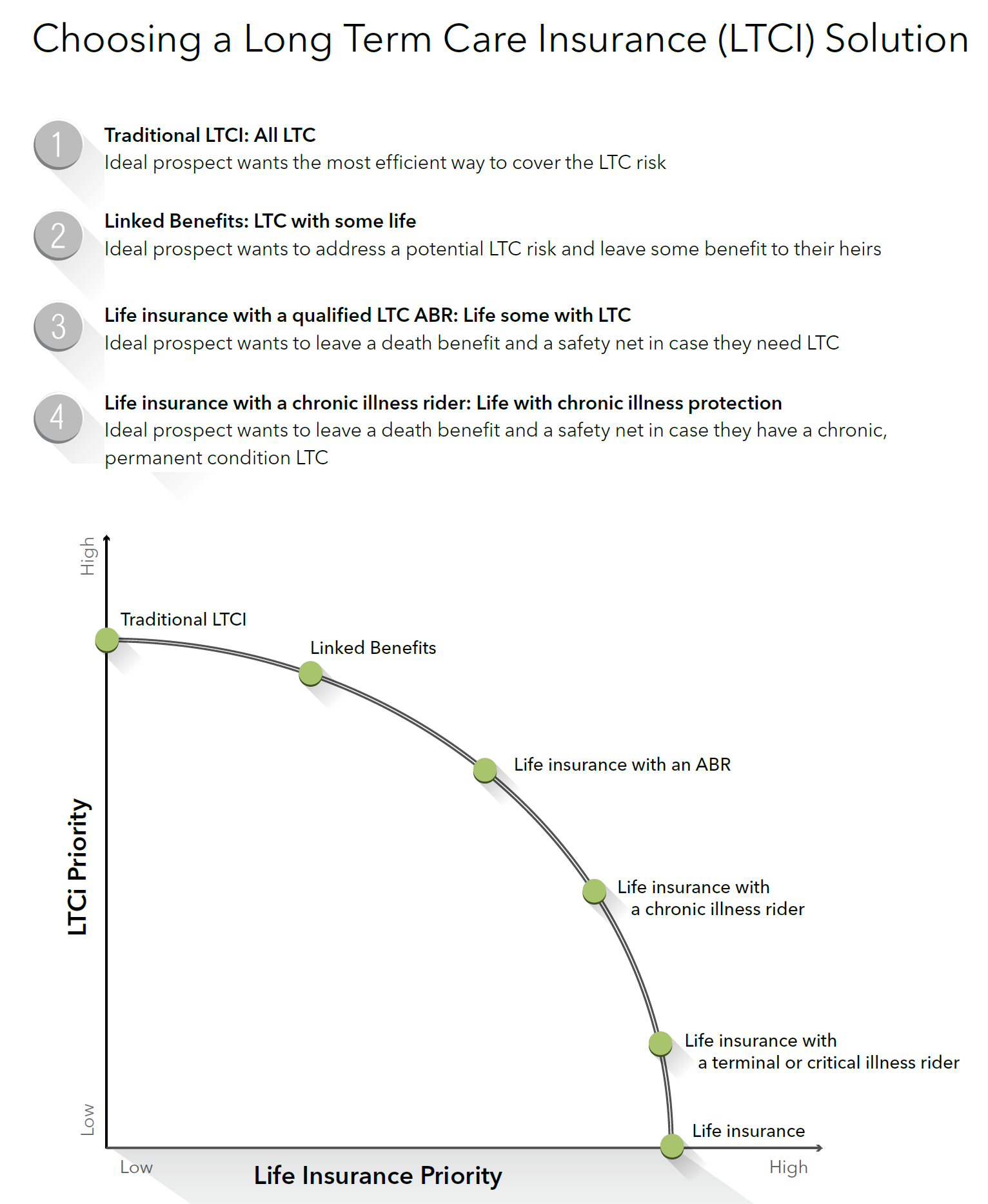
For those with moderate home equity and retirement savings, the best option is often a Hybrid Long-Term Care Policy. Unlike traditional LTC insurance, which follows a "use it or lose it" model, hybrid policies combine life insurance with a long-term care rider. If you need care, the policy pays out; if you don’t, your heirs receive a death benefit. This provides a hedge against the rising costs of assisted living, which in 2026 averages between $5,500 and $7,500 per month depending on the region.
The High-Net-Worth Tier: Self-Funding and CCRCs
If your portfolio generates enough passive income to cover $120,000 to $180,000 in annual care costs, self-funding offers the most autonomy. The premier choice for this group is often a Continuing Care Retirement Community (CCRC). These communities require a substantial entry fee but guarantee a "continuum of care," allowing you to move from independent living to assisted living to a skilled nursing facility within the same campus as your health declines.
Detailed Comparison of Long-Term Care Options
The following table outlines the estimated costs and suitability of various care models in 2026. Note that "Skilled" refers to medical necessity, while "Custodial" refers to assistance with daily tasks.
| Care Option | Primary Benefit | 2026 Estimated Monthly Cost | Best Suited For |
|---|---|---|---|
| Aging in Place (Home Care) | Maximum Independence | $5,800 - $6,900 (44 hrs/wk) | Early-stage physical help; cognitive health. |
| Adult Day Health Care | Socialization & Respite | $1,900 - $2,500 | Caregivers who work during the day. |
| Assisted Living Facility | Community & Safety | $5,500 - $8,200 | Those needing help with 1-2 ADLs but no 24/7 medical. |
| Memory Care Units | Specialized Safety | $7,500 - $10,500 | Individuals with Alzheimer’s or advanced dementia. |
| Skilled Nursing (Private) | 24/7 Medical Oversight | $10,200 - $12,500 | Chronic medical conditions or post-surgical rehab. |
Evaluating Specific Care Models
1. Aging in Place with Technology
In 2026, "Aging in Place" is the most popular choice because of technological integration. Remote patient monitoring (RPM) systems now allow family members and clinicians to track vitals and movement patterns without a live-in nurse.
- Pros: Maintaining the comfort of home and social ties.
- Cons: Can lead to social isolation if not managed; home modifications (ramps, walk-in tubs) can be an expensive upfront cost.
- Budget Tip: Look into the VA Aid and Attendance benefit if you are a veteran; it provides additional monthly income to pay for home-based care.
2. Assisted Living Facilities (ALFs)
ALFs are the middle ground. They offer private apartments with communal dining and social activities.
- Health Suitability: Ideal for those who can still walk or move via wheelchair but struggle with medication management or nutrition.
- Budget Tip: Many ALFs offer "tiered pricing." You pay a base rent and only add "care levels" as your health requires them, preventing you from paying for services you don't yet need.
3. Skilled Nursing Facilities (SNFs)
Often referred to as nursing homes, these provide the highest level of care.
- Health Suitability: Necessary for those with complex medical needs (e.g., wound care, ventilators, or total dependency for all ADLs).
- Budget Tip: If the stay is for rehabilitation after a minimum three-day hospital stay, Medicare may cover the first 20 days in full and a portion of days 21-100. Beyond that, it is private pay or Medicaid.
Strategic Timing: When to Transition?
The biggest mistake individuals make is waiting until a health crisis—like a fall or a stroke—to choose an option. This results in "crisis placement," where you are forced to accept whatever bed is available regardless of cost or quality.
The best long-term care strategy involves a Trigger-Based Plan:
- Level 1 (Independent): Stay home, install grab bars, and investigate long-term care insurance or hybrid policies by age 55.
- Level 2 (IADL Struggles): Hire part-time help for cleaning and shopping. Monitor the "look-back" period for Medicaid if assets are low.
- Level 3 (Two ADL Struggles): Move to Assisted Living or increase home health hours to a full-time schedule.
- Level 4 (Medical Fragility): Transition to Skilled Nursing or a Memory Care unit.
Common Mistakes to Avoid
- Relying on Medicare: This is the most pervasive financial error. Medicare is health insurance for acute care. It does not pay for the room and board of assisted living or long-term custodial care in a nursing home.
- Underestimating Inflation: In 2026, the cost of labor for health aides is rising faster than general inflation. Any financial plan must account for a 3-5% annual increase in care costs.
- Ignoring the Caregiver’s Health: If a spouse is the primary caregiver, their health often declines faster than the patient's. Choosing an option that provides "respite care" is essential for the long-term health of the entire family unit.
Frequently Asked Questions
Does Medicare cover long-term care in 2026?No, Medicare still does not cover "custodial care," which constitutes the majority of long-term care needs (help with eating, bathing, and dressing). It only covers skilled nursing for short-term rehabilitation following a qualified hospital stay. For more information on what is covered, visit the official Medicare site.
What is the "look-back" period for Medicaid?In most states, the Medicaid look-back period is five years (60 months). This means that when you apply for Medicaid to pay for long-term care, the government reviews all asset transfers from the previous five years. If you gave away money or property to meet the asset limits, you may face a "penalty period" of ineligibility.
Is long-term care insurance worth it if I'm already 70?At 70, premiums for traditional LTC insurance are often prohibitively expensive or you may be denied coverage based on health underwriting. In this scenario, a "Short-Term Care" policy or a "Single-Premium Hybrid Policy" might be more accessible, as they often have more relaxed underwriting standards than traditional policies.
How can I find the quality ratings of a nursing home?You should use the Care Compare tool provided by Medicare.gov. It provides a five-star rating system based on health inspections, staffing levels, and quality of care metrics. This is the gold standard for verifying the safety and performance of any facility.
What is the difference between Assisted Living and Memory Care?Assisted Living provides help with daily tasks in a social environment. Memory Care is a secured wing of a facility specifically designed for those with dementia. It features higher staffing ratios, specialized activities, and security measures to prevent "wandering," which is a common symptom of cognitive decline.
Practical Recommendation
To find the best option, start by downloading a "Home Safety Assessment" and an "ADL Worksheet." Evaluate your current health against these benchmarks. Next, consult with a Certified Senior Advisor (CSA) or a specialized elder law attorney. They can help you navigate the state-specific Medicaid rules for 2026 and determine if a hybrid insurance policy or a CCRC entry fee is the most tax-efficient use of your current savings. Planning now, while you are healthy, is the only way to ensure your budget dictates your care, rather than your care dictating your budget.
Image Gallery