What Is the Category That Contains the Most Stars?
The category that contains the most stars is the Red Dwarf, scientifically classified as M-type main-sequence stars. In our Milky Way galaxy, these small, cool, and dim stars account for approximately 70% to 75% of the total stellar po...
The category that contains the most stars is the Red Dwarf, scientifically classified as M-type main-sequence stars. In our Milky Way galaxy, these small, cool, and dim stars account for approximately 70% to 75% of the total stellar population. Their overwhelming prevalence is due to the physics of star formation, which favors low-mass objects, and their incredibly slow rate of nuclear fuel consumption.
Contents
Stellar classification is the process by which astronomers group stars based on their spectral characteristics. While the night sky is often dominated by brilliant blue giants and bright yellow stars like our Sun, these are statistical outliers. The vast majority of the "stellar census" belongs to the M-class. Understanding why this category is so populous requires an exploration of the Initial Mass Function (IMF), stellar lifespans, and the current state of astronomical surveys in 2026.
The Morgan-Keenan Spectral Classification System
To understand why M-type stars dominate, we must first look at the framework used to categorize them. The Morgan-Keenan (MK) system is the standard used by modern astronomers. It organizes stars primarily by their surface temperature, which is determined by their mass during the main-sequence phase of their lives.
The system uses the letters O, B, A, F, G, K, and M—a sequence often remembered by the mnemonic "Oh Be A Fine Girl/Guy, Kiss Me."
- O and B Stars: These are the hottest, largest, and rarest stars. They appear blue or blue-white and have very short lifespans.
- A and F Stars: These are medium-sized, white to yellow-white stars.
- G Stars: Our Sun is a G-type main-sequence star (a yellow dwarf). While we consider it "average," it is actually larger and brighter than about 90% of the stars in the galaxy.
- K Stars: Orange dwarfs, which are slightly cooler and smaller than the Sun.
- M Stars (Red Dwarfs): The smallest and coolest category of "true" stars. They appear reddish and are the most numerous.
The distribution of these stars is not uniform. If you were to take a random sample of a thousand stars in the Milky Way, you would find hundreds of M-class stars and perhaps only one or two O-class stars.
Why Red Dwarfs (M-Type) Are the Most Populous
The dominance of Red Dwarfs is a result of two primary factors: how stars are born (the Initial Mass Function) and how long they live (stellar evolution).
The Initial Mass Function (IMF)
The Initial Mass Function describes the initial distribution of masses for a population of stars. When a giant molecular cloud of gas and dust collapses to form stars, it does not produce stars of all sizes equally. Much like how a broken glass produces many tiny shards and only a few large pieces, the process of star formation is heavily biased toward low-mass objects.
Fragmenting gas clouds are more likely to create smaller pockets of high-density material that ignite as M-type stars than the massive, high-pressure environments required to create O or B-type stars. For every star born with the mass of 20 Suns, thousands are born with less than half the mass of our Sun.
Extreme Longevity
The second reason M-type stars are the most common is that they effectively never die—at least, not on the timescales the universe has existed so far. A star's lifespan is inversely proportional to its mass, but not in a linear way. Because Red Dwarfs have low mass, they have low internal pressure and temperature. Consequently, they fuse hydrogen into helium at an incredibly sluggish pace.
Furthermore, Red Dwarfs are fully convective. In stars like the Sun, helium builds up in the core, and eventually, the core runs out of hydrogen while the outer layers still have plenty. In a Red Dwarf, the entire star circulates its material. Hydrogen from the outer layers is constantly cycled into the core to be burned. This allows a Red Dwarf to use 100% of its hydrogen fuel.
As a result, an M-type star can live for trillions of years. Since the universe is only about 13.8 billion years old, every Red Dwarf ever born is still shining today. In contrast, massive O-type stars burn through their fuel in just a few million years and explode as supernovae. The M-class population is essentially an "accumulation" that keeps growing, while other classes "check out" of the galactic census.
Comparing Stellar Categories by Population and Characteristics
The following table outlines the estimated distribution and physical properties of the major stellar categories within the Milky Way galaxy.
| Spectral Type | Color | Surface Temp (K) | Mass (Solar Masses) | Population Share (%) | Est. Lifespan (Years) |
|---|---|---|---|---|---|
| O | Blue | > 30,000 | > 16 | ~0.00003% | 1–10 Million |
| B | Blue-White | 10,000–30,000 | 2.1–16 | 0.13% | 10–100 Million |
| A | White | 7,500–10,000 | 1.4–2.1 | 0.6% | 1 Billion |
| F | Yellow-White | 6,000–7,500 | 1.04–1.4 | 3% | 2–4 Billion |
| G | Yellow | 5,200–6,000 | 0.8–1.04 | 7.6% | 10 Billion |
| K | Orange | 3,700–5,200 | 0.45–0.8 | 12.1% | 15–30 Billion |
| M | Red | 2,400–3,700 | 0.08–0.45 | ~76.4% | Trillions |
Data based on standardized RECONS (Research Consortium On Nearby Stars) surveys and updated astrophysical models available in 2026.
The Visibility Paradox: Why We Don't See Them
Despite being the most numerous category, M-type stars are invisible to the naked eye. If you look up at the night sky, every single star you see is either a nearby G, K, or F-type star, or a very distant, highly luminous O or B-type giant.
This is known as the Visibility Paradox. Red Dwarfs have very low luminosity (the total amount of energy they emit). Some emit only 0.01% of the energy the Sun produces. Because they are so dim, their apparent magnitude (how bright they look from Earth) is very high, making them too faint for the human eye to detect without optical aid.
Even the closest star to our solar system, Proxima Centauri, is an M-type Red Dwarf. Despite being only 4.24 light-years away, it cannot be seen without a telescope. If our eyes were sensitive enough to see Red Dwarfs, the night sky would be crowded with thousands of reddish pinpricks of light that are currently hidden from view.
The Role of M-Type Stars in Exoplanet Research
In 2026, the study of M-type stars has become the primary frontier for astrobiology and the search for extraterrestrial life. There are several reasons why this category is the focus of missions like the James Webb Space Telescope (JWST) and the European Southern Observatory’s Extremely Large Telescope (ELT).
- Transits are easier to detect: Because Red Dwarfs are small, when a planet passes in front of them (a transit), it blocks a larger percentage of the star's light compared to a Sun-like star. This makes the signal much easier for our instruments to pick up.
- Abundance: Since Red Dwarfs are the most common stars, the statistical likelihood of finding a "Goldilocks" planet—one in the habitable zone where liquid water can exist—is highest around this category.
- Habitable Zone Proximity: Because these stars are cool, the habitable zone is very close to the star. Planets in this zone have short orbital periods (often just days or weeks), allowing astronomers to observe multiple transits in a short amount of time.
However, living around the most common type of star has its challenges. Red Dwarfs are known for being "active." They frequently produce massive stellar flares that could potentially strip the atmosphere off a nearby planet. Observations throughout the early 2020s and into 2026 have been dedicated to determining if planets around M-dwarfs, like those in the TRAPPIST-1 system, can actually retain atmospheres.
Evolutionary Endpoints: The Future of the M-Class
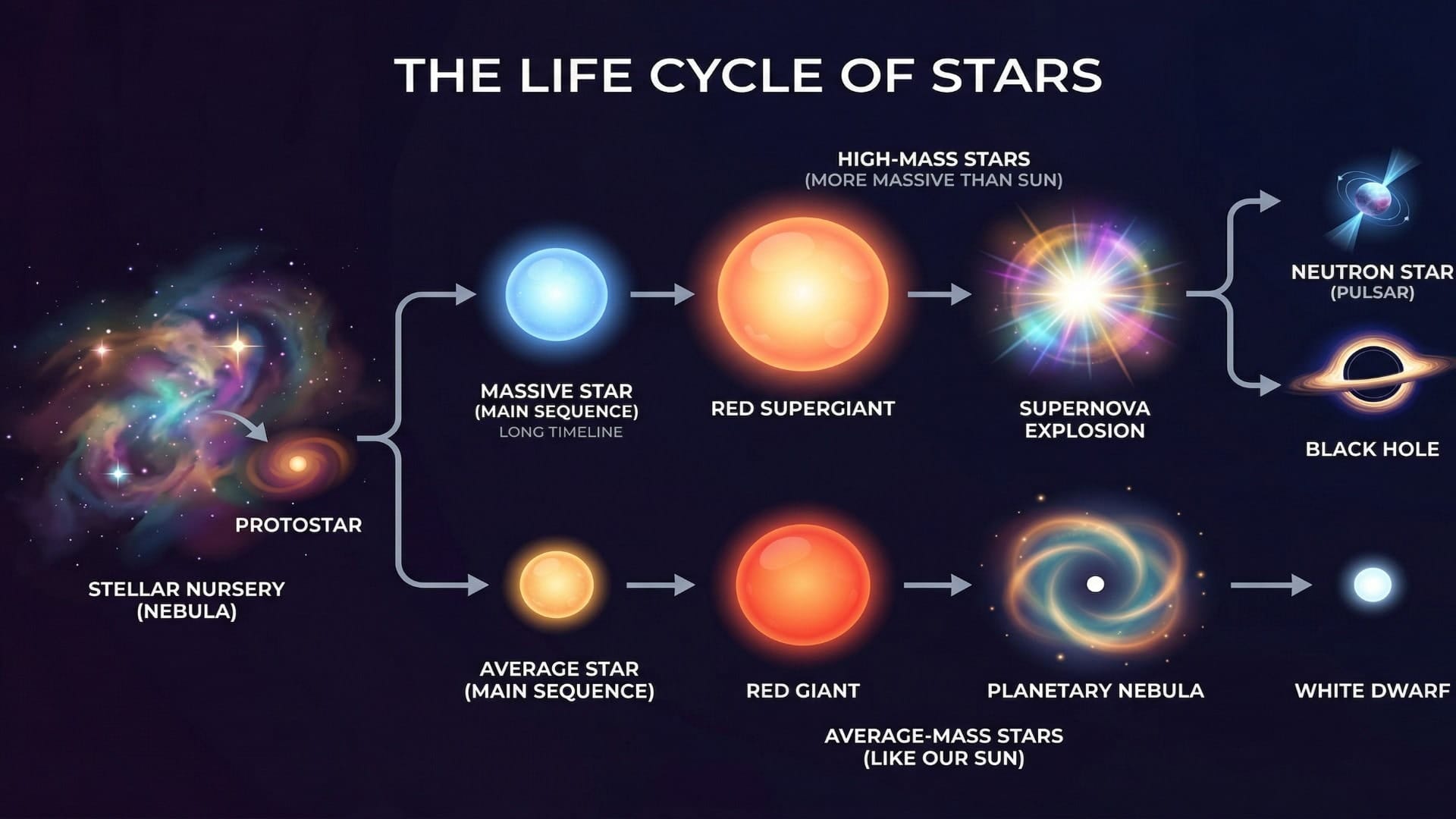
The fate of M-type stars further distinguishes them from other categories. While G-type stars like our Sun will eventually swell into Red Giants and then collapse into White Dwarfs, Red Dwarfs follow a different path.
As they consume their hydrogen, they are predicted to become Blue Dwarfs—a theoretical stage where the star gets hotter and bluer as its hydrogen is depleted. However, because their lifespans are so long, no Blue Dwarf has ever existed in the history of the universe. Eventually, they will bypass the Red Giant phase entirely and settle down as White Dwarfs made of helium.
In the "Distant Future" of the universe, trillions of years from now, long after the last G and K-type stars have died out, the Red Dwarfs will be the only stars left shining. They are the final light-bearers of the cosmos.
Common Misconceptions About Stellar Abundance
It is easy to assume that "Dwarfs" are a small, niche category because of their name. However, in astronomy, "Dwarf" is a technical term for any star on the Main Sequence (the stage where a star is fusing hydrogen in its core).
- Are Brown Dwarfs included? Brown Dwarfs are often called "failed stars" because they lack the mass to sustain nuclear fusion. While they are incredibly numerous—perhaps even more numerous than M-type stars—they are generally categorized as substellar objects rather than "stars" in the context of the Morgan-Keenan system.
- Is the Sun a "Small" star? Popular science often describes the Sun as a "small, yellow star." In reality, because M-type stars make up 76% of the population, the Sun is actually in the top 10% of stars in terms of mass and brightness.
Frequently Asked Questions
Which star category is the rarest?
The O-type blue giants are the rarest stars. They make up less than 0.00003% of the stellar population. Their rarity is due to the extreme conditions required for their formation and their very short lifespans of only a few million years.
If Red Dwarfs are so common, why can't I see any in the night sky?
Red Dwarfs have very low luminosity. They do not produce enough light for the human eye to perceive at the vast distances of interstellar space. Even the closest one, Proxima Centauri, requires a telescope to see.
Is our Sun a member of the most common star category?
No. The Sun is a G-type yellow dwarf. G-type stars make up about 7.6% of the stars in our galaxy. While common, they are nearly ten times less frequent than the M-type Red Dwarfs.
Could life exist on a planet orbiting the most common type of star?
This is a major area of research in 2026. While M-type stars have stable energy output for trillions of years, they also produce intense radiation flares. Whether a planet can maintain an atmosphere and liquid water under these conditions is currently being investigated using the James Webb Space Telescope.
Will the percentage of M-type stars change over time?
Yes, the percentage will likely increase. Because M-type stars live for trillions of years while larger stars die and explode, the "stock" of Red Dwarfs accumulates while other categories eventually vanish as the universe’s gas for new star formation is depleted.
Practical Recommendations for Amateur Astronomers
If you are interested in observing the most common star category, you will need more than just your eyes. To begin studying M-type stars:
- Use a Telescope: Even a modest 4-inch to 6-inch reflecting telescope can reveal the reddish hue of nearby M-dwarfs like Barnard’s Star.
- Consult Star Charts: Use apps or software that allow you to filter stars by spectral type. Look for stars with a "V" (main sequence) and "M" (red) designation.
- Observe Proxima Centauri: If you are in the Southern Hemisphere, Proxima Centauri is the most significant M-dwarf to locate, though it will appear only as a faint dot even in good telescopes.
By understanding that the category containing the most stars is the humble Red Dwarf, we gain a more accurate perspective of our place in the universe. We do not live near an "average" star; we live near a relatively large and rare beacon in a galaxy dominated by small, red, and incredibly long-lived neighbors.
Image Gallery