AP World History Questions: Complete 2026 Exam Guide, Formats, and Practice Strategies
Mastering AP World History: Modern questions requires understanding the rigorous analytical framework set by the College Board, balancing factual historical knowledge with complex historical thinking skills like causation, comparison,...
Mastering AP World History: Modern questions requires understanding the rigorous analytical framework set by the College Board, balancing factual historical knowledge with complex historical thinking skills like causation, comparison, and continuity. Preparing for this challenging exam in 2026 demands strategic familiarity with Stimulus-Based Multiple-Choice Questions (MCQs), Short Answer Questions (SAQs), Document-Based Questions (DBQs), and Long Essay Questions (LEQs).
Contents
Understanding the AP World History Exam Structure and Question Formats
The AP World History: Modern exam is a comprehensive three-hour and fifteen-minute assessment designed to measure your historical understanding and analytical capabilities from approximately 1200 CE to the present. The test is divided into two distinct sections, each testing different cognitive domains. Section I contains multiple-choice questions paired with historical sources, followed by short-answer questions that require targeted historical reasoning. Section II transitions into the heavy writing components, specifically the Document-Based Question and the Long Essay Question.
Familiarity with the structural breakdown is essential for pacing during the test. The format remains strictly standardized to ensure consistent scoring across global testing sites.
| Section | Question Type | Number of Questions | Percentage of Exam Score | Time Allocated |
|---|---|---|---|---|
| Section I, Part A | Multiple-Choice Questions (MCQs) | 55 Questions | 40% | 55 Minutes |
| Section I, Part B | Short-Answer Questions (SAQs) | 3 Questions (Choice on Q3) | 20% | 40 Minutes |
| Section II, Part A | Document-Based Question (DBQ) | 1 Question | 25% | 60 Minutes (includes 15-min reading) |
| Section II, Part B | Long Essay Question (LEQ) | 1 Question (Choice of 3) | 15% | 40 Minutes |
Breaking Down AP World History Multiple-Choice Questions
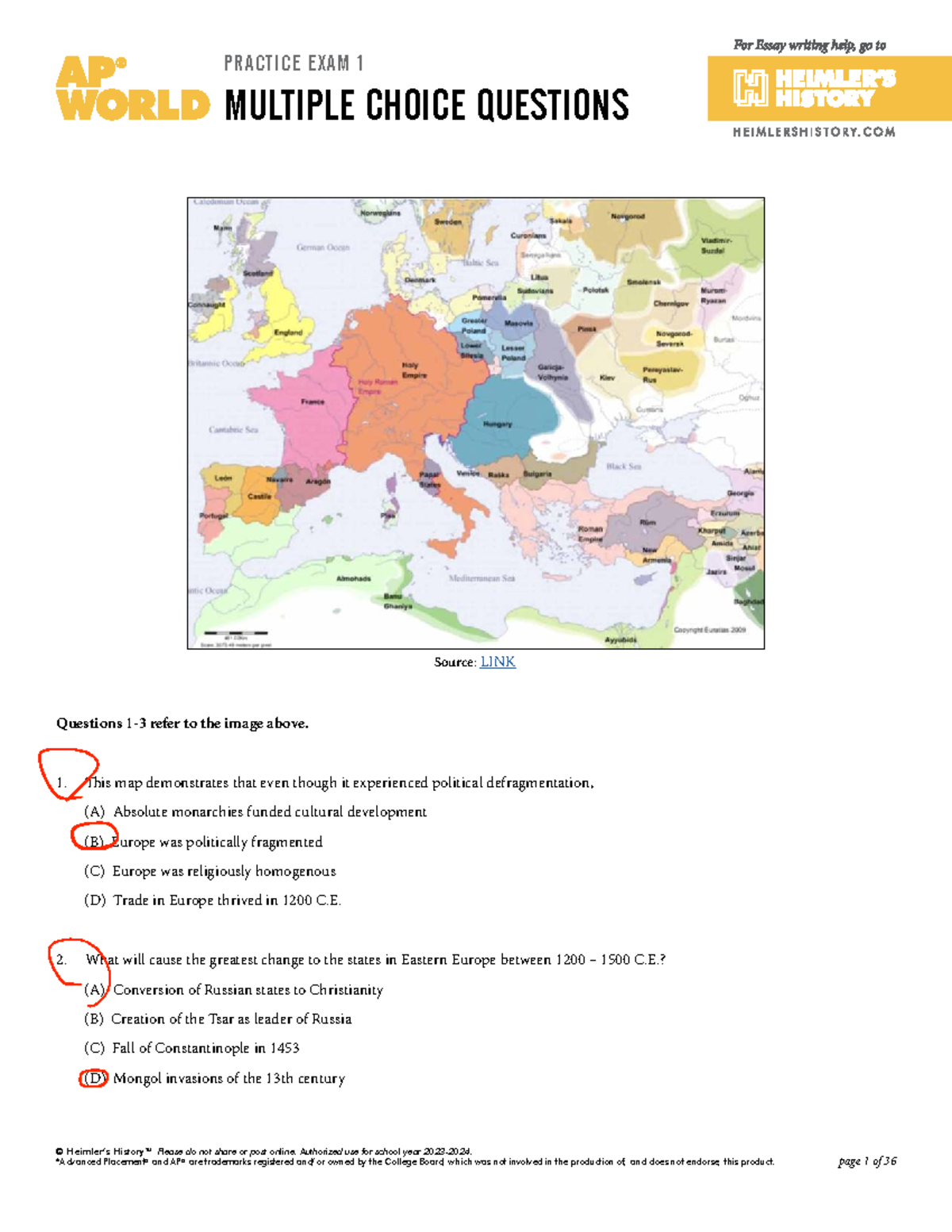
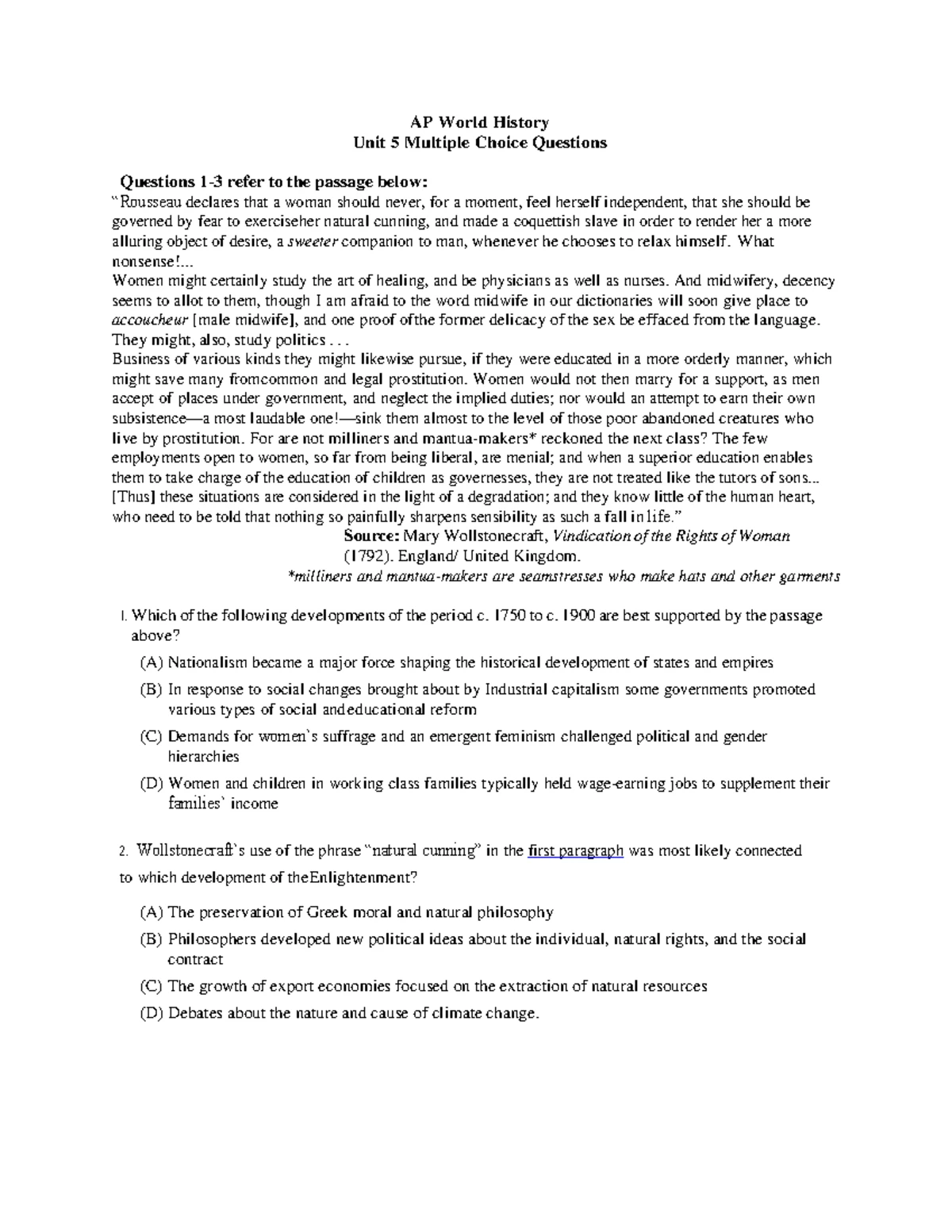
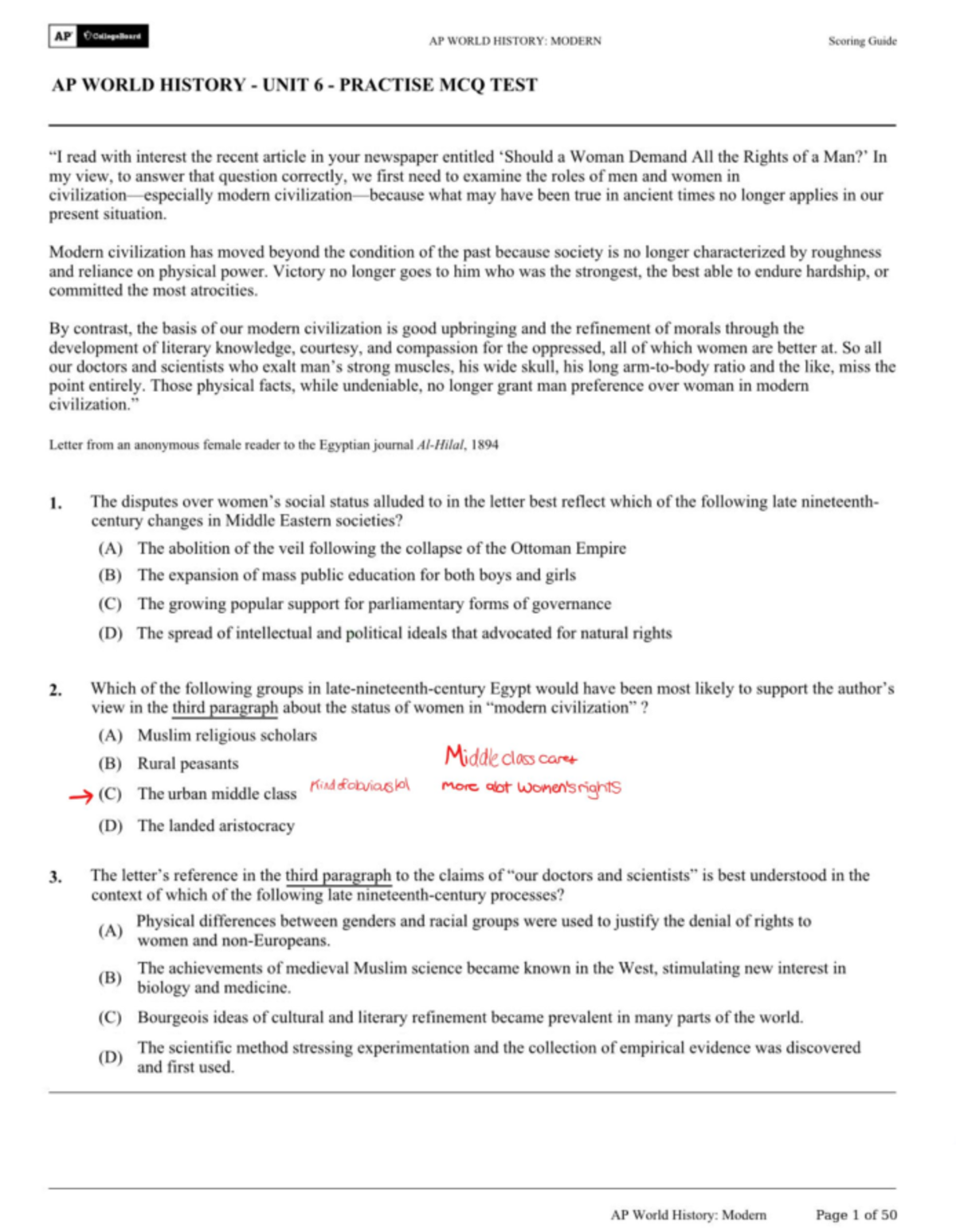
Multiple-choice questions form the foundation of your score, accounting for 40% of the total exam. Unlike tests that test pure memorization, AP World History MCQs are invariably stimulus-based. Every set of 2 to 5 questions is anchored by a primary or secondary source, which can be an excerpt from a historical text, a map, a chart, a political cartoon, or an economic graph.
To tackle these questions effectively, you must look beyond the immediate text and contextualize the stimulus within broader global processes. The questions evaluate four distinct historical thinking skills: developments and processes, sourcing and situation, claims and evidence in sources, and contextualization.
Mastering Stimulus Analysis: Contextual First Reading: Read the source attribution, date, and geographic origin before diving into the text to anchor the excerpt in its historical era. Identify the Core Argument: Determine what the author is claiming, not just what they are describing, as distractors often present historically true statements that fail to answer the specific prompt. Eliminate Chronological Impossibilities: Instantly cross out answer choices that describe events occurring before or long after the timeline established by the stimulus.
Navigating Short-Answer Questions (SAQs)
Short-answer questions require concise, precise, and direct written responses. You will be given 40 minutes to answer three SAQs. Question 1 is mandatory and focuses on secondary sources ranging from 1200 to 2001. Question 2 is also mandatory and typically uses a primary source stimulus covering the same chronological span. For Question 3, you are given a choice between two prompts—one focusing on the period from 1200 to 1750, and the other from 1750 to 2001—neither of which includes a source.
Writing a high-scoring SAQ response relies on the proven A.P.E. method, which stands for Answer, Prove, and Explain. You must avoid writing introductory paragraphs or conclusions; every sentence must directly earn points.
- A - Answer the Prompt: Directly respond to the specific task (A, B, or C) using the terminology of the question.
- P - Provide Evidence: Introduce a specific, historically accurate piece of factual evidence that supports your answer (e.g., naming a specific treaty, trade network, or political structure).
- E - Explain the Connection: Briefly state how or why that piece of evidence proves your answer, linking it back to the overarching historical concept.
Conquering the Document-Based Question (DBQ)
The Document-Based Question is the most heavily weighted component of the exam, worth 25% of your final grade. You are given seven documents and must write a cohesive, argumentative essay supported by outside historical evidence and deep document analysis.
Scoring high on the DBQ requires strict adherence to the College Board rubric, which awards points across four main categories: Thesis/Claim (1 point), Contextualization (1 point), Evidence (up to 3 points), and Analysis and Reasoning (up to 2 points).
Crucial DBQ Writing Strategy: The 15-Minute Reading Period: Spend this time actively annotating the documents. Group them by thematic similarities or contrasting perspectives to form your argumentative categories. Sourcing Beyond Quoting: To earn the complex understanding and sourcing points, attribute at least three documents to their author's point of view, historical situation, purpose, or audience using formulas like "Because [Author] was a merchant in the Indian Ocean network, his account exaggerates..." Deploying Outside Evidence: You must explicitly bring in at least one specific historical example, event, or process not found in the documents that reinforces your thesis.
Tackling the Long Essay Question (LEQ)
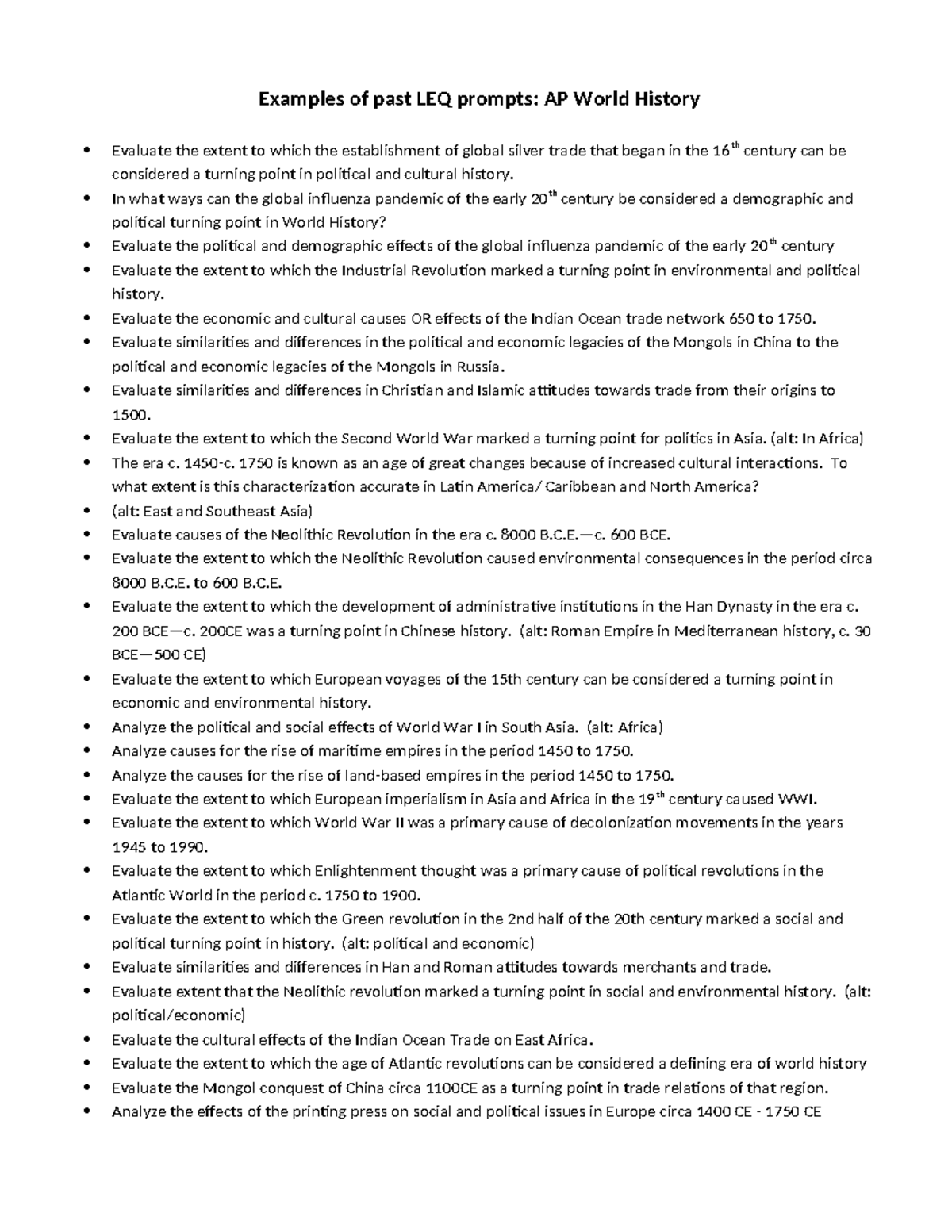
The Long Essay Question offers you a choice of three prompts, each focusing on the same historical thinking skills (Causation, Comparison, or Continuity and Change over Time) but spanning different time periods: 1200–1750, 1450–1900, or 1750–2001. You have 40 minutes to write a structured essay that demonstrates your ability to develop an argument without the aid of provided documents.
Success on the LEQ depends entirely on your command of thematic historical knowledge—such as Governance, Economic Systems, or Social Interactions—and your ability to structure a clear, historically defensible thesis statement in the introduction.
- Causation Prompts: Focus on the causes and effects of major global events, requiring you to analyze long-term structural changes rather than immediate triggers.
- Comparison Prompts: Require you to analyze similarities and differences between distinct societies or global processes within or across regions.
- Continuity and Change Prompts: Demand an evaluation of what remained the same and what shifted fundamentally across a specified historical era.
Frequently Asked Questions About AP World History Questions
What time period does the AP World History: Modern exam cover?
The exam covers global history from approximately 1200 CE to the present day. It is divided into nine distinct historical units, starting with the global tapestry of the 13th century and concluding with globalization and innovation in the 21st century.
How are the AP World History essays graded?
Essays are graded by trained high school teachers and college professors using strict, holistic rubrics provided by the College Board. Every point on the rubric (such as thesis, contextualization, and evidence) is earned independently based on objective criteria.
Can I use outside evidence that is not mentioned in the DBQ documents?
Yes, using outside evidence is mandatory to earn full points on the evidence portion of the rubric. Your outside evidence must be historically accurate, relevant to your argument, and distinct from the information provided in the documents.
How should I manage my time during the multiple-choice section?
You have 55 minutes to answer 55 multiple-choice questions, giving you an average of one minute per question. If you encounter a particularly difficult stimulus or question, make an educated guess, flag it for review if time permits, and move forward to avoid falling behind.
What are the best strategies for studying historical thinking skills?
Practice applying the four disciplinary practices—developments and processes, sourcing, claims and evidence, and contextualization—to every historical reading you do. Flashcards for vocabulary are insufficient; instead, practice writing thesis statements and mapping out cause-and-effect chains for major global developments.
Are there penalties for guessing on the AP World History exam?
No, there is no guessing penalty on any section of the AP World History exam. You should answer every single multiple-choice question, even if you have to guess randomly at the end of the time limit.
Strategic Preparation for Exam Day
Achieving a top score of 4 or 5 on the AP World History exam requires consistent, analytical practice rather than passive reading. Regularly review past free-response prompts, time yourself on practice SAQs, and thoroughly analyze the scoring guidelines for released DBQs. Focus your preparation on understanding broad global trends, cross-cultural interactions, and thematic developments rather than getting bogged down in isolated dates.
Image Gallery