Effective Cash Management Strategies for Businesses: Optimizing Liquidity and Working Capital
Effective cash management strategies for businesses involve systematically forecasting, collecting, disbursing, and investing cash assets to ensure solvency while maximizing liquidity and returns. Key techniques include implementing 13...
Effective cash management strategies for businesses involve systematically forecasting, collecting, disbursing, and investing cash assets to ensure solvency while maximizing liquidity and returns. Key techniques include implementing 13-week rolling cash flow forecasts, optimizing the Cash Conversion Cycle (CCC) through disciplined receivables and payables management, utilizing zero-balance and sweep accounts, and deploying excess liquidity into capital-preserving short-term yield instruments.
Contents
The Strategic Importance of Business Cash Management
Cash flow is the operational engine of any business enterprise. While accounting profitability demonstrates long-term commercial viability on an accrual basis, liquidity determines whether an organization can meet its daily obligations, such as payroll, vendor settlements, tax commitments, and debt service. Poor cash visibility and inefficient working capital practices remain leading catalysts for corporate distress, even among companies reporting positive net income.
Modern enterprise treasury operations view cash management not merely as a defensive bookkeeping function, but as a strategic dynamic that preserves capital, reduces borrowing costs, and creates funding capacity for growth. By establishing structured cash handling protocols, finance teams mitigate credit risks, capture early-payment supplier discounts, and generate incremental interest income on idle balances.
Disclaimer: Strategic cash and treasury management involves complex regulatory, accounting, and financial tax implications. Organizations should consult certified public accountants (CPAs), corporate financial advisors, or treasury professionals to tailor cash policies to their specific operational environment and jurisdiction.
Core Pillars of Capital and Liquidity Structure
Before deploying advanced strategies, finance leaders must understand the operational metrics that define cash efficiency:
The Cash Conversion Cycle (CCC)
The Cash Conversion Cycle measures the precise time, expressed in days, it takes for a business to convert investments in inventory and operational resources into actual cash inflows from sales. The formula is:
$$\text{CCC} = \text{DIO} + \text{DSO} - \text{DPO}$$
Where:
- Days Inventory Outstanding (DIO): Average number of days inventory is held before sale.
- Days Sales Outstanding (DSO): Average time required to collect receivables from customers.
- Days Payable Outstanding (DPO): Average time taken to settle accounts payable to suppliers.
A shorter or negative Cash Conversion Cycle indicates high operational efficiency, meaning capital is locked up for minimal periods.
Balancing Liquidity, Safety, and Yield
Treasury management operates under a strict hierarchy of priorities:
- Liquidity: Ensuring sufficient immediate funds are accessible to meet unexpected disruptions or planned disbursements.
- Capital Preservation (Safety): Protecting principal reserves against counterparty default, market fluctuations, or fraud.
- Yield: Earning competitive market returns on excess cash reserves without compromising liquidity or safety.
1. Implementing Precision Cash Flow Forecasting
Accurate cash flow forecasting provides the foundational data necessary to make capital allocation, borrowing, and investment decisions. Without predictive visibility, organizations risk liquidity shortfalls or hold excessive idle cash that erodes in purchasing power.
- 13-Week Rolling Cash Forecast
- Inflows: Accounts Receivable Collections, Cash Sales, Asset Yields
- Outflows: Payroll, AP Vendor Pay, Debt Service, Tax Payments
- Variance Analysis & Scenario Model
- Compare Actual vs. Forecasted
- Model Best/Base/Worst Cases
- Liquidity Allocation Decisions
- Cover Operating Shortfalls
- Deploy Surplus to Yield Instruments
The 13-Week Rolling Cash Forecast
The 13-week forecast is the global corporate standard for short-term operational liquidity management. Because it covers a single calendar quarter, it captures near-term billing cycles, payroll runs, and recurring debt service obligations with high statistical reliability.
- Data Aggregation: Integrate real-time accounts receivable (AR) aging schedules, accounts payable (AP) run-rates, contractual recurring bills, and scheduled capital expenditures.
- Weekly Refresh Cycle: Update the forecast model weekly by replacing historical actuals with the upcoming week's operational data, extending the 13-week horizon indefinitely.
- Variance Analysis: Track historical forecasting accuracy by measuring actual inflows and outflows against initial projections. Consistently high variance signals underlying weaknesses in operational reporting or customer payment behavior.
Scenario Modeling and Stress Testing
Static cash projections fail to prepare businesses for economic shifts. Finance teams should build dynamic financial models incorporating three key operational scenarios:
- Base Case: Standard operating conditions reflecting historical collection patterns and revenue forecasts.
- Best Case: Accelerated customer pay schedules, strong top-line sales growth, and favorable supply costs.
- Worst Case (Stress Scenario): Severe drop in collections (e.g., 20–30% DSO delay), unexpected supply chain cost surges, and simultaneous pullbacks in credit facilities.
2. Optimizing Working Capital Management
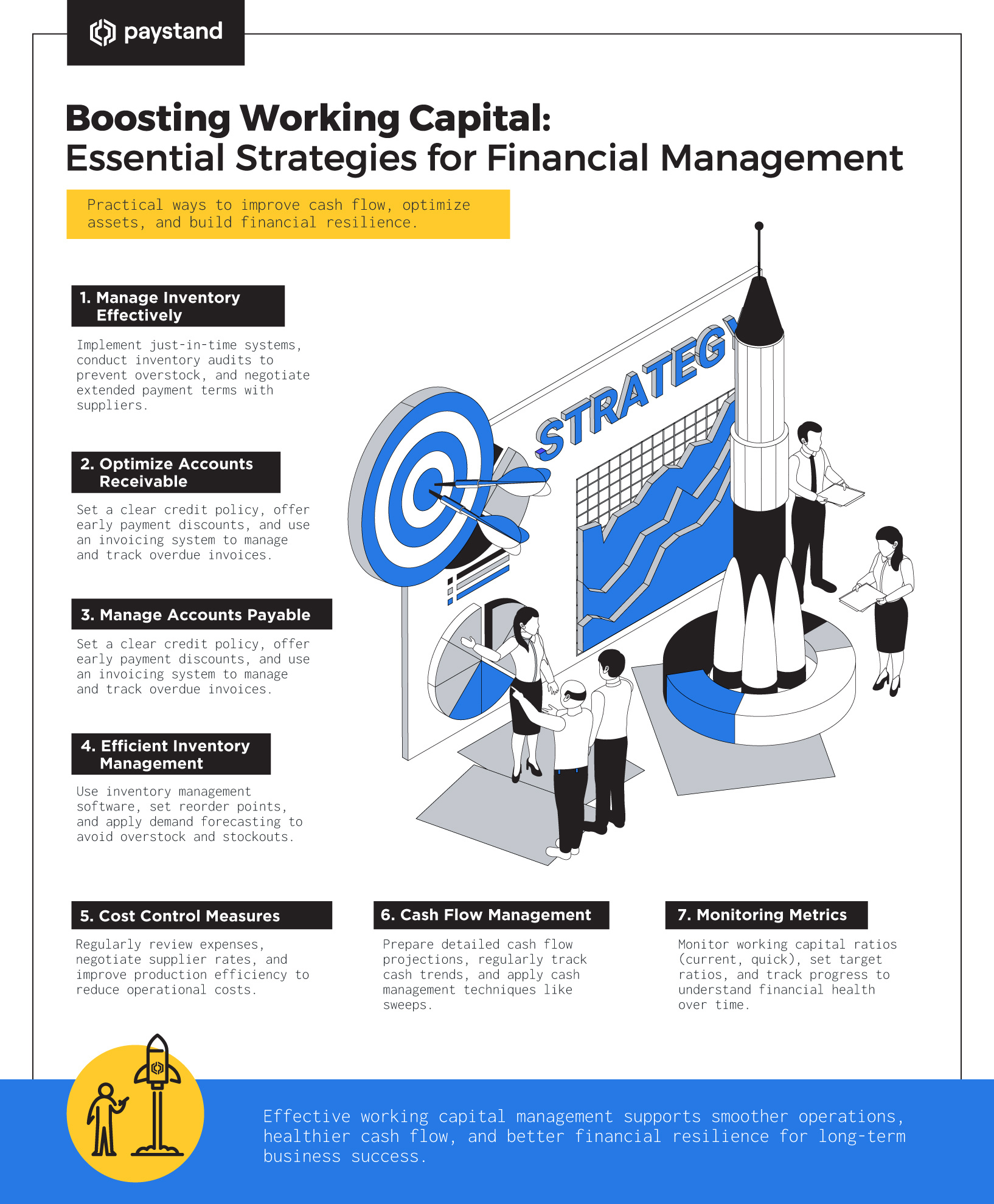
Working capital management focuses on accelerating cash generation from internal operations without compromising customer relationships or supplier goodwill.
Accelerating Accounts Receivable (AR)
Delay in invoice collection is one of the primary drivers of cash flow friction. Accelerating cash collection requires proactive billing controls and structural incentives:
- Automated and Prompt Invoicing: Issue invoices immediately upon delivery of goods or completion of service milestones. Manual delays in invoice creation directly extend DSO.
- Tiered Credit Terms and Early-Payment Discounts: Structure terms such as "2/10 Net 30" (offering a 2% discount if paid within 10 days) to incentivize rapid settlement from capital-heavy clients.
- Structured Collections Management: Establish systematic dunning processes with automated escalation triggers at 7, 15, 30, and 45 days past due. Assign dedicated credit managers to high-value accounts.
- Modernized Electronic Payment Portals: Offer ACH, wire, real-time payments (RTP), and corporate credit card integrations. Eliminating paper check processing cuts clearing latency by 3 to 7 business days.
Strategic Accounts Payable (AP) Optimization
Disbursement management aims to retain cash as long as legally and contractually permissible while avoiding late fees or supply disruptions:
- Term Maximization: Negotiate extended payment terms (e.g., Net 60 or Net 90) with key vendors in exchange for guaranteed volume commitments or long-term contracts.
- Payment Batching and Timing: Align disbursement schedules with actual cash intake cycles—such as bi-weekly or semi-monthly payment runs—rather than releasing payments on an ad-hoc basis.
- Dynamic Discounting and Supply Chain Finance: If operating with excess liquidity, utilize dynamic discounting to pay suppliers early in exchange for pre-calculated yield discounts higher than bank risk-free rates.
Inventory Rationalization
Unsold inventory represents cash tied up on the balance sheet, accompanied by storage, insurance, and obsolescence costs.
- Just-in-Time (JIT) Stock Management: Align inventory purchases tightly with verified sales orders to reduce raw material buffer stock.
- ABC Inventory Classification: Categorize inventory into A-items (high-value, lower volume), B-items (moderate value/volume), and C-items (low-value, high volume). Focus capital and tracking precision on Category A goods.
- Liquidation of Slow-Moving Stock: Discount or liquidate aged inventory that exceeds expected turnover thresholds to release trapped liquidity back into working capital.
3. Designing an Advanced Banking Architecture
A structured banking framework minimizes uninvested idle funds, mitigates operational complexity, and reduces transaction fees across domestic and international operations.
- Master Operating Account (Central Enterprise Hub)
- Automatic Sweeps to/from:
- Zero Balance Account (ZBA): Payroll
- Zero Balance Account (ZBA): Accounts Payable
- Automatic Sweeps to/from:
Zero Balance Accounts (ZBA)
Zero Balance Accounts are specialized disbursement accounts that maintain a consistent balance of exactly zero. When checks, ACH debits, or payroll obligations clear against a ZBA, funds are automatically transferred in exact amounts from a central master operating account at the close of the business day.
- Benefit: Prevents fragmentation of cash across dozens of peripheral operational accounts and reduces the risk of overdraft fees or uncoordinated spending.
Automated Sweep Accounts
Sweep accounts automatically transfer balance amounts above or below a predetermined threshold into interest-bearing vehicles or debt-paydown structures:
- Investment Sweeps: Excess end-of-day balances are automatically moved into money market mutual funds or high-yield commercial deposits, capturing overnight yield.
- Loan Sweeps: Surplus funds automatically pay down revolving lines of credit, instantly reducing compounding interest expense on outstanding enterprise debt.
Multi-Currency and Global Liquidity Pooling
For multinational businesses operating across jurisdictions, managing foreign exchange (FX) exposure and isolated currency pools is essential:
- Physical Concentration (Notional Pooling): Combine account balances across international subsidiaries virtually or physically to balance debit balances in one location with credit balances in another, optimizing total interest costs without unnecessary FX conversion fees.
- FX Hedging: Utilize forward contracts and currency options to lock in exchange rates for anticipated international receivables and payables, protecting operational cash flow from volatile currency swings.
4. Short-Term Investment and Excess Liquidity Yield Strategies
Holding all corporate cash in non-interest-bearing operating accounts exposes principal to inflationary erosion. Treasury teams must segment cash into operational, reserve, and strategic tiers, assigning appropriate investment vehicles to each tier.
Cash Segmentation Model
- Operating Cash: Funds required for daily obligations (0–30 days). Kept in liquid checking or ZBA structures.
- Core Reserve Cash: Capital held for near-term contingencies (30–90 days). Invested in highly liquid, capital-preserving instruments.
- Strategic Surplus Cash: Excess capital earmarked for long-term investments, acquisitions, or capital expenditures (90+ days). Invested in slightly longer-duration short-term instruments for higher yields.
Overview of Treasury Investment Vehicles
| Financial Instrument | Liquidity Horizon | Risk Profile | Yield Potential | Ideal Operational Use Case |
|---|---|---|---|---|
| High-Yield Business Savings / CDs | Immediate to Fixed (30–365 Days) | Low (FDIC/NCUA insured up to limits) | Low to Moderate | Core cash reserves; predictable funding needs within 12 months. |
| U.S. Treasury Bills (T-Bills) | 4 Weeks to 52 Weeks | Extremely Low (Backed by U.S. Government) | Moderate (Tied to benchmark Fed rates) | Strategic liquidity buffer; state and local tax-exempt yields. |
| Money Market Mutual Funds (MMFs) | Same-Day / Next-Day ($1.00 NAV focus) | Very Low (Government / Prime funds) | Moderate | Daily operational surplus deployment via automated sweeps. |
| Commercial Paper (CP) | 1 to 270 Days | Low to Moderate (Depends on issuer rating) | Moderate to High | Strategic cash reserves invested in top-tier corporate short-term debt. |
| Short-Duration Bond Funds | 1 to 3 Years | Moderate (Subject to interest rate shifts) | Higher | Capital set aside for medium-term corporate expansion or acquisitions. |
For detailed regulatory guidelines on liquidity requirements and approved institutional money market fund investments, consult the U.S. Securities and Exchange Commission (SEC) Rules on Money Market Funds.
5. Technology, Automation, and Internal Controls
Integrating enterprise treasury management software and enforcing strict financial security protocols protects liquidity from operational errors, external fraud, and internal misappropriation.
Treasury Management Systems (TMS) and ERP Integration
Modern corporate treasury operations rely on specialized Treasury Management Systems (TMS) connected directly to Enterprise Resource Planning (ERP) platforms like SAP, Oracle NetSuite, or Workday:
- Bank API Aggregation: Automatically consolidate multi-bank account balances, statements, and transaction histories into a single normalized platform in real time.
- Automated Reconciliation: Match incoming AR receipts and AP disbursements against general ledger entries automatically, reducing accounting close cycles from weeks to days.
- Predictive AI Analytics: Leverage historical transaction data to detect underlying cash seasonal trends and improve forecasting accuracy.
Treasury Fraud Mitigation and Control Standards
Business Email Compromise (BEC), ACH fraud, and check tampering represent direct threats to business cash. Organizations must implement standardized preventive measures:
- Positive Pay Systems: Implement automated bank services (ACH Positive Pay and Check Positive Pay) where banks compare incoming clearing requests against pre-approved lists of check numbers, dollar amounts, and payee names provided by the enterprise. Unmatched items are flagged and blocked pending manual review.
- Dual Authorization Protocols: Mandatory multi-party verification for outward funds transfers (wires, ACH batches, or manual payments) exceeding established financial thresholds.
- Separation of Duties (SoD): Ensure that the employees who create vendor records and approve invoices are strictly prohibited from initiating or approving outgoing payments.
The Federal Reserve Financial Services offers authoritative guidance on payment security standards, FedNow real-time payment mechanics, and automated clearing house (ACH) network operational rules.
Common Cash Management Errors to Avoid
Even established enterprises often suffer capital leakage by falling into avoidable operational habits:
Over-Reliance on Static Spreadsheets
Managing multi-account cash operations using manual, disconnected spreadsheets increases human error risk, lacks real-time bank connectivity, and creates critical key-person dependencies within the finance team.
Neglecting Credit Line Terms and Covenants
Relying on bank lines of credit as a primary operational cash cushion without monitoring financial debt covenants (e.g., maximum leverage ratios, debt-service coverage ratios) can trigger default clauses if cash flows tighten unexpectedly.
Trapping Cash in Regional Bank Accounts
Allowing local regional managers or operational subsidiaries to maintain independent, un-monitored bank accounts leads to idle capital buildup, uncaptured interest yields, and heightened vulnerability to uncoordinated spending.
Confusing Profitability with Liquidity
A company can record substantial income on its accrual P&L statement while suffering severe cash starvation if revenue is tied up in uncollectible accounts receivable or illiquid inventory. Cash management requires constant, direct focus on cash-equivalent positions.
Frequently Asked Questions
What is the ideal amount of cash reserves a business should maintain?
As a baseline, most financial risk managers recommend maintaining three to six months of fixed operating expenses (payroll, rent, facility maintenance, minimum debt service) in high-liquidity, low-risk accounts. However, exact targets vary based on industry seasonality, customer concentration, capital expenditure plans, and access to revolving credit lines.
What is the difference between cash flow management and treasury management?
Cash flow management focuses primarily on day-to-day operational mechanics—ensuring accounts receivable are collected and accounts payable are disbursed efficiently to maintain short-term liquidity. Treasury management encompasses broader corporate financial strategy, including managing enterprise capital structure, short- and long-term investments, foreign exchange risk exposure, debt covenants, and commercial bank relationships.
How do rising benchmark interest rates affect enterprise cash strategy?
In higher-interest-rate environments, the opportunity cost of holding non-interest-bearing cash increases significantly. Treasury teams shift focus toward optimizing automated sweeps, allocating excess balances into short-term Treasury Bills or Money Market Funds, and negotiating competitive yields on commercial interest accounts. Higher rates also increase the cost of short-term borrowing, emphasizing the need to shorten the Cash Conversion Cycle.
How does a 13-week cash flow forecast differ from an annual operating budget?
An annual operating budget is a static financial roadmap created on an accrual basis to set strategic goals, income expectations, and department spending limits for the year. A 13-week cash flow forecast is a dynamic operational tool focused exclusively on actual cash movements (inflows and outflows). It is updated weekly to give finance leaders immediate, actionable visibility into near-term cash balances.
What is the fastest way to reduce Days Sales Outstanding (DSO)?
The quickest methods to reduce DSO include migrating customers to mandatory automated payment methods (ACH or payment portals), shortening invoice payment terms from Net 60 to Net 30, implementing strict credit checks prior to extending terms, offering early-payment discounts (e.g., 2/10 Net 30), and immediately contacting clients upon an invoice becoming 1 business day past due.
Actionable Next Steps for Finance Leaders
To upgrade your business cash management operations, consider following a sequential implementation plan:
- Conduct a Liquidity Audit: Map every corporate bank account, average daily balance, yield, and fee structure across all banking partners. Eliminate redundant or dormant accounts.
- Calculate Your Baseline Cash Conversion Cycle: Measure your current DIO, DSO, and DPO metrics to identify operational bottlenecks in inventory management, billing, or payables.
- Build a 13-Week Rolling Cash Forecast: Create a dynamic spreadsheet or deploy a specialized software tool connected to your accounting package to track upcoming weekly inflows and outflows.
- Enforce Fraud Controls: Contact primary financial institutions to implement Check Positive Pay and ACH Positive Pay controls across all operational disbursement accounts.
- Structure an Excess Cash Policy: Establish formal investment guidelines defining minimum cash balances, eligible investment vehicles (e.g., T-Bills, MMFs), credit quality standards, and maximum maturity durations for short-term yield deployment.
Image Gallery