Who Killed the Smiling Knight in the Books?
In the canonical text of George R.R. Martin’s A Song of Ice and Fire series, Ser Arthur Dayne, the Sword of the Morning, killed the Smiling Knight. The encounter took place during the suppression of the Kingswood Brotherhood, an outlaw...
In the canonical text of George R.R. Martin’s A Song of Ice and Fire series, Ser Arthur Dayne, the Sword of the Morning, killed the Smiling Knight. The encounter took place during the suppression of the Kingswood Brotherhood, an outlaw band that plagued the lands near King’s Landing during the reign of King Aerys II Targaryen.
Contents
The death of the Smiling Knight is one of the most storied events in the history of Westeros, serving as a pivotal moment for several legendary characters. As we look back on these events from our vantage point in 2026, the duel remains a definitive example of the transition between the romanticized chivalry of the past and the gritty reality of the present timeline in the novels.
The Context of the Kingswood Brotherhood
The Kingswood Brotherhood was not a mere collection of common thieves. They were a sophisticated and dangerous outlaw organization that operated within the Kingswood, a massive forest south of the Blackwater Rush. Unlike many bandit groups, the Brotherhood enjoyed a degree of support from the local smallfolk. This populist support was rooted in the failures of the crown’s administration; the outlaws often shared their spoils or protected the peasants from the heavy-handedness of local lords.
The leadership of the Brotherhood was formidable. It included Simon Toyne, a disgraced nobleman seeking vengeance against the Iron Throne, and other colorful but lethal figures like Wenda the White Fawn, Oswell Kettleblack, and Big Belly Ben. However, the most terrifying member of this group was the man known as the Smiling Knight.
By the time King Aerys II ordered his Kingsguard to eliminate the threat, the Brotherhood had kidnapped several high-born individuals and eluded capture for months. The campaign to eradicate them was led by the most prestigious knights in the realm, including Ser Arthur Dayne, Ser Barristan Selmy, and a young Jaime Lannister, who was then a squire to Lord Sumner Crakehall.
The Identity of the Smiling Knight
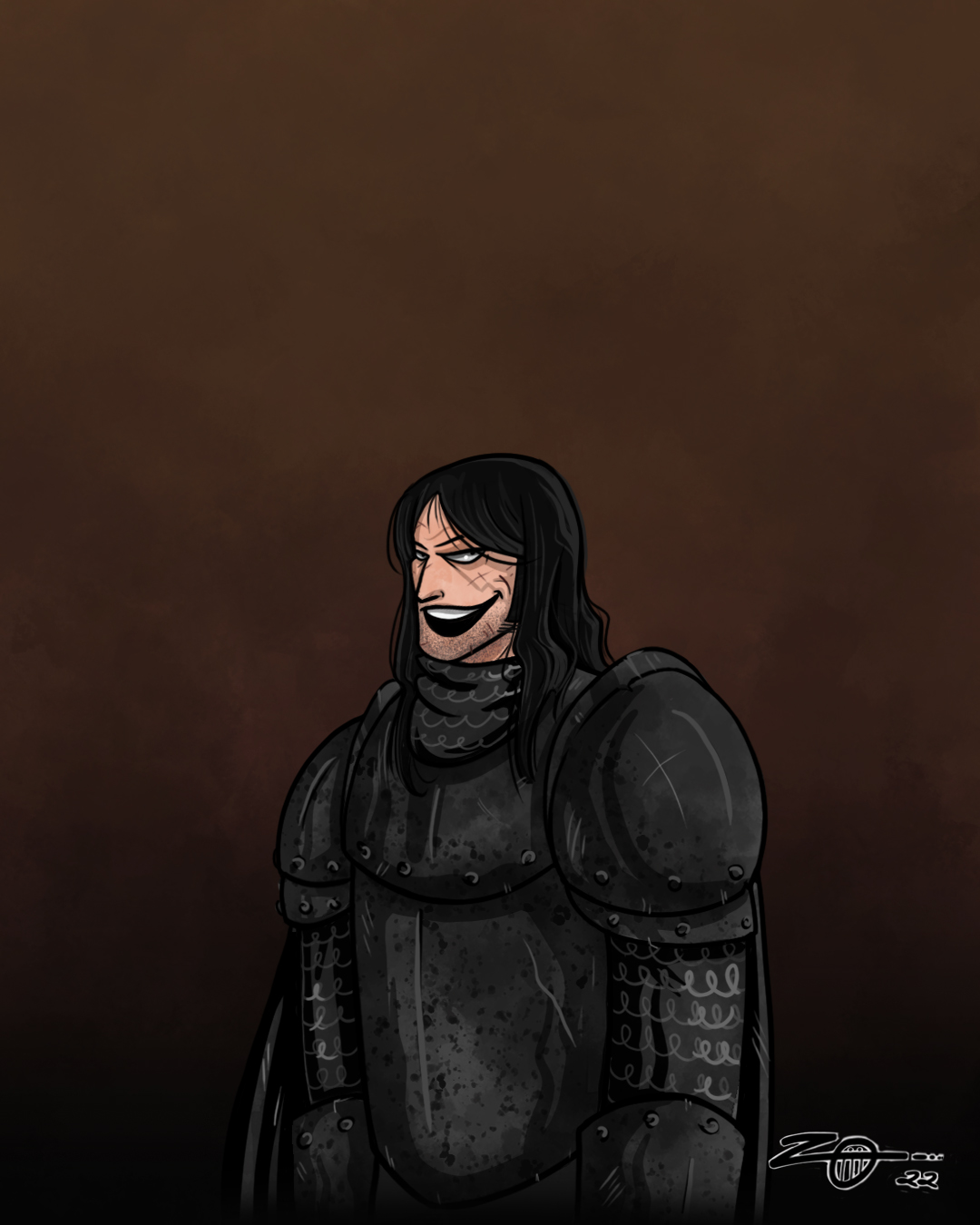
The Smiling Knight is frequently described as the "Gregor Clegane of his day," though the comparison is based more on his lethality and lack of morality than his physical size. While the Mountain that Rides is known for his massive stature, the Smiling Knight was known for his utter madness and a perpetual, unsettling grin that never left his face, even in the heat of a life-or-death struggle.
In A Storm of Swords, Jaime Lannister recalls the Smiling Knight as a man who knew no fear. He was a master swordsman whose unpredictability made him nearly impossible to defeat in single combat. He did not fight for a cause, coin, or glory in the traditional sense; he fought because he loved the carnage. Jaime’s memories highlight that the Knight was truly insane, possessing a wildness that unnerved even the most seasoned soldiers of the era.
The Fateful Duel: Arthur Dayne vs. The Smiling Knight
The confrontation that led to the Smiling Knight’s death is a cornerstone of Westerosi lore because it highlights the contrast between the "monstrous" outlaw and the "perfect" knight. After a series of skirmishes in the Kingswood, the royal forces eventually pinned down the leadership of the Brotherhood.
During the battle, the Smiling Knight first crossed blades with the young Jaime Lannister. Jaime, only fifteen at the time, managed to hold his own against the madman for a brief period, an achievement that would later contribute to his reputation as a prodigy. However, the duel was eventually taken over by Ser Arthur Dayne, the deadliest member of the Kingsguard.
The Sword "Dawn" and the Act of Chivalry
The duel was prolonged and fierce. Arthur Dayne wielded Dawn, the ancestral greatsword of House Dayne, forged from the heart of a fallen star. Dawn is said to be as sharp as Valyrian steel but is distinct in its pale, milk-glass appearance.
The technical superiority of Dawn eventually took its toll on the Smiling Knight’s equipment. During the exchange, the Smiling Knight’s sword became so notched and battered by the impacts against Dawn that it eventually shattered. In a moment that many consider the height of Westerosi chivalry, Ser Arthur Dayne paused the fight. He allowed the Smiling Knight to retrieve a new sword, stating that he would wait for him to be armed before continuing.
The Final Words
Upon retrieving a fresh blade, the Smiling Knight reportedly told Dayne, "It is that white sword of yours I want."
Arthur Dayne’s response was cold and final: "Then you shall have it, ser."
In the subsequent exchange, Dayne’s skill and the superior properties of Dawn proved insurmountable. Arthur Dayne slew the Smiling Knight, ending the reign of terror the outlaw had brought to the Kingswood. This victory, combined with Ser Barristan Selmy killing Simon Toyne, effectively broke the back of the Brotherhood.
Comparison of the Kingswood Brotherhood Conflict
To understand the scale of this conflict, it is helpful to look at the primary actors involved and their eventual fates.
| Entity | Role in Conflict | Final Status in Books |
|---|---|---|
| Ser Arthur Dayne | Leader of the Royal Force | Slain at the Tower of Joy by Eddard Stark (and Howland Reed). |
| The Smiling Knight | Primary Combatant (Outlaw) | Slain by Ser Arthur Dayne in the Kingswood. |
| Simon Toyne | Leader of the Brotherhood | Slain by Ser Barristan Selmy. |
| Jaime Lannister | Squire to Lord Crakehall | Knighted by Arthur Dayne; later Lord Commander of the Kingsguard. |
| Wenda the White Fawn | Outlaw/Archer | Disappeared; fate unknown in current lore. |
| Ser Barristan Selmy | Kingsguard Member | Joined Daenerys Targaryen; currently in Meereen. |
The Impact on Jaime Lannister’s Character
One cannot discuss who killed the Smiling Knight without addressing the impact it had on Jaime Lannister. For Jaime, the Kingswood Brotherhood campaign was the "golden age" of his life. It was the moment he transitioned from a boy to a knight.
Following the death of the Smiling Knight, Ser Arthur Dayne knighted Jaime on the spot. Jaime often reflects on this in the later books, particularly in A Feast for Crows, with a sense of bitter irony. He was knighted by the most honorable man in the realm for his bravery against a madman, only to eventually become known as the "Kingslayer" for killing the very king he was sworn to protect.
The Smiling Knight serves as a foil to Jaime's later cynicism. To the young Jaime, the Smiling Knight was the ultimate villain, and Arthur Dayne was the ultimate hero. As an adult in 2026's literary analysis, we see that Jaime struggles with the fact that he could never live up to the impossible standard set by Dayne during that duel.
Legacy of the Encounter in "A Song of Ice and Fire"
The death of the Smiling Knight is not just a piece of trivia; it represents the end of an era. The suppression of the Kingswood Brotherhood was the last major military success of the Targaryen dynasty before the chaos of Robert’s Rebellion.
- The Decline of the Kingsguard: The knights who fought the Brotherhood (Dayne, Selmy, Hightower) are remembered as the "True Kingsguard." Their deaths or exile left a vacuum that was filled by lesser men, leading to the decline of the institution seen in the current timeline.
- The Smallfolk's Perspective: The campaign taught the Iron Throne that the smallfolk would turn to outlaws if the crown failed to provide justice. This theme recurs with the Brotherhood Without Banners in later books.
- The Legend of Dawn: The duel solidified the legend of the sword Dawn. Because it was used to defeat such a chaotic and "evil" opponent, the sword’s reputation as a tool of ultimate justice was cemented for a new generation.
Frequently Asked Questions
Was the Smiling Knight featured in the Game of Thrones TV show?
No, the Smiling Knight and the Kingswood Brotherhood were largely omitted from the HBO television adaptation. While Arthur Dayne appears in a flashback at the Tower of Joy, his history with the Brotherhood and the Smiling Knight is only mentioned in supplementary materials like the "History and Lore" featurettes on the Blu-ray releases.
How does the Smiling Knight compare to Gregor Clegane?
In terms of raw strength, Gregor Clegane is far superior. However, Jaime Lannister notes that the Smiling Knight was faster and more skilled with a blade. While Gregor is driven by headaches and a baseline cruelty, the Smiling Knight’s madness was more "active"—he found genuine joy in the chaos of battle, making him a more psychologically terrifying opponent for the knights of that era.
Did Ned Stark ever mention the Smiling Knight?
Ned Stark does not mention the Smiling Knight directly in the main narrative of A Game of Thrones. However, he speaks with great respect of Arthur Dayne, calling him the finest knight he ever saw. Ned's respect for Dayne is likely bolstered by the stories of Dayne's conduct during the Kingswood campaign.
What happened to the sword the Smiling Knight was using?
In the books, the original sword used by the Smiling Knight was shattered by Dawn. The second sword he used was likely a standard steel blade taken from a fallen soldier or loot. There is no mention of his weaponry surviving the encounter as a "relic," as Arthur Dayne’s Dawn is the only weapon of note from that specific duel.
Final Recommendation for Readers
For those looking to dive deeper into the lore of the Smiling Knight, the best primary source is Jaime Lannister’s POV chapters in A Storm of Swords. Additionally, the companion book The World of Ice and Fire provides a more "historical" account of the Kingswood Brotherhood campaign from the perspective of a Maester, offering a broader view of the political ramifications of the Smiling Knight’s death. Understanding this event is essential for any reader who wants to grasp the tragic arc of Jaime Lannister and the lost honor of the Kingsguard.
Image Gallery