Understanding the Bloom Taxonomy of Education: A Framework for Cognitive Development
Bloom’s Taxonomy is a hierarchical framework used to classify educational objectives into levels of complexity and specificity. Developed to categorize learning behaviors, it helps educators design curricula, draft assessments, and cre...
Bloom’s Taxonomy is a hierarchical framework used to classify educational objectives into levels of complexity and specificity. Developed to categorize learning behaviors, it helps educators design curricula, draft assessments, and create instructional activities that progress from basic recall of information to the sophisticated creation of new ideas and original work.
Contents
The Origins and Evolution of the Framework
The original framework, titled Taxonomy of Educational Objectives: The Classification of Educational Goals, was published in 1956. A committee of educators, led by Benjamin Bloom, sought to provide a common language for educational researchers to exchange information about curricular development and assessment. The goal was to move beyond the traditional focus on rote memorization and toward a more structured understanding of how students process, synthesize, and apply knowledge.
In 2001, a group of cognitive psychologists and curriculum theorists, including Lorin Anderson and David Krathwohl, published a revised version of the taxonomy. This update shifted the framework from a noun-based system (Knowledge, Comprehension, Application, Analysis, Synthesis, Evaluation) to a verb-based system (Remembering, Understanding, Applying, Analyzing, Evaluating, Creating). This shift reflects the active nature of learning and places "Creating" at the pinnacle of cognitive development, whereas the 1956 model placed "Evaluation" at the top.
The Hierarchy of Cognitive Processes
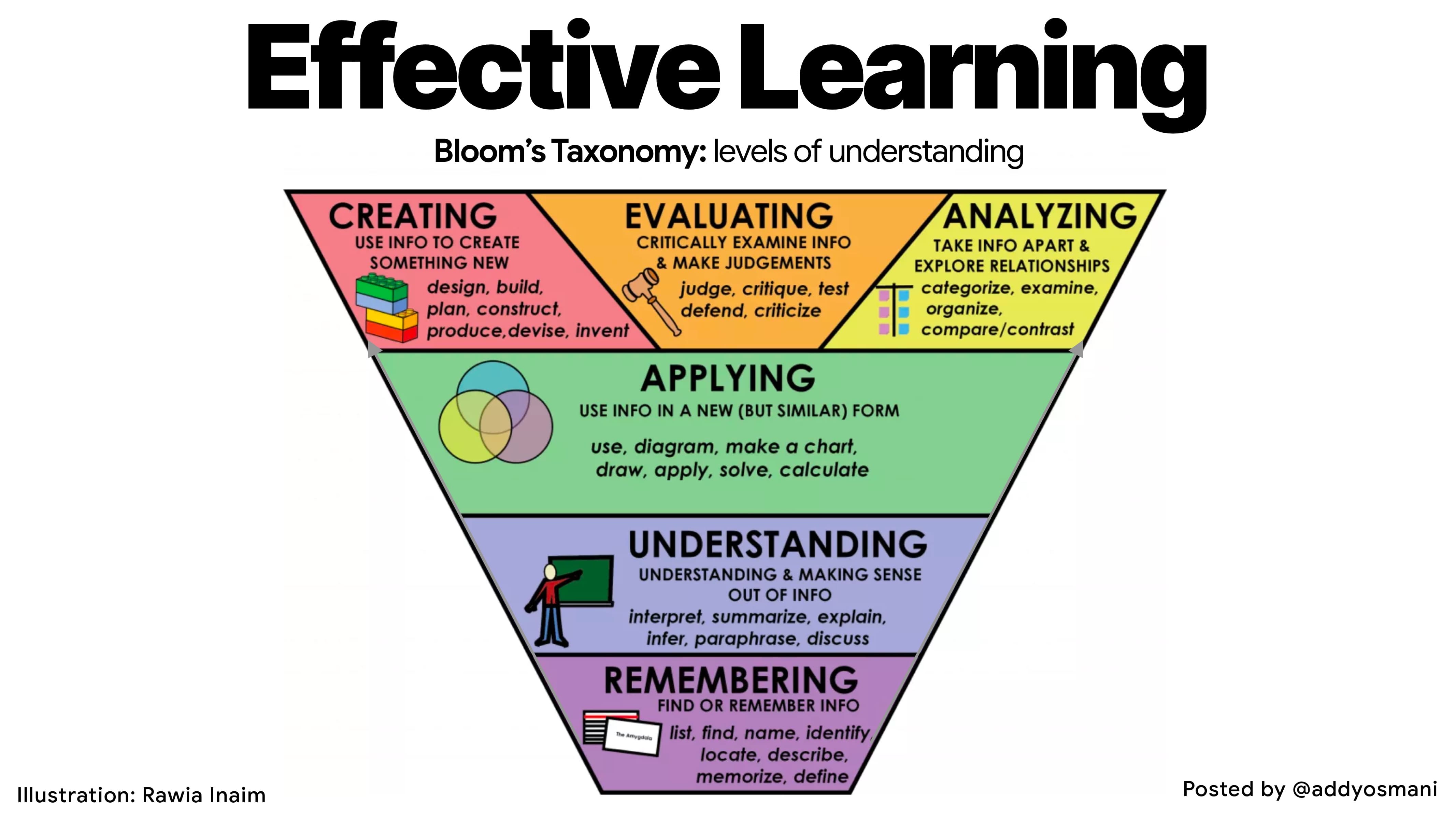
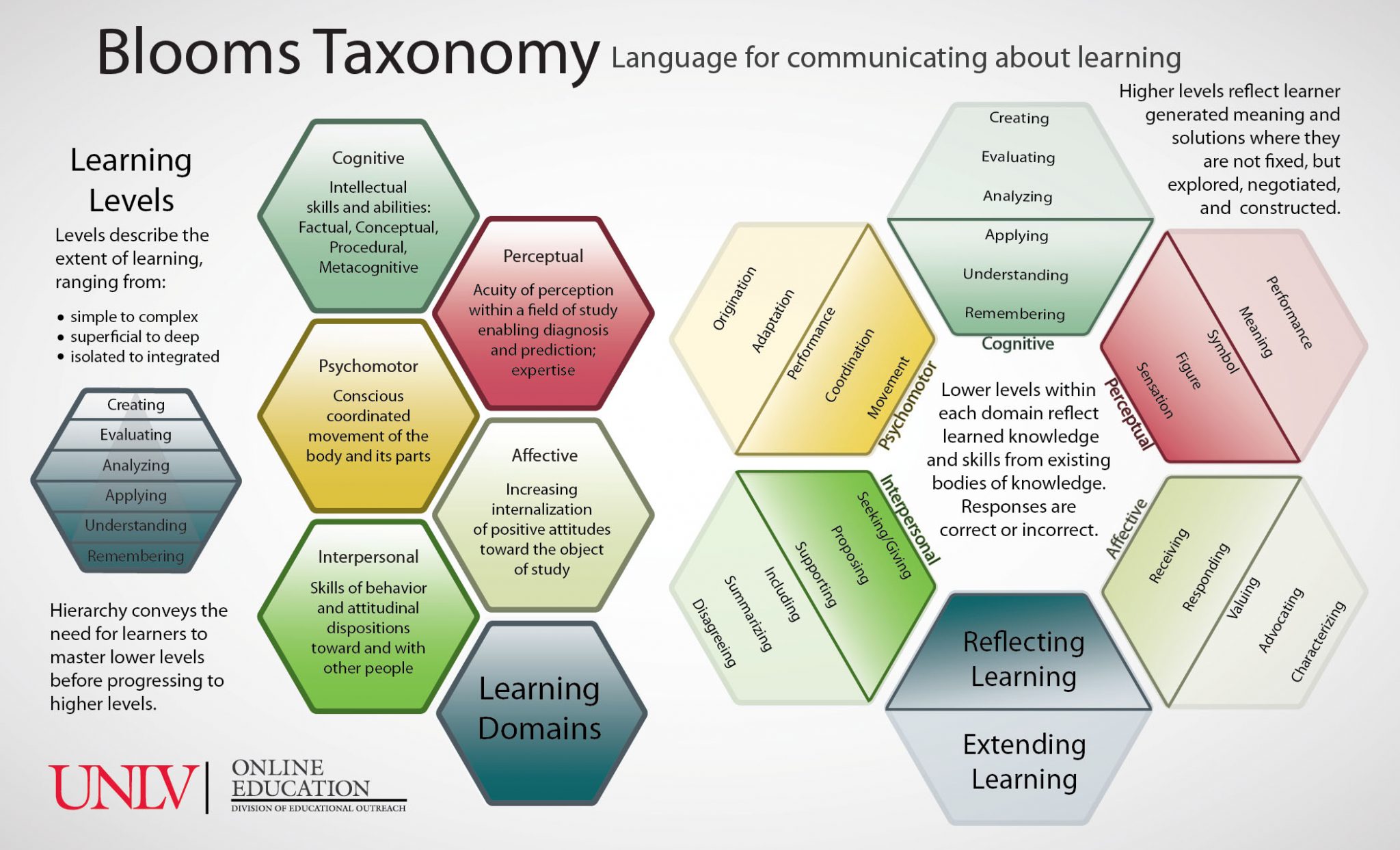
Understanding Bloom’s Taxonomy requires a granular look at its six cognitive levels. Educators use this progression to ensure that learners build a solid foundation before moving to higher-order thinking skills.
1. Remembering
This is the base of the pyramid. It involves retrieving, recognizing, and recalling relevant knowledge from long-term memory. It is the prerequisite for all further learning.
- Action Verbs: Define, list, repeat, name, memorize.
- Application: Identifying the capital of a country or reciting a historical date.
2. Understanding
Understanding requires the ability to construct meaning from instructional messages. It involves summarizing, interpreting, and classifying information.
- Action Verbs: Classify, describe, discuss, explain, identify, summarize.
- Application: Explaining the causes of a historical event in one’s own words rather than reciting them from a text.
3. Applying
Applying involves using a procedure in a given situation. It requires the learner to determine which concepts are appropriate for solving a problem.
- Action Verbs: Calculate, implement, solve, demonstrate, interpret.
- Application: Using a mathematical formula to solve a real-world engineering problem.
4. Analyzing
Analysis focuses on breaking material into constituent parts and detecting how the parts relate to one another and to an overall structure.
- Action Verbs: Differentiate, organize, relate, compare, contrast, examine.
- Application: Deconstructing a complex argument to identify bias or logical fallacies.
5. Evaluating
Evaluation is the process of making judgments based on criteria and standards. It involves checking for consistency or internal validity.
- Action Verbs: Critique, judge, check, detect, defend, verify.
- Application: Assessing the effectiveness of a proposed policy change based on economic data.
6. Creating
As the highest level in the revised taxonomy, Creating involves putting elements together to form a novel, coherent whole. It requires reorganizing elements into a new pattern or structure.
- Action Verbs: Design, construct, produce, invent, develop, formulate.
- Application: Writing an original research paper or developing a new business model.
Comparison of Taxonomy Versions
The transition from the 1956 original to the 2001 revision marked a significant philosophical shift in education. The following table illustrates the structural evolution of the model.
| Level | 1956 Original Version | 2001 Revised Version | Primary Focus |
|---|---|---|---|
| 1 | Knowledge | Remembering | Recall of facts |
| 2 | Comprehension | Understanding | Interpretation of meaning |
| 3 | Application | Applying | Use of information |
| 4 | Analysis | Analyzing | Structural breakdown |
| 5 | Synthesis | Evaluating | Judgment and critique |
| 6 | Evaluation | Creating | Generation of new ideas |
Practical Applications in Instructional Design
For educators and corporate trainers in 2026, the taxonomy remains a primary tool for aligning objectives with assessment. If the goal of a training module is to teach employees how to manage a new software platform, the curriculum must move them through the levels.
For instance, they must first remember the login protocols (Level 1). They must understand the software interface (Level 2) before they can apply the software to daily tasks (Level 3). To troubleshoot issues, they must analyze the system's output (Level 4), evaluate which tools are most efficient for specific workflows (Level 5), and perhaps create custom automation scripts to streamline their processes (Level 6).
Common Mistakes in Implementation
- Skipping the Foundation: Designers often attempt to jump straight to high-level analysis or creation without ensuring students have mastered the prerequisite knowledge.
- Mismatched Assessment: A frequent error is teaching at a "Creating" level but testing only at a "Remembering" level, which yields inaccurate data regarding the learner’s true competence.
- Over-relying on Verbs: The taxonomy is a framework, not a prescriptive checklist. Using a "high-level" verb does not automatically guarantee high-level cognitive engagement if the task itself remains superficial.
Frequently Asked Questions
Is Bloom’s Taxonomy mandatory for all learning environments? No, it is a tool for pedagogical guidance. While it is widely adopted in formal K-12 and higher education settings, its application in informal or vocational training depends on the specific goals of the curriculum designers.
Can a student perform at the "Creating" level without mastering the "Remembering" level? Generally, no. The hierarchy suggests a cumulative cognitive load. Creating something of value requires a synthesis of facts and concepts that must first be understood and analyzed.
How does Bloom’s Taxonomy handle digital learning tools? The framework is platform-agnostic. In 2026, digital tools such as generative AI or collaborative workspaces simply provide new mediums to achieve the same cognitive objectives—from using AI to summarize text (Understanding) to using AI as a partner to generate original product designs (Creating).
Are the six levels equally weighted? The levels are hierarchical, not equal. Mastery of the lower levels is considered a foundational prerequisite for the successful execution of the higher-level processes.
Does Bloom’s Taxonomy apply to non-academic skills? Yes, the framework is highly applicable to professional development, such as leadership training, where employees must understand organizational theory before they can evaluate company culture or create strategic plans.
Next Steps for Curriculum Development
To effectively integrate Bloom’s Taxonomy into your curriculum or training program, start by mapping your learning objectives to the six levels. Identify where the learners currently stand and verify that each instructional activity explicitly targets the cognitive level required for that specific module. Avoid overloading a single session with too many high-level goals; ensure that learners are given sufficient practice at the foundational levels before expecting them to engage in critical evaluation or original creation.
Image Gallery