10 Most Terrifying Sea Creatures of the Deep Ocean
The ocean shelters some of the most extraordinary and nightmare-inducing organisms on Earth. From deep-sea predators equipped with translucent fangs and bioluminescent lures to shallow-water species carrying lethal venom, these creatur...
The ocean shelters some of the most extraordinary and nightmare-inducing organisms on Earth. From deep-sea predators equipped with translucent fangs and bioluminescent lures to shallow-water species carrying lethal venom, these creatures have evolved specialized survival mechanisms to master their challenging marine environments, presenting appearances and behaviors that fascinate and terrify in equal measure.
Contents
The Biology of Deep-Sea Extremes: Why Ocean Predators Evolve Terrifying Features
The ocean covers over 70 percent of Earth's surface, with its abyssal and bathypelagic zones representing some of the most extreme habitats on the planet. Below 200 meters (650 feet), sunlight rapidly fades into absolute darkness, water pressure increases exponentially, and food becomes scarce. To survive in these harsh conditions, marine life has undergone drastic evolutionary adaptations that often result in uncanny, exaggerated physical forms.
In the complete absence of sunlight, vision functions differently. Many creatures develop giant, sensitive eyes to capture the faintest glimmers of bioluminescence, while others lose their sight entirely and rely on hyper-sensitive lateral line systems or tactile filaments. Feeding opportunistically is another imperative: when a meal might only cross a predator's path once every few weeks, the organism cannot afford to let it escape. This ecological pressure drives the evolution of massive, unhinging jaws, needle-sharp teeth that fold backward, and stomach walls capable of expanding to accommodate prey larger than the predator itself.
While abyssal creatures strike terror through their alien anatomy, shallow-water species often earn their terrifying reputations through invisible threats, such as potent neurotoxins or deceptive camouflage. Understanding these organisms requires examining both their biological structures and the specific ecological niches they occupy.
The 10 Most Terrifying Sea Creatures
1. Humpback Anglerfish (Melanocetus johnsonii)
- Bioluminescent Esca (Lure)
- Expandable Stomach
Residing in the bathypelagic zone at depths between 1,000 and 4,000 meters (3,280 to 13,120 feet), the humpback anglerfish is an iconic figure of deep-sea dread. The female of the species features a globular, pitch-black body dominated by a disproportionately large head and a cavernous mouth filled with translucent, inward-curving teeth.
Its most defining feature is the illicium—a modified dorsal fin spine projecting from above its snout. At the tip of this stalk rests the esca, an organ populated with bioluminescent bacteria (Photobacterium). By glowing in the pitch-black water, the anglerfish draws curious prey directly toward its open jaws.
The species also exhibits extreme sexual dimorphism. Male anglerfish are significantly smaller than females and lack the glowing lure. In many anglerfish families, males act as obligate sexual parasites, biting into the female's flesh and eventually fusing their circulatory system with hers, degenerating into little more than a sperm-producing organ.
2. Goblin Shark (Mitsukurina owstoni)
Often referred to as a "living fossil," the goblin shark belongs to the family Mitsukurinidae, a lineage tracing back over 125 million years. Inhabiting upper bathyal slopes at depths of roughly 200 to 1,300 meters, this rare shark stands out due to its flabby, pinkish body and a long, flat rostrum shaped like a blade.
The rostrum is lined with thousands of Ampullae of Lorenzini, electroreceptive organs capable of sensing the minute electrical fields generated by prey hiding in the seafloor mud. What makes the goblin shark truly terrifying, however, is its feeding mechanism. Its jaws are attached to elastic ligaments and can slingshot forward out of its mouth at high speeds—a process known as jaw protrusion. When prey comes within range, the shark catapults its jaws forward, snagging small fish, cephalopods, and crustaceans with nail-like teeth before snapping back into its head profile.
3. Fangtooth (Anoplogaster cornuta)
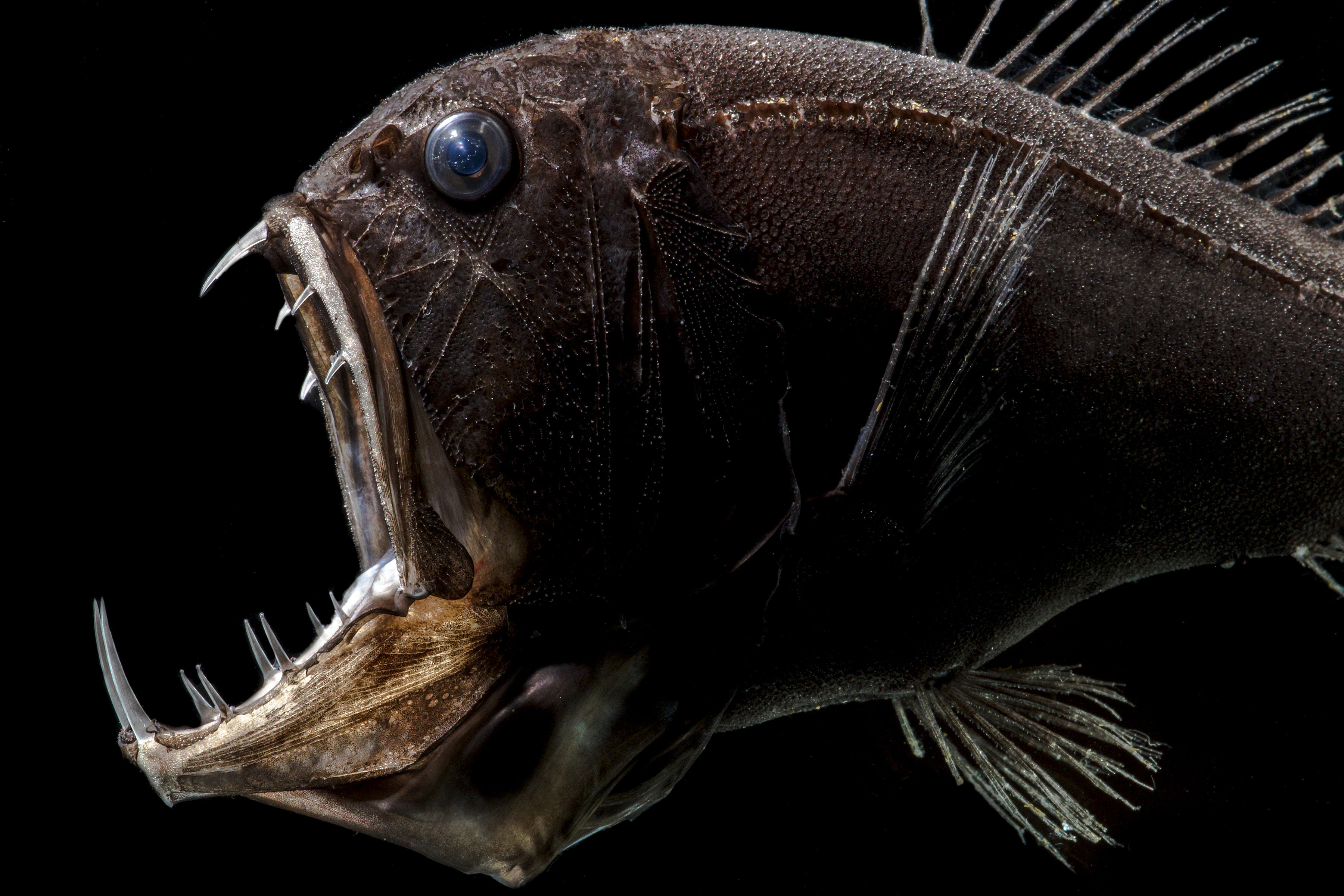
Despite its modest length—rarely exceeding 16 centimeters (6 inches)—the fangtooth possesses the largest teeth relative to body size of any known fish in the ocean. Found globally in tropical and temperate waters down to 5,000 meters, Anoplogaster cornuta is built for lethal efficiency in the aphotic zone.
The fangtooth's lower jaw features two prominent, razor-sharp fangs so long that the fish evolved specialized sockets on either side of its brain to prevent the teeth from piercing its own skull when its mouth closes. Because visual detection is impossible at bathypelagic depths, the fangtooth relies on contact feeding. It sweeps through the water column using its lateral line system to detect pressure changes, instantly clamping down on whatever crosses its path. Its tough, dark brown scale-armored body allows it to withstand extreme hydrostatic pressure.
4. Vampire Squid (Vampyroteuthis infernalis)
Translating literally to "vampire squid from hell," Vampyroteuthis infernalis is neither a true squid nor an octopus, but the sole surviving member of the order Vampyromorphida. Living in oxygen minimum zones (OMZs) at depths between 600 and 900 meters, where oxygen saturation can drop below 3 percent, this cephalopod relative is built for extreme efficiency.
- Large, reddish/blue eyes
- Webbed arms ("Pinecone" defense posture)
The vampire squid reaches lengths of approximately 30 centimeters and sports dark reddish-brown skin with large, sensory eyes that shift between blue and red depending on light conditions. Its eight arms are connected by a dark webbing, resembling a cloak. When threatened, it pulls its arms inside-out over its head in a posture known as the "pineapple" or "pinecone" defense, exposing rows of fleshy spines called cirri. Rather than ejecting black ink, which is invisible in total darkness, it expels a cloud of glowing bioluminescent mucus containing glowing orbs to disorient predators while it drifts into the dark.
5. Frilled Shark (Chlamydoselachus anguineus)
With an eel-like body stretching up to 2 meters (6.5 feet), the frilled shark looks more like a prehistoric sea serpent than a modern selachian. Occupying depths between 50 and 1,500 meters along continental shelves, Chlamydoselachus anguineus retains many primitive anatomical features, including six pairs of frilly, gill slits that extend across its throat.
Its mouth is armed with roughly 300 tricuspid teeth arranged in 25 rows. Each tooth features three sharp spikes angled backward. When a frilled shark strikes—bending its flexible body and lunging like a snake—the design of its teeth acts like a series of barbs, preventing soft-bodied prey like squid and fishes from backing out once hooked. The extended jaw articulation allows it to swallow prey up to half its own body length whole.
6. Sarcastic Fringehead (Neoclinus blanchardi)
While deep-sea monsters rely on pitch-black camouflage, the sarcastic fringehead brings terror to shallow coastal waters off the Pacific coast of North America. Measuring up to 30 centimeters (12 inches) long, this small, slender blenny inhabits abandoned shells, rock crevices, and man-made debris at depths ranging from 3 to 70 meters.
- Normal Profile
- Territorial Flare: Massive, brightly colored oral disk flare
The sarcastic fringehead is fiercely territorial. When an intruder approaches its burrow, the fringehead opens its massive, brightly colored mouth, displaying an enormous, elastic oral disk framed by metallic blue and yellow borders. If a rival fringehead refuses to back down, the two fish engage in "mouth wrestling"—pressing their wide open, needle-toothed mouths directly against one another to establish physical and spatial dominance.
7. Giant Isopod (Bathynomus giganteus)
For those with a fear of terrestrial insects, the giant isopod represents a nightmare on an enormous scale. A relative of the common pillbug (woodlouse), Bathynomus giganteus exhibits deep-sea gigantism—a phenomenon where benthic organisms grow substantially larger than their shallow-water counterparts due to cold temperatures, high pressure, and scarce food supplies.
Growing up to 50 centimeters (20 inches) in length and weighing over 1 kilogram, giant isopods inhabit the ocean floor at depths between 170 and 2,140 meters. Protected by a hard, segmented chitinous exoskeleton, they scavenge the benthic zone for falling organic material, known as marine snow, as well as sunken whale carcasses and fish remains. Their pale, glowing compound eyes contain over 3,500 individual lenses, giving them exceptional vision in low-light benthic habitats.
8. Pelican Eel (Eurypharynx pelecanoides)
Also known as the gulper eel, Eurypharynx pelecanoides is one of the most anatomically unusual fish in the ocean. Living at bathypelagic depths between 500 and 3,000 meters, the pelican eel possesses a small, slender body attached to a head dominated by an extraordinarily large mouth.
Its loose, pouch-like lower jaw functions much like that of a pelican, expanding to scoop up large volumes of water, crustaceans, and small cephalopods. The eel can unhinge its jaws to engulf organisms larger than itself. Once prey is trapped inside, the eel slowly closes its mouth and forces the water out through its gill slits before swallowing. At the end of its long, whip-like tail sits a complex organ that glows red and pink, which researchers believe is used as a lure to draw curious prey toward its gaping mouth. Learn more about bathypelagic adaptations from the Smithsonian Ocean Initiative.
9. Stargazer (Family Uranoscopidae)
The stargazer represents one of the most effective stealth predators in the marine environment. Found worldwide in both shallow and moderately deep coastal waters, these ambush predators bury themselves completely in the sand, leaving only their upward-facing eyes and wide, toothy mouths exposed.
- Eye
- Seafloor Sediment Line
- Upward-facing mouth with fringed lips
When prey swims overhead, the stargazer strikes upward with incredible speed, generating negative pressure to suck the victim into its mouth. Certain species, such as Uranaoscopus scaber, possess a worm-like appendage attached to the floor of their mouth that acts as a bait lure. Beyond their terrifying appearance, stargazers carry two large venomous spines located behind their opercles and above their pectoral fins. Some species can also deliver electric shocks of up to 50 volts using modified eye muscle organs.
10. Indo-Pacific Box Jellyfish (Chironex fleckeri)
Unlike the deep-sea species on this list whose terror stems from uncanny physical forms, the Indo-Pacific box jellyfish (Chironex fleckeri) earns its spot through lethal potency. Inhabiting coastal waters of Northern Australia and the Indo-Pacific region, this pale blue, translucent medusa possesses a cube-shaped bell up to 30 centimeters across, with up to 60 tentacles extending from its corners.
Each tentacle is loaded with millions of microscopic stinging cells called nematocysts. When triggered by contact, these cells fire microscopic venomous darts that penetrate skin and inject a complex cocktail of neurotoxins, myotoxins, and hemotoxins directly into the bloodstream. The venom can cause cardiac arrest, respiratory failure, and severe skin necrosis within minutes, making it one of the deadliest venomous marine animals known. Unlike true jellyfish that drift blindly, Chironex fleckeri possesses 24 complex eyes, complete with lenses and corneas, allowing it to actively navigate around obstacles and target prey.
Technical Comparison of Featured Species
The following table summarizes the depth ranges, physical dimensions, primary anatomical traits, and risk profiles of these marine organisms:
| Creature | Scientific Name | Typical Depth Range | Maximum Size | Primary Terror Adaptation | Threat to Humans |
|---|---|---|---|---|---|
| Humpback Anglerfish | Melanocetus johnsonii | 1,000–4,000 m | 18 cm (Females) | Bioluminescent lure, massive jaw/teeth | None (Habitat restricted) |
| Goblin Shark | Mitsukurina owstoni | 200–1,300 m | 3.8–6.0 m | Rapidly protrusible jaws, electroreception | None (Rarely encountered) |
| Fangtooth | Anoplogaster cornuta | 200–5,000 m | 16 cm | Oversized fangs, skull sockets | None (Habitat restricted) |
| Vampire Squid | Vampyroteuthis infernalis | 600–900 m | 30 cm | Webbed mantle, bioluminescent mucus | None (Harmless scavenger) |
| Frilled Shark | Chlamydoselachus anguineus | 50–1,500 m | 2.0 m | 300 needle-sharp tricuspid teeth | Extremely low |
| Sarcastic Fringehead | Neoclinus blanchardi | 3–70 m | 30 cm | Expansive mouth disk, territorial aggression | Minor (Bites if provoked) |
| Giant Isopod | Bathynomus giganteus | 170–2,140 m | 50 cm | Deep-sea gigantism, heavy armor | None (Benthic scavenger) |
| Pelican Eel | Eurypharynx pelecanoides | 500–3,000 m | 75 cm | Enormous unhinging pouch jaw | None (Habitat restricted) |
| Stargazer | Family Uranoscopidae | 0–400 m | 70 cm | Camouflaged ambush, venomous spines, electric discharge | Moderate (Venom/Spines) |
| Box Jellyfish | Chironex fleckeri | 0–10 m | 3 m (Tentacles) | Potent neurotoxic nematocysts | Extreme (Potentially fatal) |
Shallow vs. Deep-Sea Threats: Understanding Ecological Roles
It is helpful to distinguish between creatures that provoke fear due to biological aesthetics and those that pose real operational risks to humans.
- Deep-Sea Adaptation Path (Darkness, High Pressure, Sparse Food)
- Biological Traits: Transparent fangs, bioluminescence, soft tissues, expanding stomachs
- Human Risk Level: Non-existent (Organisms die outside high-pressure, cold environments)
- Shallow-Water Adaptation Path (High Competition, Coastal Predators)
- Biological Traits: Active venom glands, camouflage, electric defense, complex visual systems
- Human Risk Level: Moderate to Severe (Direct spatial overlap with swimmers and divers)
- Abyssal Adaptation: Creatures like the anglerfish, pelican eel, and fangtooth are structurally adapted to function under pressure hundreds of times greater than atmospheric pressure at sea level. Their muscle tissue is low-density and soft, and their bones are lightly ossified to save energy. If brought to the surface, the temperature change and pressure drop render them incapable of surviving. They pose zero physical risk to humans.
- Coastal Defense Mechanisms: Shallow-water species such as the box jellyfish and the stargazer evolved their lethal venom and camouflage mechanisms not to frighten humans, but to immobilize agile prey like fish or deter large marine mammals in competitive shallow habitats. Because humans swim, dive, and fish in these same coastal zones, encounters with these species carry genuine medical risks.
Understanding these biological differences transforms irrational fear into scientific appreciation. What appears grotesque or terrifying to human eyes is, in reality, a masterful evolutionary solution to surviving in Earth's most demanding ecological environments. For updated research on newly discovered deep-ocean biodiversity, refer to the global survey data compiled by the Ocean Census Initiative.
Frequently Asked Questions
Which deep-sea creature lives at the deepest ocean depth?
While creatures like the fangtooth (Anoplogaster cornuta) can reach depths around 5,000 meters, the deepest living fish recorded is the Mariana snailfish (Pseudoliparis swirei), discovered in the Mariana Trench at depths exceeding 8,000 meters (26,200 feet). Unlike large-jawed predators, snailfish are small, translucent, and adapted to extreme hydrostatic pressure.
Are deep-sea creatures dangerous to swimmers or divers?
No. Deep-sea species live hundreds to thousands of meters beneath the surface where humans cannot swim without specialized submersible equipment. Furthermore, the extreme pressure and cold temperatures of the deep ocean mean these creatures cannot survive in shallow waters.
Why do many deep-sea creatures have red skin or red bioluminescence?
Red light has the longest wavelength on the visible light spectrum and is absorbed by ocean water within the top 10 to 20 meters. Below 200 meters, red light is completely absent. Because there is no ambient red light to reflect, animals with red pigmentation appear pitch-black, offering optimal camouflage against predators and prey.
How do deep-sea creatures withstand extreme ocean pressure?
Deep-sea organisms lack air-filled cavities like lungs or swim bladders that would collapse under immense pressure. Instead, their tissues contain high concentrations of small organic molecules called osmolyts (such as trimethylamine N-oxide, or TMAO), which stabilize proteins and cellular structures against pressure-induced distortion.
What should you do if stung by a box jellyfish?
If stung by an Indo-Pacific box jellyfish (Chironex fleckeri), immediate emergency medical aid is required. The sting area should be doused liberally with household vinegar (acetic acid) for at least 30 seconds to un-fired nematocysts and stop further venom injection. Do not rub the wound or apply fresh water, as this triggers remaining stingers to discharge.
Recommended Next Steps
To further explore marine biology and ocean exploration without falling prey to sensationalized myths, consider taking the following actions:
- Explore Verified Research Databases: Use academic portals such as the World Register of Marine Species (WoRMS) or NOAA’s Ocean Exploration archive to view high-definition footage and taxonomic data gathered by Remotely Operated Vehicles (ROVs).
- Support Ocean Conservation: Many bathypelagic ecosystems are threatened by emerging industrial activities such as deep-sea mining and bottom trawling. Support organizations dedicated to establishing Marine Protected Areas (MPAs) in international waters.
- Practice Coastal Safety: If visiting tropical marine environments where venomous species like box jellyfish or stargazers reside, consult local lifeguard reports, wear protective stinger suits or thick wetsuits during peak jelly seasons, and refrain from touching unfamiliar benthic organisms.
Image Gallery