Shulman & Hill Workers' Compensation Law Firm in Brooklyn, NY: Navigating Your Claim
Shulman & Hill is a New York law firm representing injured employees throughout Brooklyn in Workers' Compensation claims, contested hearing disputes, medical benefit denials, and third-party personal injury lawsuits. The firm helps wor...
Shulman & Hill is a New York law firm representing injured employees throughout Brooklyn in Workers' Compensation claims, contested hearing disputes, medical benefit denials, and third-party personal injury lawsuits. The firm helps workers navigate the New York State Workers' Compensation Board filing process, contest insurer denials, negotiate lump-sum settlements, and secure maximum statutory wage replacement and medical coverage.
Contents
Navigating Workers' Compensation in Brooklyn, New York
Under New York State law, almost all employers are required to carry workers' compensation insurance to cover employees who suffer job-related injuries or occupational illnesses. The system is designed as a no-fault insurance arrangement: employees do not need to prove their employer was negligent to receive benefits, but in exchange, they generally give up the right to sue their employer directly for negligence.
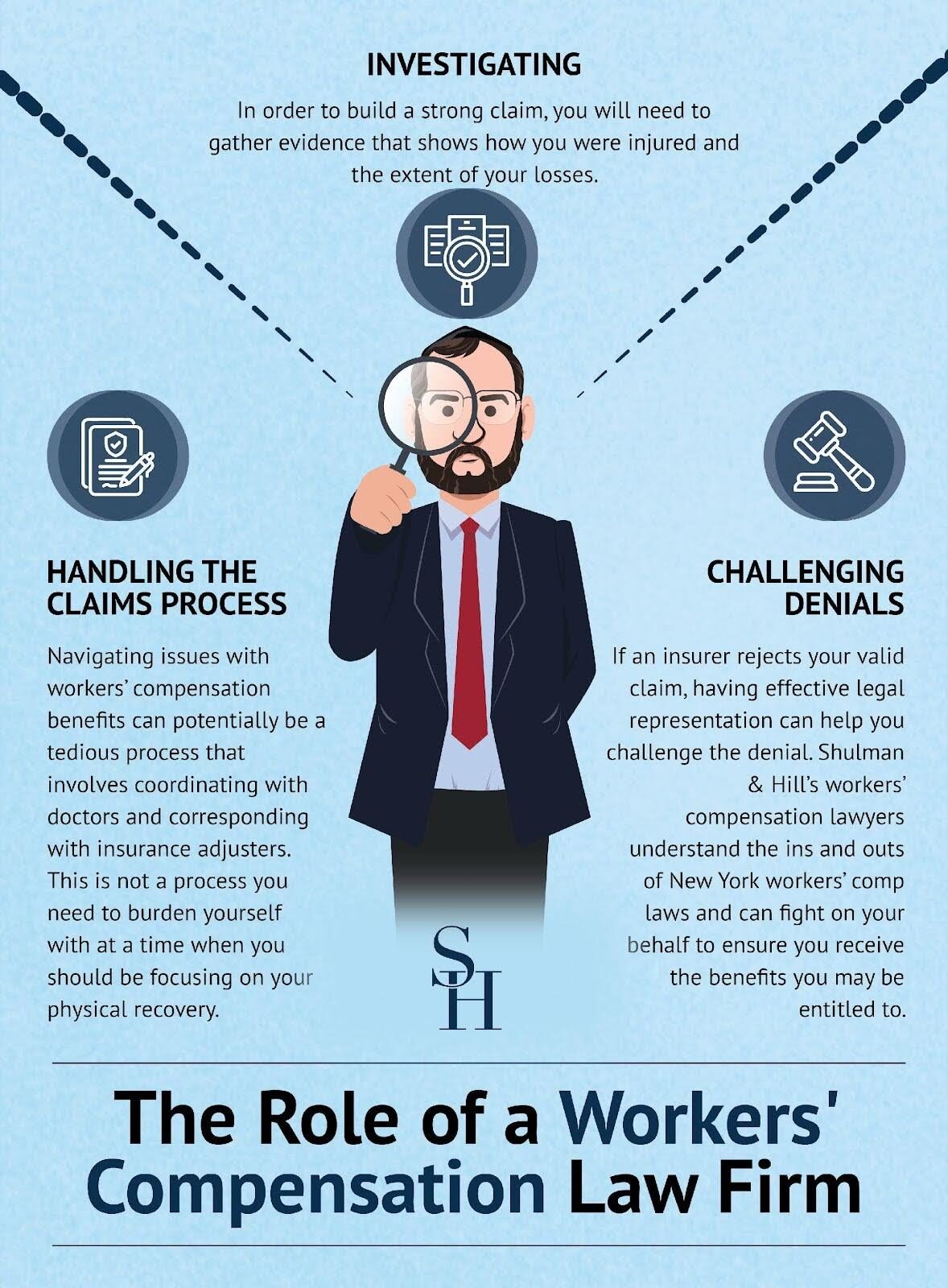
Despite the no-fault nature of the program, obtaining full financial recovery is rarely straightforward. Insurance carriers frequently dispute the extent of an injury, challenge whether an accident occurred within the scope of employment, or classify a disability as temporary rather than permanent to minimize payouts. Working with an experienced legal team such as Shulman & Hill, located in Brooklyn, ensures that injured workers present thorough medical documentation, meet strict statutory deadlines, and maintain their rights throughout administrative hearings before the New York State Workers' Compensation Board.
Brooklyn’s commercial and industrial landscape exposes workers to diverse occupational hazards. From high-rise construction sites along the Downtown Brooklyn skyline to maritime operations, healthcare facilities, warehouse fulfillment centers, and public transport infrastructure, workplace injuries range from sudden traumatic events to cumulative repetitive stress disorders.
Disclaimer: This guide provides educational information regarding New York State workers' compensation procedures and general legal framework as of 2026. It does not constitute formal legal advice. Injured workers should consult a qualified attorney for advice regarding specific legal matters.
Core Services Provided by Shulman & Hill in Brooklyn
Shulman & Hill handles complex workplace injury cases, combining traditional workers' compensation representation with personal injury litigation when third-party negligence is involved. Their primary practice areas for injured Brooklyn workers include:
1. Initial Claim Filing and Documentation
Filing a workers' compensation claim requires precision. Errors or omissions in the initial paperwork can lead to delayed benefit payments or outright claim rejections. Attorneys ensure that the Employee Claim Form (Form C-3) is accurately completed and submitted alongside supporting medical reports (Form C-4) from board-authorized physicians.
2. Contesting Claim Denials and Notice Disputes
If an insurance carrier controverts (denies) a claim—arguing, for example, that the injury occurred outside working hours or resulted from a pre-existing condition—the firm represents the worker at formal hearings before a Workers' Compensation Law Judge (WCLJ). Attorneys gather witness statements, subpoena employment records, and obtain supplemental medical testimony to establish causal relationship.
3. Medical Treatment Authorization Disputes
Under New York Workers' Compensation Board Medical Treatment Guidelines (MTG), insurance carriers must authorize necessary treatments, diagnostic tests, surgeries, and physical therapy. When carriers issue denials or fail to respond to Form MG-2 (Variance Requests), legal intervention helps expedite administrative review and secure needed medical care.
4. Schedule Loss of Use (SLU) and Disability Classification
When an injury results in permanent impairment to an extremity (arm, leg, hand, foot), vision, or hearing, the worker may be entitled to a cash award known as a Schedule Loss of Use (SLU). Attorneys work with medical experts to evaluate the percentage of loss of function under Board medical standards, ensuring the claimant receives the full monetary evaluation statutory formulas allow.
5. Section 32 Settlement Negotiations
A Section 32 Waiver Agreement allows an injured worker to settle their claim for a negotiated lump-sum payment, closing part or all of their future benefit entitlement. Attorneys evaluate whether a lump-sum settlement is in the claimant’s best long-term interest, structure indemnity and medical allocations, and draft agreements that meet WCB approval requirements.
Statutory Benefits Under New York Workers' Compensation Law
The New York State Workers' Compensation Law governs the types and amounts of compensation available to injured employees. Statutory benefits generally fall into three primary categories:
Cash Benefits (Indemnity Payments)
Weekly wage replacement benefits are calculated based on the worker's Average Weekly Wage (AWW) for the 52 weeks prior to the injury and the degree of disability assigned by a medical provider.
The formula used by the Workers' Compensation Board is:
$$\text{Weekly Benefit} = \frac{2}{3} \times \text{Average Weekly Wage} \times \text{Disability Percentage}$$
- Total Disability (100%): Receives two-thirds of the pre-injury Average Weekly Wage, subject to the state maximum weekly cap set for the date of injury.
- Partial Disability (e.g., 50%): Receives a proportionate reduction based on the degree of impairment and loss of earning capacity.
- Statutory Maximum Caps: The maximum weekly benefit is adjusted annually based on the New York State Average Weekly Wage (NYSAWW).
Medical Benefits
The employer’s insurance carrier must pay for all reasonable and medically necessary treatment related to the accepted work injury or illness. This includes emergency care, physician visits, surgery, hospitalization, prescription medications, medical devices, and travel reimbursement for medical visits. Injured workers must seek treatment from healthcare providers who are authorized by the New York State Workers' Compensation Board, except in emergency situations.
Death Benefits
If a workplace injury or occupational disease results in death, surviving spouses, dependent children, or dependent estate beneficiaries are entitled to weekly cash compensation and funeral expense reimbursement up to statutory limits established for Kings County and the broader New York City metropolitan area.
Workers' Compensation vs. Third-Party Personal Injury Claims
A critical area of legal strategy involves identifying whether an injured worker has both a workers' compensation claim and a third-party personal injury lawsuit.
While workers' compensation benefits cover medical expenses and partial lost wages regardless of fault, they do not provide recovery for non-economic damages such as pain and suffering, loss of enjoyment of life, or full lost wages. However, if a third party (someone other than the employer or a co-worker) contributed to the accident, the worker may file a civil personal injury lawsuit.
- Workplace Accident Occurs in Brooklyn
- Workers' Compensation Claim (No-Fault / Board Process)
- Medical Coverage
- Partial Wage Replacement
- SLU / Disability Awards
- Third-Party Lawsuit (Civil Court / Fault-Based)
- Full Lost Wages
- Pain & Suffering
- Loss of Consortium
- Workers' Compensation Claim (No-Fault / Board Process)
Common Third-Party Scenarios in Brooklyn
- Construction Site Accidents: Under New York Labor Law § 240(1) (the "Scaffold Law") and Labor Law § 241(6), general contractors and property owners maintain non-delegable duties to provide proper safety equipment for elevation-related risks. A worker injured in a scaffold collapse or fall from heights can collect workers' compensation while simultaneously suing the property owner or general contractor for full damages.
- Motor Vehicle Collisions: Delivery drivers, transit employees, or traveling workers hit by a negligent driver while on the job can seek workers' comp from their employer's carrier and file a personal injury claim against the at-fault driver.
- Defective Equipment: If a worker is injured by a malfunctioning power tool, defective machinery, or unsafe industrial equipment, a product liability suit may be brought against the manufacturer or distributor.
Comparative Overview: Workers' Compensation vs. Civil Personal Injury
| Feature | New York Workers' Compensation Claim | Third-Party Personal Injury Lawsuit |
|---|---|---|
| Fault Requirement | No-fault system; fault is irrelevant. | Must prove third-party negligence or statutory violation. |
| Eligible Defendants | Employer's insurance carrier only. | Third parties (property owners, general contractors, drivers, tool manufacturers). |
| Pain & Suffering | Not recoverable. | Full recovery permitted for past and future pain and suffering. |
| Wage Replacement | Capped at 2/3 of Average Weekly Wage up to state maximum. | 100% of past and future lost income, plus lost earning capacity. |
| Medical Expenses | Covered 100% based on Board fee schedules. | Recoverable as past and future economic damages. |
| Resolution Body | NYS Workers' Compensation Board (Administrative). | NY State Supreme Court (e.g., Kings County Supreme Court). |
Critical Filing Timelines in New York State
Strict statutory deadlines govern workers' compensation claims in New York. Missing a deadline can result in permanent forfeiture of benefits.
Injury Event
Notice to Employer (30 Days)
File Form C-3 with WCB (2 Years)
30 Days – Employer Notification: Under New York Workers' Compensation Law § 18, an injured worker must provide written notice of the injury to their employer within 30 days of the accident date. For occupational diseases, notice must be given within 90 days after the worker knew or should have known that the disease was due to the nature of the employment.
2 Years – Claim Filing (Form C-3): Under Law § 28, the formal Employee Claim (Form C-3) must be filed with the Workers' Compensation Board within two years of the date of the accident or within two years from the date of disablement caused by an occupational disease.
90 Days / 1 Year 90 Days – Municipal Entities: If the workplace injury involves a public authority or municipality in Brooklyn (such as the City of New York, MTA, or NYC Health + Hospitals) for a third-party claim, a Notice of Claim must generally be served within 90 days, and the lawsuit commenced within one year and 90 days.
Common Challenges and Legal Remedies
Insurer resistance is common in high-value or long-term disability claims. Experienced attorneys use administrative and legal procedures to protect claimant rights.
Independent Medical Examinations (IMEs)
Insurance companies frequently require claimants to attend an examination conducted by a physician paid by the carrier (an IME under WCL § 13-a). IME doctors often issue reports concluding that the worker has fully recovered or that current symptoms stem from pre-existing conditions.
- Legal Remedy: Attorneys cross-examine IME physicians, present opposing treating physician reports (Form C-4.2), and request depositions or hearings to challenge the credibility of the insurance doctor's findings.
Average Weekly Wage (AWW) Disputes
Because cash benefits depend directly on the AWW, insurance carriers may miscalculate earnings by omitting overtime, seasonal bonuses, concurrent employment earnings, or fringe benefits.
- Legal Remedy: Counsel submits payroll records (Form C-240) for the 52 weeks preceding the accident to establish an accurate AWW, ensuring maximum weekly benefit checks.
Form C-8.1 Disputes (Unpaid Medical Bills)
When medical providers are not reimbursed by the carrier, providers may bill the claimant directly or cease care.
- Legal Remedy: Filing administrative objections (Form HP-1) and bringing the issue before a WCLJ forces the insurer to comply with statutory treatment coverage mandates.
Step-by-Step Action Plan Following a Brooklyn Workplace Injury
Injured workers can protect their health and legal claims by taking immediate, structured steps:
- Obtain Immediate Medical Evaluation: Seek medical treatment at an emergency room, urgent care center, or authorized physician. Explicitly inform medical personnel that the injury occurred on the job so the visit is billed under Workers' Compensation and registered on Form C-4.
- Report the Accident in Writing: Provide written notice to a supervisor or HR department within 30 days. Detail the exact date, time, location, and nature of the incident. Keep a copy of the written notification.
- Document the Scene and Symptoms: Take photographs of dangerous workplace conditions, broken equipment, safety violations, and physical injuries. Record names and contact details of co-workers who witnessed the event.
- File Form C-3 with the NYS WCB: Complete and submit the official claim form online or by mail to establish a formal case number (WCB Case #).
- Track Out-of-Pocket Costs and Mileage: Keep receipts for prescription co-pays, medical supplies, and travel logs (miles driven or transit fares) to and from authorized medical appointments for reimbursement.
- Consult a Workers' Compensation Attorney: Seek a legal evaluation prior to giving recorded statements to insurance adjusters or signing full release forms or settlement agreements.
Legal Fee Structure in New York Workers' Compensation
Injured workers facing financial stress often worry about the cost of hiring legal representation. In New York Workers' Compensation cases:
- No Upfront Retainers or Out-of-Pocket Legal Fees: Attorneys operate on a contingency fee basis regulated directly by statute.
- Board Approval Required: A lawyer cannot charge or collect a fee directly from the injured worker. All legal fees must be submitted to and approved by a Workers' Compensation Law Judge.
- Deduction from Awards: Approved legal fees (typically around 10% to 15% of the monetary benefits recovered or secured, depending on the complexity and stage of the case) are deducted directly from the back-pay award or lump-sum settlement issued by the insurance carrier. If no financial recovery is obtained, no legal fee is awarded for the workers' compensation representation.
Frequently Asked Questions
Can I be fired for filing a workers' compensation claim in Brooklyn?
No. Section 120 of the New York Workers' Compensation Law strictly prohibits employers from discriminating or retaliating against an employee for filing a claim or testifying in a workers' compensation proceeding. If an employer fires, demotes, or harasses a worker for seeking benefits, the worker can file a retaliatory discharge complaint with the Board to seek reinstatement, lost wages, and civil penalties.
What if I was partially at fault for my work accident?
New York Workers' Compensation is a no-fault system. You remain eligible for full statutory medical and cash benefits even if your own mistake or negligence caused the accident. Benefits are barred only under rare statutory exceptions, such as when the injury resulted solely from intentional self-harm or severe intoxication from alcohol or drugs on the job.
What is a Schedule Loss of Use (SLU) award?
A Schedule Loss of Use (SLU) award is a lump-sum cash benefit for workers who suffer a permanent functional impairment to an extremity (such as a hand, arm, foot, leg), or loss of vision or hearing. The Workers' Compensation Board provides a statutory schedule specifying a set number of weeks of compensation for total loss of each body part; a partial percentage loss pays a corresponding fraction of those statutory weeks.
Can I see my own personal doctor for a work injury?
You may see your personal doctor only if that physician is specifically authorized by the New York State Workers' Compensation Board to treat injured workers. If your doctor is not Board-authorized, the insurance company is not obligated to pay for the care. In emergency situations, initial care at any emergency department is fully covered regardless of authorization status.
How long can I receive workers' compensation wage benefits in New York?
For temporary total disability, benefits continue as long as medical evidence supports total incapacity, up to statutory maximum limits. For permanent partial disability established after July 13, 2007, New York law caps the duration of wage benefits between 225 and 525 weeks, depending on the established percentage of loss of wage-earning capacity. Permanent total disability benefits can continue for life.
Practical Recommendations for Injured Workers
Navigating a workplace injury in Brooklyn requires balancing physical recovery with rigorous legal compliance. To protect your financial security, prioritize written communication with your employer, ensure every treating doctor submits official C-4 reports directly to the Workers' Compensation Board, and exercise caution when interacting with insurance claims adjusters.
If your claim is controverted, your benefits are delayed, or your injury involves a third party, consulting an experienced firm like Shulman & Hill allows you to protect your rights, challenge improper IME denials, and pursue all available avenues of monetary recovery under New York law.
Image Gallery