Why the Online Textile Course Works for Career Changers
Enrolling in an online textile course allows career changers to gain specialized industry knowledge—such as fiber science, fabric construction, digital pattern design, and supply chain management—without leaving their current jobs. Thi...
Enrolling in an online textile course allows career changers to gain specialized industry knowledge—such as fiber science, fabric construction, digital pattern design, and supply chain management—without leaving their current jobs. This flexible educational format combines remote theoretical training with hands-on swatch kits, enabling career pivoters to build professional portfolios and transition into apparel, home furnishings, or technical textiles efficiently.
Contents
The Evolving Landscape of Textile Education
The textile and apparel industries are undergoing rapid transformation. Advances in digital printing, 3D garment simulation, sustainable material development, and global supply chain logistics have expanded the technical requirements for entry-level and mid-tier roles. Historically, entering the textile sector required a traditional four-year Bachelor of Fine Arts (BFA) or Bachelor of Science (BS) in Textile Design, Weaving, or Textile Engineering. These campus-bound programs often presented significant barriers to working adults due to rigid schedules, high tuition fees, and geographical relocation demands.
Online textile education has evolved to meet modern industry demands while solving accessibility challenges for non-traditional students. Rather than relying solely on physical campus looms and chemistry laboratories, contemporary online courses utilize specialized physical material kits, cloud-based textile Computer-Aided Design (CAD) software, virtual loom simulators, and high-definition macro video tutorials. This structural shift makes modern textile education flexible, targeted, and directly tailored for professionals seeking a strategic career change.
Key Reasons Online Textile Courses Suit Career Changers
Transitioning to a new field as an adult requires balancing learning commitments with existing professional and personal obligations. Online textile courses are structured around the practical realities facing career changers.
CAREER CHANGER LEARNING ADVANTAGES
- Asynchronous Flexibility: Retain current income during pivot
- Skill-Specific Modules: Fast-track practical competency
- Portfolio-Focused Output: Demonstrate real-world capability
- Low Capital Investment: Minimize tuition & relocation risk
Asynchronous Flexibility for Working Professionals
Most career changers cannot afford to take a hiatus from full-time employment to attend daytime lectures. Asynchronous online learning platforms allow students to study fiber chemistry, fabric structures, and pattern repeats during off-hours. Lectures, reading materials, and technical demonstrations are available on demand, enabling learners to pace their education according to their personal schedules.
Targeted, Industry-Aligned Curriculums
Traditional degree programs often include broad general education coursework that extends program duration to three or four years. In contrast, professional online textile courses focus directly on practical industry skills. Curriculums concentrate on essential competencies such as:
- Fabric Analysis: Identifying fiber content, yarn types, weave structures, and knit density.
- Textile Software Mastery: Using industry-standard programs like Adobe Illustrator, Photoshop, Pointcarré, NedGraphics, or CLO 3D.
- Production Technical Packs: Creating detailed spec sheets for manufacturing partners.
- Regulatory Compliance: Navigating fiber labeling standards, safety testing, and environmental certifications.
Hands-On Tactile Experience via Remote Swatch Kits
A common concern among prospective students is whether a tactile discipline like textiles can be mastered remotely. Leading online courses address this by delivering curated physical swatch kits directly to students.
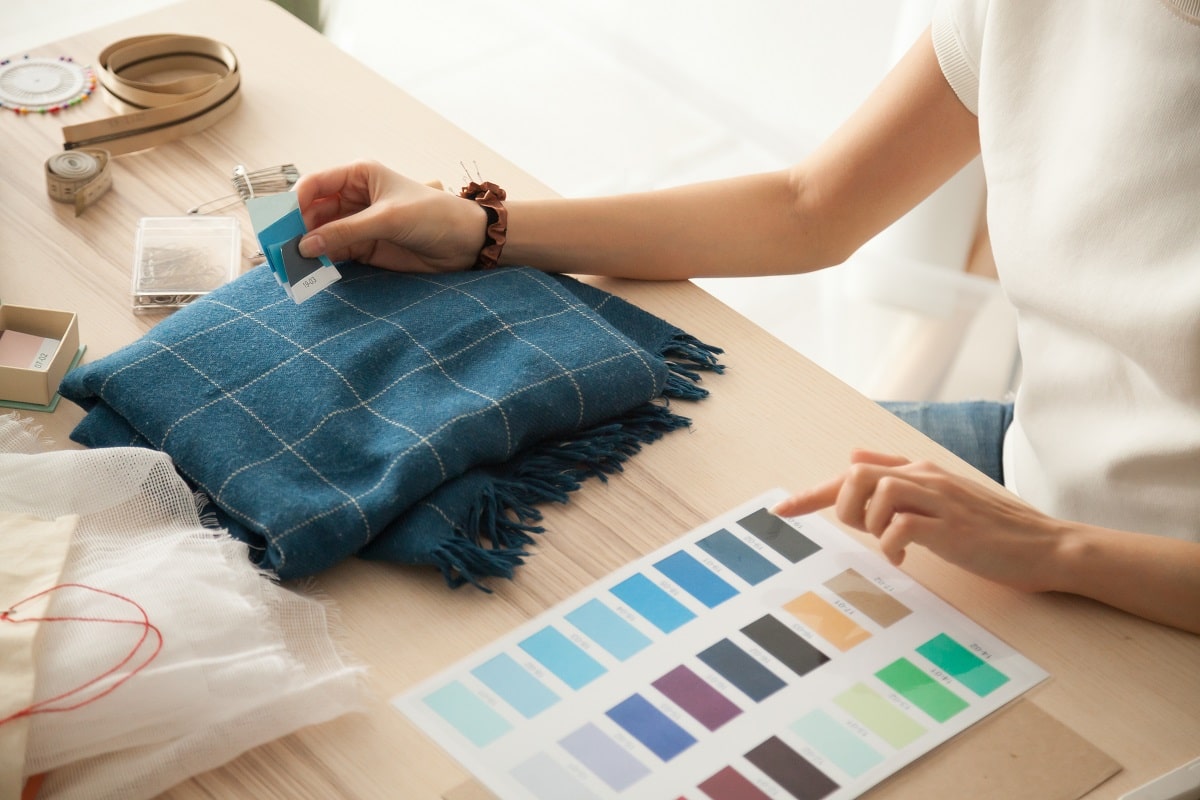
Equipped with magnifying pick glasses (line testers), burn-test identification sets, fabric weight scales, and hundreds of standardized fiber and weave samples, students perform physical hand-feel (handle) assessments, thread counts, and fiber burn tests at home while following guided video tutorials. This hybrid approach ensures that digital conceptual learning is continuously reinforced through physical contact with real-world materials.
Core Disciplines Taught in Online Textile Programs
To succeed in the textile industry, career changers must develop a balanced foundation in both creative design and technical material science. Quality online textile courses break these requirements down into distinct, structured modules.
- ONLINE TEXTILE CURRICULUM
- TECHNICAL SCIENCE
- Fiber & Yarn Properties (GSM, Denier)
- Weave & Knit Structures (Twill, Jacquard)
- Dyeing & Finishing Operations
- Sustainable Certifications (GOTS, OEKO-TEX)
- CREATIVE DESIGN
- Surface Pattern Design & Repeats
- Color Separation & Palette Math
- Digital Rendering & CAD Workflows
- Spec Sheet & Tech Pack Generation
- TECHNICAL SCIENCE
Fiber Science and Yarn Construction
Understanding raw materials is fundamental to designing, sourcing, or quality-assuring textiles. Students learn to categorize fibers into natural (cotton, wool, linen, silk) and synthetic/regenerated categories (polyester, nylon, rayon, lyocell, recycled synthetics).
Key metrics covered include:
- Yarn Count and Denier: Measuring yarn fineness across cotton count ($Ne$), metric count ($Nm$), and Denier/Tex systems.
- Yarn Twist and Structure: Evaluating single, ply, and novelty yarns, along with how S-twist and Z-twist affect fabric strength and drape.
- Fabric Mass per Unit Area: Calculating grams per square meter (GSM) or ounces per square yard (OSY) to determine suitability for specific end-uses, such as lightweight apparel or heavy upholstery.
Fabric Mechanics: Weaves, Knits, and Non-Wovens
Courses systematically guide learners through fabric construction methods. In weaving modules, students analyze warp and weft interactions, studying fundamental weaves (plain, twill, satin) alongside complex structures like dobby and jacquard.
In knitting modules, students learn to differentiate between warp knits (tricot, raschel) and weft knits (single jersey, rib, interlock), examining stretch percentages, recovery, and edge-curl characteristics essential for activewear and athleisure design.
Surface Pattern Design and Digital CAD Integration
For career changers targeting print and surface design, online programs teach technical repeat creation. Students master straight-across, half-drop, and brick repeats while managing color separation for screen printing or color profiling for direct-to-fabric digital printing.
Learning to work within factory color limits (such as Pantone Fashion, Home + Interiors standards) ensures that creative output remains commercially viable and ready for industrial production.
Educational Pathway Comparison
Choosing the right learning platform requires comparing time commitments, financial investments, and tangible outcomes across different educational models.
| Evaluation Metric | Professional Online Textile Course | University BFA/BS Degree | Self-Taught / Free Tutorials |
|---|---|---|---|
| Typical Duration | 3 to 12 months | 2 to 4 years | Unstructured (variable) |
| Estimated Tuition | $500 – $3,500 | $20,000 – $80,000+ | $0 – $200 (books/materials) |
| Schedule Flexibility | High (Asynchronous) | Low (Fixed campus hours) | Very High |
| Tactile Component | Physical swatch kits & home labs | On-campus studios & equipment | Self-sourced material samples |
| Software Training | Focused, job-relevant CAD instruction | Comprehensive broad software labs | Ad-hoc, piecemeal software videos |
| Portfolio Development | Guided commercial portfolio creation | Academic portfolio development | Unguided personal projects |
| Industry Networking | Virtual peer groups & mentor reviews | Campus career fairs & alumni network | Independent social media networking |
Leveraged Career Transition Strategy
Career changers rarely start from zero; they bring valuable soft skills and industry experience from prior fields. The key to a successful transition is blending previous professional experience with newly acquired textile technical skills.
- PAST CAREER EXPERTISE
- Project Management
- Graphic Design
- Data Analysis/Sales
- ONLINE TEXTILE COURSE
- Fiber & Fabric Specs
- Textile CAD & Repeat
- Sourcing & Compliance
- HIGH-VALUE HYBRID CAREER ROLE
- Product Developer / Sourcing Specialist
- Surface Pattern Designer
- Technical Fabric Account Manager
Identifying Transferable Skills
Prior professional backgrounds map directly into high-demand textile roles:
- Graphic Designers & Illustrators: Can transition rapidly into Surface Pattern Design or Print Colorist roles by learning textile-specific repeat math, color separation, and fabric printing characteristics.
- Supply Chain & Operations Managers: Can pivot to Textile Sourcing Managers or Apparel Production Coordinators by gaining technical knowledge in fabric testing standards, factory audit protocols, and mill communication.
- Sales & Client Management Professionals: Can step into Textile Account Executive or B2B Material Representative positions, using their communication skills alongside fabric specification expertise.
Building a Industry-Ready Portfolio
An online textile course helps career changers build an industry-aligned portfolio that showcases practical technical capability rather than just abstract creative concepts.
A professional textile portfolio should include:
- Concept Boards: Clearly defined target market, end-use case (e.g., performance outerwear, luxury bedding), and seasonal color story using standardized palettes.
- Pattern Collections: Mini-collections demonstrating a main hero print alongside supporting secondary prints and coordinate patterns in technical repeat.
- Technical Specification Sheets (Tech Packs): Detailed factory documentation outlining fiber content, weave/knit construction, finished GSM, print methods, pantone codes, and quality assurance testing metrics (e.g., Martindale abrasion resistance, colorfastness).
- Physical Swatch Documentation: Clear photography or video demonstration of physical samples, showcasing drape, texture, and structural characteristics.
Selecting the Right Online Textile Course
Not all online courses provide the depth required to support a complete career change. Prospective students should evaluate programs against clear quality standards before enrolling.
- COURSE SELECTION CHECKLIST
- Instructor Credentials: Active industry professionals or educators
- Material Kit Inclusion: Physical swatches, pick glass, burn test kit
- Software Integration: Teaches Adobe Illustrator/Photoshop or specialized CAD
- Portfolio Mentorship: Live or async critique of student work
- Industry Standard Units: Covers ISO/AATCC testing, GSM, construction specs
Instructor Background and Practical Curriculum
Verify that course instructors possess real-world experience in textile design, mill management, or product development. Curriculums should reflect modern industrial practices, covering current supply chain compliance standards, such as the Global Organic Textile Standard (GOTS) for organic fibers or OEKO-TEX Standard 100 for harmful substance testing.
Software Integration and Hardware Requirements
Ensure the program covers software used by commercial textile studios. While general drawing apps are useful for preliminary sketches, professional employers expect fluency in vector-based programs like Adobe Illustrator, raster-based manipulation in Adobe Photoshop, or specialized CAD platforms. Additionally, check whether the program provides student software licenses or discounts.
Mentorship, Peer Review, and Portfolio Feedback
Self-paced video courses without instructor feedback can leave students unsure of their progress. Prioritize platforms that offer direct feedback on assignments, peer review forums, or one-on-one portfolio critiques from experienced mentors. This guidance ensures that your work meets professional manufacturing standards.
Frequently Asked Questions
Can you effectively learn textile design and fabric science online without access to a university campus?
Yes. Modern online textile courses use high-definition video demonstrations paired with physical swatch kits sent directly to your home. Students perform hand-feel evaluations, thread count measurements, and fiber burn tests independently. When combined with digital CAD software instruction, learners build practical skills that match modern remote and hybrid industry workflows.
What entry-level roles can career changers target after completing an online textile program?
Graduates can apply for roles such as Assistant Surface Pattern Designer, Textile Product Development Assistant, Junior Sourcing Specialist, Fabric Assistant, Material Development Coordinator, or Print Colorist. Your target role will depend on how you combine your previous career experience with your new technical textile skills.
Do I need strong freehand drawing skills to enroll in an online textile design course?
No. While drawing skills can be helpful, modern surface pattern design relies heavily on vector geometry, digital manipulation, digital painting tools, and photography-based motifs within software like Adobe Illustrator and Photoshop. Online courses teach students how to create compelling motifs using digital tools, motifs, and technical grid repeats regardless of their fine-art background.
How long does it usually take to transition into the textile industry via an online program?
Most intensive online programs take between 3 and 12 months to complete on a part-time basis. Dedicated students who commit 10 to 15 hours per week can typically build a job-ready digital portfolio and begin applying for entry-level or mid-tier hybrid roles within 6 to 9 months.
What software programs should I learn during an online textile course?
Focus on mastering Adobe Illustrator (for vector patterns, flat technical sketches, and colorways) and Adobe Photoshop (for painted, floral, or textured print repeats). Learning 3D apparel and textile rendering tools like CLO 3D or specialized textile CAD programs like Pointcarré can also provide a distinct advantage in today's job market.
Recommended Next Steps for Career Changers
Transitioning into the textile industry requires a clear, step-by-step strategy:
- Audit Your Current Experience: List your professional strengths—such as project management, graphic design, data analysis, or sales—and identify which textile sub-sector (e.g., apparel, home goods, technical textiles, sourcing) aligns best with your background.
- Acquire Core Study Materials: Purchase an entry-level textile swatch kit (such as the Textile Kit) along with a 10x pick glass magnifier to begin familiarizing yourself with basic weave structures and fabric weights.
- Enroll in a Structured Online Course: Select an online program that offers physical material kits, industry-standard CAD software training, and instructor portfolio critiques.
- Develop a Focused Portfolio: Complete 3 to 5 mini-collections with complete technical specifications, repeat tiles, color stories, and end-use concept boards targeted at your chosen industry niche.
- Engage with Professional Textile Organizations: Join industry associations such as the American Association of Textile Chemists and Colorists (AATCC) or The Textile Institute to access technical publications, webinar archives, and global networking channels.
Image Gallery