Choosing the Right iOS App Company for Enterprise and Startup Development in 2026
Partnering with a specialized iOS app company involves evaluating technical proficiency in Swift, SwiftUI, and the Apple Human Interface Guidelines to translate a product vision into a scalable, high-performance mobile application. Sel...
Partnering with a specialized iOS app company involves evaluating technical proficiency in Swift, SwiftUI, and the Apple Human Interface Guidelines to translate a product vision into a scalable, high-performance mobile application. Selecting the right development partner requires a structured approach to architectural standards, security frameworks, and lifecycle management.
Contents
Evaluating Technical Competence and Apple Ecosystem Alignment
A capable iOS app company demonstrates deep proficiency across the entire Apple software development kit (SDK) ecosystem. Beyond basic coding capability, top-tier engineering teams leverage native frameworks to ensure applications run with optimal memory management and minimal battery consumption.
Modern iOS development relies heavily on declarative UI paradigms and reactive data flow. When assessing a potential development partner, verify their mastery of core technologies:
- Swift and SwiftUI: The primary language and framework for modern iOS user interfaces, enabling seamless animations and cross-device responsiveness across iPhone, iPad, Mac, and Apple Watch.
- Combine and Swift Concurrency: Asynchronous programming models utilizing async/await patterns to manage network requests and background processing without blocking the main thread.
- Core Data and SwiftData: Native persistence frameworks designed to handle local data storage securely and efficiently on-device.
- Combine and CloudKit: Native cloud database integration that synchronizes user data securely across Apple devices via iCloud without requiring third-party server infrastructure for simpler apps.
The Development Lifecycle Managed by an iOS App Company
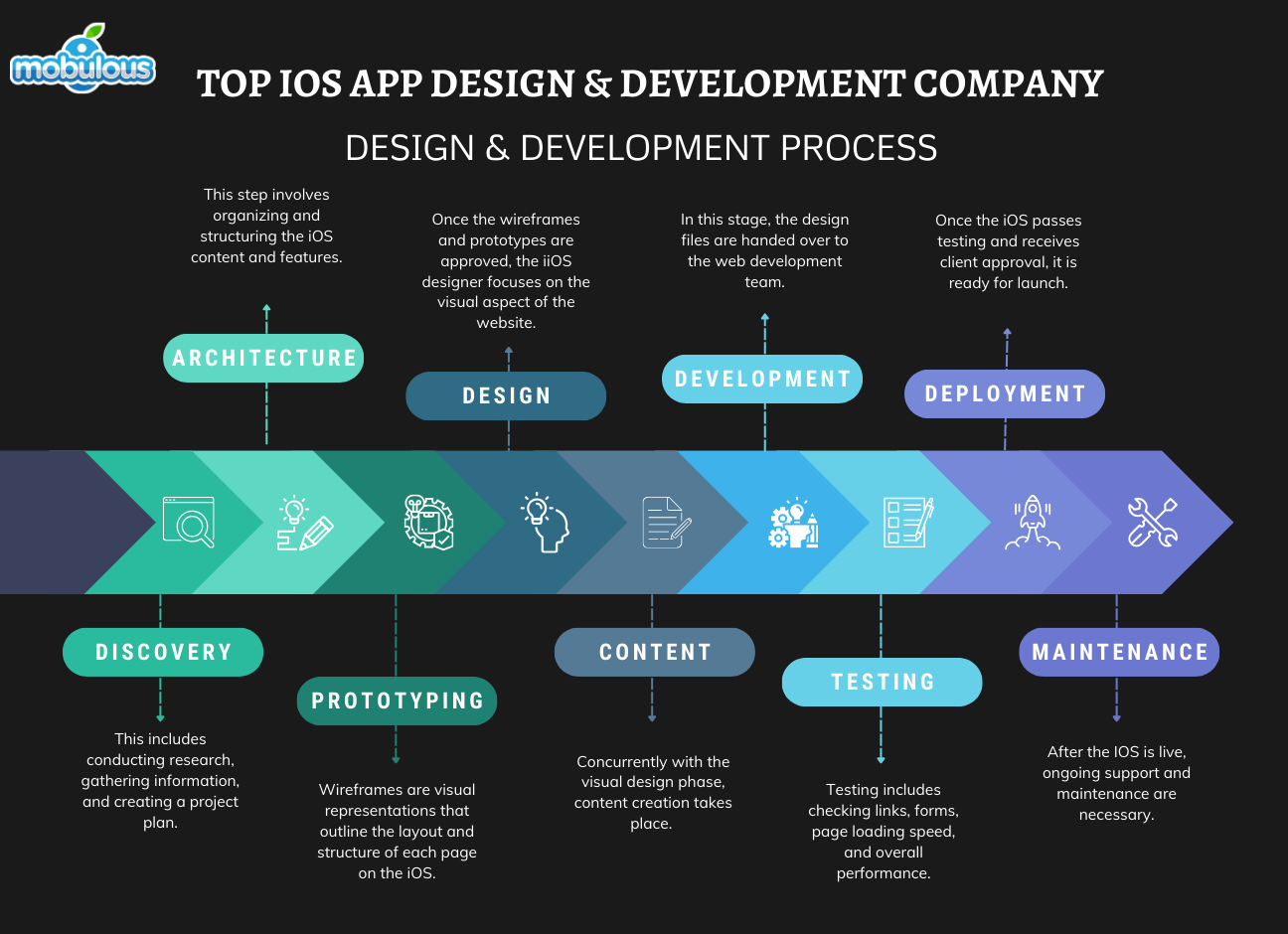
Collaborating with a professional development vendor follows a rigorous, phase-driven methodology. Understanding this lifecycle ensures stakeholders can plan resource allocation, milestone reviews, and quality assurance gates effectively.
Discovery & Architecture -> UI/UX Prototyping -> Agile Sprint Development -> Automated Testing & QA -> App Store Deployment
Discovery and Architecture Planning
During the initial phase, system architects define the technical blueprint. This involves selecting design patterns—such as Model-View-ViewModel (MVVM) or The Composable Architecture (TCA)—to ensure modularity, testability, and long-term maintainability. Security requirements, including App Transport Security (ATS) enforcement and Keychain data encryption, are established at this stage.
UI/UX Design Tailored for iOS
An experienced iOS app company adheres strictly to Apple's Human Interface Guidelines (HIG). This ensures the application feels native to the operating system, reducing user friction and improving onboarding conversion rates. Design teams build interactive prototypes using tools like Figma, translating wireframes into high-fidelity interfaces that accommodate dynamic type, dark mode, and accessibility features like VoiceOver.
Engineering and Agile Execution
Development proceeds in iterative sprints. Engineers write unit and UI tests concurrently with feature code to maintain high test coverage. Continuous Integration and Continuous Deployment (CI/CD) pipelines, often utilizing Xcode Cloud, GitHub Actions, or Bitrise, automate the build and testing process, reducing human error and accelerating delivery timelines.
In-House Development Versus Outsourcing to an iOS App Company
Organizations often weigh the operational costs of building an internal engineering team against hiring an external iOS app company. Each model presents distinct advantages and trade-offs regarding speed, cost control, and domain expertise.
| Evaluation Metric | In-House Engineering Team | Specialized iOS App Company |
|---|---|---|
| Time-to-Market | Slow (requires months of recruiting and onboarding) | Fast (established teams deploy immediately) |
| Upfront Cost | High (salaries, benefits, hardware, office overhead) | Controlled (project-based or dedicated team retainers) |
| Technical Breadth | Limited to hired specialists' immediate skill sets | Broad (access to UI/UX designers, QA, and senior architects) |
| Long-Term Maintenance | High internal ownership and institutional knowledge | Managed via ongoing maintenance service-level agreements (SLAs) |
| Scalability | Difficult to scale up or down rapidly | Flexible resource allocation based on project phases |
Key Factors in Selecting an iOS App Company
Navigating the vendor selection process requires looking beyond polished marketing portfolios. Decision-makers must vet potential partners through a technical and operational lens to mitigate project failure risks.
- App Store Publication Track Record: Review live applications developed by the company currently available on the Apple App Store. Check user reviews, performance stability, and update frequency.
- Code Quality and Architecture Standards: Request code samples or GitHub repositories demonstrating clean architecture, separation of concerns, and adherence to Swift style guides.
- Communication and Project Management: Ensure the vendor operates within overlapping time zones and utilizes transparent project management tools such as Jira, Linear, or Trello.
- Post-Launch Support and SLAs: Apple frequently updates iOS annually. Confirm the vendor offers post-launch maintenance contracts to handle iOS version updates, bug fixes, and security patches.
Financial Structures and Investment Realities
Understanding how an iOS app company structures its pricing models helps prevent budget overruns. Development costs vary based on complexity, integration requirements (such as Bluetooth Low Energy or complex payment gateways), and geographic location.
- Fixed-Price Contracts: Best suited for well-defined scope of work, minimal ambiguity, and strictly locked-in feature sets. However, they offer less flexibility for mid-project scope changes.
- Time and Materials (T&M): Ideal for agile projects where requirements evolve based on user testing and market feedback. Clients pay for actual hours worked by engineers, designers, and project managers.
- Dedicated Team Retainer: A monthly subscription model providing dedicated full-time engineers who function as an extension of your internal product organization.
Common Pitfalls in iOS App Development and How to Avoid Them
Even with an experienced iOS app company, projects can encounter friction points if specific operational risks are not managed proactively from day one.
App Store Review Delays: Apple enforces strict App Guideline reviews. Avoid rejection by ensuring your chosen company strictly complies with privacy policies, in-app purchase requirements (utilizing StoreKit 2), and account deletion guidelines.
Ignoring Device Fragmentation: While iOS devices are standardized compared to Android, supporting various screen sizes (iPhone SE to iPad Pro) requires flexible layout constraints using Auto Layout or SwiftUI stack views.
Neglecting Offline Capabilities: Mobile users frequently encounter poor network conditions. A robust app must handle offline states gracefully using local caching and optimistic UI updates.
Frequently Asked Questions About Hiring an iOS App Company
How long does it take an iOS app company to build a custom application?
A standard MVP (Minimum Viable Product) typically takes between 3 to 5 months from initial discovery to App Store submission. Highly complex enterprise applications requiring custom backend infrastructure, hardware integrations, or rigorous compliance certifications can take 6 to 12 months or longer.
What is the difference between native iOS development and cross-platform frameworks?
Native iOS development utilizes Swift and SwiftUI specifically optimized for Apple hardware, delivering superior performance, smoother animations, and immediate access to new iOS features. Cross-platform frameworks like Flutter or React Native use a single codebase for both iOS and Android, which can reduce initial development costs but may introduce performance bottlenecks or delayed access to new native APIs.
Who owns the intellectual property (IP) of the source code?
In standard commercial agreements with a reputable iOS app company, the client retains 100% ownership of the source code, design assets, and intellectual property once final payment milestones are fulfilled. Always review the Master Services Agreement (MSA) to confirm IP assignment clauses.
How do app companies handle ongoing maintenance after launch?
Post-launch maintenance typically involves monitoring crashlytics reports (using tools like Firebase or Sentry), optimizing performance bottlenecks, and releasing updates to maintain compatibility with new iOS operating system versions released annually by Apple.
What should be prepared before contacting an iOS app company?
Stakeholders should prepare a comprehensive product requirements document (PRD), user flow diagrams, target audience definitions, monetization strategy, and an estimated budget range to receive accurate and actionable proposals.
Ready to transform your mobile product vision into a high-performance reality? Contact an experienced engineering partner today to schedule an architectural consultation and technical scoping session.
Image Gallery