Guardian Whole Life Insurance Dividend History and 2026 Payout Analysis
Guardian Life Insurance Company of America has maintained an unbroken streak of paying dividends to participating policyholders every year since 1868. For 2026, Guardian approved a record-setting dividend payout of $1.4 billion, mainta...
Guardian Life Insurance Company of America has maintained an unbroken streak of paying dividends to participating policyholders every year since 1868. For 2026, Guardian approved a record-setting dividend payout of $1.4 billion, maintaining a Dividend Interest Rate (DIR) of 5.75%. This consistent performance underscores the company's financial stability and its commitment to sharing surplus earnings with its mutual policyholders.
Contents
The Mechanics of Guardian’s Mutual Dividend System
To understand the dividend history and payout structure of Guardian, one must first recognize the company’s organizational structure. Guardian is a mutual insurance company, meaning it is owned by its policyholders rather than outside shareholders. When the company experiences favorable financial results—specifically through lower-than-expected mortality costs, disciplined expense management, and robust investment returns—it returns a portion of that surplus to its "participating" policyholders in the form of dividends.
Legally, the Internal Revenue Service (IRS) classifies life insurance dividends as a return of premium. Because you are essentially receiving back a portion of the money you paid for the policy (due to the company operating more efficiently than projected), these dividends are generally not taxable as income until the total dividends received exceed the total premiums paid into the policy.
Components of the Dividend Payout
The annual dividend is not a single flat percentage applied to the entire face value of the policy. Instead, it is the result of three distinct "building blocks" of insurance company profitability:
- Mortality Gains: If fewer policyholders pass away than the actuarial tables predicted, the company retains more capital, which contributes to the dividend pool.
- Expense Savings: Guardian’s ability to manage its operational overhead, commissions, and administrative costs directly impacts the surplus available for distribution.
- Investment Income: This is the most visible component. Guardian invests the premiums it receives—primarily in long-term high-quality bonds, mortgages, and some equities—to generate a return that supports the Dividend Interest Rate.
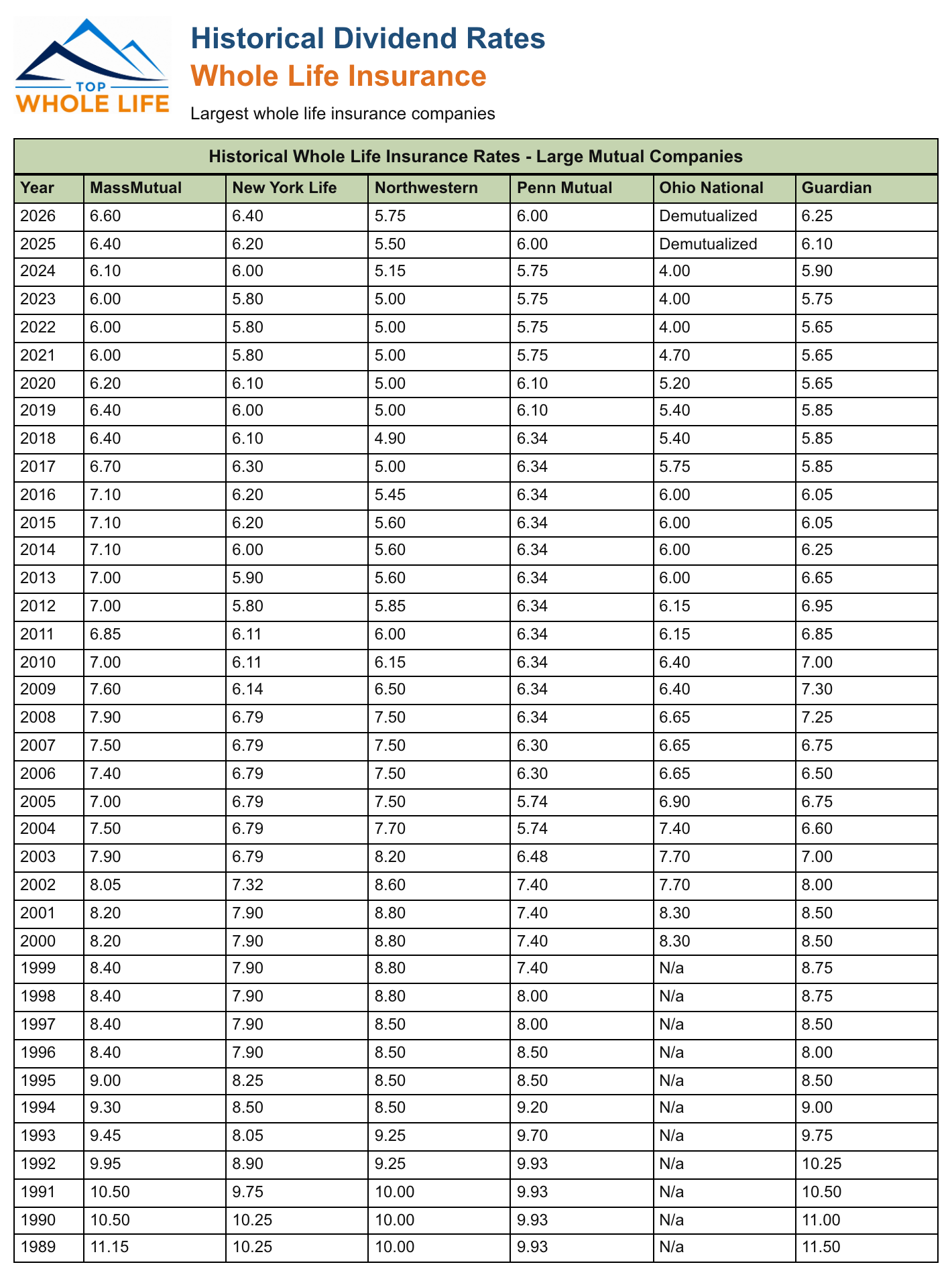
Guardian Dividend Interest Rate History (2008–2026)
The Dividend Interest Rate (DIR) is a key metric used by mutual companies to illustrate the performance of their participating products. It is important to distinguish the DIR from the Internal Rate of Return (IRR) of a policy. The DIR is the gross rate applied to the portion of the cash value that is eligible for dividends, before the company deducts the costs of insurance and administrative fees.
The following table outlines Guardian’s DIR over the last nearly two decades, demonstrating the company’s stability through various economic cycles, including the high-inflation periods of the early 2020s and the subsequent stabilization in 2026.
| Year | Dividend Interest Rate (DIR) | Total Payout to Policyholders |
|---|---|---|
| 2026 | 5.75% | $1.40 Billion |
| 2025 | 5.75% | $1.39 Billion |
| 2024 | 5.75% | $1.35 Billion |
| 2023 | 5.75% | $1.26 Billion |
| 2022 | 5.65% | $1.13 Billion |
| 2021 | 5.65% | $1.05 Billion |
| 2020 | 5.65% | $982 Million |
| 2019 | 5.85% | $955 Million |
| 2018 | 5.85% | $911 Million |
| 2017 | 5.85% | $851 Million |
| 2016 | 6.05% | $826 Million |
| 2015 | 6.05% | $804 Million |
| 2014 | 6.05% | $783 Million |
| 2013 | 6.05% | $751 Million |
| 2012 | 6.15% | $735 Million |
| 2011 | 6.50% | $702 Million |
| 2010 | 6.50% | $664 Million |
| 2009 | 6.80% | $648 Million |
| 2008 | 7.30% | $623 Million |
Source: Historical data compiled from Guardian Life Insurance Company annual reports and board announcements.
The 2026 Dividend Announcement in Context
The $1.4 billion payout for 2026 represents the largest in the company’s 166-year history. This milestone is significant because it occurred during a period of complex global economic recovery. By maintaining the 5.75% rate for the fourth consecutive year, Guardian has signaled a "plateau of stability."
For policyholders, the 2026 payout confirms that Guardian's investment portfolio—which is heavily weighted toward high-quality fixed-income assets—has successfully captured the higher yield environment of the mid-2020s. This helps offset the rising costs of living and ensures that the "cash value" component of whole life policies remains a competitive asset class within a diversified financial plan.
Guardian’s Approach to Direct Recognition
One of the most technical aspects of Guardian’s dividend payout is its use of Direct Recognition. When a policyholder takes a loan against their cash value, the insurance company must decide how to treat the dividends on the portion of the cash value used as collateral.
- Direct Recognition (Guardian's Model): Guardian adjusts the dividend rate on the cash value that is currently being used as collateral for a loan. If the interest rate the policyholder pays on the loan is higher than the DIR, Guardian may actually increase the dividend on that specific portion of the cash value. Conversely, if the loan rate is lower, the dividend might be reduced.
- Non-Direct Recognition: Some other mutual companies (like Northwestern Mutual or MassMutual) do not change the dividend rate regardless of whether a loan is outstanding.
Guardian's direct recognition model is often preferred by those who use their life insurance as a "banking" vehicle (often referred to as Infinite Banking or Privatized Banking). It allows the company to remain equitable to all policyholders; those who do not take loans are not "subsidizing" the investment returns of those who do.
How Policyholders Receive Payouts: The Four Primary Options
Guardian offers several ways for policyholders to utilize their annual dividend payouts. The choice of option can significantly alter the long-term performance of the policy.
1. Paid-Up Additions (PUAs)
This is widely considered the most powerful option for wealth accumulation. The dividend is used to purchase additional "mini" whole life policies that have their own cash value and death benefit. These additions are "paid-up," meaning no future premiums are required for them. Over time, this creates a compounding effect, as future dividends are paid on the original policy plus all accumulated PUAs.
2. Premium Reduction
Policyholders can elect to have their annual dividends applied toward their scheduled premium payments. In many mature policies, the dividend may eventually become large enough to cover the entire premium, effectively making the policy "self-funding."
3. Cash Payout
The company simply mails a check to the policyholder or deposits the funds into a linked account. While this provides immediate liquidity, it removes those funds from the tax-advantaged growth environment of the policy.
4. Accumulate at Interest
The dividends are left with Guardian in a separate side account that earns a set interest rate (different from the DIR). This interest is generally taxable annually, unlike the growth within the life insurance policy itself.
Comparative Standing: Guardian vs. Other Mutual Giants
In the landscape of "Big Mutuals," Guardian is frequently compared to MassMutual, New York Life, and Northwestern Mutual.
- Financial Strength: Guardian consistently maintains exceptionally high credit ratings. As of 2026, it holds an AA+ (Extremely Strong) from S&P, an Aa2 (Excellent) from Moody’s, and an A++ (Superior) from A.M. Best.
- Dividend Consistency: While all four major mutuals have impressive streaks of paying dividends, Guardian is often noted for the "smoothness" of its rate changes. It tends to avoid drastic drops, preferring incremental adjustments that allow policyholders to plan with greater certainty.
- Product Flexibility: Guardian is highly regarded for its "L-95" or "L-99" (Life to age 95/99) products and its "Paid-Up Additions Rider," which allows policyholders to overfund their policies for faster cash value growth.
Strategic Considerations for 2026
If you are reviewing your Guardian policy in 2026, there are several actions to consider:
- Review Your Dividend Option: If you are currently taking dividends in cash but do not need the liquidity, switching to Paid-Up Additions can significantly increase your death benefit and cash value over the next decade.
- Evaluate Loan Performance: With the 5.75% DIR and Guardian's direct recognition policy, check your current loan interest rate. In many cases, the "net cost" of borrowing from your policy may be lower than market rates for personal or business loans.
- Check for "Reduced Paid-Up" Status: For older policyholders, the 2026 dividend may provide enough cushion to stop paying premiums entirely while maintaining a substantial death benefit.
Frequently Asked Questions
Are Guardian dividends guaranteed?
No. By law and contract, dividends are never guaranteed. They are declared annually by the Board of Directors based on the company's financial performance. However, Guardian’s 158-year history of uninterrupted payments provides a high degree of confidence in future payouts.
Why is my policy’s actual return lower than the 5.75% DIR?
The Dividend Interest Rate is a gross rate. Before the net growth is applied to your cash value, the company must subtract the cost of insurance (the pure death benefit protection) and administrative expenses. Most whole life policies see a net internal rate of return (IRR) that is 1% to 1.5% lower than the DIR once the policy is past the initial "break-even" years.
How does inflation affect Guardian's dividend history?
Historically, as inflation rises, interest rates generally follow. Since Guardian invests heavily in fixed-income securities, a sustained period of higher interest rates (as seen in the mid-2020s) eventually leads to higher dividend payouts as the company reinvests maturing bonds into newer, higher-yielding ones.
Is the 2026 dividend taxable?
For most policyholders, no. Dividends are considered a return of premium. You only pay taxes if you withdraw cash (including dividends) that exceeds the total amount of premiums you have paid into the policy (your "basis").
When are Guardian dividends usually credited to the policy?
Dividends are typically credited to the policy on the "policy anniversary date," which is the anniversary of the day the policy first went into force.
Final Recommendation
For those seeking long-term financial stability, Guardian’s 2026 dividend announcement of $1.4 billion at a 5.75% rate confirms the company's position as a premier mutual insurer. Current policyholders should prioritize the Paid-Up Additions option to maximize the compounding effect of these record payouts. If you are considering a new policy, ensure you work with an advisor who understands Direct Recognition and can model how the current dividend history aligns with your specific goals for liquidity and legacy.
Image Gallery