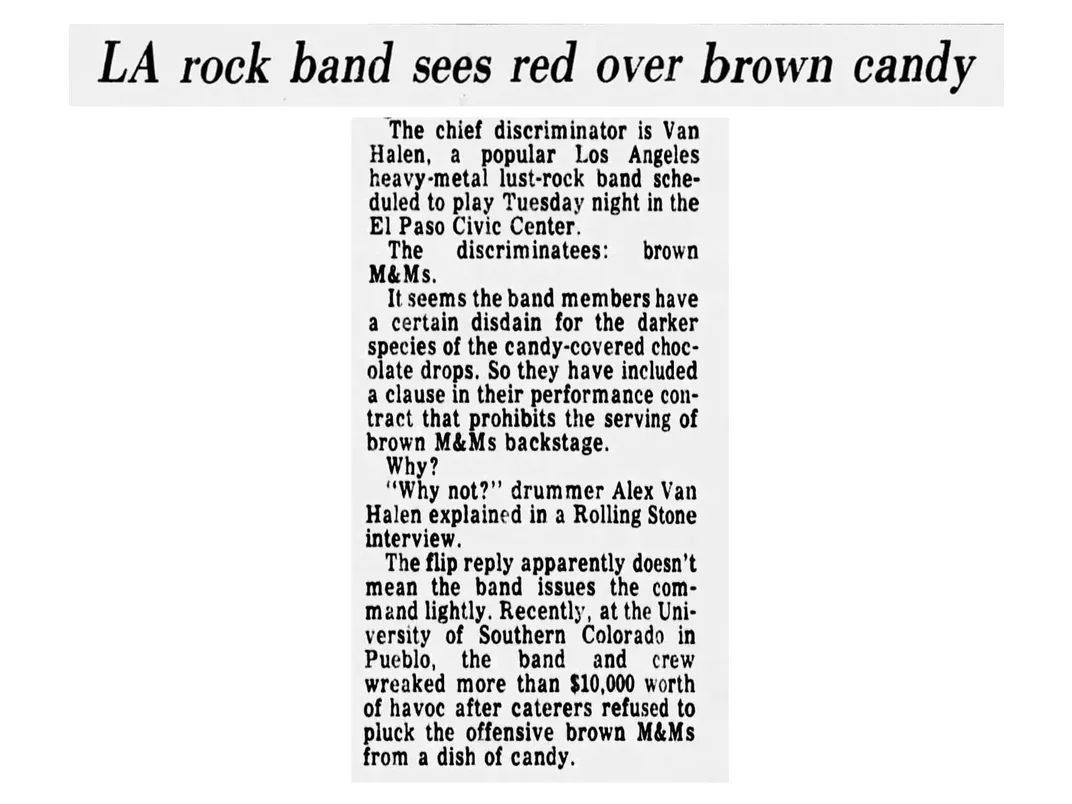
The True Story Behind Van Halen’s Brown M&M Contract Clause
The famous "brown M&M story" is a legendary tale of rock and roll excess that is actually a masterclass in quality control. While often cited as proof of Van Halen’s diva-like demands, the contract clause forbidding brown M&M’s was a s...
The famous "brown M&M story" is a legendary tale of rock and roll excess that is actually a masterclass in quality control. While often cited as proof of Van Halen’s diva-like demands, the contract clause forbidding brown M&M’s was a strategic safety test designed to ensure promoters had read and followed every technical specification in the band's massive production rider.
Contents
For decades, the image of rock stars demanding specific candy colors was the ultimate symbol of celebrity entitlement. However, the reality of the situation is rooted in the high-stakes world of 1980s arena rock production. In an era where concert tours were becoming increasingly complex and dangerous, Van Halen frontman David Lee Roth devised a simple, visual indicator to determine whether a local promoter was paying attention to the details that kept the band and crew alive.
The Cultural Legend of Rock Star Excess
In the late 1970s and early 1980s, stories of rock stars trashing hotel rooms and making impossible demands were staples of the tabloid press. When the story leaked that Van Halen’s contract rider included a specific provision regarding M&M’s—specifically, that there should be "absolutely no brown ones"—it was immediately characterized as the height of arrogance.
The media portrayed the band as petty millionaires who would throw a tantrum if they saw a chocolate candy of the wrong hue. To the public, it seemed like an absurd waste of a promoter’s time. Why should a stagehand spend hours sorting through bags of candy? This narrative persisted for years, painting Van Halen as the poster children for "difficult" artists. However, the "ridiculous" demand was never about the candy itself; it was about the technical requirements buried in the hundreds of pages that preceded the catering section.
Understanding the 1982 World Tour Rider
To understand why the M&M clause existed, one must understand the context of touring in 1982. Van Halen was one of the first bands to bring a "Broadway-sized" production into secondary and tertiary markets. They traveled with nine eighteen-wheeler trucks full of equipment at a time when the standard for most bands was maybe three.
The technical rider for the 1982 tour was a massive document. It didn't just list what the band wanted for lunch; it detailed the exact voltage required for the lighting rigs, the weight-bearing capacity of the stage floors, and the precise placement of pyrotechnic triggers. If these specifications were ignored, the consequences weren't just a bad-sounding show—they were potentially fatal.
Article 126: The Specific Clause
The infamous instruction was located in the "Munchies" section of the rider. It was designated as Article 126. The wording was precise:
"M&M's (WARNING: ABSOLUTELY NO BROWN ONES)"
This was placed strategically deep within the document. In his autobiography, Crazy from the Heat, David Lee Roth explained that if he walked into the backstage area and saw brown M&M's in the bowl, he knew immediately that the promoter had not read the rider thoroughly. This triggered a "line-check" of the entire production.
The Logic of the "Canary in the Coal Mine"
In engineering and safety management, the "canary in the coal mine" is an early indicator of potential danger. For Van Halen, the brown M&M was that canary. The band’s logic was simple: if a promoter was lazy enough to ignore a specific instruction about snacks, they were likely lazy enough to ignore Article 148 (the weight of the lighting rig) or Article 72 (the number of electrical outlets required).
When the band found brown M&M's, it was a signal to their technical crew to double-check every bolt, every circuit breaker, and every structural support. It wasn't about being picky; it was about preventing the stage from collapsing under the weight of several tons of equipment or preventing the pyrotechnics from blowing up in the wrong direction.
The Pueblo, Colorado Incident
The most famous instance of the "brown M&M" rule being triggered occurred at the University of Southern Colorado in Pueblo. Upon arriving backstage, Roth noticed brown M&M's in the bowl. He famously trashed the dressing room, causing roughly $12,000 in damage (though the media reported a much higher figure).
While the press focused on the "diva" outburst and the candy, the technical reality was horrifying. Because the promoter had failed to read the rider, they had not noticed the weight requirements for the stage. The band's equipment was so heavy that it literally sank through the floor of the basketball court, causing over $80,000 in structural damage to the venue. The presence of the brown M&M's had correctly predicted a catastrophic failure of the promoter’s attention to detail.
Technical Specifications and Safety Risks
The scale of Van Halen’s production in the 1980s was unprecedented. The following table illustrates the difference between the "perceived" petty demands and the "actual" technical risks involved in their shows.
| Perceived "Diva" Demand | Actual Technical Requirement | Potential Consequence of Neglect |
|---|---|---|
| No Brown M&M's | Full Rider Compliance Check | Structural collapse or electrical fire |
| Specific Brand of Water | Clean, dedicated power lines | Equipment interference or electrocution |
| Room Temperature | HVAC and Ventilation for Pyrotechnics | Premature ignition of explosives |
| Specific Towel Count | Load-bearing capacity of stage floor | Stage sinking or crashing into the "pit" |
| Detailed Catering Menu | Clear access for emergency personnel | Blocked exits during a fire or emergency |
The "no brown M&M's" clause was a low-cost, high-efficiency audit tool. In the world of complex systems, this is known as a "forcing function"—a design element that forces the user to take a specific action or pay attention to a specific detail.
Legacy in Business and Management
The Van Halen story has moved beyond rock history and is now a staple of business management courses and legal seminars. It is frequently used to illustrate the importance of attention to detail and quality assurance.
- Contractual Auditing: The story teaches that you should build "tells" into your contracts to see if the other party is actually reading the terms.
- Risk Mitigation: In high-risk environments (like construction or medicine), small errors often correlate with large systemic failures.
- Communication: It highlights the difficulty of communicating complex technical needs to third-party vendors who may be prone to cutting corners.
Today, many organizations use similar "tests" in their vetting processes. For example, some law firms or tech companies include "easter eggs" in long documents to ensure that junior associates or vendors are performing a "close read" of the material.
The Role of the Media in the Myth
It is worth noting why the "diva" version of the story survived so much longer than the "safety" version. For the media, a story about a rock star throwing a fit over candy is entertaining and fits a pre-existing archetype. A story about a rock star meticulously checking the structural integrity of a stage floor and adhering to National Electrical Code standards is boring.
David Lee Roth eventually set the record straight in his 1997 autobiography and subsequent interviews, including a famous segment for NPR. Despite this, the myth persists as a cautionary tale of celebrity ego, proving that a good story often travels faster than the truth.
Frequently Asked Questions
Was the brown M&M clause actually in the contract?
Yes. The clause was part of the 1982 Van Halen world tour rider, specifically under the catering section. It was Article 126 and was written in all-caps to ensure visibility.
Did Van Halen actually cancel shows over the candy?
No. The band never canceled a show specifically because of the M&M’s. Instead, finding a brown M&M triggered a mandatory, exhaustive safety inspection of the entire stage and lighting setup. If the technical specs failed that inspection, the show might be delayed or canceled, but the candy was merely the warning sign.
Who came up with the idea?
The idea is widely attributed to David Lee Roth. He recognized that as the band's production grew, they were increasingly at the mercy of local promoters who might not have the experience to handle such a massive setup safely.
Are there other bands with "weird" rider requests?
Many bands have unique rider requests, but most are for comfort or habit. For instance, Jack White famously had a specific recipe for guacamole in his rider, and Iggy Pop’s rider is known for being a 28-page work of comedy. However, few are as functionally significant as Van Halen’s M&M clause.
Why specifically brown M&M's?
There was no technical reason for picking brown. It was likely chosen because brown was a common color at the time, and its absence would be immediately noticeable to someone glancing at a bowl of candy.
Final Recommendation: Applying the "M&M Rule"
In 2026, the lesson of the brown M&M's is more relevant than ever in our era of automated processes and "skimming" culture. Whether you are managing a software project, overseeing a construction site, or signing a lease, you should look for your own "brown M&M's."
Next Action: Review your most critical workflows or contracts. Is there a simple, "telltale" sign you can look for that indicates whether a process has been followed correctly? By identifying these small indicators of quality, you can prevent major failures before they occur. Always remember that in complex systems, the smallest details often serve as the most important safeguards.
Image Gallery