The Definitive Guide to Salmon Cooked Temp: Achieving Perfection and Food Safety
According to the United States Department of Agriculture (USDA) and the U.S. Food and Drug Administration (FDA), the safe minimum internal temperature for cooked salmon is 145°F (63°C). However, culinary professionals and seafood enthu...
According to the United States Department of Agriculture (USDA) and the U.S. Food and Drug Administration (FDA), the safe minimum internal temperature for cooked salmon is 145°F (63°C). However, culinary professionals and seafood enthusiasts frequently advocate for lower target temperatures—ranging from 120°F to 135°F (49°C to 57°C)—to prevent the fish from drying out while retaining a tender, flaky texture.
Contents
Mastering the ideal salmon cooked temp requires balancing rigorous food safety standards with culinary precision. Because salmon is rich in delicate fats and moisture, understanding how heat transforms its muscle structure is essential for achieving restaurant-quality results at home. This guide explores the science of cooking salmon, official regulatory guidelines, thermometer usage techniques, common preparation mistakes, and regional variations in texture preferences.
The Science of Salmon Muscle Structure and Heat
To understand why salmon cooked temp is such a heavily debated topic among home cooks and professional chefs alike, you must first examine how heat affects fish muscle tissue. Unlike mammals and poultry, which feature dense connective tissue and tough collagen networks requiring high heat and long cooking times to break down, fish flesh is structurally delicate.
Salmon muscle fibers (myotomes) are short and held together by very thin sheets of connective tissue (myocommata). These bonds begin to denature and break down at relatively low temperatures, typically starting around 100°F (38°C). As heat increases, the moisture within the muscle cells expands, and the proteins firm up.
If salmon is overcooked, the muscle fibers contract tightly, squeezing out moisture and natural oils. This process also releases a white, coagulated protein substance called albumin. While completely safe to eat, excessive albumin extrusion is a visual indicator that the fish has passed its optimal tenderness window and is beginning to dry out.
Official Food Safety Standards vs. Culinary Preference
When discussing cooking temperatures for seafood, a clear distinction exists between government safety recommendations and culinary execution. Navigating this gap safely involves understanding pathogen reduction, time-temperature relationships, and individual risk profiles.
The USDA and FDA Recommendation
The USDA and FDA recommend cooking all finfish to an internal temperature of 145°F (63°C), measured at the thickest part of the fillet. This benchmark ensures the immediate destruction of potential parasites, bacteria, and foodborne pathogens that might be present in wild or farmed marine species.
The Culinary Standard (Medium-Rare to Medium)
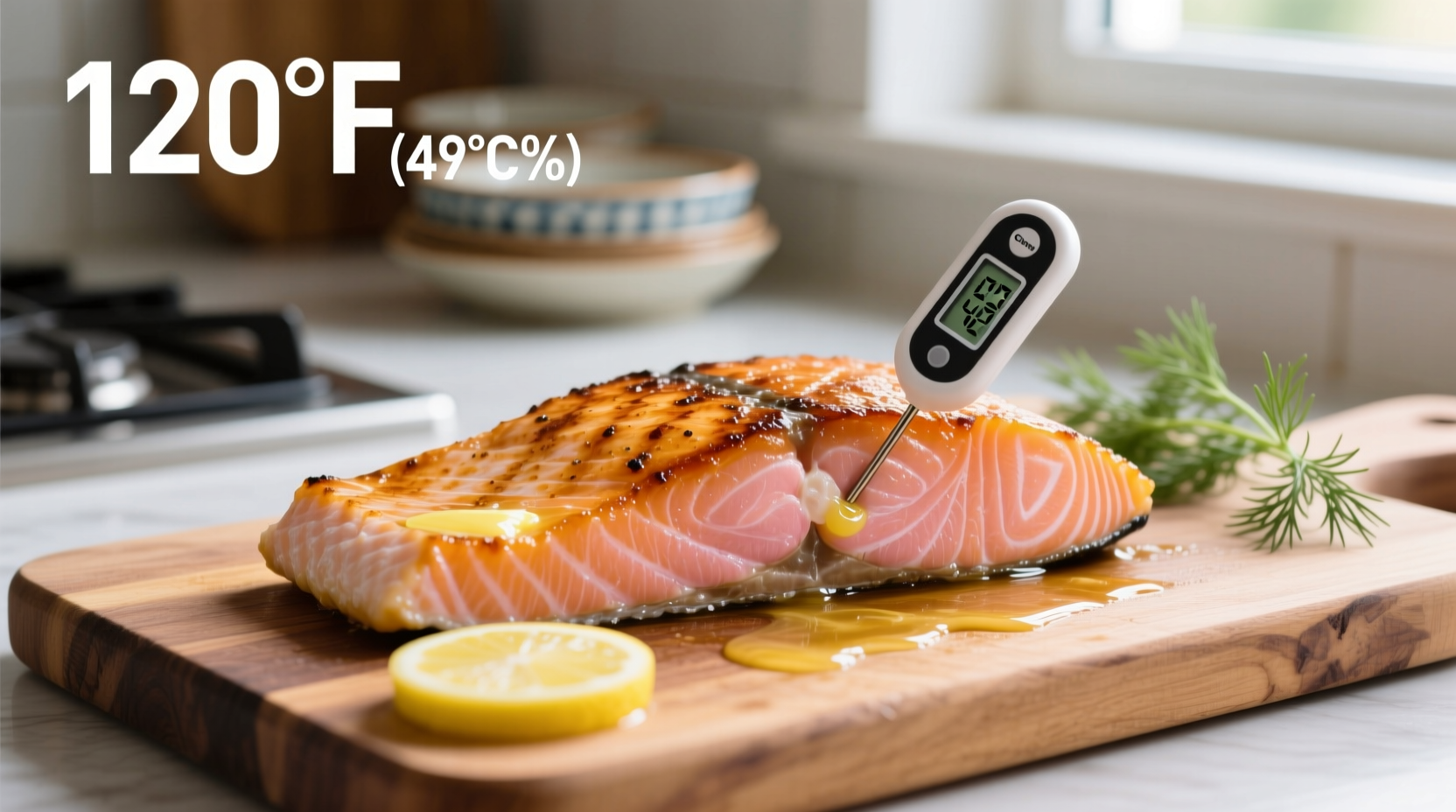
Despite official guidelines, many culinary authorities, including America’s Test Kitchen and top seafood restaurants, target an internal temperature between 120°F (49°C) and 130°F (54°C). At this range, the salmon remains translucent in the center, exceptionally moist, and buttery.
For high-quality, fresh salmon that has been handled according to strict cold-chain protocols, many cooks accept the slight reduction in thermal kill-time in exchange for superior texture. However, individuals with compromised immune systems, pregnant women, the elderly, and young children should adhere strictly to the USDA-recommended 145°F standard to minimize health risks.
Measuring Salmon Cooked Temp Accurately
Guessing doneness by sight or flake test often results in overcooked fish. Utilizing a digital meat thermometer is the single most reliable method for achieving consistent results.
Choosing the Right Thermometer
An instant-read digital thermometer with a thin probe is ideal for checking fish. Because salmon fillets are relatively thin compared to roasts or whole poultry, thick probes can displace too much meat or slip through the fillet entirely, leading to inaccurate readings.
Proper Technique for Insertion
- Remove from Heat Source: Take the pan, baking sheet, or grill away from the direct heat source before measuring to prevent accidental overcooking while you test.
- Locate the Thickest Part: Insert the probe horizontally into the side of the thickest part of the fillet rather than vertically from the top. This ensures the tip reaches the geometric center of the muscle mass.
- Avoid Bone and Skin: Ensure the probe tip does not touch skin or large pin bones, as bone conducts heat differently than flesh and will yield falsely high temperature readings.
Salmon Temperature Comparison Guide
Different cooking methods and preference levels yield distinct textures. The following table outlines the correlation between internal temperatures, sensory characteristics, and recommended safety applications.
| Internal Temperature | Texture and Appearance | Culinary Designation | Safety & Suitability |
|---|---|---|---|
| 115°F – 120°F (46°C – 49°C) | Very rare; translucent center; melts in the mouth. | Rare / Sashimi-style warm | Requires sushi-grade, ultra-fresh fish; high risk for vulnerable populations. |
| 125°F – 130°F (52°C – 54°C) | Tender and moist; opaque edges with a slightly translucent, glossy center. | Medium-Rare (Chef's Standard) | Popular in fine dining; standard for high-grade fresh salmon. |
| 135°F – 140°F (57°C – 60°C) | Firm throughout; fully opaque; flakes easily with a fork. | Medium to Medium-Well | Balanced texture; preferred by those who dislike translucent centers. |
| 145°F (63°C) and above | Completely opaque; firm, dense texture; significant albumin release. | Well-Done / USDA Standard | Officially recommended safe temperature for all populations and general food service. |
Residual Heat and Carryover Cooking
One of the most common pitfalls when monitoring salmon cooked temp is failing to account for carryover cooking. Carryover cooking occurs when heat continues to travel from the outer layers of the food toward the center after the fish has been removed from the heat source.
Because salmon retains thermal energy efficiently, its internal temperature will typically rise by 3°F to 5°F (2°C to 3°C) after you take it off the stove, grill, or out of the oven.
- Practical Application: If your target serving temperature is 130°F (54°C) for a medium-rare fillet, you should remove the salmon from the heat source when it reaches approximately 125°F (52°C). Allow it to rest for 3 to 5 minutes. During this resting period, the juices will redistribute evenly throughout the muscle fibers, and the final temperature will settle right at your target zone.
Common Mistakes When Monitoring Salmon Temperature
Even experienced home cooks sometimes struggle with fish temperature control due to a few recurrent errors.
- Testing the Skin Side: Inserting the thermometer through the bottom skin layer can cause conduction interference, leading to inaccurate readings. Always probe from the side or top flesh layer.
- Ignoring Thickness Variances: A standard salmon side is tapered; the tail end is much thinner than the loin. If you cook a whole side of salmon uniformly, the tail will inevitably overcook while the thickest part reaches your target temp. Cut fillets into uniform portions or tuck the thin tail underneath itself to promote even cooking.
- Failing to Calibrate the Thermometer: Digital thermometers can drift out of calibration over time due to drops or steam exposure. Test your thermometer periodically in an ice-water bath (should read 32°F or 0°C) or boiling water (should read 212°F or 100°C at sea level).
- Leaving the Thermometer in During Oven Cooking: Unless using a specialized leave-in probe designed for high-heat continuous monitoring, leaving a standard digital unit in the fish while it bakes can melt plastic components or damage internal sensors.
Frequently Asked Questions About Salmon Cooked Temp
How do I know if salmon is done without a thermometer?
While a thermometer is best, you can press the top of the fillet gently with a fork or your finger. If the flakes begin to separate slightly along the natural white lines (myocommata) and the flesh transitions from glossy translucent pink to matte opaque pink, it is largely cooked. However, checking with a digital thermometer remains the only foolproof method.
Does farmed salmon require a different cooking temperature than wild salmon?
Farmed salmon typically contains a higher fat content than wild-caught varieties like Sockeye or Chinook. This higher fat content makes farmed salmon more forgiving and less prone to drying out if cooked slightly past its target temperature. Wild salmon, being leaner, cooks much faster and dries out rapidly, making strict adherence to lower target temperatures (120°F–130°F) especially crucial.
Can I eat salmon if the center is still bright pink?
Yes, as long as the fish has reached a safe internal temperature or has been properly sourced and handled for raw consumption. Many culinary enthusiasts prefer salmon cooked to a medium-rare state where the center remains bright pink and translucent.
Why is white stuff oozing out of my salmon while it cooks?
That white substance is albumin, a water-soluble protein that coagulates and pushes to the surface when heat is applied too quickly. To minimize albumin production, brine your salmon in a simple salt-and-water solution (1 tablespoon of salt per cup of water) for 15 minutes before cooking, or lower your overall cooking temperature.
How long should salmon rest after cooking?
Salmon should rest for 3 to 5 minutes before serving. This brief resting period allows the internal temperature to stabilize via carryover cooking and enables the muscle fibers to relax, reabsorbing savory juices that would otherwise spill out onto the plate.
Conclusion and Next Action
Achieving the ideal salmon cooked temp requires a balance between food safety guidelines and culinary texture preferences. By utilizing an instant-read digital thermometer, factoring in carryover cooking, and accounting for the natural differences between wild and farmed varieties, you can consistently serve perfectly moist, tender salmon. For your next meal, choose your target temperature based on your guests' health considerations, remove the fish a few degrees early, let it rest, and enjoy optimal flavor and texture.
Image Gallery