Navigating Health, Life, and Annuity Insurance Misconceptions
Misconceptions about health, life, and annuity insurance frequently cause policyholders to misallocate capital, leave critical risks uninsured, or select ill-suited financial products. Common myths stem from confusing risk transfer wit...
Misconceptions about health, life, and annuity insurance frequently cause policyholders to misallocate capital, leave critical risks uninsured, or select ill-suited financial products. Common myths stem from confusing risk transfer with wealth accumulation, misinterpreting complex policy riders, or relying on outdated regulations. Dispelling these misunderstandings ensures that insurance choices accurately align with personal financial plans, health profiles, and retirement goals.
Contents
Disclaimer: Insurance policies, state regulations, and tax structures vary by jurisdiction. The information presented here is for educational purposes. Consult a licensed insurance professional, certified financial planner, or tax advisor for individualized guidance.
The Three Pillars of Insurance Risk Management
Financial security rests on managing three distinct personal risks: healthcare expenses, premature death, and outliving one's assets. Insurance products are engineered around these specific risk categories:
- Health Insurance: Mitigates the short- and long-term financial impact of medical treatments, emergency care, prescription drugs, and preventive health services.
- Life Insurance: Replaces lost human capital and income for surviving dependents or facilitates estate transfer upon the policyholder’s death.
- Annuity Contracts: Mitigates longevity risk by converting a lump sum or series of payments into guaranteed, periodic income streams during retirement.
Treating these three distinct contract types as interchangeable financial instruments creates coverage gaps and unexpected costs. A clear understanding of each category starts with dispelling persistent myths.
Common Health Insurance Misconceptions
Health insurance remains one of the most frequently used—and misunderstood—financial products. Misinterpreting coverage rules can result in unexpected medical bills and severe out-of-pocket expenses.
HEALTH INSURANCE MISCONCEPTIONS
- Myth 1: Group / High-Deductible plans cover all financial risks
- Myth 2: "Preventive Care" covers every routine medical service
- Myth 3: Young and healthy individuals do not require medical coverage
Myth 1: "Group Coverage or High-Deductible Plans Eliminate All Financial Risk"
Many employees assume that having a employer-sponsored health plan or a High-Deductible Health Plan (HDHP) guarantees complete financial protection against medical crises. In reality, health insurance is subject to deductibles, copayments, coinsurance rates, and annual out-of-pocket maximums.
For instance, an HDHP may carry a lower monthly premium, but the policyholder must pay 100% of non-preventive medical costs up to the deductible limit before the insurer contributes. Furthermore, network boundaries matter: out-of-network emergency or specialized care can lead to balance billing or significantly higher coinsurance responsibilities. Relying solely on basic coverage without maintaining a dedicated emergency reserve or understanding the plan's maximum out-of-pocket limits leaves individuals vulnerable to sudden financial stress.
Myth 2: "Preventive Care Coverage Means Every Routine Doctor Visit Is Free"
Under the Affordable Care Act (ACA), compliant health plans must cover designated preventive services—such as annual wellness physicals, specific immunizations, and select screening tests—at zero out-of-pocket cost to the patient. However, patients frequently conflate preventive care with diagnostic care.
If a physician orders additional lab work, conducts diagnostic tests based on a reported symptom, or addresses an existing chronic condition during a routine checkup, the service transitions from preventive to diagnostic. Diagnostic services are billed against the policy's deductible and coinsurance structures. Misunderstanding this distinction leads to unexpected medical bills for routine appointments.
Myth 3: "Young and Healthy Individuals Do Not Need Medical Coverage"
Younger demographics often forgo health insurance under the assumption that good health renders insurance unnecessary. This perspective treats health insurance solely as a mechanism for treating chronic disease, ignoring its core function: protecting against catastrophic, unpredictable medical events.
A single unexpected surgery, motor vehicle accident, or sudden illness can generate tens of thousands of dollars in medical debt. Additionally, uninsured individuals miss out on negotiated network discounts that insurers maintain with medical providers. Without these pre-negotiated rates, uninsured patients face full chargemaster prices for medical services.
Debunking Life Insurance Misconceptions
Life insurance provides financial support for surviving dependents, replaces lost income, and assists with estate distribution. Myths in this category often stem from confusing temporary protection with permanent financial planning tools.
Myth 1: "Workplace Group Life Insurance Is Sufficient Coverage"
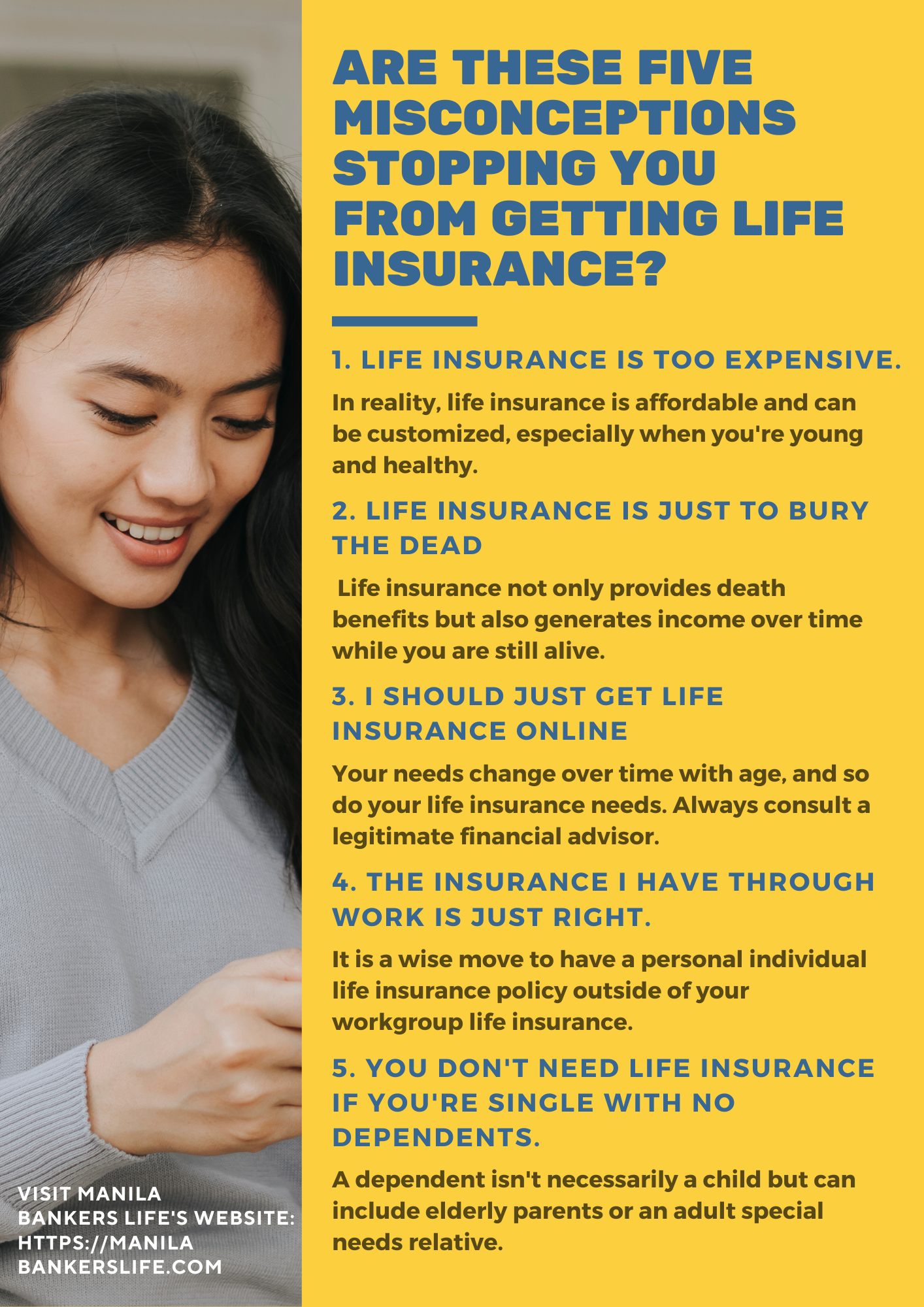
Employer-provided group term life insurance is a valuable benefit, but it rarely serves as a comprehensive life insurance strategy. Group policies typically cap coverage at low multiples of an employee's base salary—often 1x or 2x annual earnings—which is usually insufficient for families with mortgages, child-rearing costs, or long-term financial obligations.
Furthermore, group life insurance is generally tied to employment. If an individual changes jobs, suffers a lay-off, or leaves the workforce due to illness, coverage typically terminates or becomes prohibitively expensive to convert into an individual policy. Relying entirely on employer coverage leaves dependents unprotected during career transitions or unexpectedly late in life when private coverage costs are higher.
Myth 2: "Permanent Life Insurance Is Always Superior to Term Policies"
Permanent life insurance (such as Whole Life or Universal Life) includes both a death benefit and an internal cash-value accumulation account. Marketing materials often present permanent policies as an ideal dual-purpose vehicle for protection and investment. However, permanent life insurance is not inherently superior to term insurance; it serves fundamentally different objectives.
- Term Life Insurance: Provides pure death benefit protection for a specified period (e.g., 10, 20, or 30 years) at a significantly lower initial premium cost. It is often ideal for replacing income during working years or covering temporary debt like a home mortgage.
- Permanent Life Insurance: Entails substantially higher premiums to fund the cash-value element and internal administrative fees. It is primarily suited for estate planning, tax-advantaged wealth transfer, business succession funding, or individuals who have already maximized traditional tax-deferred accounts.
Purchasing permanent life insurance without a clear strategy for its cash-value component often leads to lapsed policies due to unsustainable premium payments.
TERM LIFE vs. PERMANENT LIFE INSURANCE
| Feature | Term Life Insurance | Permanent Life (Whole/Universal) |
|---|---|---|
| Duration | Fixed period (10-30 years) | Lifelong (if premiums paid) |
| Premium Cost | Lower initial cost | Significantly higher |
| Cash Value Component | None | Yes (grows tax-deferred) |
| Best Used For | Income replacement, temporary debt | Estate planning, wealth transfer |
Myth 3: "Non-Earning Family Members Do Not Require Life Insurance"
A common assumption is that life insurance is only necessary for primary wage earners. This overlooks the substantial economic value contributed by non-earning family members, such as stay-at-home parents or primary caregivers.
If a non-earning parent passes away, the surviving partner often faces significant out-of-pocket costs for childcare, household management, transportation, and eldercare services to maintain standard family operations. Securing term life insurance on a non-earning spouse protects the surviving family's financial stability by funding these essential services.
Unpacking Annuity Insurance Misconceptions
Annuities are financial contracts issued by insurance companies designed to pay out funds at regular intervals, mitigating the risk of individuals outliving their savings. Because of complex product structures and varying fee models, annuities generate significant misunderstandings.
ANNUITY INSURANCE MISCONCEPTIONS
- Myth 1: Insurance companies keep remaining funds if you die early
- Myth 2: Annuities yield lower returns than standard investments
- Myth 3: Surrender charges make annuity funds completely illiquid
Myth 1: "The Insurance Company Keeps Your Money When You Die"
A persistent myth suggests that if an annuitant dies shortly after purchasing an annuity, the insurance company retains the remaining balance. While this can occur under a simple Single Life (Life Only) payout structure, modern annuity contracts offer multiple payout configurations designed to protect principal:
- Joint and Survivor Payouts: Payments continue for the lifetime of a surviving spouse.
- Period Certain Riders: Guarantees that payments will continue to designated beneficiaries for a minimum number of years (e.g., 10 or 20 years), even if the annuitant dies earlier.
- Cash Refund / Installment Refund Riders: Guarantees that if the total payments distributed prior to death are less than the initial principal paid in, the remaining balance is returned to the beneficiaries.
Contract structure determines whether remaining capital is preserved for heirs or sacrificed in exchange for higher monthly lifetime distributions.
Myth 2: "Annuities Offer Poor Returns Compared to the Stock Market"
Evaluating annuities purely on capital growth misinterprets their core function. Annuities are insurance against financial depletion in retirement, not wealth-maximization investments like growth stocks or equities.
Comparing a fixed or fixed-indexed annuity directly to a diversified equity portfolio misses the key feature of an annuity: transfer of sequence-of-returns risk. While equity markets offer higher potential returns, they carry market volatility. Annuities provide guaranteed contract minimums or steady income floors, shielding retirees from severe market downturns occurring early in retirement.
Myth 3: "Surrender Charges Lock Up All Your Capital Without Exception"
Annuities often carry surrender charges—penalties imposed on withdrawals made during the contract's initial years. This has created the misconception that annuity capital is entirely inaccessible.
In practice, most modern deferred annuities include free withdrawal provisions, allowing contract holders to access a portion of their contract value (typically 10% annually) without triggering surrender penalties. Furthermore, many contracts include waiver riders that grant penalty-free access to funds in the event of terminal illness, admission to a qualified nursing facility, or severe disability.
Comparative Matrix: Insurance Types and Operational Realities
The following table summarizes key operational parameters across standard health, life, and annuity contract structures to help compare features and clear up misconceptions:
| Category | Product Variant | Primary Intent | Common Misconception | Fact / Reality |
|---|---|---|---|---|
| Health | High-Deductible Health Plan (HDHP) | Lowers monthly premiums while providing catastrophic risk protection. | Premium savings offset all out-of-pocket healthcare expenses. | Policyholders pay 100% of non-preventive costs up to the annual deductible limit. |
| Health | ACA Preventive Services | Free routine wellness screenings and baseline immunizations. | Covers all diagnostic testing and doctor visit follow-ups. | Diagnostic investigations, non-routine lab tests, and chronic conditions trigger normal out-of-pocket costs. |
| Life | Employer Group Term | Basic income replacement provided as an employment benefit. | Provides comprehensive, fully portable lifelong coverage. | Typically capped at 1-2x salary and usually terminates upon employment change. |
| Life | Individual Term Life | Cost-effective death benefit protection for a set timeframe. | Money spent is wasted if the policyholder outlives the policy term. | Functions as pure risk transfer, providing maximum financial security at lower costs during high-need years. |
| Life | Permanent Whole Life | Lifetime coverage with an internal cash-value component. | Functions as a flexible primary investment strategy for all households. | Higher premiums fund internal management fees; best used for specific estate planning or tax strategies. |
| Annuity | Fixed Immediate Annuity (SPIA) | Converts a lump sum into immediate, guaranteed income streams. | Insurer retains all capital if the annuitant passes away shortly after purchasing. | Beneficiary protections like period-certain options or refund riders preserve remaining principal. |
| Annuity | Fixed-Indexed Annuity (FIA) | Principal protection with growth tied to market indices. | Captures full market gains without downside exposure or caps. | Returns are limited by participation rates, interest caps, and spread fees defined in the contract. |
Framework for Auditing Insurance Coverage
To ensure coverage aligns with practical needs and to eliminate cost inefficiencies caused by common misconceptions, follow this systematic evaluation process:
COVERAGE AUDIT FRAMEWORK
- STEP 1: Conduct a Comprehensive Needs Analysis
- Evaluate medical usage, household obligations, income gaps
- STEP 2: Audit Existing Contracts & Group Benefits
- Review out-of-pocket maxes, policy portability, riders
- STEP 3: Match Insurance Types to Core Objectives
- Risk Transfer (Health/Term) vs Income Security (Annuities)
Step 1: Conduct a Comprehensive Needs Analysis
Calculate your actual exposure across all three areas. For health coverage, evaluate annual medical utilization alongside the maximum out-of-pocket limit, not just monthly premiums. For life insurance, calculate total financial obligations—including outstanding debts, future education costs, and ongoing household income requirements—rather than selecting an arbitrary multiple of your salary. For retirement, calculate your fixed expense gap (total guaranteed retirement expenses minus pension and Social Security benefits).
Step 2: Audit Existing Contracts and Group Benefits
Review current policies to understand their limitations. Examine employer benefit handbooks to verify group life insurance portability rules and coverage limits. For existing annuity contracts, review surrender charge schedules, withdrawal allowances, and beneficiary options. For health plans, check network boundaries and drug formularies to avoid unexpected out-of-network costs.
Step 3: Match Insurance Types to Core Objectives
Avoid forcing an insurance product to perform a function outside its design. Use health insurance and term life insurance for efficient, direct risk transfer. Reserve permanent life insurance for long-term wealth transfer, estate tax planning, or specialized asset protection strategies. Utilize annuities to create a guaranteed income floor in retirement rather than seeking aggressive capital growth.
Frequently Asked Questions
Can a term life insurance policy be converted to permanent coverage without a medical exam?
Many individual term life insurance policies include a convertibility rider. This provision allows policyholders to convert their term policy into a permanent life insurance policy within a specified timeframe without undergoing additional medical underwriting or providing proof of insurability. This is particularly valuable if an individual's health deteriorates during the term period.
How do Health Savings Accounts (HSAs) work with High-Deductible Health Plans?
An HSA is a tax-advantaged account available exclusively to individuals enrolled in an HSA-qualified High-Deductible Health Plan (HDHP). Contributions are pre-tax or tax-deductible, funds grow tax-free, and withdrawals are tax-free when used for qualified medical expenses. Unlike Flexible Spending Accounts (FSAs), HSA funds roll over completely from year to year, allowing participants to build long-term medical expense reserves.
Are payout distributions from an annuity subject to standard income tax?
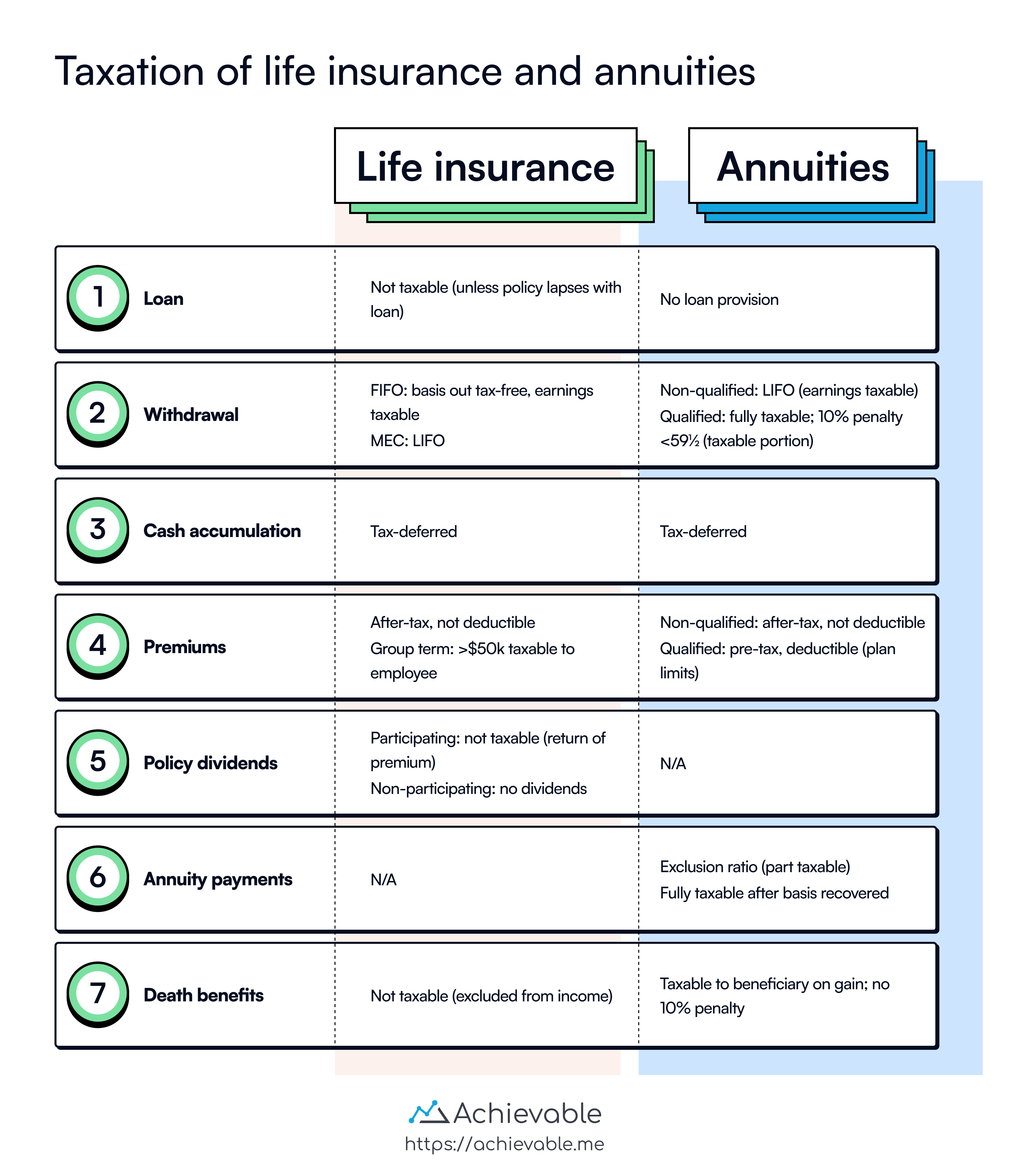
Taxation depends on how the annuity was funded. If purchased with pre-tax dollars (such as within a Traditional IRA or 401(k)), distributions are taxed as ordinary income. If purchased with non-qualified, post-tax funds, distributions follow the IRS exclusion ratio: a portion of each payment represents a tax-free return of principal, while the earnings portion is taxed as ordinary income.
Does Medicare cover all health expenses after age 65?
No. Original Medicare (Parts A and B) includes deductibles, copayments, and coinsurance without a built-in annual limit on out-of-pocket expenses. It also excludes services such as routine dental care, vision exams, hearing aids, and long-term custodial care. Beneficiaries often purchase Medicare Supplement (Medigap) plans, Medicare Advantage (Part C) coverage, or stand-alone prescription drug plans (Part D) to manage these cost gaps.
What is the primary difference between immediate and deferred annuities?
An immediate annuity (such as a SPIA) requires a single lump-sum premium and begins issuing income payouts almost right away—typically within 30 to 365 days of purchase. A deferred annuity accumulates value over an investment horizon (the deferral phase) before income distributions begin at a designated future date, allowing tax-deferred growth in the interim.
Strategic Recommendations for Policyholders
Making informed insurance decisions requires stepping back from popular myths and focusing on verified product structures:
- Separation of Concerns: Treat risk protection (health and term life insurance) and retirement income planning (annuities and retirement accounts) as distinct strategies. Combining them into complex hybrid products often leads to higher management fees and reduced transparency.
- Review Policy Terms Annually: Life stages, employer benefits, and health profiles change over time. Audit coverage annually to verify that deductibles, policy limits, and beneficiary designations match your current circumstances.
- Work With Independent Professionals: When seeking advice, consult independent insurance agents or fee-only fiduciary financial advisors. Independent brokers can compare products across multiple carriers, offering objective analysis of fees, riders, and financial strength ratings.
Understanding the mechanics of health, life, and annuity policies protects against unexpected costs and helps build a secure long-term financial plan.
Image Gallery