Comprehensive Guide to Amazon Warehouse Locations: Network Infrastructure and Facilities
Navigating Amazon warehouse locations requires understanding a vast, multi-tiered logistics network that includes Fulfillment Centers, Sortation Centers, Delivery Stations, and Prime Now Hubs. This physical infrastructure spans major g...
Navigating Amazon warehouse locations requires understanding a vast, multi-tiered logistics network that includes Fulfillment Centers, Sortation Centers, Delivery Stations, and Prime Now Hubs. This physical infrastructure spans major global metropolitan areas and rural logistics corridors, designed to optimize inventory placement, accelerate last-mile delivery, and maintain strict fulfillment SLAs.
Contents
Understanding the Amazon Fulfillment Network Architecture
The Amazon logistics ecosystem is built on a hierarchy of facilities, each playing a specific role in moving a product from a third-party seller or vendor's hands to a customer's doorstep. Recognizing the distinctions between these facilities is essential for supply chain management, freight forwarding, and employment seekers.
Fulfillment Centers (FCs) represent the backbone of this network. These massive structures, often ranging from 600,000 to over 1,000,000 square feet, house millions of active SKUs. FCs are categorized by their operational handling capabilities:
- Traditional Non-Sortable Facilities: Designed for oversized, bulky, or heavy items that cannot fit into standard automated storage pods, such as furniture, large electronics, and exercise equipment.
- Traditional Sortable Facilities: Handle standard-sized consumer goods where human pickers walk aisles or utilize picking carts to retrieve items.
- Robotic Sortable Facilities: Incorporate advanced robotics (such as Amazon Robotics drives) that bring mobile storage shelves directly to human station workers, drastically reducing pick-and-pack cycle times.
- Specialty Facilities: Tailored for specific product categories like apparel, hazardous materials (HAZMAT), or fresh groceries.
Classification of Amazon Facilities by Operational Function
To accurately map Amazon warehouse locations, one must distinguish among the distinct operational nodes within the supply chain pipeline. Each facility type features unique square footage requirements, technological deployments, and labor models.
| Facility Type | Primary Function | Typical Size Range | Key Operational Focus |
|---|---|---|---|
| Fulfillment Center (FC) | Inventory storage, picking, packing, and initial outbound shipping. | 600,000 - 1,000,000+ sq. ft. | Bulk storage, inventory management, high-density SKU housing. |
| Sortation Center (SC) | Aggregating packages from multiple FCs and sorting them by final destination zip code. | 200,000 - 500,000 sq. ft. | Cross-docking, route optimization, carrier handoff preparation. |
| Delivery Station (DS) | Final-mile staging where local delivery routes are organized for drivers. | 100,000 - 200,000 sq. ft. | Last-mile dispatch, Flex driver coordination, van routing. |
| Sub-Same-Day Hub (SSD) | Ultra-fast regional stocking for same-day delivery of high-velocity items. | 50,000 - 150,000 sq. ft. | Rapid pick-and-pack, hyper-local inventory, expedited dispatch. |
Geographic Distribution and Regional Placement Strategy
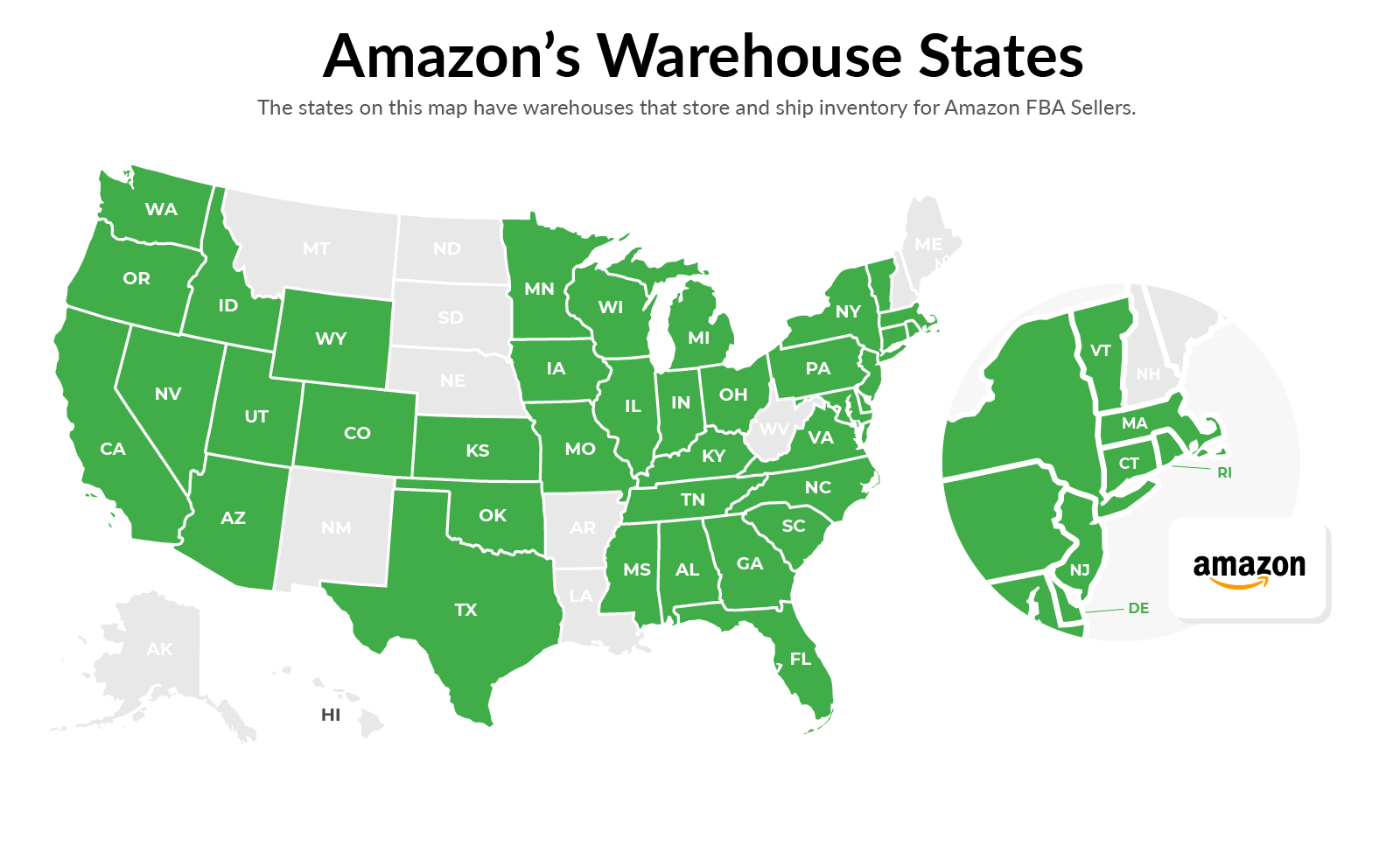
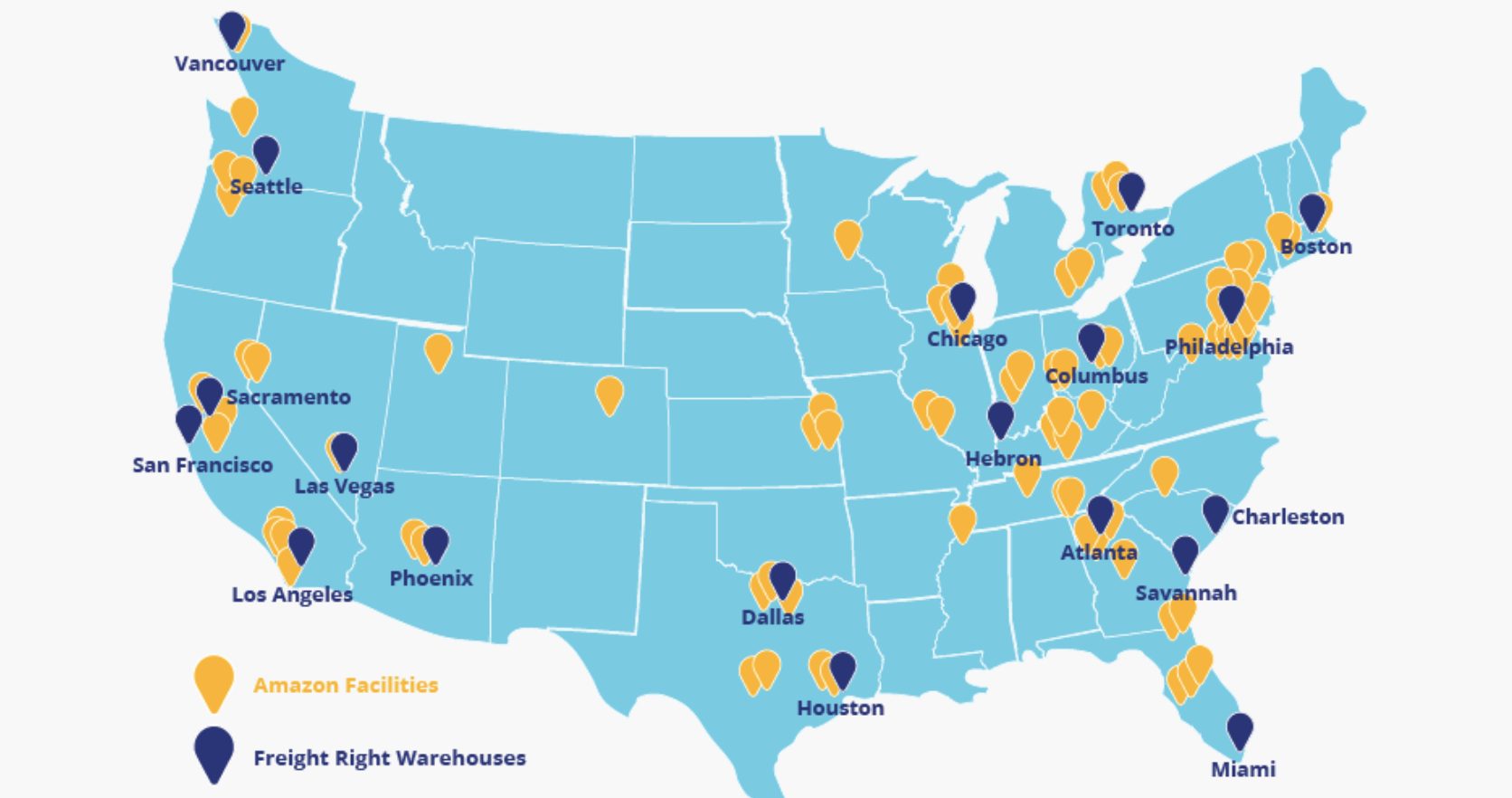
Amazon strategically places its warehouse locations based on macro-economic and demographic factors rather than arbitrary selection. Real estate acquisitions target major transportation arteries, population density clusters, and proximity to intermodal rail yards, international airports, and deep-water ports.
Primary logistics clusters in North America and Europe typically center around major metropolitan rings. For example, the Inland Empire region in Southern California, the corridor between Dallas and Fort Worth in Texas, and the central logistics hubs in Ohio and Pennsylvania serve as massive cross-docking vectors. This placement minimizes transit fuel burn and directly supports Prime's one-day and same-day delivery guarantees.
Logistics Infrastructure Note Strategic Real Estate Selection: Amazon prioritizes zoning compatibility, heavy-freight road access, and robust electrical grid capacity when developing new warehouse locations to support continuous robotic automation and high-speed conveyor systems.
How to Find Specific Amazon Warehouse Locations
Whether you are a logistics coordinator planning drayage, a job seeker applying for warehouse openings, or a vendor delivering inbound shipments, finding accurate, up-to-date physical addresses requires utilizing official and verified secondary channels.
- Amazon Seller Central: Registered sellers can view assigned inbound fulfillment center codes (e.g., ONT8, MDW2) and their corresponding physical street addresses when creating shipping plans.
- Carrier Load Boards: Freight brokers and truck drivers utilize load management software that cross-references facility codes with verified GPS coordinates and dock-scheduling portals.
- Local Economic Development Boards: Municipal and county planning commissions publish public zoning filings and commercial real estate approvals for newly proposed or expanding Amazon facilities.
Facility Coding Nomenclature Explained
Amazon utilizes a standardized, highly structured alphanumeric naming convention for its warehouse locations. Understanding this nomenclature allows logistics professionals to instantly identify the geographical region and facility type of any given shipping node.
A typical facility code consists of a three-letter airport or metropolitan area identifier followed by a numerical digit. For instance, in the code BFI1, "BFI" refers to the Seattle-Tacoma International Airport region, while the number "1" denotes the chronological sequence of facilities opened in that market.
Furthermore, suffix letters or internal designations sometimes indicate specialized handling, such as automated versus non-automated sorting infrastructure. Recognizing these codes prevents costly routing errors during inbound freight appointment scheduling.
Operational Workflows: From Inbound Freight to Last-Mile Dispatch
The lifecycle of a product moving through an Amazon warehouse location follows a rigorously optimized, data-driven workflow designed to minimize dwell time and eliminate inventory bottlenecks.
- Inbound Receiving: Pallets or floor-loaded containers arrive at the dock doors of a Fulfillment Center. Workers scan Global Trade Item Numbers (GTINs) or Amazon Barcode (FNSKU) labels to log inventory into the warehouse management system (WMS).
- Stowage and Inventory Placement: Items are assigned dynamic storage locations. In robotic facilities, items are placed into pods wherever space is available, relying on algorithms rather than human categorization (e.g., storing books next to vacuum cleaners) to optimize space utilization.
- Customer Order Processing: When a customer places an order, the WMS triggers picking instructions via handheld scanners or automated conveyor routing, consolidating items bound for the same customer at a pack station.
- Outbound Consolidation: Packed cartons are palletized or loaded into gaylords and shipped via linehaul trucks to Sortation Centers.
- Sortation and Delivery: Sortation centers route packages to local Delivery Stations, where Delivery Service Partners (DSPs) and Amazon Flex drivers load vans for final-mile drop-off.
Frequently Asked Questions About Amazon Warehouse Locations
How can I find the exact street address of an Amazon fulfillment center code?
You can identify the exact street address by accessing your Amazon Seller or Vendor account shipping tools, checking your carrier's facility database, or referencing official load-planning software that maintains active dock directories. Facility codes are universally mapped to verified GPS coordinates for freight navigation.
What is the difference between an Amazon Fulfillment Center and a Sortation Center?
A Fulfillment Center stores inventory and packs individual customer orders into shipping boxes, whereas a Sortation Center does not hold long-term inventory. Instead, a Sortation Center aggregates finished packages from multiple fulfillment centers and sorts them by zip code for handoff to regional postal services and delivery carriers.
Are Amazon warehouse locations open to the public for inventory drop-offs?
No, Amazon warehouse locations are secure industrial facilities strictly closed to the general public. Inbound freight must be delivered by pre-approved commercial carriers, freight forwarders, or registered Amazon Partnered Carriers holding scheduled dock appointments.
How does Amazon choose where to build new warehouse locations?
Amazon selects new warehouse sites based on predictive demand analytics, highway infrastructure capacity, proximity to dense consumer populations, labor pool availability, and local municipal tax incentives. This data-driven approach ensures optimal placement for regional delivery speed.
Can I visit an Amazon warehouse for a tour?
Amazon periodically offers public and virtual fulfillment center tours through structured corporate programs, though availability varies by facility and local operational policies. Interested visitors must register through official Amazon tour scheduling portals in advance.
Strategic Conclusion and Logistics Recommendations
Mastering the layout, function, and nomenclature of Amazon warehouse locations is critical for maintaining efficient supply chain operations, optimizing freight costs, and ensuring timely inventory replenishment. Whether managing inbound shipments as a third-party seller or analyzing regional logistics trends, maintaining familiarity with facility classifications ensures seamless integration with the world's most sophisticated retail distribution network. To streamline your shipping operations, always verify facility codes and dock appointment windows within official portal systems before dispatching freight.
Image Gallery