How Group Life Insurance for Memberships Works
Group life insurance for memberships provides low-cost, simplified term life coverage to members of associations, labor unions, alumni networks, and professional societies without requiring individual medical exams. Associations, profe...
Group life insurance for memberships provides low-cost, simplified term life coverage to members of associations, labor unions, alumni networks, and professional societies without requiring individual medical exams.
Contents
Associations, professional societies, labor unions, and alumni networks are constantly searching for ways to deliver tangible, high-value benefits that boost member retention and attract new sign-ups. One of the most effective yet frequently misunderstood tools in this retention arsenal is group life insurance for memberships. Unlike traditional employer-sponsored plans tied to a workplace, these programs use the collective buying power of an organization to offer simplified, cost-effective term life protection to individuals based strictly on their active membership status.
Understanding the mechanics of these programs requires looking past standard workplace benefits and examining how group underwriting, master contracts, and premium structures function in non-traditional settings. Whether you are an association administrator evaluating new member perks or an individual considering opting into an association-sponsored plan, knowing the operational realities, financial structures, and coverage limits is essential for making informed decisions.
Defining Group Life Insurance in Membership Organizations
Group life insurance for memberships is a master policy issued to an organization—such as a trade association, credit union, or professional guild—that extends life insurance coverage to its individual members. Rather than issuing a separate, customized contract to every single person, the insurance carrier issues a single master contract to the organization. Every participating member receives a certificate of insurance detailing their specific coverage amount, beneficiaries, and terms.
This structure shifts the administrative burden away from the individual and places it primarily on the organization or a designated third-party administrator (TPA). The core philosophy behind this model is risk pooling. By spreading the risk across a broad pool of members, insurance underwriters can offer baseline coverage at significantly lower rates than what individuals would pay for a comparable individual term life policy on the open market.
Furthermore, these plans are frequently structured as guaranteed issue or simplified issue, meaning members can secure coverage without undergoing invasive medical examinations or submitting extensive bloodwork. This makes coverage accessible to individuals who might otherwise face high premiums or outright denial due to pre-existing health conditions or older age.
The Core Mechanics: How Coverage is Established and Maintained
Implementing and running a group life insurance program for a membership organization involves several distinct structural layers. The lifecycle of a policy relies on clear agreements between the insurer, the association, and the individual members.
1. The Master Contract Agreement
The relationship begins when the membership organization negotiates and executes a master contract with an authorized insurance carrier. This contract dictates the master policy terms, including the overall pricing formula, eligibility parameters, participation minimums, and claims procedures. The association holds the legal ownership of the master policy, while the members are treated as certificate holders.
2. Eligibility and Enrollment Windows
To qualify for coverage, an individual must maintain active, dues-paying membership in the sponsoring organization. Plans often introduce an initial waiting period—such as 30 to 90 days of continuous membership—before a new member becomes eligible to enroll. Organizations typically offer open enrollment periods annually, though newly joined members usually receive a special introductory window to sign up without providing evidence of insurability.
3. Premium Collection and Remittance
Funding mechanisms vary based on how the organization chooses to package the benefit:
- Employer-Paid (Non-Contributory): The association pays 100% of the insurance premium using a portion of membership dues or general operating revenue. In these models, coverage is often automatic for all eligible members.
- Member-Paid (Contributory): The organization secures the group rate, but individual members choose whether to opt in and pay their own premiums, typically billed directly through their membership dues renewal cycle or via automatic credit card drafts.
4. Coverage Adjustments and Termination
Coverage remains active as long as the master policy is renewed by the organization, the individual remains a dues-paying member, and premiums are paid on time. If a member lets their association membership lapse, their group life insurance certificate typically terminates after a brief grace period, though many policies offer a conversion option to transition into an individual whole or term policy without proof of medical insurability.
Comparing Individual Term Life vs. Membership Group Life
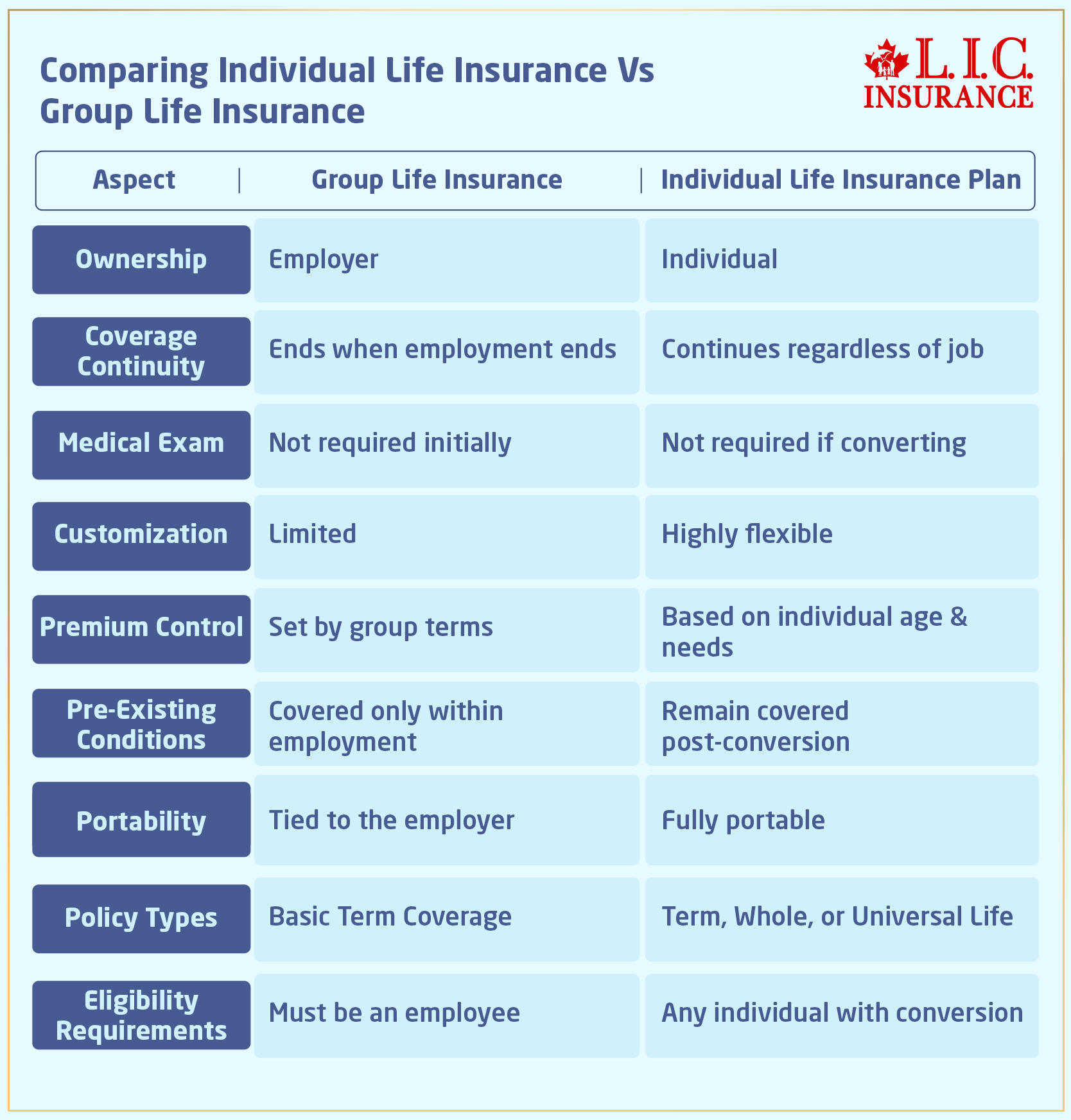
| Feature | Individual Term Life Insurance | Group Life Insurance for Memberships |
|---|---|---|
| Underwriting | Requires medical exams, lab work, and health history reviews. | Typically guaranteed issue or simplified issue with no medical exam. |
| Cost Determination | Based strictly on personal age, gender, health, and lifestyle habits. | Flat rates tiered by age brackets across the entire membership pool. |
| Ownership | Owned solely by the individual; completely independent of employment or associations. | Owned by the organization via a master contract; certificate issued to the member. |
| Portability | Fully portable; stays with you regardless of career or membership changes. | Generally non-portable; terminates if association membership lapses (subject to conversion). |
| Coverage Limits | Highly customizable; often ranges from $100,000 to several millions of dollars. | Typically modest fixed amounts (e.g., $5,000 to $50,000), though supplemental buy-ups may be available. |
Key Benefits and Strategic Advantages
Organizations deploy group life insurance programs to achieve specific operational and financial goals, while members leverage them for accessible protection.
For the Sponsoring Organization
- Enhanced Member Value: Offering a complimentary or deeply discounted life insurance policy transforms an abstract membership card into an indispensable financial safety net, directly driving renewal rates.
- Competitive Differentiation: In crowded professional markets, unique perks help professional societies stand out against rival organizations.
- Revenue Generation (In Some Models): Certain sponsored plans operate via administrative service agreements where the association receives a small royalty or administrative fee from the insurer for managing billing and communication.
For the Individual Member
- Low Barrier to Entry: Because medical underwriting is either eliminated or heavily streamlined, members with minor health concerns can secure baseline financial protection.
- Affordable Bulk Pricing: Group pricing discounts make coverage exceptionally economical, particularly for older members or those who find individual market rates prohibitive.
- Simplicity: The application process is streamlined, often requiring only a few basic questions regarding tobacco use and major medical conditions.
Operational Limitations and Potential Drawbacks
Despite clear advantages, group life insurance for memberships comes with structural limitations that participants and administrators must carefully evaluate.
- Lower Coverage Ceilings: Group policies are rarely designed to serve as a family's sole financial safety net. A standard benefit of $10,000 or $25,000 is intended to assist with final expenses or provide short-term buffer funds, not to replace decades of lost income.
- Lack of True Portability: If a member changes professions, retires from the industry, or simply stops paying association dues, the coverage evaporates. Relying solely on a membership group plan leaves individuals vulnerable if their association status changes unexpectedly.
- Rate Creep Across Age Brackets: While group plans use pooled risk, many policies utilize age-banded premium schedules. As a member ages into higher brackets, their personal premium contribution may increase significantly every few years.
- Master Policy Vulnerability: If the sponsoring organization experiences severe financial distress, disbands, or decides to cancel the master policy to cut costs, all underlying member certificates are terminated simultaneously.
Regulatory and Compliance Frameworks
Group insurance is heavily regulated at the state level by insurance commissioners to protect consumers from predatory pricing and unfair cancellation practices. Sponsoring organizations must ensure that their program complies with state group insurance laws, which often dictate the minimum percentage of members required to participate (participation ratios) to prevent adverse selection—a scenario where only high-risk, sick members opt into the plan.
Furthermore, associations must navigate tax implications carefully. When an organization provides group-term life insurance as a complimentary benefit funded by dues, the value of that coverage may have specific tax reporting nuances for members, particularly in professional trade settings where dues may or may not be treated as deductible business expenses. Organizations should consult qualified legal and tax professionals before launching or restructuring a member benefit program.
Frequently Asked Questions
Can I keep my group life insurance if I cancel my association membership?
Generally, no. Because the coverage is tied directly to the master contract held by the organization, letting your membership lapse terminates your certificate. However, many master policies include a conversion privilege that allows you to convert your group certificate into an individual permanent life insurance policy without proving insurability, provided you apply within a specified window, such as 31 days.
Do I need to take a medical exam to qualify for membership group life insurance?
In most cases, no medical exam is required. These plans are structured as guaranteed issue or simplified issue. You may be asked a few basic health or tobacco-use questions on a short enrollment form, but blood draws, physical measurements, and attending physician statements are rarely required for standard baseline coverage tiers.
Can I purchase higher coverage amounts than the base plan offers?
Many association plans offer tiered options or supplemental buy-up riders. While the base membership may include a complimentary $5,000 or $10,000 policy paid for by dues, members typically have the option to purchase additional coverage increments (e.g., up to $100,000 or $250,000) through payroll or direct-bill deductions, though these higher tiers may require simplified medical underwriting.
What happens if the association decides to cancel the insurance program?
If the sponsoring organization terminates the master contract with the insurance carrier, all active member certificates cease upon the policy's cancellation date. Insurers are typically required to provide advance written notice to the organization, which then must notify certificate holders, giving them an opportunity to seek alternative individual coverage.
Who is the legal owner of the group life insurance policy?
The organization or association holds the master contract and is the legal owner of the policy. The individual member is designated as the certificate holder and retains the right to name and change beneficiaries, but they do not control the overarching terms, premium rates, or continuation of the master contract itself.
Image Gallery