Why Cloud Infrastructure Matters for Modern Businesses
Cloud infrastructure provides the scalable, secure, and cost-effective foundation necessary for digital operations in 2026. By abstracting physical hardware into virtualized services, it enables organizations to deploy applications rap...
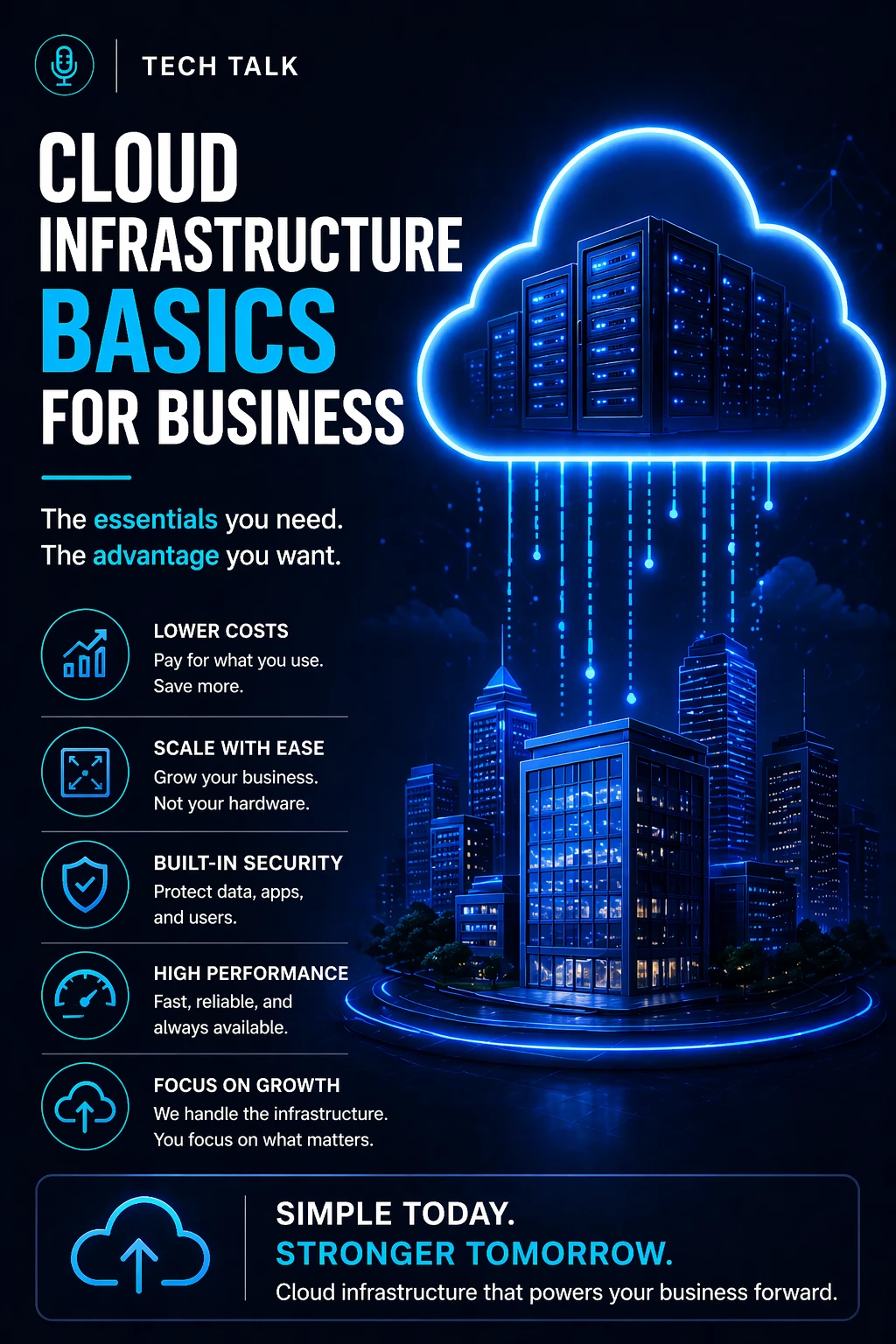
Cloud infrastructure provides the scalable, secure, and cost-effective foundation necessary for digital operations in 2026. By abstracting physical hardware into virtualized services, it enables organizations to deploy applications rapidly, manage massive data sets, and integrate advanced technologies like generative AI, ensuring competitive agility and operational resilience in an increasingly volatile global market.
Contents
The Paradigm Shift from Physical to Virtual Assets
For decades, business growth was tethered to the physical limitations of on-premise data centers. Companies had to forecast their computing needs years in advance, purchase expensive hardware, and maintain a dedicated staff to keep servers running. In 2026, this model is largely considered a legacy approach, reserved only for highly specific localized edge cases or air-gapped security environments.
Cloud infrastructure represents the transition from Capital Expenditure (CapEx) to Operating Expenditure (OpEx). Instead of buying "boxes," businesses now subscribe to compute power, storage, and networking capabilities. This shift is not merely financial; it is strategic. Modern infrastructure-as-a-service (IaaS) allows a startup to access the same high-performance computing (HPC) clusters as a Fortune 500 company, effectively democratizing the ability to innovate.
The evolution of cloud infrastructure has moved beyond simple hosting. It now encompasses a sophisticated ecosystem of Software-Defined Networking (SDN), automated provisioning, and global content delivery networks (CDNs). For the modern business, this means the "plumbing" of IT is no longer a bottleneck but a catalyst for speed-to-market.
Core Pillars of Cloud Value in 2026
To understand why cloud infrastructure is the backbone of modern commerce, one must examine the specific pillars that support business continuity and growth.
1. Unprecedented Scalability and Elasticity
In a traditional IT environment, scaling meant ordering new servers, waiting for delivery, and manual installation. If demand dropped, those assets sat idle, draining the budget. Cloud infrastructure introduces elasticity—the ability to scale resources up or down automatically based on real-time demand.
Whether a retail site experiences a 500% traffic surge during a flash sale or a research firm needs massive throughput for a weekend simulation, the cloud responds instantly. This prevents the "over-provisioning" trap, where companies pay for peak capacity that they only use 5% of the time.
2. Enhanced Security and Compliance
A common misconception in the early 2010s was that the cloud was less secure than on-premise systems. By 2026, the reality is the opposite. Major cloud service providers (CSPs) like Amazon Web Services (AWS), Microsoft Azure, and Google Cloud Platform (GCP) invest billions of dollars annually into security research and infrastructure hardening.
Cloud infrastructure operates under a Shared Responsibility Model. While the provider secures the "cloud itself" (hardware, physical security, cooling), the business secures what is "in the cloud" (data, encryption, access controls). Modern cloud platforms offer built-in tools for identity and access management (IAM), automated threat detection, and seamless compliance with global standards like GDPR, HIPAA, and SOC 2.
3. Business Continuity and Disaster Recovery (BCDR)
Data loss is an existential threat to modern enterprises. Cloud infrastructure provides inherent redundancy. Data is not just stored on one disk; it is replicated across multiple geographic "Availability Zones." In the event of a natural disaster or localized hardware failure, the system automatically fails over to a secondary site with near-zero downtime. For businesses, this eliminates the need for expensive secondary physical data centers and provides a level of resilience that was previously unaffordable for small and medium enterprises.
The Economic Impact: Optimizing Total Cost of Ownership (TCO)
One of the primary reasons cloud infrastructure matters is its impact on the bottom line. However, the financial benefits extend beyond just "saving money" on hardware. It is about the Total Cost of Ownership (TCO) and the reduction of technical debt.
| Feature | On-Premise Infrastructure | Cloud Infrastructure (2026) |
|---|---|---|
| Initial Investment | High Upfront CapEx (Hardware/Facilities) | Low/Zero Upfront OpEx (Pay-as-you-go) |
| Maintenance | Manual patching, cooling, power, physical repair | Managed by provider; automated updates |
| Time-to-Market | Weeks or months for procurement | Minutes for automated provisioning |
| Energy Efficiency | High (Cooling/Powering underused servers) | Optimized (High density, green energy focus) |
| Scalability | Fixed capacity; difficult to grow | Elastic; scales dynamically with demand |
| Asset Lifespan | 3–5 years (Depreciating assets) | Evergreen (Continuous hardware refreshes) |
By 2026, the emergence of FinOps—the practice of bringing financial accountability to the variable spend of cloud—has allowed businesses to fine-tune their infrastructure costs. Organizations can now see exactly which department is using which resource, allowing for precise budget allocation and the elimination of "zombie" resources.
Supporting the Modern Workforce: Remote and Hybrid Models
The workplace has fundamentally changed, and cloud infrastructure is what makes the "work from anywhere" reality possible. Remote employees require low-latency access to enterprise applications and data. Cloud-based Virtual Desktop Infrastructure (VDI) and cloud-native collaboration tools ensure that a developer in Berlin and a designer in Tokyo can work on the same environment simultaneously without the lag associated with traditional VPNs.
Furthermore, cloud infrastructure supports the "edge" computing needs of 2026. For businesses involved in manufacturing or logistics, processing data at the edge—closer to where it is generated—reduces latency. This is made possible by cloud providers extending their infrastructure to the very edge of the network, connecting 5G, IoT devices, and central data lakes into a single, cohesive ecosystem.
Driving Innovation: The AI and Big Data Catalyst
You cannot run modern AI models on standard office servers. The massive computational power required for training Large Language Models (LLMs) or performing real-time predictive analytics is only accessible via the cloud. Cloud infrastructure provides specialized hardware, such as Tensor Processing Units (TPUs) and Graphics Processing Units (GPUs), on a fractional basis.
Modern businesses use cloud infrastructure to:
- Store and analyze Big Data: Use massive data lakes to identify market trends.
- Deploy Generative AI: Integrate AI agents into customer service and product development.
- Enable DevOps: Use containerization (like Kubernetes) and serverless computing to push code updates multiple times per day without downtime.
Without the underlying cloud infrastructure, these innovations would be too expensive and complex for most businesses to implement, leaving them at a distinct disadvantage against tech-native competitors.
Common Pitfalls and How to Avoid Them
While the cloud is essential, it is not a magic solution. Business leaders must navigate several challenges to maximize their investment:
- Vendor Lock-in: Relying too heavily on one provider's proprietary tools can make it difficult to migrate later. Modern businesses mitigate this by adopting a Multi-cloud or Hybrid-cloud strategy, ensuring they are not beholden to a single ecosystem.
- Uncontrolled Costs: Without proper governance, the "pay-as-you-go" model can lead to "bill shock." Implementing automated tagging, budget alerts, and scheduled shutdowns for non-production environments is critical.
- The Skills Gap: Operating cloud-native infrastructure requires different skills than traditional IT. Companies must invest in continuous training or partner with Managed Service Providers (MSPs) to bridge the gap in cloud architecture and security.
Frequently Asked Questions
Is cloud infrastructure safer than keeping data in our own office?
Yes, in almost all scenarios. Major cloud providers have physical and digital security protocols that far exceed what an individual business can typically afford. This includes biometric access to data centers, 24/7 surveillance, and hundreds of dedicated security engineers. However, the business is still responsible for managing user permissions and encrypting sensitive data.
How does cloud infrastructure affect business sustainability?
In 2026, sustainability is a key business metric. Large-scale cloud data centers are significantly more energy-efficient than private server rooms because they run at much higher utilization rates. Furthermore, most major CSPs have committed to 100% renewable energy, helping businesses reduce their Scope 3 carbon emissions.
What is the difference between IaaS, PaaS, and SaaS?
IaaS (Infrastructure as a Service) provides the raw building blocks like virtual servers and storage. PaaS (Platform as a Service) provides a framework for developers to build and deploy apps without managing the underlying hardware. SaaS (Software as a Service) is the finished software product delivered over the web, such as an email or CRM platform.
Can we move our existing "legacy" software to the cloud?
Yes, this is often called a "Lift and Shift" migration. While it allows you to get out of the hardware business quickly, it doesn't take full advantage of cloud-native features like auto-scaling. Over time, most businesses "refactor" their legacy apps to be more cloud-efficient.
What is "Serverless" computing?
Serverless is a cloud execution model where the provider automatically manages the allocation of machine resources. Developers only write the code (functions), and the cloud provider handles the rest. You only pay for the exact time the code runs, often measured in milliseconds, making it highly cost-effective for intermittent tasks.
Practical Recommendation for 2026
For businesses looking to optimize their infrastructure, the first step is to conduct a Cloud Maturity Assessment. Do not attempt to move everything at once. Start by migrating non-critical workloads to gain experience, then focus on "cloud-native" development for all new projects.
Invest heavily in Identity-Driven Security (Zero Trust) and ensure your finance and IT teams are aligned through a FinOps framework. By treating cloud infrastructure as a strategic asset rather than a utility, modern businesses can ensure they remain agile, secure, and prepared for the technological shifts of the next decade.
Image Gallery