Is Milk an Element? Understanding Its Chemical Composition
Milk is not an element; it is a complex, heterogeneous mixture composed of water, fats, proteins, carbohydrates, vitamins, and minerals. Because it contains multiple distinct chemical substances held together in a colloidal suspension...
Milk is not an element; it is a complex, heterogeneous mixture composed of water, fats, proteins, carbohydrates, vitamins, and minerals. Because it contains multiple distinct chemical substances held together in a colloidal suspension and emulsion rather than a single type of atom, it cannot be classified as an element on the periodic table.
Contents
Defining Chemical Elements vs. Mixtures
To understand why milk is not an element, one must first distinguish between elements, compounds, and mixtures. In chemistry, an element is a pure substance consisting entirely of atoms that all have the same number of protons in their atomic nuclei. Elements are the building blocks of matter and cannot be broken down into simpler substances by ordinary chemical means. Examples include gold, oxygen, iron, and carbon.
A compound, by contrast, consists of two or more elements chemically bonded in a fixed ratio, such as water (H₂O) or sodium chloride (NaCl). A mixture is a combination of two or more substances that are physically blended together but not chemically bonded. In a mixture, each component retains its individual chemical identity and properties. Milk falls firmly into this third category.
The Composition of Milk: A Complex Matrix
Milk is essentially a biological fluid produced by the mammary glands of mammals. Its composition varies depending on the species of the animal, its diet, and the stage of lactation. However, at a fundamental chemical level, it is a combination of several distinct categories of matter.
1. Water as the Continuous Phase
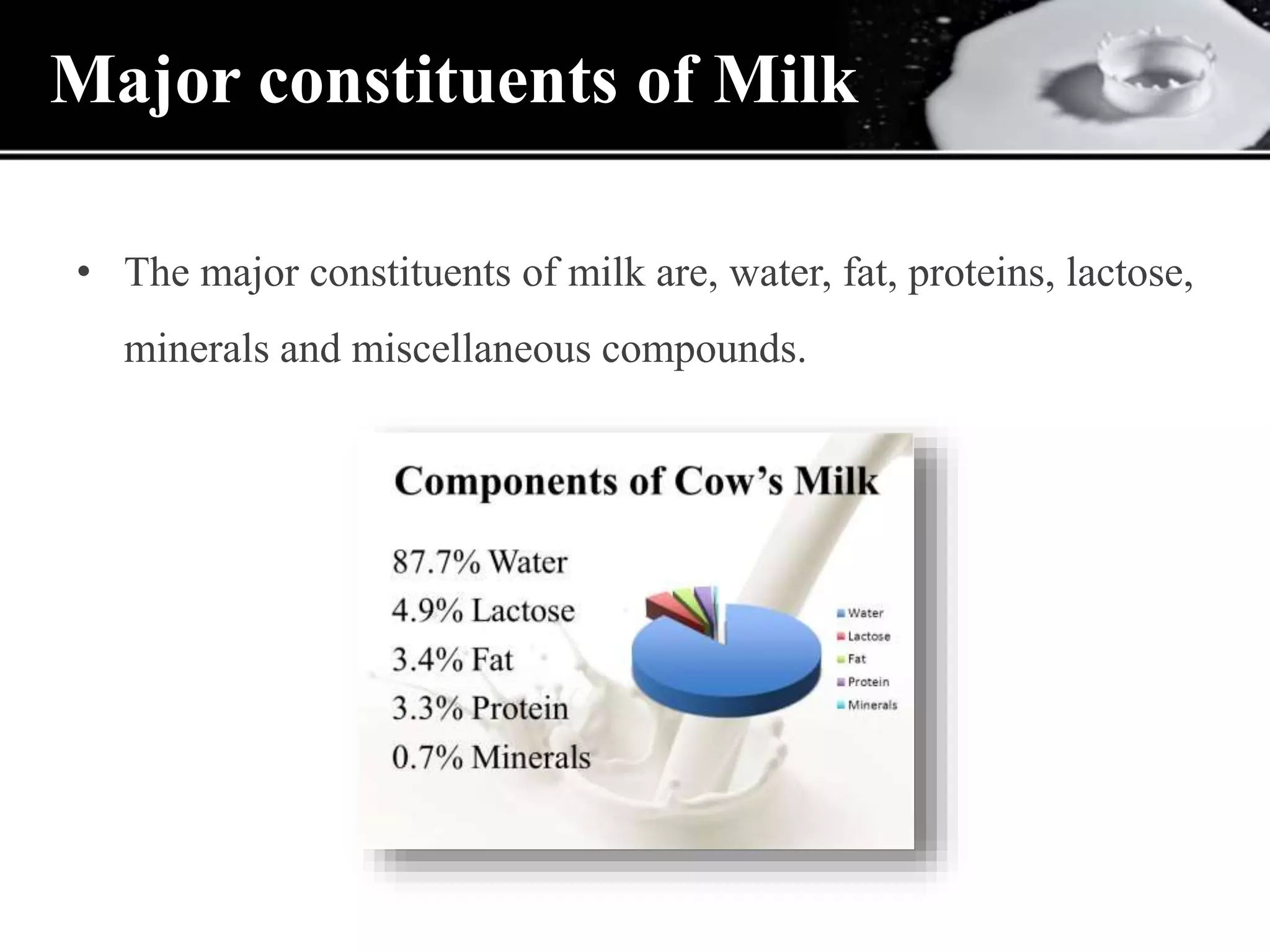
The largest component of milk is water, which typically accounts for approximately 87% of its total weight. This water acts as the continuous phase or solvent in which all other components are suspended or dissolved. Because water is a compound (H₂O), the mere presence of it ensures that milk cannot be an element.
2. Milk Fats and Emulsions
Milk contains fat, primarily in the form of triglycerides. These fats do not dissolve in the water phase; instead, they exist as small globules dispersed throughout the liquid. This structure is known as an emulsion. If milk is allowed to sit, these fat globules often rise to the top—a process prevented in commercial production through homogenization, which breaks the globules down into smaller sizes to ensure a consistent texture.
3. Proteins and Colloids
Milk contains a variety of proteins, most notably caseins and whey proteins. Caseins are organized into complex structures called micelles. These micelles are suspended in the liquid, making milk a colloidal suspension. Like fats, these proteins are complex organic molecules consisting of carbon, hydrogen, nitrogen, oxygen, and sulfur, which further emphasizes that milk is a collection of compounds, not a singular element.
4. Carbohydrates and Minerals
Lactose, a disaccharide (a sugar composed of two simple sugars bonded together), is the primary carbohydrate in milk. Additionally, milk contains dissolved minerals such as calcium, phosphorus, magnesium, and potassium. These minerals exist as ions or salts within the liquid. The presence of these diverse chemical species—sugars, salts, and proteins—confirms that milk is a multifaceted mixture.
Scientific Classification: Why Milk is a Colloid
In physical chemistry, milk is classified as a colloid. A colloid is a mixture where one substance of microscopically dispersed insoluble particles is suspended throughout another substance.
- The Emulsion Aspect: Because milk contains liquid fat droplets dispersed in a water-based liquid, it functions as an emulsion.
- The Suspension Aspect: Because milk contains protein particles that are larger than simple molecules but small enough to remain suspended without settling, it functions as a suspension.
Because these components remain physically distinct at the microscopic level, you can separate the parts of milk using physical processes. For instance, centrifugation can separate the cream (fat) from the skimmed milk. Since elements cannot be separated into different components by physical means, the fact that milk can be separated reinforces its classification as a mixture.
Comparison of Substances
The following table differentiates between elements, compounds, and mixtures using common examples to illustrate where milk fits in the broader chemical landscape.
| Substance | Classification | Composition Notes |
|---|---|---|
| Gold | Element | Atoms with 79 protons only. |
| Oxygen | Element | Diatomic molecules (O₂) of one type of atom. |
| Water (H₂O) | Compound | Two elements chemically bonded in fixed ratio. |
| Milk | Mixture | A complex fluid of water, fat, protein, and sugar. |
| Salt (NaCl) | Compound | Two elements ionically bonded. |
Does Processing Change the Chemical Status?
Consumers often wonder if pasteurization, homogenization, or fortification changes milk into an element or a different type of substance. The answer is no.
- Pasteurization involves heating milk to a specific temperature for a set time to kill bacteria. This process denatures some proteins and kills microorganisms, but it does not change the fundamental atomic composition of the mixture.
- Homogenization uses high pressure to break up fat globules. It is a physical process that alters the texture and consistency of the mixture, but it does not create or destroy chemical elements.
- Fortification (e.g., adding Vitamin D) adds additional molecules to the existing mixture. While this changes the concentration of certain nutrients, it does not alter the fact that the resulting liquid is still a mixture.
Frequently Asked Questions
Is milk a liquid or a solid? Milk is a liquid. In terms of states of matter, it behaves as a fluid, though it is technically a mixture that contains microscopic solid particles (proteins) and liquid droplets (fats) suspended within a liquid solvent (water).
Why do some people call milk a "pure" substance? In marketing, the term "pure" is often used to imply that the milk is free from additives or contaminants. This is a culinary or quality control term, not a scientific one. Scientifically, there is no such thing as "pure" milk because it is inherently a mixture of many different substances.
Can I separate the elements out of milk? You can separate the components of milk (such as fat, protein, and water) through physical processes like churning or evaporation. However, you cannot separate "elements" like calcium or carbon from those components without high-energy chemical reactions or nuclear processes.
Does milk have a chemical formula? No. Because milk is a mixture with a variable composition—meaning the exact ratios of fat to protein to water change depending on the source—it does not have a single chemical formula like water (H₂O) or carbon dioxide (CO₂).
Is milk a solution? Milk is not a true solution because a solution is a homogeneous mixture where solutes are dissolved at the molecular level. Because milk contains large suspended particles (fat globules and protein micelles), it is classified as a colloid, not a true solution.
Conclusion and Next Steps
Milk is definitively a complex mixture, not an element. It serves as a biological solution-suspension-emulsion hybrid that provides a rich array of nutrients. For those interested in the chemistry of food, the study of milk provides a perfect gateway into understanding how different states of matter interact on a microscopic level. If you are examining milk for professional or educational purposes, remember to treat it as a variable biological product rather than a standardized chemical constant. For further study into food chemistry, consider reviewing the properties of emulsions in culinary applications or the role of protein denaturation in dairy processing.
Image Gallery