Sony TA-AN1000 Review: Benchmark 7.2-Channel 8K AV Receiver Performance
The Sony TA-AN1000 delivers an exceptional 7.2-channel home theater experience, combining 8K HDMI 2.1 video passthrough, Dolby Atmos, and Sony's proprietary 360 Spatial Sound Mapping. Featuring precise D.C.A.C. IX auto-calibration and...
The Sony TA-AN1000 delivers an exceptional 7.2-channel home theater experience, combining 8K HDMI 2.1 video passthrough, Dolby Atmos, and Sony's proprietary 360 Spatial Sound Mapping. Featuring precise D.C.A.C. IX auto-calibration and seamless PlayStation 5 integration, it offers class-leading spatial audio separation, dynamic clarity, and effortless setup for movie enthusiasts and audio purists.
Contents
Key Specifications and Hardware Architecture of the Sony TA-AN1000
The Sony TA-AN1000 represents a ground-up redesign of Sony's mid-range audio-visual receiver lineup, bridging the gap between mainstream consumer AV receivers and high-end custom-install amplifiers. Built around a rigid Frame Beam (FB) chassis, the receiver minimizes mechanical vibrations that can destabilize audio signals. Its internal layout isolates digital processing circuits from analogue power stages, preventing electromagnetic interference across the signal chain.
At its core, the amplification section delivers 85 watts per channel into 8 ohms (20 Hz – 20 kHz, 0.09% THD, 2 channels driven) and up to 120 watts per channel into 6 ohms (1 kHz, 0.9% THD, 1 channel driven). This power envelope allows the TA-AN1000 to drive demanding floor-standing speakers or low-efficiency bookshelf speakers without audible distortion during dynamic transient peaks.
Core Circuit Optimization Sony incorporates a custom-designed power transformer alongside high-capacity main power supply capacitors. The digital processing circuit board utilizes a 32-bit DAC architecture, ensuring pristine signal reproduction across multi-channel high-resolution PCM audio files and object-based spatial audio bitstreams.
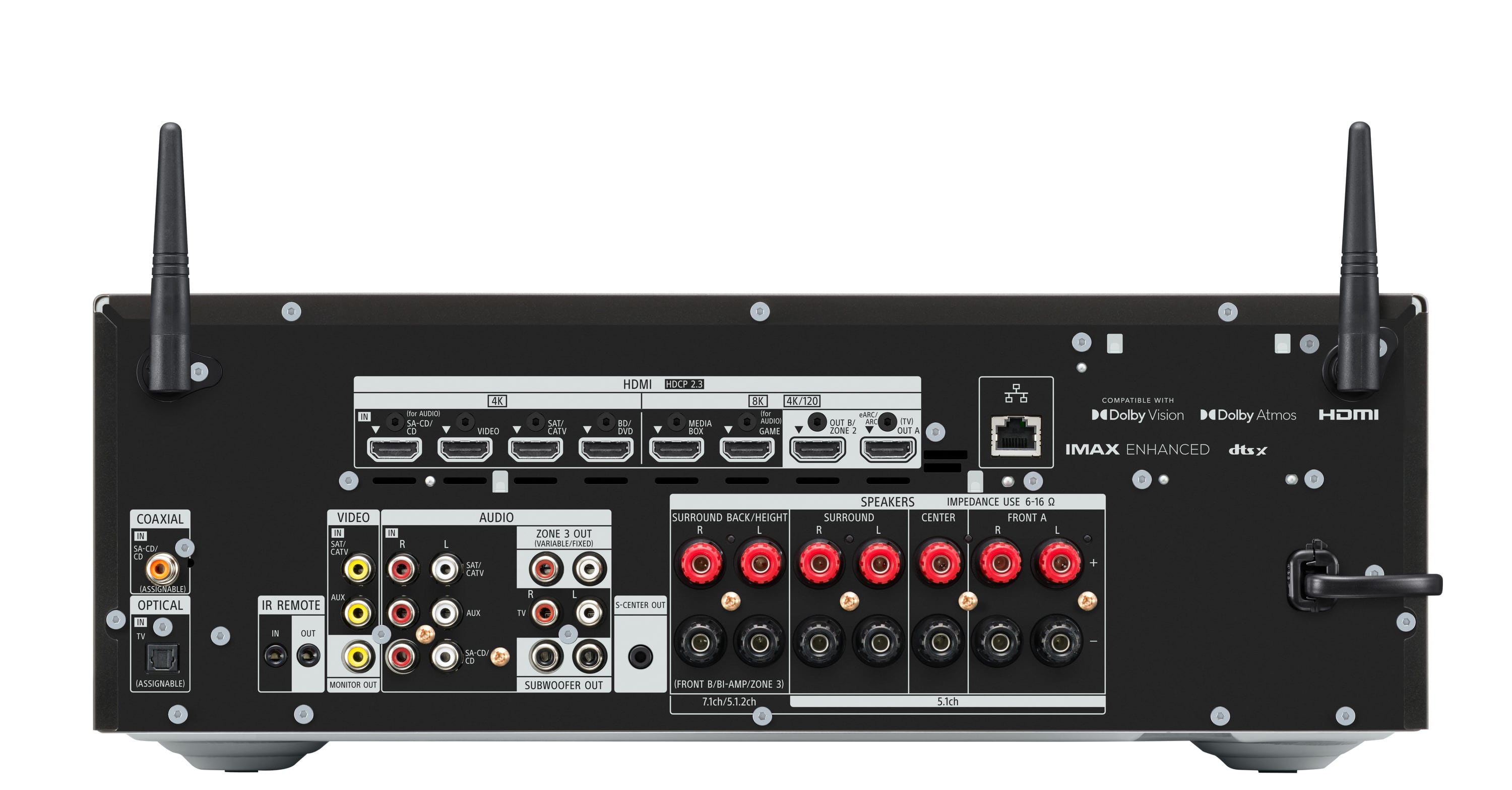
The rear panel features a comprehensive connection array suited for multi-zone and multi-source systems:
- HDMI Connectivity: 6 HDMI inputs total, with 2 designated high-bandwidth HDMI 2.1 ports capable of 8K/60Hz and 4K/120Hz video passthrough.
- HDMI Outputs: 2 HDMI outputs supporting eARC (Enhanced Audio Return Channel) on the primary output and independent Zone 2 video routing on the sub output.
- Analogue & Digital Audio: 4 sets of stereo RCA analogue inputs, 1 optical digital input, 1 coaxial digital input, and dual dedicated subwoofer pre-outs.
- Speaker Terminals: 7 pairs of high-grade binding posts supporting banana plugs, bare wire, or spade connectors.
Spatial Audio Performance: Dolby Atmos, DTS:X, and 360 Spatial Sound Mapping
While conventional AV receivers rely solely on standard decoding for Dolby Atmos and DTS:X, the TA-AN1000 incorporates Sony's proprietary 360 Spatial Sound Mapping technology. Using room acoustic data gathered during calibration, the receiver synthesizes "phantom" virtual speakers in positions where physical speakers are absent. This creates a continuous, three-dimensional acoustic dome overhead and around the listener.
In a standard 5.1.2 physical speaker setup (five surround speakers, one subwoofer, and two height channels), 360 Spatial Sound Mapping calculates the exact angles and distance offsets of each driver. It then generates multiple virtual speaker sources, filling gaps between the physical channels.
- Physical & Phantom Soundstage
- Height Layer: Phantom Height, Physical Height 1, Phantom Height
- Front Layer: Front Left, Center, Front Right
- Middle Area: Phantom Side, Listener, Phantom Side
- Surround Layer: Surround Left, Surround Right
During intensive dynamic movie playback, sound transitions—such as low-flying aircraft or subtle rain patterns—move seamlessly across the room soundstage. Midrange clarity remains defined, preventing dialogue from getting buried beneath heavy LFE (Low-Frequency Effects) sound effects. High-frequency detail is extended without turning harsh, even when pushing the volume toward reference levels.
Digital Cinema Auto Calibration (D.C.A.C. IX) Setup and Tuning
A critical component of the TA-AN1000’s performance is its calibrated room correction system, Digital Cinema Auto Calibration IX (D.C.A.C. IX). Unlike basic single-point auto calibration tools, D.C.A.C. IX utilizes a supplied stereo calibration microphone mounted on an adjustable calibration stand to analyze speaker placement across three dimensions: distance, sound pressure level, frequency response, and speaker height/angle relative to the primary listening position.
- Step 1: Physical Setup: Position the stereo calibration microphone at ear height on a tripod at the main seating area.
- Step 2: Dual Microphone Sweep: Connect the microphone to the front-panel calibration jack and initiate auto setup from the GUI menu.
- Step 3: 3D Spatial Calculation: The TA-AN1000 emits test tones to evaluate speaker distance, channel levels, frequency response, and 3D height angles.
- Step 4: Automatic Phase Matching (A.P.M.): The receiver aligns the phase characteristics of all surround speakers with the front channels to eliminate phase cancellation.
The system automatically measures speaker distances down to sub-centimeter accuracy and applies parametric equalization to smooth out room modes—such as bass buildup caused by corner speaker placement. Furthermore, the Automatic Phase Matching (A.P.M.) feature ensures that non-matching speaker brands work harmoniously by aligning their phase responses across the crossover spectrum.
Next-Gen Video and Gaming Features: 8K Passthrough, HDMI 2.1, and PS5 Synergies
The Sony TA-AN1000 fully supports 40Gbps and 48Gbps HDMI 2.1 specifications, making it an ideal central hub for high-end home cinema displays and modern gaming consoles like the PlayStation 5, Xbox Series X, and high-performance gaming PCs.
Video Format Compatibility
The receiver passes through ultra-high-definition content up to 8K resolution at 60Hz and 4K resolution at 120Hz. Broad High Dynamic Range (HDR) support includes Dolby Vision, HDR10, Hybrid Log-Gamma (HLG), and IMAX Enhanced content pass-through.
Next-Gen Gaming Performance Gamers gain access to Variable Refresh Rate (VRR) and Auto Low Latency Mode (ALLM), eliminating screen tearing and input lag. When paired with a PlayStation 5 and a compatible Sony BRAVIA display, the receiver enables Auto HDR Tone Mapping and Auto Genre Picture Mode, optimizing HDR settings automatically during console boot-up.
Sony TA-AN1000 vs. Competitive Mid-Range AV Receivers
To understand how the TA-AN1000 fits into the current audio-visual landscape, compare its feature set against three key mid-range competitors: the Denon AVR-X2800H, the Onkyo TX-NR6100, and the Marantz Cinema 70s.
| Receiver Model | Channels / Pre-Outs | Power Output (8 ohms, 20Hz-20kHz, 0.09% THD) | Dedicated HDMI 2.1 Inputs | Auto Room Calibration | Key Audio Feature | Target Application |
|---|---|---|---|---|---|---|
| Sony TA-AN1000 | 7.2 Channels / 2 Sub Pre-outs | 85 W / Channel (2ch driven) | 2 Inputs (8K/60, 4K/120) | D.C.A.C. IX (3D Spatial Measurement) | 360 Spatial Sound Mapping | Living rooms & media rooms needing spatial virtual speaker placement |
| Denon AVR-X2800H | 7.2 Channels / 2 Sub Pre-outs | 95 W / Channel (2ch driven) | 3 Inputs (8K/60, 4K/120) | Audyssey MultEQ XT | HEOS Multi-room Streaming | Traditional home cinema rooms with standard speaker configurations |
| Onkyo TX-NR6100 | 7.2 Channels / 2 Sub Pre-outs | 100 W / Channel (2ch driven) | 3 Inputs (8K/60, 4K/120) | AccuEQ / THX Certified | THX Select Audio Certification | Dedicated gaming setups and high-power stereo driving |
| Marantz Cinema 70s | 7.2 Channels / 7.2 Pre-outs | 50 W / Channel (2ch driven) | 3 Inputs (8K/60, 4K/120) | Audyssey MultEQ | Slimline Chassis Design & Full Pre-Outs | Space-constrained cabinets or use as a dedicated AV processor |
Connectivity, Streaming Protocols, and Smart Home Integration
Beyond traditional home theater inputs, the Sony TA-AN1000 serves as a high-resolution wireless music streamer. Built-in network protocols allow seamless audio playback across multiple platforms without requiring external streaming hardware.
- Wireless Protocols: Apple AirPlay 2, Spotify Connect, Chromecast built-in, and Roon Tested certification.
- Bluetooth Connectivity: Bluetooth 5.0 with support for high-bitrate Sony LDAC decoding, as well as standard AAC and SBC codecs.
- Sonos Ecosystem: Carries "Works with Sonos" certification, enabling the receiver to power up and switch to the correct input automatically when commanded through the Sonos app.
- Acoustic Center Sync: Connects to compatible Sony BRAVIA XR televisions using an included analogue audio cable. This feature combines the TV's internal panel speakers with the physical center channel speaker, raising dialogue height directly to the center of the screen.
In addition, the TA-AN1000 natively supports Sony's optional wireless surround ecosystem. If running speaker wires across a room is unfeasible, users can wirelessly pair Sony's SA-RS3S or SA-RS5 active rear speakers and SA-SW3 or SA-SW5 active subwoofers directly to the receiver.
Practical Acoustic Recommendations and Setup Considerations
Achieving optimal acoustic performance with the TA-AN1000 requires careful system configuration during physical setup and software calibration.
Speaker Impedance Setting The amplifier defaults to an 8-ohm speaker load. If connecting 4-ohm or 6-ohm nominal impedance speakers, navigate to the system settings menu and adjust the speaker impedance setting before running room calibration to prevent thermal protection shutdown at high volume levels.
Follow these acoustic best practices for installation:
- Thermal Clearance: Allow a minimum of 2 to 3 inches (5–8 cm) of open space above the top chassis cover. The internal heat sinks rely on passive convection cooling; trapping heat inside closed media cabinets will degrade component life.
- Subwoofer Crossover Adjustment: When using small bookshelf speakers, set the receiver’s manual crossover point to 80 Hz (the THX reference standard). Let the dual subwoofer output handle low frequencies below 80 Hz to relieve amplifier stress on the main channels.
- Physical Height Channel Placement: For optimal Dolby Atmos height rendition, install dedicated ceiling speakers or wall-mounted height speakers angled toward the seating area. If using up-firing Atmos elevation modules, ensure your ceiling is flat, non-porous, and between 8 and 14 feet (2.4 to 4.2 meters) high.
Frequently Asked Questions About the Sony TA-AN1000
Does the Sony TA-AN1000 support 4K 120Hz gaming on all HDMI inputs?
No, 4K 120Hz and 8K 60Hz passthrough are specifically supported on two of the six HDMI inputs (Inputs 1 and 2 labeled "GAME" and "MEDIA BOX"), as well as the main HDMI output. The remaining four HDMI inputs support standard HDMI 2.0b bandwidth up to 4K 60Hz.
How does 360 Spatial Sound Mapping differ from standard Dolby Atmos processing?
Standard Dolby Atmos decoding places sound objects across existing physical speakers based on bed-channel metadata. Sony’s 360 Spatial Sound Mapping uses speaker distance, angle, and height data from the D.C.A.C. IX calibration to synthesize virtual "phantom" speakers in empty spatial zones, creating a denser, more seamless soundstage.
Can I connect external power amplifiers to the TA-AN1000?
The TA-AN1000 includes pre-outs for two active subwoofers and Zone 2 stereo audio, but it does not feature a full set of 7.1-channel pre-outs for main external amplification. If your setup requires external power amplifiers for all channels, consider higher-tier models such as Sony's ES series.
Is the Sony TA-AN1000 compatible with wireless rear speakers?
Yes, the TA-AN1000 natively connects to Sony's wireless rear speakers (SA-RS3S and battery-powered SA-RS5) and wireless subwoofers (SA-SW3 and SA-SW5). This eliminates the need to run physical speaker wire from the receiver to the back of the room.
How does Acoustic Center Sync work with Sony BRAVIA TVs?
Acoustic Center Sync connects the TA-AN1000 to a compatible Sony BRAVIA XR TV via a dedicated 3.5mm audio cable. The receiver blends the TV's internal panel speakers with your physical center channel speaker, raising dialogue height to point directly from the actors on screen.
Final Verdict: Is the Sony TA-AN1000 Right for Your Home Theater?
The Sony TA-AN1000 stands out as one of the most versatile mid-range 7.2-channel AV receivers on the market. Its combination of 360 Spatial Sound Mapping, precise D.C.A.C. IX 3D room calibration, and deep integration with PlayStation 5 consoles makes it a compelling choice for living room media centers and dedicated home theaters alike.
While power purists with complex multi-zone layouts or hard-to-drive 4-ohm floor-standing speakers might prefer receivers with full pre-outs or greater raw wattage output, the TA-AN1000 delivers benchmark-setting spatial immersion, refined acoustic detail, and seamless modern connectivity for the vast majority of surround sound environments.
Image Gallery