Chem 232: A Realistic Path for Organic Chemistry Learners
Mastering organic chemistry requires a shift from memorizing isolated facts to understanding mechanistic logic, three-dimensional molecular geometry, and multi-step synthesis. For students navigating second-semester organic chemistry—c...
Mastering organic chemistry requires a shift from memorizing isolated facts to understanding mechanistic logic, three-dimensional molecular geometry, and multi-step synthesis. For students navigating second-semester organic chemistry—commonly designated as Chem 232—success depends less on raw intellectual talent and more on structured problem-solving, active visualization, and a realistic daily study routine that prioritizes conceptual fluency over passive reading.
Contents
Understanding the Chem 232 Landscape and Curriculum
Second-semester organic chemistry typically builds directly upon the foundational principles established in the first semester. While Chem 231 generally introduces basic structure, bonding, acid-base chemistry, stereochemistry, and introductory substitution and elimination reactions ($S_N1$, $S_N2$, $E1$, $E2$), Chem 232 expands the reaction toolkit significantly. Learners encounter complex functional groups, including aromatic systems, carbonyl compounds, carboxylic acid derivatives, and various nitrogen-containing molecules.
The core challenge of this course is the sheer volume of reactions combined with the requirement to predict regioselectivity and stereoselectivity. Instead of treating every reaction as a discrete event, successful learners recognize that organic chemistry operates under a unified set of physical principles centered around electron density. Nucleophiles seek electrophiles, acids protonate bases to create better leaving groups, and resonance stabilizes intermediates. Approaching Chem 232 with this mechanistic mindset transforms an overwhelming list of reactions into a predictable framework.
Furthermore, students often transition from straightforward functional group interconversions to retrosynthetic analysis. This involves working backward from a target molecule to available starting materials, requiring a high degree of spatial reasoning and strategic planning. A realistic path acknowledges this cognitive leap and provides specific methodologies to bridge the gap between rote memorization and true structural comprehension.
Building a Realistic Study Routine and Time Management Plan
Excelling in organic chemistry demands consistency rather than eleventh-hour cramming. Because the subject builds cumulatively, falling behind by a single chapter can create cascading difficulties when advanced multi-step syntheses are introduced.
Daily and Weekly Engagement Strategies
- Pre-reading before lectures: Spend 15 to 20 minutes scanning the textbook section before class to familiarize yourself with new terminology and reaction names. This primes your brain to capture complex details during the actual lecture.
- Post-lecture active processing: Immediately after class, review your notes not by reading them passively, but by rewriting mechanisms in your own words and asking why specific electron movements occur.
- Spaced repetition for mechanisms: Use flashcards or digital tools to review key functional group transformations, reagents, and reactive intermediates at increasing intervals.
- Dedicated problem-solving blocks: Allocate at least one to two hours daily specifically for working end-of-chapter problems without looking at the answer key prematurely.
| Study Phase | Primary Objective | Recommended Time Allocation |
|---|---|---|
| Pre-Lecture | Identify unfamiliar terms and reaction names | 15–20 minutes per class |
| Active Lecture | Focus on mechanistic rationale rather than copying text | Duration of lecture |
| Post-Lecture | Redraw mechanisms and synthesize concepts | 30–45 minutes per class |
| Problem Solving | Apply concepts to novel multi-step synthesis prompts | 6–8 hours weekly |
Mastering Reaction Mechanisms and Electron Pushing
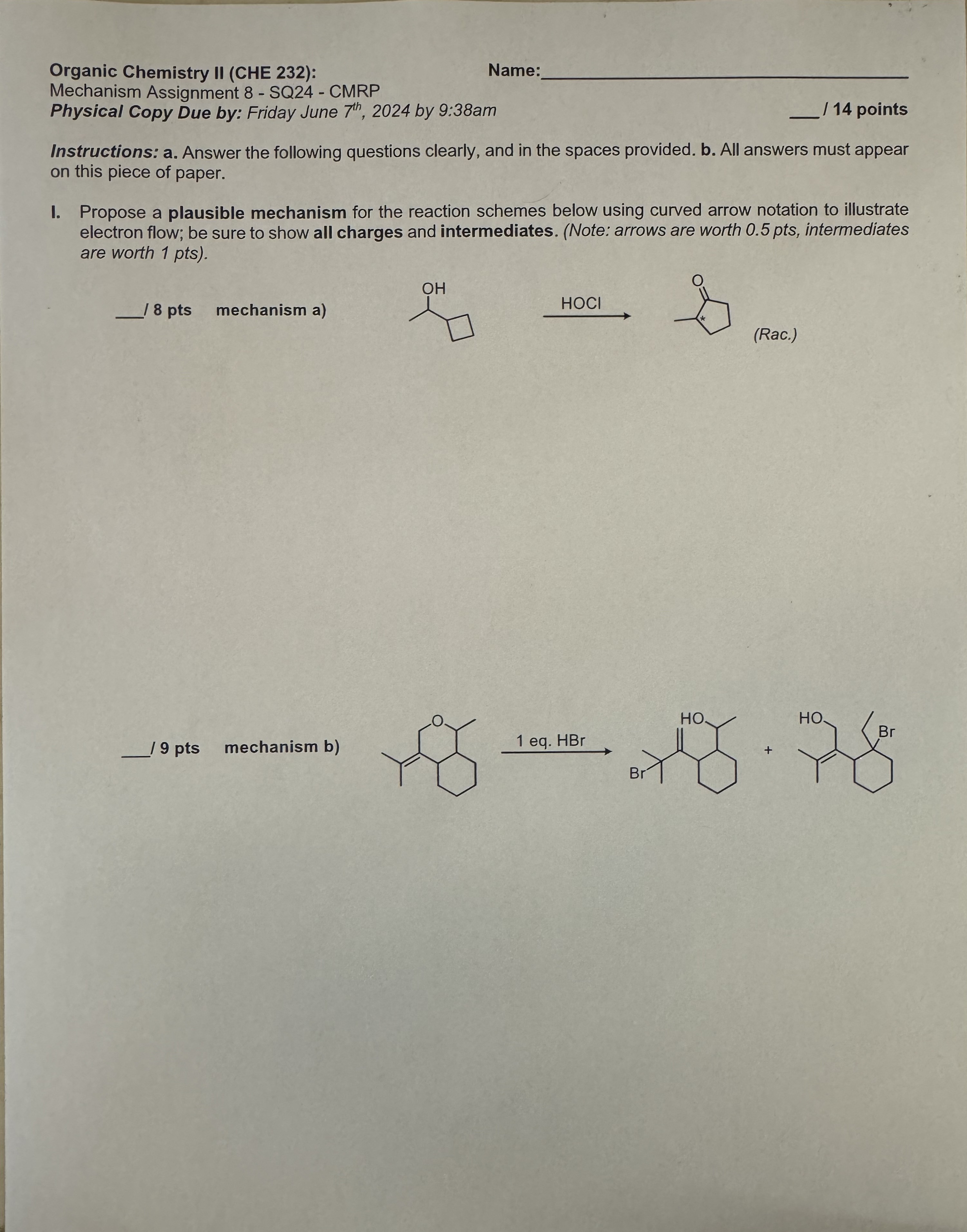
The backbone of Chem 232 is the curved arrow formalism. Arrows show the movement of electron pairs from electron-rich sources (nucleophiles, $\pi$-bonds, lone pairs) to electron-deficient sinks (electrophiles, empty orbitals). Memorizing reactions without understanding electron pushing is a recipe for failure on novel exam questions.
When analyzing any mechanism, break it down into elementary steps. Identify the most nucleophilic site and the most electrophilic site in the reaction mixture. Consider whether strong acids or strong bases are present, as these dictate protonation states and leaving group capabilities. For instance, a hydroxyl group ($-\text{OH}$) is a poor leaving group, but protonation converts it into water ($-\text{OH}_2^+$), which departs readily.
Practicing mechanisms also requires rigorous attention to stereochemistry. Drawing molecules in proper three-dimensional representations—using wedges for bonds projecting out of the page and dashes for bonds receding behind it—ensures that you account for inversion or retention of configuration during substitution and addition steps.
Navigating Multi-Step Synthesis and Retrosynthetic Analysis
As the semester progresses, examinations shift heavily toward synthesis problems: "Show how you would prepare compound X starting from compound Y using any necessary reagents." These questions test your ability to connect disparate chapters into a cohesive pathway.
To approach synthesis realistically, employ retrosynthetic analysis. Cover the target molecule and ask yourself: What was the immediate precursor to this functional group? Work backward step-by-step until you reach a molecule containing the carbon skeleton of your starting material.
Keep a dedicated reaction notebook or reference sheet categorized by carbon-carbon bond-forming reactions, oxidation-reduction sequences, and functional group interconversions. Knowing how to lengthen a carbon chain using Grignard reagents, organolithiums, or acetylide ions is just as important as knowing how to functionalize an existing ring.
| Reaction Category | Common Reagents / Methods | Primary Synthetic Utility |
|---|---|---|
| Oxidation | PCC, Jones Reagent, $\mathrm{KMnO_4}$ | Converting alcohols to aldehydes, ketones, or carboxylic acids |
| Reduction | $\mathrm{LiAlH_4}$, $\mathrm{NaBH_4}$, $\mathrm{H_2 / Pd-C}$ | Reducing carbonyls and nitro groups, hydrogenating alkenes |
| C-C Bond Formation | Grignard reagents, Wittig reaction, Enolate alkylation | Lengthening carbon chains and building complex backbones |
| Aromatic Substitution | Electrophilic aromatic substitution ($\mathrm{Halogenation}$, $\mathrm{Friedel\text{-}Crafts}$) | Introducing substituents onto benzene rings |
Common Pitfalls and How to Avoid Them
Even dedicated learners often stumble into predictable traps during Chem 232. Recognizing these hazards early allows you to adjust your approach before grades suffer.
- Relying on rote memorization: Memorizing hundreds of individual reactions without understanding the underlying thermodynamics and kinetics leaves you helpless when an exam presents an unfamiliar substrate. Focus on patterns.
- Skipping the drawing phase: Organic chemistry is a visual discipline. Refusing to draw out structures, intermediates, and transition states on paper during self-study prevents you from developing the necessary spatial intuition.
- Consulting answer keys too quickly: Looking at solutions manuals immediately when stuck trains your brain to recognize answers rather than generate them. Struggle with a problem for at least 15 to 20 minutes before checking your work.
- Ignoring stereochemical outcomes: Forgetting to account for racemic mixtures, meso compounds, or diastereomeric excess will consistently cost you partial or full credit on complex examination questions.
Leveraging Resources and Seeking Support
No student should navigate Chem 232 in isolation. Utilizing a curated mix of campus resources, peer study groups, and high-quality reference texts can clarify ambiguous concepts and provide essential practice problems.
Effective Resource Categories
- Office Hours: Visit your professor or teaching assistants regularly. Bring specific failed problems rather than vague statements like "I don't get chapter 18."
- Molecular Model Kits: Physical plastic model kits remain one of the most cost-effective investments for visualizing ring conformations, chiral centers, and stereoisomeric relationships.
- Peer Study Groups: Explaining a mechanism to a classmate is one of the most effective ways to solidify your own understanding and expose gaps in your reasoning.
- Supplemental Literature: Reference texts like Organic Chemistry As a Second Language by David Klein offer alternative explanations and targeted practice drills for foundational skills.
Frequently Asked Questions
Is Chem 232 harder than Chem 231?
Chem 232 is generally considered more challenging because it expands beyond basic principles into complex multi-functionalized molecules and multi-step synthesis. However, if you mastered the foundational electron-pushing rules and stereochemistry of Chem 231, you possess the structural tools needed to succeed.
How many hours a week should I study for organic chemistry?
Most successful students dedicate between 8 and 12 hours per week outside of class to reading, reviewing mechanisms, and working practice problems. Consistency matters more than marathon weekend study sessions.
Do I really need a physical molecular model kit?
While digital rendering software exists, physical model kits allow you to physically rotate chiral centers, observe ring strain in cycloalkanes, and verify cis/trans relationships instantly during exams and homework.
What is the best way to memorize reagents and reactions?
Instead of flashcards featuring isolated reactions, create functional group maps and practice synthesis problems that require applying those reagents in context. Understanding why a specific reagent is chemoselective or regioselective cements its function in your memory.
How should I prepare for organic chemistry cumulative exams?
Review past midterm exams to identify persistent conceptual weaknesses. Re-work missed problems from scratch without looking at answer keys, and construct comprehensive summary sheets mapping all major carbon-carbon bond-forming reactions.
Conclusion and Next Actions
Succeeding in Chem 232 requires patience, active problem-solving, and a commitment to understanding the mechanistic logic of chemical transformations rather than relying on memorization. Begin by organizing a weekly schedule that allocates consistent time for active drawing and synthesis practice. Gather your molecular model kit, establish a peer study group, and tackle problem sets systematically. By treating every reaction as an interaction between electron-rich and electron-deficient centers, you will build the confidence and competence necessary to master organic chemistry.
Image Gallery