Can You Endorse a Whole Life Insurance Policy? Understanding Riders, Amendments, and Assignments
Yes, you can endorse a whole life insurance policy. In insurance terminology, an endorsement (commonly called a rider) is a legal amendment added to the base contract to modify, expand, or restrict coverage. Additionally, policyholders...
Yes, you can endorse a whole life insurance policy. In insurance terminology, an endorsement (commonly called a rider) is a legal amendment added to the base contract to modify, expand, or restrict coverage. Additionally, policyholders can endorse policy rights to third parties through legal assignments for loan collateral or ownership transfers.
Contents
What Does Endorsing a Whole Life Insurance Policy Mean?
When discussing whether you can endorse a whole life insurance policy, insurance professionals and contract law generally point to two distinct actions: modifying the contract terms through policy riders, or endorsing/assigning the policy's legal rights to another person or financial institution.
A policy endorsement (or rider) is a written agreement attached to the original whole life policy that alters its core terms, conditions, benefits, or exclusions. Because standard whole life insurance policies provide fixed premiums, guaranteed death benefits, and guaranteed cash value growth, endorsements allow policyholders to customize these rigid baseline contracts to fit evolving financial goals.
Alternatively, endorsing rights over to another party refers to policy assignment. Similar to endorsing a check or financial instrument, assigning a life insurance contract legally transfers specific rights—such as the right to use the policy's cash value as loan collateral or the right of absolute ownership—to a third party.
Disclaimer: Life insurance contracts, policy endorsements, and tax implications are governed by state insurance regulations and federal tax codes. The information below is for educational purposes. Consult a licensed financial advisor, estate planning attorney, or tax professional regarding your specific situation.
Types of Whole Life Insurance Policy Endorsements (Riders)
Insurance companies offer various standardized endorsements that can alter the structure of a whole life policy. These endorsements fall into three primary functional categories: living benefits, cash-value growth enhancers, and coverage flexibility options.
Whole Life Policy Endorsements:
- Living Benefits
- Terminal Illness
- Chronic Illness
- Waiver Premium
- Cash Accumulation
- Paid-Up Additions (PUA)
- Dividend Scale
- Coverage Adjust.
- Term Riders
- Guaranteed Ins.
- Child/Spouse
1. Living Benefit Endorsements
Living benefit endorsements allow policyholders to access a portion of their death benefit while still living if specific health conditions occur.
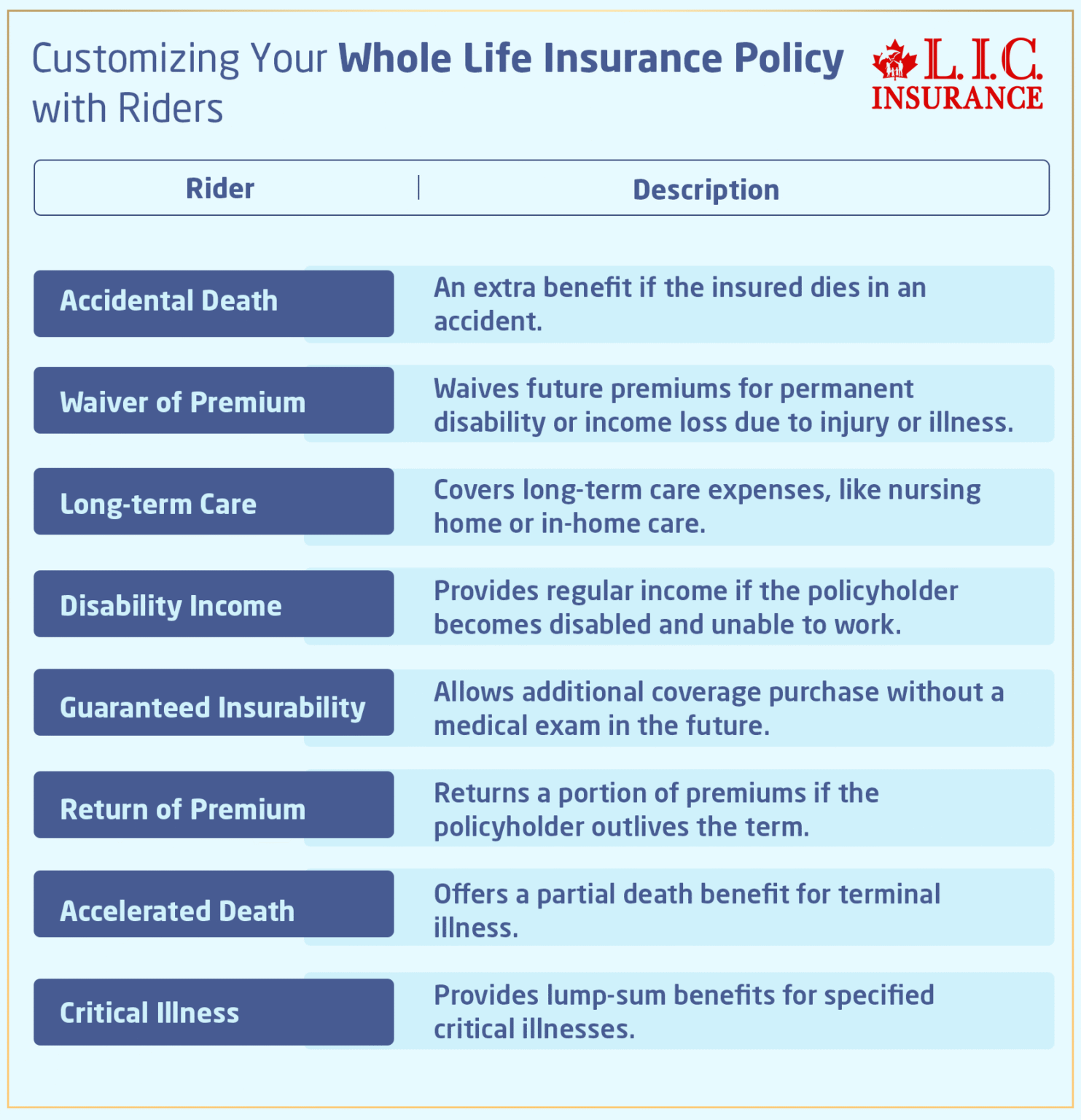
- Accelerated Death Benefit (ADB) Endorsement: This rider allows access to a portion of the policy's face amount if the insured is diagnosed with a qualifying terminal illness (typically a life expectancy of 12 to 24 months). The funds received reduce the final death benefit paid to beneficiaries.
- Chronic and Critical Illness Endorsements: These riders allow partial acceleration of the death benefit if the insured cannot perform a designated number of Activities of Daily Living (ADLs)—such as eating, bathing, or dressing—or suffers a qualifying medical event like a severe stroke or heart attack.
- Long-Term Care (LTC) Rider: A specialized living benefit endorsement that provides dedicated payouts to cover nursing home, assisted living, or home health care services.
2. Cash-Value Enhancers
Policyholders seeking to maximize the accumulation of cash value within their whole life contract often utilize specific performance endorsements.
- Paid-Up Additions (PUA) Rider: This endorsement enables policyholders to contribute additional funds into the contract above the base premium. These extra funds purchase small blocks of fully paid-up whole life insurance, which immediately build cash value and earn dividends. According to tax guidelines under the Internal Revenue Service (IRS) Code Section 7702, PUA endorsements must be monitored to prevent the policy from becoming a Modified Endowment Contract (MEC).
- Waiver of Premium Rider: An endorsement stating that if the primary insured becomes totally and permanently disabled, the insurance company waives all future premium payments while keeping the whole life policy, death benefit, and cash value growth fully intact.
3. Coverage and Flexibility Endorsements
- Guaranteed Insurability Rider (GIR): This endorsement guarantees the right to purchase additional whole life coverage at specified future dates or life events (such as marriage or the birth of a child) without undergoing medical underwriting.
- Term Insurance Rider: Policyholders can attach a temporary term endorsement to a base whole life policy to create a "blended" policy. This increases the total initial death benefit at a lower cost than purchasing full whole life coverage.
Underwriting and Timing: When Can You Add an Endorsement?
Not all policy endorsements can be added at any point during the contract's lifespan. Timing and underwriting requirements play a critical role in determining whether an endorsement can be attached.
| Endorsement Type | Typical Addition Timeframe | Underwriting Requirement | Impact on Premium |
|---|---|---|---|
| Paid-Up Additions (PUA) | Policy Issue or Post-Issue | Often requires medical evidence post-issue | Increases flexible outlay |
| Waiver of Premium | Policy Issue Only | Full medical underwriting | Increases base premium |
| Guaranteed Insurability | Policy Issue Only | Full medical underwriting at issue | Increases base premium |
| Accelerated Death Benefit | Policy Issue or Post-Issue | Administrative approval / Minimal underwriting | Low or no upfront cost; fee taken upon acceleration |
| Term Insurance Rider | Policy Issue or Post-Issue | Medical underwriting required post-issue | Increases total premium |
Underwriting at Issue vs. Post-Issue Modifications
When applying for a new whole life policy, riders are added during the initial underwriting process. The insurance company evaluates health, lifestyle, and financial profile to approve the policy and all requested endorsements simultaneously.
Adding an endorsement post-issue (after the policy is active) is more restricted:
- Medical Re-evaluation: Adding riders that increase the insurer's risk—such as adding a PUA rider or increasing death benefit limits—usually requires updated evidence of insurability. This may include a medical questionnaire, paramedical exam, or blood tests.
- Contractual Restrictions: Certain riders, such as the Waiver of Premium or Guaranteed Insurability options, generally cannot be added post-issue under standard carrier guidelines.
- Administrative Changes: Endorsements involving simple administrative adjustments—such as changing a beneficiary, updating a legal name, or applying standard accelerated death benefit riders—typically require no medical underwriting and can be executed at any time.
Endorsing Policy Rights: Assignments and Collateral Transfers
Beyond modifying coverage through riders, policyholders often ask about endorsing a whole life policy in the legal context of transferring ownership or financial rights. In insurance law, this process is governed by policy assignment.
Whole Life Policy Ownership:
- Collateral Assignment
- Temporary Transfer
- Secures Debt/Loan
- Excess cash to owner
- Absolute Assignment
- Permanent Transfer
- All Rights Shifted
- Ownership / Estate
1. Collateral Assignment
A collateral assignment is a temporary endorsement of policy rights to a lender (such as a commercial bank or small business lender) as security for a debt.
- How It Works: The policyholder retains ownership of the whole life policy, but the lender is listed as a primary assignee. If the insured dies before the loan is repaid, the lender receives the portion of the death benefit necessary to satisfy the outstanding loan balance. Any remaining proceeds are paid to the designated beneficiaries.
- Cash Value Usage: Lending institutions frequently accept whole life insurance as collateral because of its guaranteed cash value accumulation. Under frameworks monitored by state insurance commissioners through organizations like the National Association of Insurance Commissioners (NAIC), assignment forms must be formally filed with and acknowledged by the insurance carrier to be legally enforceable.
2. Absolute Assignment
An absolute assignment is a permanent transfer of all rights, title, and interest in the whole life insurance policy to another individual, trust, or legal entity.
- Impact on Control: Once an absolute assignment is executed, the original policyholder surrenders all control. The new owner gains sole authority to name beneficiaries, take policy loans, surrender the contract, or change payment arrangements.
- Estate Planning Applications: Absolute assignments are frequently used in estate planning to transfer policies into an Irrevocable Life Insurance Trust (ILIT). When executed correctly, this removes the policy proceeds from the insured's gross taxable estate.
How to Formally Execute an Endorsement or Policy Assignment
Modifying a whole life contract or transferring rights requires formal documentation. Verbal requests or informal notes are not recognized under standard insurance contract laws.
Steps to Execute a Policy Endorsement:
- Request Endorsement Form from Insurance Carrier
- Determine Underwriting & Medical Requirements
- Submit Completed Forms and Supporting Documentation
- Carrier Reviews, Processes, and Issues Updated Policy Schedule
- Review Revised Endorsement Page for Accuracy
Step 1: Contact the Servicing Agent or Carrier
Initiate the request directly with your insurer's policyholder service department or your licensed agent of record. Request the specific form required for your goal (e.g., Application for Policy Modification, Paid-Up Additions Rider Request, or Form of Assignment).
Step 2: Determine Underwriting and Evidence Requirements
If the endorsement involves adding coverage or cash-funding capacity (like a PUA rider), confirm whether full or simplified medical underwriting is necessary. Gather required medical records or schedule a health screening if requested by the carrier.
Step 3: Complete and Submit Legal Documentation
Fill out the endorsement or assignment paperwork completely. For legal assignments:
- Ensure all primary owners, contingent owners, and irrevocable beneficiaries sign the document.
- Many carriers require assignment forms to be notarized.
- Submit the original executed documents directly to the carrier's home office.
Step 4: Obtain Formal Carrier Acknowledgement
An endorsement or assignment is generally not binding until the insurance company reviews, approves, and formally stamps the document. The carrier will issue an updated Policy Schedule Page or an official Endorsement Amendment to be kept with your original contract paperwork.
Common Pitfalls and Financial Risks to Consider
While endorsing a whole life policy adds valuable flexibility, improper execution can lead to severe tax penalties or loss of coverage.
1. Triggering Modified Endowment Contract (MEC) Status
Adding aggressive Paid-Up Additions endorsements increases cash value quickly. However, if total premium contributions exceed specific annual limits established under federal law (the "7-Pay Test"), the IRS reclassifies the policy as a Modified Endowment Contract (MEC).
- Consequence: While the death benefit remains tax-free, cash value withdrawals and policy loans become taxable as ordinary income on a first-in, first-out earnings basis, and may incur a 10% IRS penalty if taken before age 59½.
2. Loss of Unintended Rights in Assignments
When endorsing a policy as collateral or transferring ownership via absolute assignment, policyholders sometimes overlook beneficiary restrictions.
- Consequence: In an absolute assignment, you permanently lose the ability to change the beneficiary or access cash value. Ensure that all assignments are thoroughly reviewed by legal counsel before signing.
3. Underwriting Rejection or Rating Increases
Attempting to add post-issue endorsements that require medical qualification exposes the policyholder to current underwriting standards. If your health has deteriorated since the policy was issued, the insurer may decline the endorsement request or offer it only at an increased rating (higher cost).
Frequently Asked Questions
Can I remove an endorsement from my whole life policy later?
Yes, most optional endorsement riders (such as term riders or paid-up additions riders) can be removed or canceled by submitting a written request to the carrier. However, once removed, re-adding the rider in the future will typically require fresh medical underwriting.
What is the difference between a policy endorsement and a policy amendment?
In life insurance practice, the terms "endorsement" and "amendment" are often used interchangeably. Formally, an endorsement refers to standard printed riders attached to alter benefits, while an amendment is a specific contract alteration written to adjust details like age errors, occupational classes, or rating classifications.
Does adding an endorsement increase my premium payment?
It depends on the type of endorsement. Coverage-expanding riders (like Waiver of Premium or Term Riders) increase the fixed periodic premium. Living benefit riders often carry no immediate fee, but apply an administrative charge or deduction from the payout if the benefit is ever accelerated.
Can a lender surrender my whole life policy under a collateral assignment?
A collateral assignment grants the lender specific rights to the policy's cash value up to the amount of the unpaid debt. If the borrower defaults on the loan agreement, the terms of the assignment typically permit the lender to surrender the policy or take a policy loan to satisfy the outstanding balance.
Is there a fee to endorse or assign a whole life insurance contract?
Most life insurance companies do not charge explicit administrative processing fees to file endorsement or assignment forms. However, adding riders that expand coverage will increase ongoing premium costs.
Recommended Next Steps
If you are considering endorsing or assigning your whole life insurance policy:
- Review Your Baseline Contract: Read your current policy schedule page to confirm existing riders, coverage limits, and current cash value levels.
- Request a Policy Illustration: Ask your insurance company for an updated in-force illustration showing how proposed endorsements (like a PUA rider) will impact cash value accumulation and death benefits over time.
- Check MEC Limits: Ensure that any additional premium contributions will not trigger MEC status under IRS guidelines.
- Consult Qualified Professionals: Work with a licensed life insurance professional and an estate planning attorney before signing legal assignment documents or modifying structural policy terms.
Image Gallery