How Studio Ghibli Movies Are Ranked—And Why My Neighbor Totoro Holds the Top Spot
When animation critics, film historians, and devoted audiences rank the filmography of Studio Ghibli, Hayao Miyazaki’s 1988 masterpiece My Neighbor Totoro consistently secures a position at the very top of the list. Its enduring rank i...
When animation critics, film historians, and devoted audiences rank the filmography of Studio Ghibli, Hayao Miyazaki’s 1988 masterpiece My Neighbor Totoro consistently secures a position at the very top of the list. Its enduring rank is sustained by its narrative simplicity, emotional depth, unmatched cultural footprint, and role as Studio Ghibli's permanent mascot.
Contents
The Anatomy of Studio Ghibli Rankings
Ranking the film catalog of Studio Ghibli presents a unique challenge for film critics and audiences alike. Unlike traditional Hollywood animation studios that often rely on straightforward hero-versus-villain frameworks and franchise sequels, Studio Ghibli’s portfolio spans wildly varied genres, thematic depths, and artistic styles.
To understand how films are evaluated within the Ghibli canon, rankings generally weigh five core pillars:
- Narrative Innovation and Pacing: How effectively the story moves away from standard cinematic conventions to create immersive, atmospheric storytelling.
- Visual Artistry and Background Craftsmanship: The quality of traditional hand-drawn animation, color palettes, and painterly backgrounds (largely pioneered by art directors like Kazuo Oga).
- Thematic Resonances: The exploration of complex motifs such as environmentalism, pacifism, childhood agency, nostalgia, and grief.
- Musical Score: The emotional synergy created by musical compositions, predominantly those by long-time collaborator Joe Hisaishi.
- Cultural Legacy and Rewatchability: The film's long-term impact on global cinema, merchandise, museum curation, and cross-generational appeal.
While grand epics like Spirited Away (2001) frequently capture the top spot on modern critical review aggregators due to their Academy Award recognition and technical scale, My Neighbor Totoro holds a distinct, unshakeable tier of its own. It represents the purest distillation of Studio Ghibli’s founding philosophy.
Why My Neighbor Totoro Consistently Retains Its Peak Position
Released in 1988 as part of a double feature alongside Isao Takahata’s devastating war drama Grave of the Fireflies, My Neighbor Totoro initially faced uncertain box office prospects. However, over the subsequent decades, it transformed into a foundational text of global animation.
A Narrative Free of Antagonists
The primary structural reason My Neighbor Totoro stands apart from almost all contemporary animated feature films is its complete absence of a traditional villain, conflict-driven plot, or existential threat.
Instead of pitting the young protagonists—Satsuki and her younger sister Mei—against an external antagonist, Miyazaki focuses entirely on the internal emotional world of childhood. The sisters move into an old rural house with their father to be closer to their mother, who is recovering from an illness in a local convalescent hospital. The tension in the film is derived entirely from real-life vulnerabilities: the anxiety of family illness, adjusting to a new environment, and the fear of being separated.
By eliminating dramatic battles and villainous machinations, the film creates room for quiet observation. The narrative relies on slice-of-life realism punctuated by magical encounters. When the magical forest spirits—including the titular giant creature Totoro—appear, they do not arrive to save the world; they arrive to offer comfort, gentle companionship, and a sense of wonder to children coping with adult anxieties.
The Artistry of Kazuo Oga and Environmental Realism
Visually, My Neighbor Totoro established the signature visual tone of Studio Ghibli’s depictions of nature. Art director Kazuo Oga brought a painterly, impressionistic style to the Japanese countryside of the late 1950s.
Rather than presenting an idealized fairy-tale forest, the film captures specific seasonal details: wet mud under rain boots, sun-ripened summer vegetables cooling in fresh stream water, moss-covered shrines, and towering camphor trees. This commitment to environmental realism makes the arrival of the supernatural elements feel grounded and credible. The contrast between mundane human life and serene natural spirits creates a sense of sacred space that continues to captivate visual artists and animators worldwide.
Joe Hisaishi’s Score and Audio Pacing
Sound design and musical scoring play an integral role in maintaining Totoro’s ranking. Joe Hisaishi’s score balances playful synth-pop themes with deeply melancholic orchestral arrangements. The music does not overwhelm the audio landscape; instead, Miyazaki and Hisaishi utilize silence and environmental sound—rain dripping onto an umbrella, wind rustling through leaves, or the hum of cicadas—to anchor the viewer in the physical world.
Comparative Matrix: How Totoro Measures Against Top Ghibli Classics
To understand why My Neighbor Totoro maintains its top-tier status alongside other studio heavyweights, it is useful to analyze key attributes across Studio Ghibli’s most critically acclaimed releases:
| Film Title | Release Year | Primary Themes | Narrative Structure | Target Audience & Tone | Legacy Benchmark |
|---|---|---|---|---|---|
| My Neighbor Totoro | 1988 | Childhood innocence, comfort in grief, nature spirits | Low-conflict, episodic, atmospheric | All ages; comforting, gentle, melancholic | Studio mascot; foundational benchmark for ambient storytelling |
| Grave of the Fireflies | 1988 | World War II survival, tragedy, societal breakdown | Linear historical tragedy | Mature audiences; harrowing, poignant | Cited among the most powerful anti-war films ever created |
| Princess Mononoke | 1997 | Environmental conflict, industrialization, morality | Epic conflict, morally complex factions | Young adults / Adults; intense, visceral | Redefined Western perception of anime as serious cinematic art |
| Spirited Away | 2001 | Identity, greed, transition to maturity, bathhouse lore | Heroic journey / Coming-of-age surrealism | All ages; whimsical, intense, expansive | Academy Award winner; historic international box office record holder |
| Howl’s Moving Castle | 2004 | Self-worth, pacifism, love under curse | Fantasy romance / Anti-war drama | All ages; romantic, whimsical, visual scale | High commercial success; renowned character design and art direction |
| Kiki’s Delivery Service | 1989 | Burnout, independence, creative identity | Slice-of-life coming-of-age | Family / Young adults; uplifting, practical | Foundational work on adolescent independence and creative block |
The Commercial and Historical Pivot: How Totoro Saved Studio Ghibli
While My Neighbor Totoro is celebrated today as an artistic triumph, its historic role in preserving Studio Ghibli as a financial enterprise is equally significant.
When Studio Ghibli was founded in 1985 by Hayao Miyazaki, Isao Takahata, and producer Toshio Suzuki, hand-drawn feature animation was an extraordinarily expensive and risky endeavor. The 1988 theatrical release of Totoro and Grave of the Fireflies did not break box office records immediately upon release.
However, the film’s fortune changed dramatically when Japanese plush manufacturer Sun Arrow released licensed stuffed animals of Totoro. The plush toys sold in unprecedented volumes across Japan, revealing a massive market of fans who desired a physical connection to the character.
The revenue generated from merchandise licensing provided Studio Ghibli with the capital stability needed to sustain full-time, salaried animators—a rare practice in the anime industry at the time. The character was subsequently adopted as the official studio logo, appearing at the beginning of every Ghibli film. In practical terms, Totoro’s commercial longevity guaranteed the financial freedom for Miyazaki and Takahata to produce subsequent masterpieces such as Princess Mononoke and Spirited Away.
Deconstructing the Masterpiece: Key Scenes That Define Its Ranking
Several specific sequences illustrate why My Neighbor Totoro remains unmatched in its execution:
1. The Bus Stop Sequence
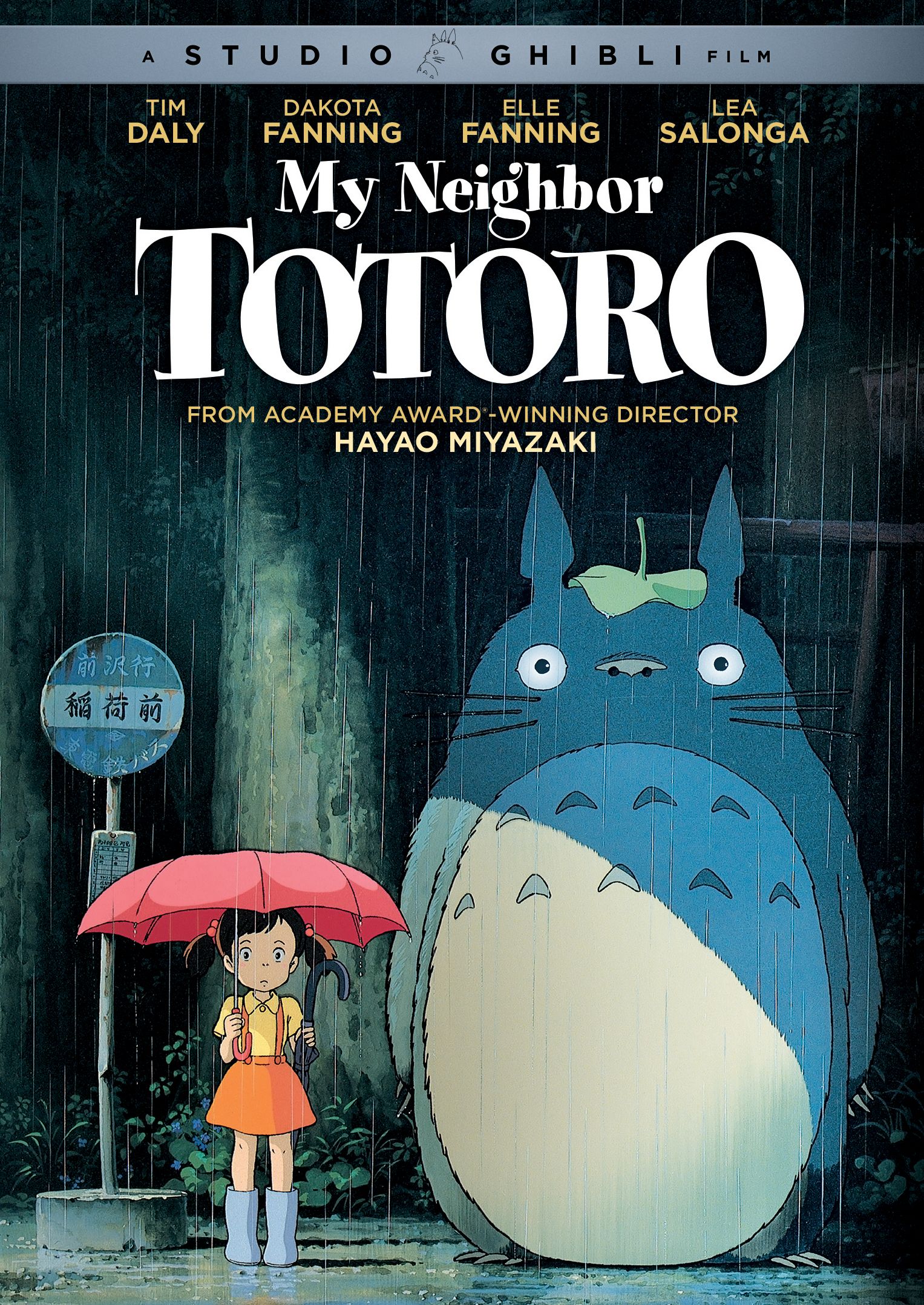
Widely regarded as one of the greatest scenes in animation history, the bus stop sequence brings together Satsuki, Mei, and Totoro under a pouring rainstorm. Satsuki carries her sleeping sister on her back while waiting for their father's delayed bus. Totoro stands beside them, wearing a small leaf on his head that fails to block the rain.
When Satsuki lends Totoro her father’s spare umbrella, the scene captures pure cinematic joy. Totoro delights in the sound of raindrops hitting the stretched canvas, stamping his feet to make a heavy cascade of water fall from the tree canopy above. The sequence balances quiet tension, childhood vulnerability, surreal humor, and sudden wonder without a single line of exposition.
2. The Sprouting of the Seeds
In a nighttime sequence, Totoro and his smaller spirit companions conduct a quiet ritual around the newly planted garden seeds. Satsuki and Mei join them, mimicking their stretching gestures. As the score swells, a colossal tree erupts from the ground, soaring into the night sky.
This scene embodies the film’s core philosophy: nature is majestic, mysterious, and deeply connected to human emotional well-being. The magical tree exists in the realm of shared childhood imagination, offering the sisters hope during a stressful period.
3. The Catbus Search for Mei
When young Mei strays away trying to deliver a fresh ear of corn to her mother at the hospital, the village erupts into panic. Overwhelmed, Satsuki seeks Totoro's help. Totoro summons the Catbus (Nekobus), a multi-legged feline vehicle that streaks across countryside electrical wires and rice paddies invisible to adult eyes.
This climax resolves the narrative tension not through violence or combat, but through community assistance, spirit intervention, and sisterly reconciliation.
Common Debates: Totoro vs. Spirited Away
In online film discussions and critical roundups, the debate for the top Studio Ghibli spot almost always narrows down to My Neighbor Totoro versus Spirited Away.
Critics who place Spirited Away at number one point to its intricate world-building, grand allegorical scope regarding consumerism, and technical complexity. Spirited Away is an epic journey filled with dozens of distinct spirit designs, dramatic stakes, and a dense multi-layered plot.
Conversely, champions of My Neighbor Totoro argue that simplicity is far harder to achieve than complexity. Totoro manages to evoke profound emotional resonance using minimal plot mechanics. It captures the exact psychological experience of early childhood—where small distances feel vast, storm clouds feel ominous, and an overgrown backyard can contain an entire universe. Where Spirited Away is a extraordinary spectacle, My Neighbor Totoro is a quiet sanctuary.
Frequently Asked Questions
Is My Neighbor Totoro suitable for very young children?
Yes. My Neighbor Totoro is rated G and contains no violence, scary villains, or inappropriate language. Its gentle pacing and empathetic storytelling make it one of the most accessible animated films for young children while offering deep artistic value for adults.
Why is Totoro the official logo of Studio Ghibli?
Following the success of the film and its massive merchandise sales in the late 1980s, Totoro became the defining icon of the studio. Toshio Suzuki and Hayao Miyazaki selected Totoro as the official logo to represent the studio’s commitment to imagination, craftsmanship, and nature-centered storytelling.
What year is My Neighbor Totoro set in?
The film is set in rural Japan in 1958, during a period of post-war recovery and economic transition when small farming villages were still deeply connected to local forests and traditional community life.
Are Totoro and the spirits based on traditional Japanese folklore?
While Totoro draws inspiration from Shinto nature spirits (kami) and traditional Japanese woodland folklore, the character of Totoro is an original creation by Hayao Miyazaki. He designed Totoro as a gentle blend of several animals, including bears, owls, and napping domestic cats.
How does My Neighbor Totoro fit into the modern Ghibli Park?
In Ghibli Park (located in Aichi Prefecture, Japan), Dondoko Forest is dedicated entirely to the world of My Neighbor Totoro. It features a full-scale physical reconstruction of Satsuki and Mei’s house built using traditional 1950s architectural techniques, emphasizing the film's lasting cultural relevance.
Navigating the Studio Ghibli Catalog
For those exploring Studio Ghibli’s filmography, starting with My Neighbor Totoro provides the ultimate baseline for understanding the studio's ethos. Rather than viewing film rankings as definitive statements of artistic superiority, audiences benefit most by exploring the catalog through thematic pairings:
- For Gentle Wonder and Nature: Pair My Neighbor Totoro (1988) with Kiki’s Delivery Service (1989) or Ponyo (2008).
- For Epic World-Building and Mythology: Pair Princess Mononoke (1997) with Spirited Away (2001) or Nausicaä of the Valley of the Wind (1984).
- For Historical Realism and Emotion: Pair Grave of the Fireflies (1988) with The Wind Rises (2013) or From Up on Poppy Hill (2011).
My Neighbor Totoro holds its legendary rank not because it boasts the most complex plot or the highest body count, but because it accomplishes something far rarer in cinema: it captures the delicate, fleeting magic of childhood and preserves it forever on screen.
Image Gallery