How to Structure an MBA Project on Life Insurance
To structure an MBA project on life insurance effectively, organize your dissertation or capstone into five core chapters: Introduction, Literature Review & Industry Overview, Research Methodology, Data Analysis & Empirical Findings, a...
To structure an MBA project on life insurance effectively, organize your dissertation or capstone into five core chapters: Introduction, Literature Review & Industry Overview, Research Methodology, Data Analysis & Empirical Findings, and Strategic Recommendations. This structure ensures a rigorous balance between academic research standards, financial modeling, and managerial decision-making.
Contents
1. Defining Project Scope and Domain Specialization
Before establishing the chapter outlines, align your life insurance project with your specific MBA concentration. Life insurance is a vast industry spanning actuarial risk, investment management, distribution channels, regulatory frameworks, and digital transformation (InsurTech). Narrowing your focus early prevents your project from becoming overly broad or descriptive.
Finance and Risk Management Concentration
If your specialization is corporate finance or financial risk management, focus on capital adequacy, portfolio management, asset-liability management (ALM), or solvency metrics. Key themes include:
- Analyzing the impact of macroeconomic interest rate fluctuations on life insurers' fixed-income portfolios.
- Evaluating capital adequacy under global frameworks such as Solvency II or the National Association of Insurance Commissioners (NAIC) Risk-Based Capital (RBC) requirements.
- Assessing the adoption of International Financial Reporting Standards (IFRS 17) for insurance contracts and its impact on financial statement transparency.
Marketing and Consumer Behavior Concentration
For marketing specialists, the focus shifts toward customer acquisition, retention, product perception, and distribution channel optimization. Suitable research angles include:
- Measuring customer persistency rates across direct-to-consumer digital channels versus traditional agency networks.
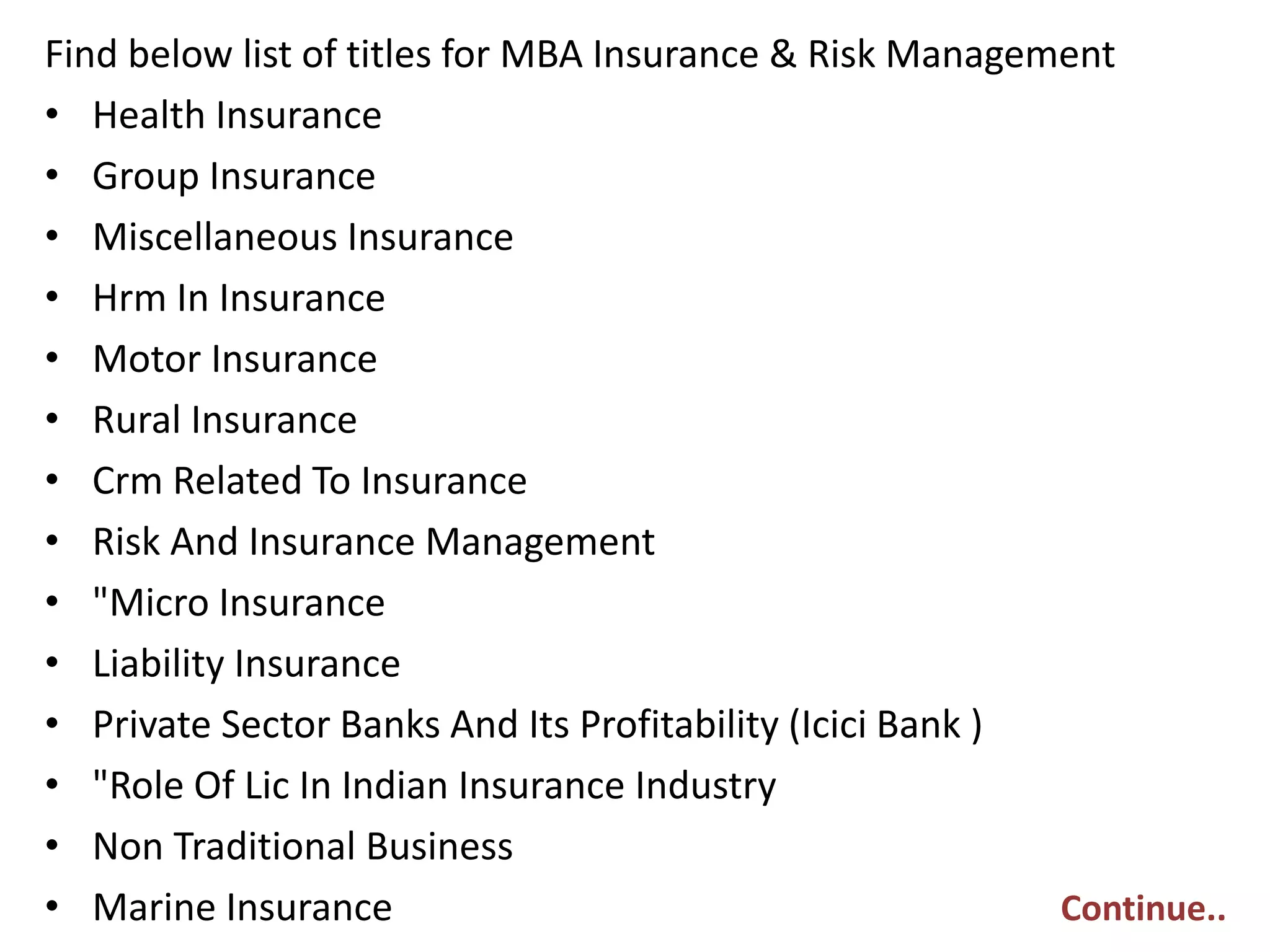
- Evaluating consumer awareness and purchase drivers for unit-linked insurance plans (ULIPs) versus term life policies.
- Analyzing the impact of personalized micro-insurance offerings on financial inclusion in emerging markets.
Operations and InsurTech Concentration
Operations management and IT management students should evaluate operational efficiency, underwriting automation, and digital claims processing:
- Assessing the implementation of artificial intelligence and machine learning in automated underwriting and fraud detection.
- Analyzing operational bottleneck reduction in claims settlement through digital verification platforms.
- Evaluating customer retention management (CRM) systems and their impact on policy servicing workflows.
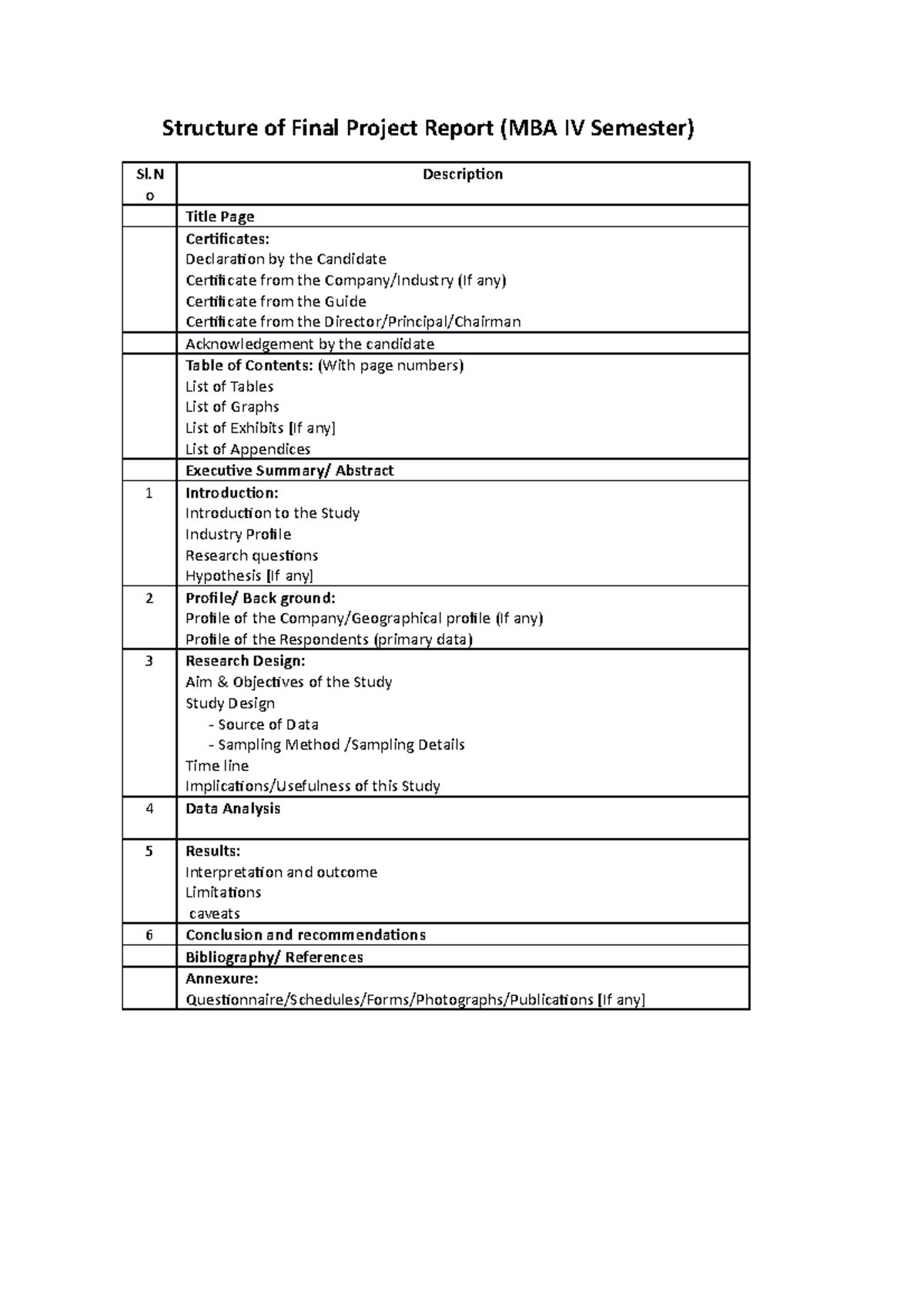
2. Standard Five-Chapter Structure for an MBA Life Insurance Dissertation
The core of your MBA project report follows an established academic format tailored to executive decision-making. Each chapter must logically flow into the next, building from background context to empirical evidence and strategic managerial insights.
Chapter 1: Introduction and Research Objectives
The introductory chapter establishes the business problem, research scope, and practical relevance of your study.
- Background of the Study: Overview of the global or regional life insurance industry, highlighting macroeconomic drivers, market penetration rates, and regulatory bodies (such as the NAIC in the United States, IRDAI in India, or the PRA/FCA in the UK).
- Statement of the Problem: Clearly identify the executive or financial challenge your study addresses. For example: "Traditional life insurance distribution models face declining persistency rates and elevated acquisition costs among younger demographics."
- Research Questions and Hypotheses: State 3–5 specific questions that your research answers, alongside testable hypotheses (e.g., $H_0$: Digital onboarding speed has no statistically significant effect on 13th-month policy persistency).
- Objectives of the Study: Define the primary research objective and supporting secondary goals.
- Significance of the Project: Explain how your findings benefit insurance executives, regulators, policyholders, or equity analysts.
Chapter 2: Literature Review and Theoretical Framework
This chapter synthesizes existing academic journals, industry whitepapers, and regulatory reports to benchmark current knowledge.
- Theoretical Foundations: Ground your work in established economic and management theories, such as Expected Utility Theory, Prospect Theory, Adverse Selection, and Moral Hazard frameworks.
- Industry Dynamics: Summarize past research regarding life insurance demand elasticity, demographic determinants of coverage, and investment yield challenges.
- Regulatory Frameworks: Review governing statutes, statutory accounting principles, solvency margins, and consumer protection mandates.
- Gaps in Existing Research: Point out what previous studies missed, establishing why your current MBA project is necessary.
Chapter 3: Research Methodology
The methodology chapter explains how data was collected, cleaned, and analyzed. Academic rigour requires complete transparency regarding research design.
- Research Design: Specify whether your research is quantitative, qualitative, or a mixed-methods empirical study.
- Sampling Strategy: Detail the target population (e.g., retail policyholders, independent insurance brokers, financial advisory firms), sample size, and sampling technique (e.g., stratified random sampling, purposive sampling).
- Data Collection Methods: Describe your data sources. Primary data can be gathered via structured surveys or expert interviews with underwriters and actuaries. Secondary data can be gathered from financial statements (Form 10-K), statutory filings, or regulatory databases.
- Analytical Tools and Models: Specify the software (SPSS, R, Python, Excel) and statistical tests (Multiple Linear Regression, Chi-Square tests, ANOVA, Ratio Analysis) used to process your data.
Chapter 4: Data Analysis, Findings, and Discussion
This is the core empirical section of your MBA project, translating raw data into meaningful business intelligence.
- Descriptive Statistics: Present demographic profiles, policy distribution metrics, or baseline financial Ratios using clear tables and charts.
- Hypothesis Testing & Analytical Modeling: Present the results of statistical tests, regression outputs, or financial ratio analyses.
- Discussion of Findings: Interpret the statistical outputs in the context of your literature review. Do your empirical results confirm or challenge industry benchmarks?
Chapter 5: Strategic Recommendations, Limitations, and Conclusion
The final chapter transitions your academic findings into practical managerial recommendations.
- Managerial Implications: Provide actionable advice for c-suite insurance executives, marketing directors, or risk managers.
- Strategic Action Plan: Outline implementation phases, resource requirements, and risk mitigation strategies for your recommendations.
- Project Limitations: Honestly state any constraints faced during research, such as sample size restrictions, geographical limits, or data privacy barriers.
- Future Scope: Suggest related sub-topics for future researchers or academic scholars.
3. MBA Specialization Mapping Matrix
To help structure your project according to your academic major, use the matrix below to map specializations, typical methodologies, data sources, and analytical frameworks.
| MBA Specialization | Focus Topic Example | Primary Data Sources | Recommended Metrics / Frameworks |
|---|---|---|---|
| Finance | Impact of Interest Rates on Solvency & Investment Yields | Statutory filings, 10-K filings, Federal Reserve / Central Bank data | Solvency Ratio, Embedded Value (EV), Net Investment Yield, Asset-Liability Duration Matching |
| Marketing | Consumer Adoption Factors for Digital Term Insurance Policies | Primary survey of prospective buyers, agency performance logs | Net Promoter Score (NPS), Customer Acquisition Cost (CAC), Persistency Rate (13th & 61st month) |
| Strategic Management | Mergers & Acquisitions and Post-Merger Integration Efficiency | Annual reports, insurance regulatory databases, press releases | Return on Equity (ROE), Expense Ratio, Market Share, Value Chain Analysis |
| Operations / InsurTech | AI Automation in Claims Processing and Fraud Detection | Operational logs, underwriting time studies, InsurTech whitepapers | Turnaround Time (TAT), Claims Settlement Ratio, Cost per Claim, Fraud Identification Rate |
| Human Resources | Agent Retention and Sales Force Productivity Drivers | Internal agency surveys, HR retention records, industry HR benchmarks | Sales Capacity per Agent, Commission vs. Retention Ratio, Employee Turnover Rate |
4. Key Performance Indicators and Financial Ratios to Include
An outstanding MBA project on life insurance must incorporate industry-specific metrics rather than relying on generic corporate finance ratios. Integrating these financial and operational metrics strengthens your analysis:
Financial and Solvency Metrics
- Embedded Value (EV): Measures the consolidated net asset value plus the present value of future profits expected to emerge from in-force life insurance policies.
- Solvency Ratio: Measures the capital adequacy of the insurer relative to regulatory obligations, assessing the buffer available to absorb unforeseen operational or market shocks.
- Net Investment Yield: Evaluates the investment returns generated by the insurer's general account assets (primarily fixed-income bonds and mortgage loans) relative to policy reserves.
Operational and Underwriting Metrics
- Persistency Rate: The percentage of insurance policies remaining in force over specific intervals (e.g., 13th month, 37th month, 61st month). This is a critical indicator of customer satisfaction and long-term product profitability.
- Claims Settlement Ratio (CSR): The percentage of total claims received that are settled by the insurer within a given financial period.
- Combined Ratio / Expense Ratio: While more common in property & casualty, the insurance expense ratio (underwriting expenses divided by net written premiums) measures operational overhead control in life insurance operations.
- Underwriting Margin: Measures the profitability of policy underwriting prior to factoring in investment income.
5. Trustworthy Data Sources for Life Insurance Projects
Academic and practical credibility depends on accurate, verifiable data. Relying on generic blog posts or secondary aggregators weakens your dissertation. Utilize established regulatory and industry sources for data collection:
- Regulatory Authorities: The National Association of Insurance Commissioners (NAIC) offers official statutory reporting data, consumer insights, and regulatory updates within the United States. In India, the Insurance Regulatory and Development Authority of India (IRDAI) publishes comprehensive annual statistical reports.
- Global Reinsurance Insights: The Swiss Re Institute publishes the Sigma research series, providing macro-economic trends, global market premium rankings, and mortality risk studies.
- Credit Rating Agencies: Publications from AM Best, Fitch Ratings, Moody's, and S&P Global offer structural analyses of balance sheet strength, operational performance, and credit profiles across life insurers.
- Corporate Financial Reports: SEC Form 10-K filings (or equivalent international filings) provide audited income statements, balance sheets, management discussion and analysis (MD&A) sections, and actuarial liability disclosures for publicly traded life insurance carriers.
6. Common Pitfalls to Avoid in Life Insurance MBA Projects
To achieve high academic evaluation, avoid these common analytical errors:
- Confusing Life Insurance with Property & Casualty (P&C) Insurance: Life insurance contracts feature long-tail liabilities, complex actuarial reserving methods, and investment-driven business models that differ significantly from short-term P&C indemnity policies. Do not apply short-term P&C frameworks to long-term life products without adjusting your parameters.
- Over-relying on Generic Business Frameworks: While SWOT, PESTLE, and Porter's Five Forces provide helpful context, relying only on them results in a surface-level analysis. Ground your analysis with actuarial ratios, persistency modeling, solvency frameworks, and yield curve analyses.
- Ignoring Regulatory Constraints: Life insurance operations are tightly regulated regarding capital reservation, investment assets, policy terms, and sales practices. Any strategic recommendation that ignores statutory capital impacts or regulatory approval requirements is impractical.
- Failing to Separate Distribution Channels: Comparing direct digital sales channels directly to traditional agency models without accounting for policy complexity, average policy size, and target demographics distorts operational conclusions.
7. Step-by-Step Execution Schedule
To complete your project on schedule, follow a structured sequence over your project term:
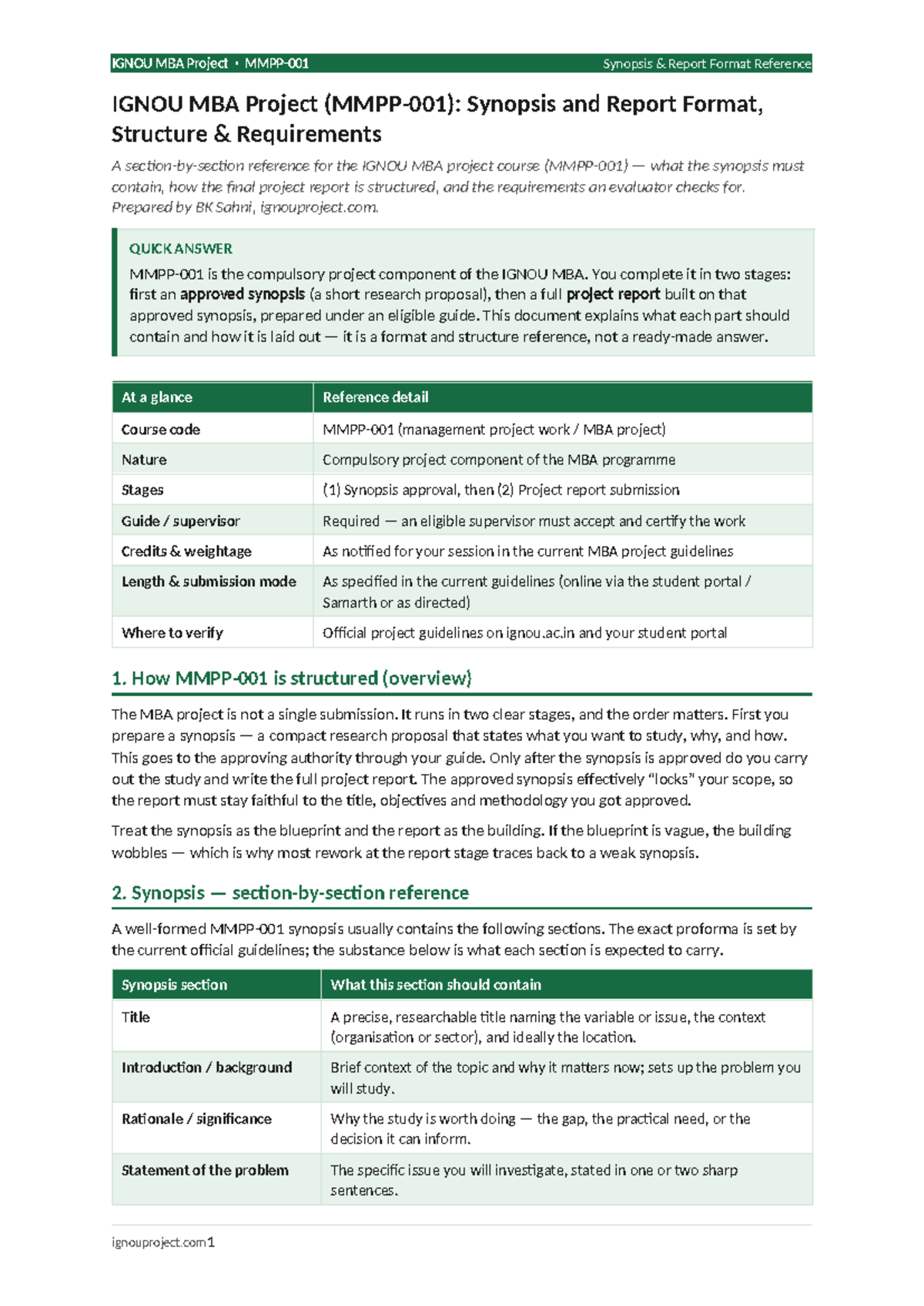
- Weeks 1–2: Scope Definition & Topic Approval Select your specialization angle, formulate 3–5 research objectives, and obtain formal approval from your project advisor.
- Weeks 3–4: Literature Search & Hypothesis Framing Review academic papers, regulatory documents, and annual reports. Draft Chapter 1 and Chapter 2.
- Weeks 5–6: Research Methodology & Instrument Design Formulate survey questions, prepare interview scripts, or build data extraction models for financial statements. Submit methodology to your ethics committee or advisor.
- Weeks 7–9: Data Gathering & Data Cleaning Distribute surveys, conduct executive interviews, or extract statutory accounting data from corporate filings. Clean and validate dataset integrity.
- Weeks 10–11: Data Analysis & Empirical Testing Run statistical models (SPSS, R, Excel), compute core ratios (Solvency, Persistency, EV), and write Chapter 4.
- Weeks 12–13: Strategic Synthesis & Formatting Draft Chapter 5, linking empirical findings to actionable strategic recommendations. Format your bibliography and citations according to APA or required academic standards.
- Week 14: Peer Review & Final Submission Review your document against plagiarism guidelines, verify table alignments, confirm calculations, and submit your final dissertation.
Frequently Asked Questions
What is the ideal word count for an MBA project on life insurance?
Standard MBA dissertations typically range between 8,000 and 15,000 words, depending on institutional requirements. Capstone projects focusing primarily on financial models or empirical surveys may range between 6,000 and 10,000 words. Always check your university's guidelines.
Can I base my MBA life insurance project entirely on secondary data?
Yes, particularly for Finance and Strategic Management concentrations. Analyzing multi-year SEC Form 10-K filings, NAIC statutory data, and macroeconomic yield curves offers sufficient analytical depth without needing primary consumer surveys.
What is the difference between writing a project on term life insurance versus unit-linked plans (ULIPs)?
Term life insurance projects focus primarily on mortality risk, underwriting efficiency, and low-cost digital distribution. Projects on ULIPs or variable universal life policies focus heavily on asset management, investment performance disclosures, market volatility risks, fee structures, and regulatory protection rules.
How do I formulate testable hypotheses for my insurance research?
Frame your hypotheses around measurable operational or financial variables. For example: "There is a statistically significant positive relationship between agent tenure and the 37th-month policy persistency rate," or "Digital underwriting adoption significantly decreases claims processing lead time."
Next Steps for Your MBA Project
To begin structuring your MBA project immediately:
- Select Your Concentration Angle: Choose whether your core methodology will lean toward quantitative corporate finance, consumer marketing, or operations management.
- Define a Specific Geographical and Institutional Scope: Limit your study to a distinct region or set of 3–5 comparative companies over a defined timeframe (e.g., 2021–2026).
- Draft Your Chapter 1 Proposal: Detail your problem statement, research questions, and data collection methodology to secure early approval from your faculty advisor.
Image Gallery