The Massive History and Engineering of the World's Largest Pie
The official Guinness World Record for the largest meat pie was set on September 12, 1996, in Stratford-upon-Avon, United Kingdom. Created by a team of catering students from Stratford-upon-Avon College, the record-breaking pie weighed...
The official Guinness World Record for the largest meat pie was set on September 12, 1996, in Stratford-upon-Avon, United Kingdom. Created by a team of catering students from Stratford-upon-Avon College, the record-breaking pie weighed a staggering 10.54 tonnes (23,237 lbs), measuring 5.18 meters long and 2.9 meters wide.
Contents
While individual record-breaking events capture global headlines, the story of the world’s largest pie is deeply rooted in a centuries-old tradition of communal celebration, engineering challenges, and regional rivalry. To understand the scale of these culinary feats, one must examine the evolution of "Great Pies" from the village of Denby Dale to the high-tech, industrialized attempts of the late 20th century.
The Definitive Record: The 1996 Stratford-upon-Avon Masterpiece
The 1996 Stratford-upon-Avon meat pie remains the benchmark for culinary scale. This project was not merely a cooking exercise; it was a feat of civil engineering and logistics. The students and faculty of Stratford-upon-Avon College spent months planning the structural integrity of the container and the thermal dynamics required to cook over ten tonnes of meat and pastry evenly.
Ingredients and Composition
To achieve the record, the team utilized industrial-grade quantities of ingredients. The primary components included:
- 5,500 kg of beef: Sourced from local suppliers, the beef had to be diced and pre-processed to ensure food safety.
- 1,400 kg of pastry: A heavy-duty shortcrust was required to support its own weight across the massive surface area.
- 1,000 kg of onions: Used for flavor and moisture.
- 90 kg of gravy browning: Essential for the traditional aesthetic and consistency of the filling.
The Engineering Challenge
Cooking a pie of this size presents a significant risk: the "cold spot" phenomenon. In a 10-tonne mass, the center can remain at dangerous temperatures while the exterior burns. The team utilized a custom-built steel container and a specialized heating system that ensured the internal temperature reached the required 75°C (167°F) to meet UK health and safety standards. After cooking, the pie was distributed to the public, with proceeds often benefiting local charities, a tradition that mirrors the "Great Pies" of previous centuries.
The Denby Dale Tradition: The Spiritual Home of Giant Pies
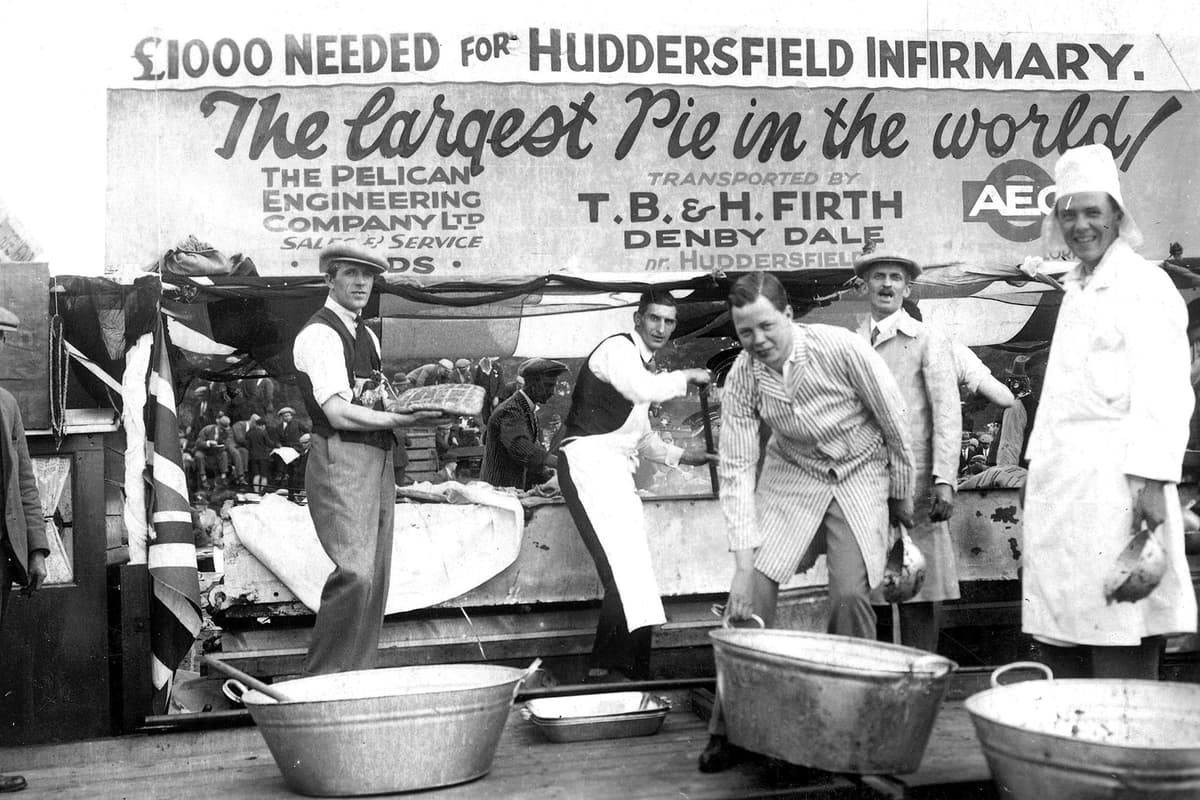
While Stratford-upon-Avon holds the technical weight record, the village of Denby Dale in West Yorkshire, England, is widely considered the historical heart of giant pie-making. Since 1788, the village has baked ten "Great Pies" to commemorate significant national events, ranging from the recovery of King George III to the end of the World Wars.
A Chronology of Denby Dale Pies
The Denby Dale tradition is characterized by both triumph and occasional disaster, illustrating the difficulty of large-scale baking before the advent of modern refrigeration and thermometers.
- 1788 - The First Pie: Baked to celebrate the recovery of King George III from mental illness. It was a modest start compared to modern records but established the village's identity.
- 1815 - The Victory Pie: Commemorating the Battle of Waterloo. This pie was significantly larger, reflecting the growing ambition of the local bakers.
- 1846 - The Repeal of the Corn Laws: This event turned into a minor catastrophe. The pie was reportedly "high" (spoiled) by the time it was cut, leading to a riot where the putrid meat was buried in a nearby field.
- 1887 - Queen Victoria’s Golden Jubilee: Another disaster occurred when the pie dish cracked during the procession. A second "Resurrection Pie" had to be baked weeks later to satisfy the disappointed crowds.
- 1988 - The Bicentenary Pie: This was the first modern "mega-pie" in Denby Dale, weighing over 9 tonnes. It held the Guinness World Record until the Stratford-upon-Avon attempt in 1996.
Cultural Significance
For Denby Dale, these pies were never about individual glory. They served as symbols of resilience and community. The 1964 "Labour" pie, for example, celebrated four years of prosperity and the village's industrial heritage. Each baking involved the entire community, from the local blacksmiths who forged the pie tins to the farmers who donated livestock.
Technical Requirements for World-Record Pies
Creating a pie that exceeds 10 tonnes requires more than just a large oven. As of 2026, the standards for food records have become increasingly stringent, focusing on both the verifiable weight and the eventual consumption of the food to prevent waste.
Heat Distribution and Structural Integrity
The primary technical hurdle is the Biot number, a dimensionless quantity used in heat transfer calculations. For a pie several meters thick, the heat must penetrate the center without carbonizing the crust. In the 1996 record, this was solved through a combination of pre-searing the meat and using steam-injection ovens.
Structural integrity is the second major hurdle. A 10-tonne pie exerts massive pressure on the bottom crust. If the filling is too liquid, the pastry becomes saturated and collapses. If it is too dry, it loses the "pie" classification and becomes a meat-and-dough stack. Bakers often use "pie birds" or industrial vents—large ceramic or metal tubes—to allow steam to escape and prevent the crust from exploding under pressure.
Hygiene and Food Safety
In the modern era, record-breaking food must be fit for human consumption. This involves:
- Continuous Temperature Monitoring: Using dozens of thermocouples embedded throughout the meat mass.
- Rapid Cooling: Once the record is verified, the pie must be cooled quickly or served immediately to prevent the growth of Clostridium perfringens and other foodborne pathogens.
- Environmental Controls: Large-scale outdoor bakes must be shielded from pests and debris, often requiring temporary "clean room" structures.
Comparison of World-Record Class Pies
While the meat pie record is the most famous, other categories of "largest pie" exist, each with its own set of logistical challenges.
| Pie Type | Location | Year | Weight | Key Feature |
|---|---|---|---|---|
| Meat Pie | Stratford-upon-Avon, UK | 1996 | 10,540 kg | Current Guinness World Record holder. |
| Pumpkin Pie | New Bremen, Ohio, USA | 2010 | 1,678 kg | Diameter of 20 feet; used 1,212 lbs of canned pumpkin. |
| Fruit Pie (Cherry) | Oliver, BC, Canada | 1990 | 17,900 kg* | Disputed; often cited as a "tart" or "cobbler" by some standards. |
| Shepherd’s Pie | Dublin, Ireland | 2015 | 1,250 kg | Created by the Guinness Storehouse; included 790 kg of local lamb. |
| Custard Pie | Beano (Dundee), UK | 2017 | 848 kg | Largest "throwing" style pie, though technically edible. |
The Legacy of the "Great Pie"
The story behind the world’s largest pie is ultimately a transition from folk tradition to professional food science. The 1996 Stratford record represents the pinnacle of this evolution. Since then, while smaller regional records have been broken, the 10.54-tonne threshold remains unchallenged due to the immense cost and the logistical nightmare of disposing of over 20,000 pounds of meat.
In 2026, the focus has shifted slightly. While the "weight" remains the primary metric for Guinness, there is an increasing emphasis on the sustainability of these attempts. Modern organizers must provide a comprehensive plan for food distribution, often partnering with food banks and homeless shelters to ensure that the "Great Pie" serves its original purpose: feeding the masses in a spirit of celebration.
Frequently Asked Questions
What happened to the world's largest pie after it was weighed?
Following the verification by Guinness World Record officials, the 1996 Stratford-upon-Avon pie was sliced and served to thousands of spectators and locals. This is a requirement for most modern food records to ensure that the food is not wasted.
Is the Denby Dale pie still the record holder?
No. While Denby Dale held the record for many years (notably with their 1988 pie which weighed over 9 tonnes), they were surpassed by the Stratford-upon-Avon College team in 1996. However, Denby Dale remains the most famous location for recurring giant pie festivals.
What is the most difficult part of baking a giant pie?
The most significant challenge is ensuring the center is thoroughly cooked without burning the outside. Because of the sheer mass, heat takes a long time to reach the core. If the center doesn't reach 75°C (167°F), the pie is considered unsafe for consumption and the record may be disqualified.
How much did the ingredients for the world's largest pie cost?
While the exact 1996 figures are not public, estimates for a 10-tonne meat pie in today's currency (2026) exceed £40,000–£60,000 for ingredients alone, not including the custom engineering of the pan, the oven, and the labor.
Has anyone tried to break the 1996 record recently?
There have been various regional attempts at specific types of pies (like the largest Shepherd's pie or largest fruit pie), but no organization has attempted to eclipse the 10.54-tonne meat pie record in recent years due to the massive logistical and financial requirements.
Practical Recommendation for Future Attempts
For any organization or municipality considering a challenge to the "World's Largest Pie" record, the primary focus must be on thermal engineering rather than just volume. Utilizing a modular heating system that can cook internal sections independently before the final assembly of the crust is the most viable path to exceeding the 10.54-tonne mark safely. Furthermore, early collaboration with local health departments is essential to ensure that the record is not only "large" but also legally "edible" under modern food safety statutes.
Image Gallery