The Difference Between Orcas and Whales: Taxonomy, Biology, and Behavior Explained
While orcas are frequently referred to as "killer whales," they are biologically classified as the largest members of the oceanic dolphin family (Delphinidae). All dolphins are technically toothed whales, but orcas differ from the "gre...
While orcas are frequently referred to as "killer whales," they are biologically classified as the largest members of the oceanic dolphin family (Delphinidae). All dolphins are technically toothed whales, but orcas differ from the "great whales" in their skeletal structure, sophisticated social hunting strategies, and their specific taxonomic lineage as apex predators within the dolphin branch.
Contents
The distinction between an orca (Orcinus orca) and what most people consider a "whale" is rooted in the complex hierarchy of marine biology. To understand these differences, one must look past the common names and examine the evolutionary paths that separate the massive filter-feeders from the highly intelligent, pack-hunting dolphins. As of 2026, genomic sequencing and longitudinal field studies have further clarified that orcas are not just another whale, but a unique evolutionary powerhouse with more in common with a bottlenose dolphin than a blue whale.
Taxonomic Classification: The Cetacean Family Tree
To understand why an orca is a dolphin, we must first look at the order Cetacea, which encompasses all whales, dolphins, and porpoises. This order is divided into two primary suborders: Mysticeti (baleen whales) and Odontoceti (toothed whales).
Mysticeti vs. Odontoceti
The "great whales," such as the Blue whale, Humpback, and Gray whale, belong to the suborder Mysticeti. These animals are characterized by baleen plates—fringed bristles made of keratin—used to filter tiny organisms like krill and plankton from the water. They generally possess two blowholes and do not use echolocation for hunting in the same complex manner as their toothed cousins.
In contrast, orcas belong to the suborder Odontoceti. This group includes all animals that possess teeth rather than baleen. This suborder further branches into several families, including Delphinidae (oceanic dolphins). Orcas are the largest members of this family. Therefore, while an orca is technically a whale in the broad sense (as all cetaceans are whales), it is specifically a dolphin.
The Evolutionary Split
The divergence between the ancestors of modern baleen whales and toothed whales occurred approximately 34 million years ago. This split led to drastically different physiological developments. While baleen whales evolved to grow to immense sizes to facilitate bulk feeding, the lineage leading to the orca focused on brain development, acoustic sophistication, and high-speed maneuverability.
Physical Differences and Morphology
The most immediate differences between orcas and other whales are found in their physical appearance and anatomical structures. Even compared to other toothed whales, such as the Sperm whale, the orca exhibits unique adaptations.
Size and Weight
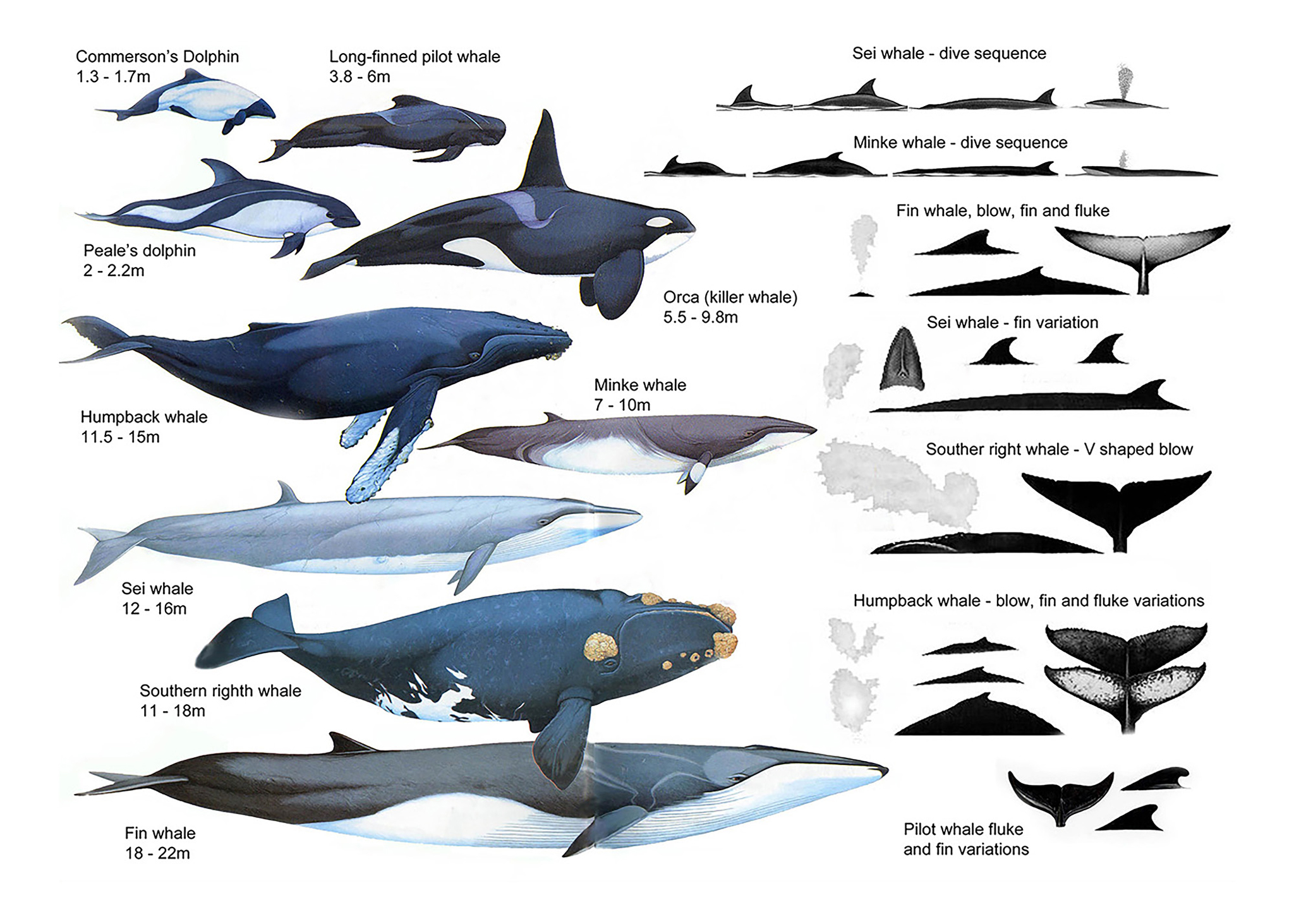
One of the primary markers of the "great whales" is their sheer scale. A Blue whale can reach lengths of 100 feet and weigh up to 200 tons. In contrast, an orca is much smaller, typically measuring between 20 and 32 feet and weighing approximately 6 to 11 tons. While this makes them giants among dolphins, they are significantly smaller than the majority of baleen whales.
Dorsal Fins and Coloration
Orcas possess a highly distinct aesthetic that sets them apart from most cetaceans. Their jet-black backs and stark white underbellies (and eye patches) provide a form of camouflage known as countershading. From above, they blend into the dark depths; from below, their white bellies mimic the bright surface of the water.
The dorsal fin of an orca is also a defining characteristic. In males, the dorsal fin can reach heights of up to six feet and is triangular and erect. Most large whales have relatively small, curved, or even non-existent dorsal fins in proportion to their body size.
Blowholes and Respiration
Baleen whales (Mysticeti) possess two blowholes side-by-side, which produce a distinct "V" shaped blow. Orcas, like all dolphins and toothed whales, have a single blowhole. This anatomical difference is a reliable way for researchers to identify the suborder of a surfacing cetacean from a distance.
Diet, Hunting, and the "Killer" Moniker
The name "Killer Whale" is actually a linguistic flip of the original term. Ancient mariners observed orcas hunting and killing much larger whales, leading them to call the creatures "Whale Killers" (asesina ballenas in Spanish). Over time, this was transposed into "Killer Whale."
Apex Predators vs. Filter Feeders
The dietary habits of orcas are perhaps their most significant departure from the great whales. Most whales are generalists or filter-feeders that consume vast quantities of low-trophic level organisms. Orcas are apex predators at the very top of the marine food chain.
Depending on their ecotype (a distinct population with specific behaviors), orca diets can include:
- Fish and cephalopods (salmon, herring, rays).
- Marine mammals (seals, sea lions, and even the calves of large baleen whales).
- Sharks (including Great Whites).
- Seabirds.
Echolocation and Acoustic Hunting
While all whales use sound for communication, orcas and other toothed whales have a highly developed biological sonar known as echolocation. They emit clicks that bounce off objects, allowing them to "see" their environment in total darkness or murky water. Baleen whales primarily use low-frequency sounds (moans and songs) for long-distance communication but do not possess the specialized fatty organ in the forehead (the melon) used by orcas to focus echolocation beams.
Social Structure and "Cultural" Intelligence
One of the most profound differences between orcas and many other whale species is the depth of their social complexity. While Humpback whales may migrate in loose groups and Sperm whales have stable social units, orcas exhibit a level of social cohesion and cultural transmission that is nearly unparalleled in the animal kingdom.
Matrilineal Societies
Orca pods are strictly matrilineal, led by an older female (the matriarch). These pods are incredibly stable; in many populations, offspring stay with their mothers for their entire lives. This social structure allows for the passage of "culture"—specific hunting techniques, vocal dialects, and dietary preferences that are unique to that pod and passed down through generations.
Hunting Strategies
Orcas exhibit pack-hunting behaviors more akin to wolves or lions than other whales. Different populations have developed specialized methods for capturing prey:
- Wave Washing: In the Antarctic, orcas work together to create synchronized waves that knock seals off ice floes.
- Beach Charging: In Patagonia, orcas intentionally strand themselves on the beach to snatch sea lion pups before wriggling back into the surf.
- Carousel Feeding: Pods in the North Atlantic circle schools of herring, using bubbles and flashes of their white bellies to herd the fish into a tight ball before stunning them with tail slaps.
These behaviors require high-level communication and cooperation, traits that are far more pronounced in orcas than in the more solitary baleen whales.
Summary of Key Differences
The following table highlights the primary distinctions between orcas and the broader category of whales (specifically focusing on the contrast with baleen whales).
| Feature | Orca (Dolphin Family) | Great Whales (Baleen) |
|---|---|---|
| Taxonomy | Suborder: Odontoceti (Toothed) | Suborder: Mysticeti (Baleen) |
| Feeding Mechanism | Conical teeth for gripping/tearing | Keratin baleen plates for filtering |
| Blowholes | Single blowhole | Double blowhole |
| Average Length | 20–32 feet | 40–100 feet |
| Social Structure | Highly stable matrilineal pods | Often solitary or loose aggregations |
| Diet | Apex predator (fish, mammals, sharks) | Plankton, krill, small schooling fish |
| Acoustics | High-frequency echolocation | Low-frequency "songs" and moans |
| Dorsal Fin | Very prominent (up to 6ft in males) | Relatively small or absent |
Cultural and Conservation Status in 2026
As of 2026, the scientific community continues to debate whether the various "ecotypes" of orcas should be classified as separate species. For instance, the Resident orcas of the Pacific Northwest (which eat fish) and the Transient (Bigg's) orcas (which eat mammals) do not interbreed and have different vocalizations.
Conservation efforts also differ significantly. While many large whale populations have seen a steady recovery since the global moratorium on commercial whaling, specific orca populations—particularly the Southern Resident Killer Whales—remain critically endangered due to prey depletion (declining salmon stocks), chemical contaminants, and vessel noise interference. Protecting orcas requires a different approach than protecting baleen whales; it involves managing entire ecosystems to ensure the availability of their specific, culturally preferred prey.
Frequently Asked Questions
Is an orca a whale or a dolphin?
Biologically, an orca is a dolphin. However, because all dolphins fall under the suborder Odontoceti (toothed whales), they are technically whales as well. In common parlance, "whale" usually refers to the larger baleen species, while "dolphin" refers to the smaller, toothed species with beaks and complex social structures.
Why are orcas called "Killer Whales"?
The name is a mistranslation of the Spanish term asesina ballenas, which means "whale killer." Sailors gave them this name after witnessing pods of orcas hunting and killing large baleen whales. Over time, the words were flipped to "killer whale."
Can orcas survive in all oceans?
Yes, orcas are the most widely distributed mammals in the world, second only to humans. They are found in every ocean, from the freezing waters of the Arctic and Antarctic to tropical seas near the equator, though they are most abundant in cooler, coastal waters.
How smart are orcas compared to other whales?
While intelligence is difficult to measure across species, orcas have one of the highest brain-to-body mass ratios of any cetacean. Their brains are highly encephalized and possess a complex paralimbic system, which is involved in processing emotions and social bonds. Their ability to teach offspring specific "cultural" behaviors is a hallmark of high-level intelligence.
Do orcas ever attack humans in the wild?
There are no documented cases of an orca killing a human in the wild. While there have been rare instances of orcas "nudging" or biting humans (possibly out of curiosity or mistaken identity), they generally show no predatory interest in humans. Most incidents involving orca aggression toward humans have occurred in captivity, where the animals are under significant psychological stress.
Identifying Orcas in the Wild
If you are on a whale-watching expedition, identifying an orca is relatively straightforward compared to other cetaceans. Look for the tall, dark dorsal fin and the distinctive "white patch" just behind the eye. Unlike many baleen whales that show their tail flukes (the tail fins) before a deep dive, orcas are more likely to engage in "surface active" behaviors such as breaching (jumping out of the water), spy-hopping (sticking their head straight up to look around), and tail-slapping.
To learn more about the specific ecotypes in your region or to support ongoing conservation efforts, you can visit official resources such as the National Oceanic and Atmospheric Administration (NOAA) Fisheries or the International Whaling Commission. Understanding these distinctions is the first step toward appreciating the unique role orcas play as the guardians and top predators of our global oceans.
Image Gallery