How Does a Nuclear Powered Missile Work? The Science of Infinite Range
A nuclear-powered missile operates by using a compact nuclear reactor to heat compressed atmospheric air, which then expands rapidly and is expelled through a nozzle to create thrust. Unlike conventional missiles that rely on chemical...
A nuclear-powered missile operates by using a compact nuclear reactor to heat compressed atmospheric air, which then expands rapidly and is expelled through a nozzle to create thrust. Unlike conventional missiles that rely on chemical combustion, this system uses nuclear fission as a heat source, allowing for theoretically unlimited range and endurance.
Contents
The concept of a nuclear-powered cruise missile represents one of the most complex challenges in aerospace engineering. While traditional propulsion systems—such as turbojets, turbofans, or rocket motors—are limited by the amount of fuel they can carry, a nuclear-powered system uses the immense energy density of uranium or other fissile materials to sustain flight for days or even weeks. By 2026, the global interest in this technology has shifted from the experimental "flying crowbar" designs of the mid-20th century to highly specialized, modern strategic assets. Understanding how these machines work requires an exploration of thermodynamics, reactor physics, and high-speed aerodynamics.
The Core Concept: The Nuclear Ramjet
To understand how a nuclear-powered missile works, one must first understand the ramjet cycle. In a standard ramjet, the missile’s forward motion "rams" air into an intake. This air is compressed by its own velocity, mixed with liquid fuel, ignited, and exhausted.
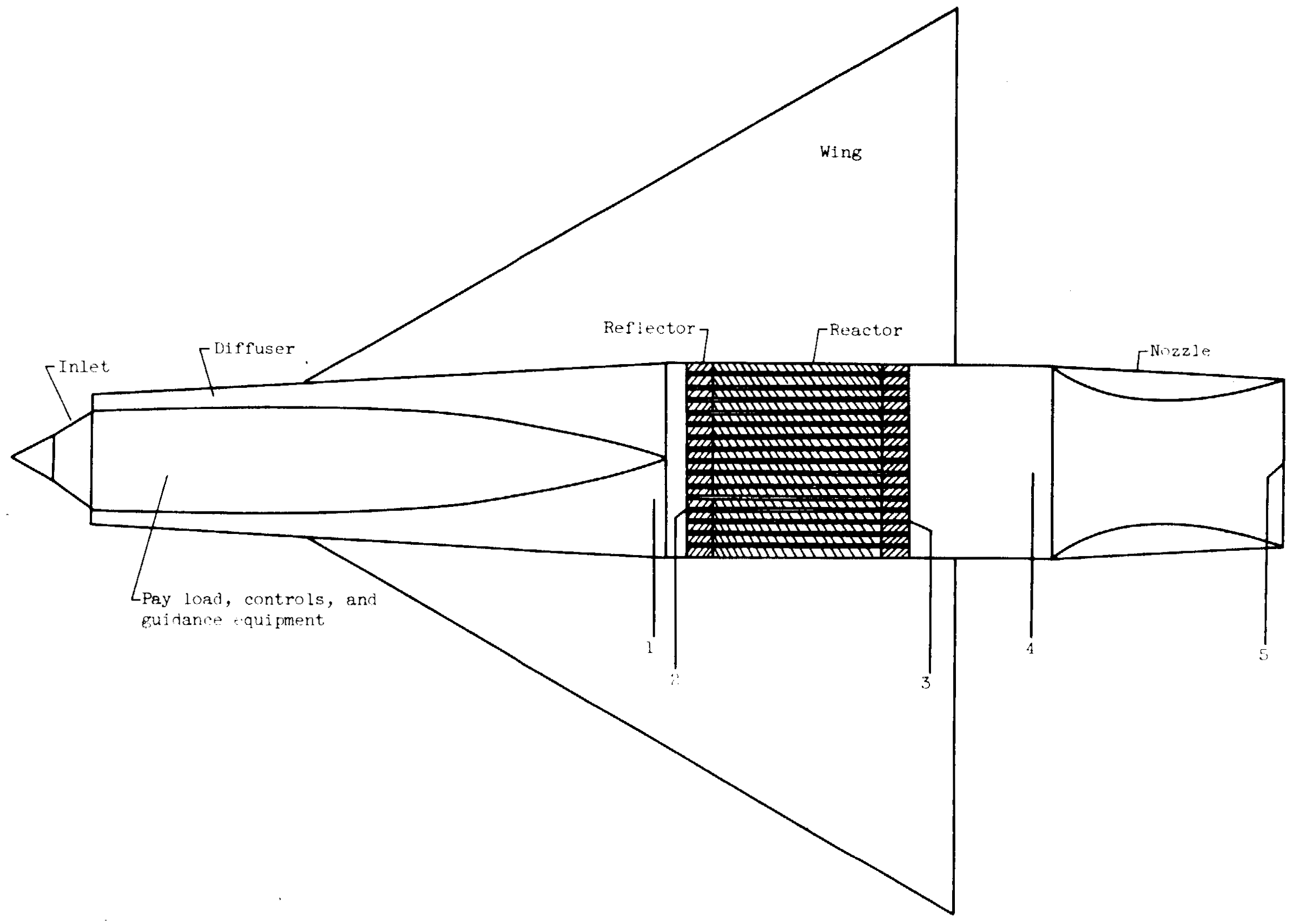
In a nuclear-powered version, the liquid fuel and combustion chamber are replaced by a nuclear reactor core. As the missile travels at supersonic speeds, high-pressure air is forced into the engine. Instead of being set on fire, the air passes directly through or around the hot reactor core. The reactor transfers immense thermal energy to the air, causing it to expand violently. This heated air is then ejected through the rear nozzle at a much higher velocity than it entered, providing the thrust necessary to maintain flight.
Thermal Exchange and Heat Transfer
The efficiency of a nuclear missile depends entirely on how effectively heat can be transferred from the reactor to the incoming air. This requires the reactor to operate at extremely high temperatures—often exceeding 1,000 to 1,500 degrees Celsius. Because there is no chemical reaction taking place (no "burning"), the engine does not "run out" of fuel in the traditional sense. It only stops when the reactor can no longer maintain critical heat or when the mechanical components of the missile fail due to thermal stress.
Historical Foundations: Project Pluto and the SLAM
The most famous historical example of this technology is the United States’ Project Pluto, initiated in the late 1950s. The goal was to create the Supersonic Low Altitude Missile (SLAM), a weapon designed to fly at Mach 3 at low altitudes to evade radar.
The heart of the SLAM was the Tory-II reactor series. These were "open-cycle" reactors, meaning the air intake passed directly over the bare nuclear fuel elements. The technical achievements of Project Pluto proved that such an engine could work, but it also revealed the inherent dangers. The exhaust was essentially a continuous stream of radioactive isotopes, and the noise generated by a Mach 3 missile flying at tree-top level would have been lethal to anyone on the ground directly beneath its flight path.
While the U.S. cancelled the project in 1964 due to the emergence of reliable Intercontinental Ballistic Missiles (ICBMs), the physics established during this era remain the foundation for any modern attempt to build a nuclear-powered missile.
The Open-Cycle vs. Closed-Cycle Design
Engineers generally categorize nuclear thermal propulsion into two main architectures, each with significant trade-offs regarding weight, complexity, and environmental safety.
1. Open-Cycle Propulsion
In an open-cycle system, the atmospheric air comes into direct contact with the nuclear fuel rods. This is the most efficient way to transfer heat because there is no barrier between the energy source and the propellant. However, this design is "dirty." As the air passes over the fuel, it picks up radioactive fission products and neutron-activated particles, leaving a trail of radioactive fallout behind the missile wherever it flies.
2. Closed-Cycle Propulsion
A closed-cycle system uses a heat exchanger. The nuclear reactor heats a secondary fluid (like liquid metal or a specialized gas) in a closed loop. This hot fluid then passes through a radiator-like structure where it heats the incoming atmospheric air. While this prevents the release of radioactive exhaust, it is significantly heavier and less efficient than the open-cycle design. For a missile, where weight is a critical factor for achieving supersonic flight, the closed-cycle approach is often considered technically impractical.
Key Components of a Nuclear-Powered Missile
Building a nuclear missile requires materials that can survive the dual stressors of high-intensity radiation and extreme thermal heat.
- The Nuclear Reactor: Usually a compact fast-neutron reactor. Unlike the massive reactors found in power plants, these must be small enough to fit within a missile fuselage (typically less than a meter in diameter).
- Fuel Elements: These are often made of ceramic-metallic composites (cermets) or specialized alloys that can withstand the corrosive effects of high-velocity air at extreme temperatures without melting.
- The Air Intake and Diffuser: A precision-engineered duct that slows the incoming supersonic air to subsonic speeds before it hits the reactor, increasing the pressure and allowing for better heat absorption.
- Shielding: To protect the missile’s own guidance electronics and payload from the reactor’s radiation, a "shadow shield" is placed between the reactor and the forward section of the missile. Full 360-degree shielding is usually omitted to save weight.
- Control Rods: These are used to manage the reactor’s power level. Withdrawing the rods increases the fission rate (and heat), while inserting them absorbs neutrons and shuts the engine down.
Operational Workflow: From Launch to Sustained Flight
A nuclear-powered missile cannot take off under nuclear power alone. Because ramjets require high-speed forward motion to compress air, the missile must first be accelerated by a different source.
- The Booster Phase: The missile is launched using a conventional solid-fuel rocket booster. This stage pushes the missile to high altitudes and accelerates it to a speed (usually around Mach 2) where the air intake can function effectively.
- Reactor Activation: Once the target velocity is reached, the nuclear reactor is brought to "criticality." Control rods are moved to begin the fission process, rapidly heating the core.
- Transition to Nuclear Power: The air intake doors open, and the cold, high-pressure air hits the hot reactor. As the nuclear engine begins generating thrust, the solid booster is jettisoned.
- Cruise Phase: The missile enters its long-endurance cruise. Because it does not need to conserve fuel, it can take circuitous routes—flying around entire continents or loitering over oceans for days—to approach a target from an unexpected, unmonitored direction.
- Terminal Phase: Upon reaching the target, the missile delivers its payload. In some historical designs like the SLAM, the missile itself was intended to be a weapon, acting as a "flying dirty bomb" even after it dropped its primary warheads.
Strategic Capabilities and Technical Comparison
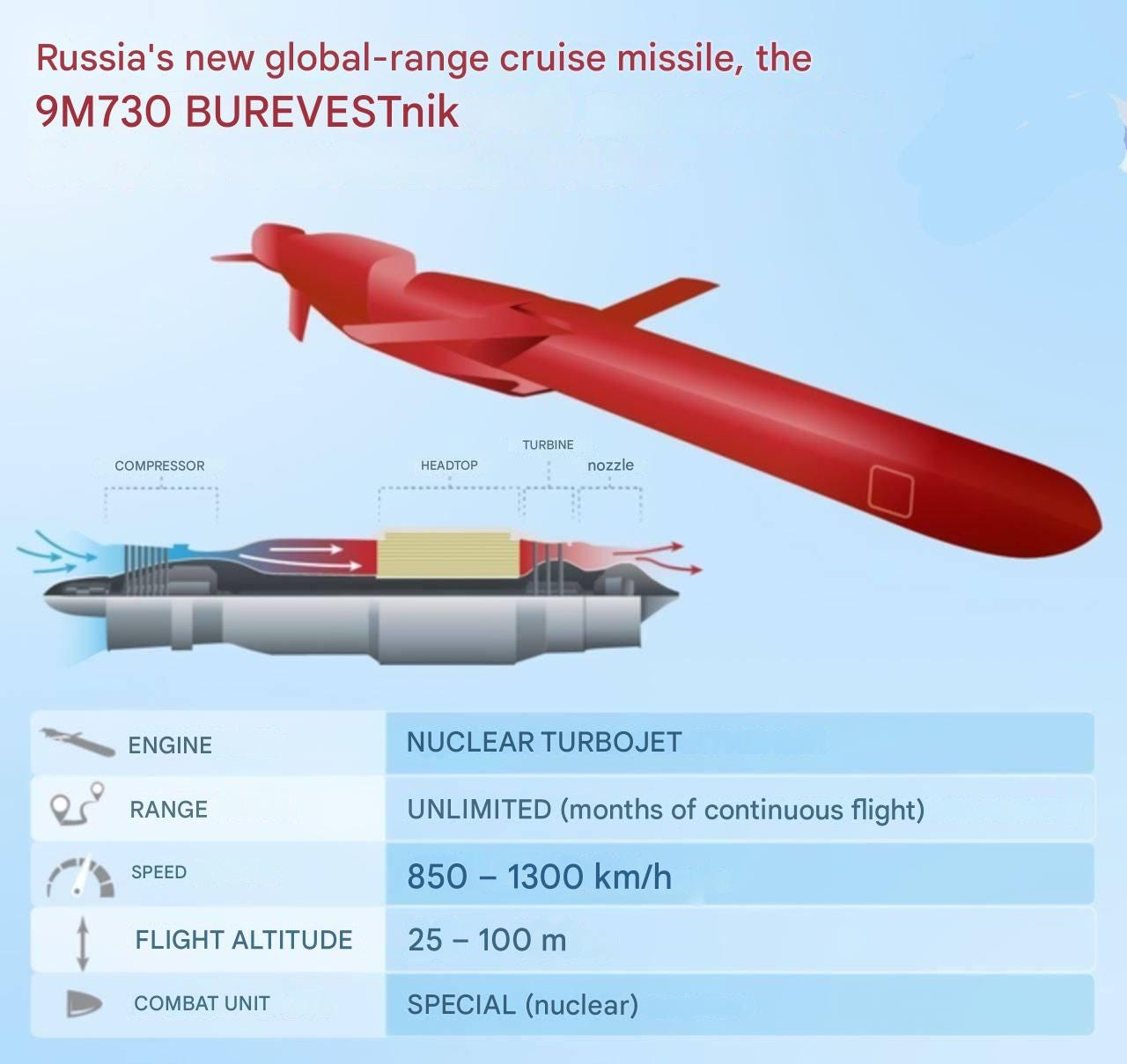
The primary advantage of a nuclear-powered missile is persistence. A conventional cruise missile like the Tomahawk has a range of roughly 1,000 to 1,500 miles. A nuclear-powered missile, such as the Russian 9M730 Burevestnik (SSC-X-9 Skyfall), is designed to have a range that is functionally global.
| Feature | Conventional Cruise Missile | Intercontinental Ballistic Missile (ICBM) | Nuclear-Powered Cruise Missile |
|---|---|---|---|
| Propulsion | Turbojet / Turbofan | Liquid or Solid Rocket | Nuclear Ramjet |
| Range | Limited (1,500 - 2,500 km) | Limited by fuel (10,000+ km) | Virtually Unlimited |
| Flight Path | Low altitude, maneuverable | High-altitude parabolic arc | Low altitude, highly maneuverable |
| Speed | Subsonic or Supersonic | Hypersonic (during reentry) | Supersonic |
| Detection | Hard to detect (low altitude) | Easy to detect (launch flash/radar) | Extremely difficult to track over time |
| Deployment Year | 1970s - Present | 1950s - Present | Experimental / Limited (2020s) |
The Environmental and Safety Risks
The "How" of a nuclear missile is often overshadowed by the "Why not?" The environmental risks of testing and deploying these weapons are substantial.
The most significant risk is radioactive contamination during flight. If the missile uses an open-cycle reactor, it is essentially a moving source of radiation. Furthermore, if the missile crashes—whether due to a mechanical failure or being shot down—the reactor core could shatter, spreading highly radioactive material over a wide area. This makes testing these systems extremely difficult, as any accident can result in a localized ecological disaster.
Additionally, the thermal management of such a device is a nightmare for engineers. If the missile stops moving (for example, if it is intercepted), the air cooling stops. Without a cooling flow, the reactor core can melt through the missile’s fuselage in seconds, creating a "meltdown" scenario mid-air or on the ground.
Frequently Asked Questions
Is a nuclear-powered missile the same as a nuclear-armed missile?
No. A "nuclear-armed" missile carries a nuclear warhead but uses conventional fuel (like kerosene or solid chemicals) for its engine. A "nuclear-powered" missile uses a nuclear reactor for its propulsion. However, most nuclear-powered missiles are also nuclear-armed.
Can a nuclear-powered missile stay in the air forever?
Theoretically, it can stay aloft for as long as the reactor's fuel lasts, which could be months. Practically, the flight time is limited by the mechanical wear and tear on the engine components and the structural integrity of the airframe under the stress of supersonic flight and radiation.
Why don't we use this technology for passenger planes?
The weight of the necessary shielding to protect passengers from radiation would make the airplane too heavy to fly. Additionally, the risk of a crash releasing a nuclear reactor into a populated area is a safety risk that no civilian aviation authority would accept.
Has any country successfully deployed a nuclear-powered missile?
As of 2026, Russia is the only nation that has publicly confirmed the development and testing of a modern nuclear-powered cruise missile, the 9M730 Burevestnik. While the United States conducted extensive testing in the 1960s, it has not officially deployed such a system in the modern era.
Can these missiles be shot down?
Yes. Despite their range and speed, they are still cruise missiles. They can be intercepted by modern surface-to-air missiles (SAMs) or specialized aircraft. However, shooting one down carries the added risk of dispersing the radioactive material from the missile's reactor core.
The Future of Global Reach
The technical reality of a nuclear-powered missile is a testament to the extremes of cold-war era and modern physics. By bypassing the limitations of chemical combustion, these machines achieve a level of strategic unpredictability that conventional weapons cannot match. However, the immense engineering hurdles—specifically regarding material science and environmental containment—ensure that they remain among the most controversial and difficult weapons to maintain in any national arsenal.
For those tracking developments in global security or aerospace engineering, the nuclear-powered missile remains the ultimate "high-risk, high-reward" technology. Its ability to loiter and strike from any angle makes it a formidable tool for bypassing traditional missile defense shields, even as its existence poses significant questions about the long-term safety of the environments through which it flies.
Image Gallery