Navigating a Truck Accident Lawyer Washington State Claim Basics
Navigating a commercial truck accident claim in Washington State requires understanding strict statutory deadlines, comparative fault rules, and federal motor carrier regulations. Because collisions involving semi-trucks, tractor-trail...
Navigating a commercial truck accident claim in Washington State requires understanding strict statutory deadlines, comparative fault rules, and federal motor carrier regulations. Because collisions involving semi-trucks, tractor-trailers, and commercial delivery vehicles often lead to catastrophic injuries, insurance carriers deploy rapid-response teams to minimize payouts, making foundational knowledge of the state's legal framework essential for protecting your recovery rights.
Contents
Understanding the Washington State Legal Landscape for Commercial Vehicle Collisions
Commercial truck wrecks differ fundamentally from standard passenger car accidents. When a semi-truck or commercial carrier collides with a passenger vehicle, the physics involved often result in devastating structural damage and severe physical injuries. Beyond the sheer scale of the vehicles, the legal framework governing these cases involves an intricate web of state civil laws and federal safety mandates.
In Washington State, victims pursuing compensation must navigate specific procedural rules that dictate how long they have to file, how fault is allocated, and which entities can be held legally responsible. Commercial trucking operations are bound by both Washington State Department of Transportation (WSDOT) regulations and the Federal Motor Carrier Safety Administration (FMCSA) rules. These regulations govern everything from maximum driver hours of service to mandatory vehicle maintenance schedules. When an accident occurs, investigating whether the driver or the carrier violated these standards forms the foundation of a successful civil claim.
Key Differences Between Truck Accidents and Standard Car Crashes
While both types of motor vehicle collisions rely on the legal concept of negligence, truck accident claims are vastly more complex. Passenger vehicle accidents typically involve two individual drivers and their respective insurance companies. In contrast, commercial truck crashes often involve multiple corporate entities and intricate layers of liability.
| Feature | Standard Passenger Car Accident | Commercial Truck Accident |
|---|---|---|
| Primary Parties | Individual drivers, personal auto insurers | Driver, motor carrier, cargo loader, parts manufacturer, commercial insurers |
| Governing Regulations | State traffic laws | State traffic laws plus complex FMCSA and WSDOT federal regulations |
| Evidence Preservation | Police report, photos, witness statements | Electronic Control Modules (ECM), driver logs, maintenance records, GPS data |
| Insurance Policy Limits | Often capped at relatively low state minimums ($25,000/$50,000) | Commercial policies frequently range from $750,000 to $5,000,000+ |
| Corporate Defense Strategy | Direct negotiation with a single adjuster | Aggressive deployment of rapid-response corporate legal teams and adjusters |
This structural complexity means that treating a commercial vehicle collision like a standard fender-bender will almost certainly jeopardize your ability to recover fair compensation for medical bills, lost wages, and pain and suffering.
Establishing Liability and Identifying Responsible Parties
In a standard car accident, fault typically rests with one or both drivers. In a Washington State truck accident claim, liability can extend far beyond the person behind the wheel. Establishing who is legally responsible requires a thorough investigation into the commercial enterprise operating the vehicle.
Potential defendants in a commercial truck claim include:
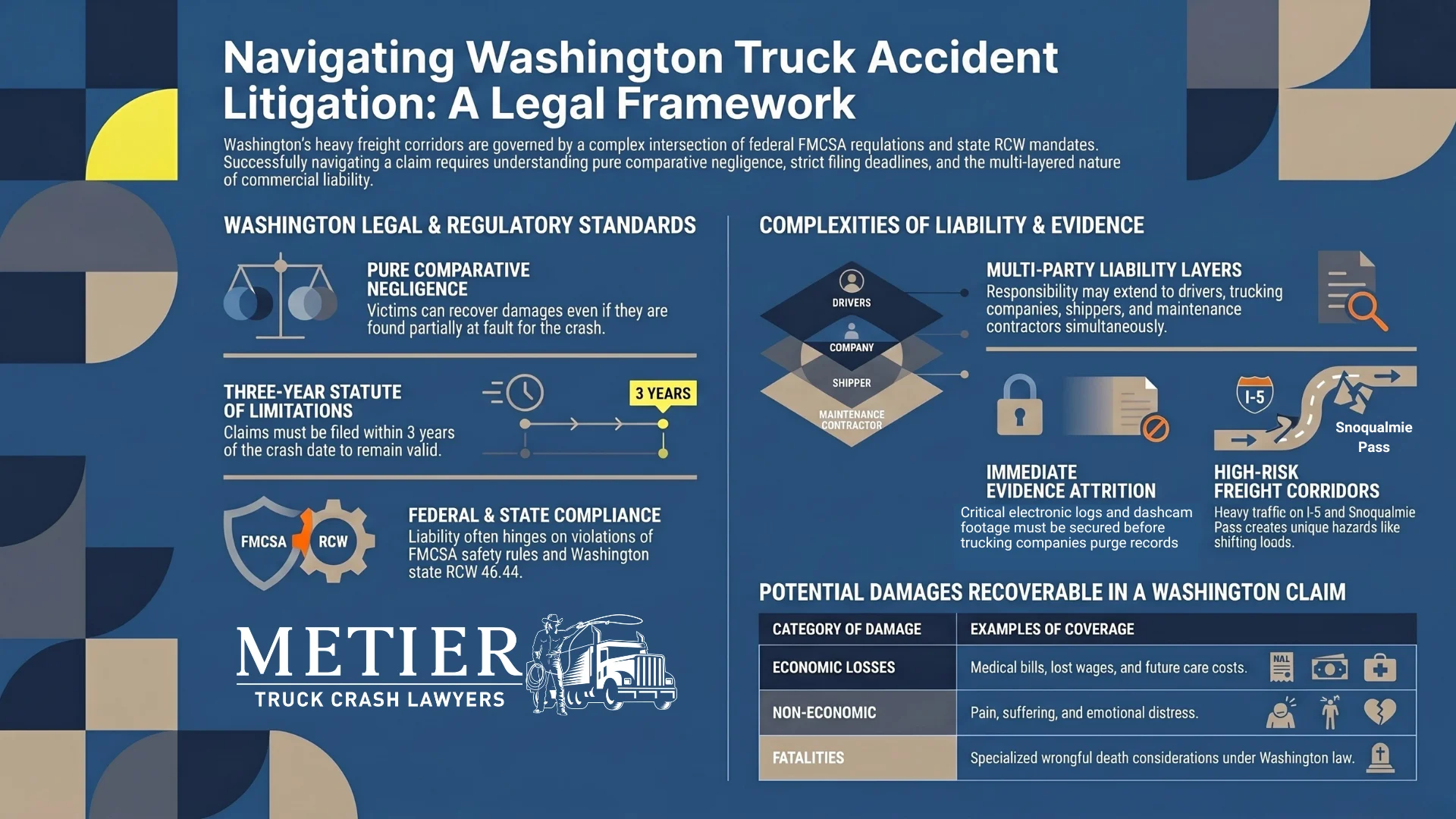
- The Truck Driver: For operational errors such as speeding, distracted driving, driving while fatigued, or operating under the influence of drugs or alcohol.
- The Motor Carrier (Employer): Under the legal doctrine of respondeat superior, employers are generally liable for the negligent acts of their employees committed within the scope of employment. Furthermore, carriers can be held directly liable for negligent hiring, poor training, or forcing drivers to violate hours-of-service regulations.
- The Cargo Shipper or Loader: If improperly secured cargo shifts and causes the truck to jackknife or lose control, the company responsible for loading the trailer can be held liable.
- Maintenance Providers: Third-party contractors who failed to properly service brakes, steering mechanisms, or tires can share fault for mechanical failures.
- Parts Manufacturers: Defective components, such as faulty braking systems or tire blowouts caused by manufacturing flaws, can lead to product liability claims against the manufacturer.
Washington State Statute of Limitations and Deadlines
Time is one of the most critical factors in any personal injury claim. Under the Revised Code of Washington (RCW) 4.16.080, the general statute of limitations for personal injury and property damage claims is three years from the date of the accident.
Failing to file a formal lawsuit within this three-year window generally bars you from recovering any compensation through the Washington court system. However, specific exceptions and shorter deadlines may apply:
- Claims Against Government Entities: If the truck involved was owned or operated by a city, county, or state agency in Washington, you must file a formal tort claim notice within strict statutory windows before you can even file a lawsuit. These administrative deadlines are often much shorter than the standard three-year period.
- Minors: If the injured party is a minor, the statute of limitations typically does not begin to run until the individual turns 18, giving them until their 21st birthday to file a personal injury claim.
- Property Damage Only: If the collision resulted solely in property damage without personal injury, the three-year limitation under RCW 4.16.080 still applies.
Waiting until the eleventh hour to begin the claims process is a critical mistake. Critical evidence, such as dashcam footage and electronic logging device (ELD) data, can be legally overwritten or destroyed by trucking companies shortly after a crash.
Comparative Fault Rules in Washington State
Washington operates under a pure comparative fault system, codified in RCW 4.22.005. Under this legal doctrine, an injured party can still recover damages even if they share a portion of the blame for the collision.
However, your total financial recovery is reduced in direct proportion to your percentage of fault. For example, if a court determines that you suffered $100,000 in damages but were 20% at fault for the crash (perhaps for minor speeding or failing to signal), your final recovery is reduced by 20%, netting you $80,000.
Insurance adjusters frequently attempt to shift a disproportionate amount of blame onto the injured passenger vehicle driver to minimize their payout. Understanding this rule underscores the importance of securing independent evidence to counter claims of shared liability.
Essential Evidence to Preserve Immediately After a Truck Wreck
Securing compensation in a Washington truck accident claim depends heavily on the quality and timeliness of the evidence collected. Unlike physical evidence at a typical crash site, commercial trucking evidence is often controlled entirely by the opposing party.
- Electronic Control Module (ECM) Data: Often referred to as the truck's "black box," the ECM records speed, braking force, throttle position, and engine status in the seconds leading up to the crash.
- Driver Qualification File: Federal regulations require motor carriers to maintain records regarding the driver's commercial driver’s license (CDL) status, medical certifications, driving history, and drug testing results.
- Hours of Service (HOS) Logs: Electronic logging devices track how long a driver has been behind the wheel, helping prove whether driver fatigue played a role in the collision.
- Maintenance and Repair Records: These documents reveal whether the motor carrier neglected required safety inspections or deferred critical mechanical repairs.
- Eyewitness Testimony and Police Reports: Independent accounts and the responding officer’s official diagram provide an unbiased baseline of the accident scene.
Frequently Asked Questions
What should I do immediately after a truck accident in Washington State?
Prioritize your safety and call 911 to ensure law enforcement and medical personnel are dispatched to the scene. Seek immediate medical attention, even if you feel your injuries are minor, as adrenaline can mask severe trauma. Document the scene with photos and videos if you are able, and avoid giving recorded statements to the commercial truck's insurance adjuster before consulting with legal counsel.
Can I handle a truck accident claim without a lawyer?
While it is technically permissible to represent yourself, handling a commercial truck claim independently is extremely difficult. Trucking companies deploy aggressive defense teams and corporate lawyers whose primary objective is to minimize liability. An experienced attorney levels the playing field by managing evidence preservation, expert witness testimony, and complex corporate negotiations.
How are truck accident settlements calculated in Washington?
Settlements are calculated by aggregating both economic and non-economic damages. Economic damages include verifiable financial losses such as past and future medical bills, rehabilitation costs, lost wages, and property damage. Non-economic damages compensate for subjective losses, including physical pain, emotional distress, loss of enjoyment of life, and permanent impairment.
What if the truck driver was an independent contractor rather than an employee?
When a driver is classified as an independent contractor, motor carriers often attempt to shield themselves from liability. However, Washington courts and federal regulations look beyond simple contract titles. If the carrier exercised significant operational control over the driver, or if federal non-delegable duty rules apply, the motor carrier can still be held legally responsible for the driver's negligence.
How much does it cost to hire a truck accident attorney?
Most personal injury attorneys handle truck accident claims on a contingency fee basis. This means you pay no upfront hourly fees or out-of-pocket costs to retain representation. Instead, the attorney’s fee is an agreed-upon percentage of the final settlement or court award, and they only collect a fee if they successfully recover compensation for you.
Next Steps and Professional Guidance
If you or a loved one has been injured in a commercial vehicle collision, taking prompt action is essential to protect your legal rights. Preserve all medical documentation, vehicle repair estimates, and correspondence with insurers. Because commercial carriers begin investigating accidents within hours of the crash, consulting with a qualified Washington State truck accident attorney ensures that critical evidence is formally requested and preserved through spoliation letters before it can be legally erased or discarded.
Image Gallery