Active Volcanoes Examples: Global Locations, Eruption Types, and Volcanic Hazards
Active volcanoes are vent structures in the Earth's crust that are currently erupting, showing signs of unrest such as seismic tremors and gas emissions, or have documented eruptions within the Holocene epoch—roughly the past 11,700 ye...
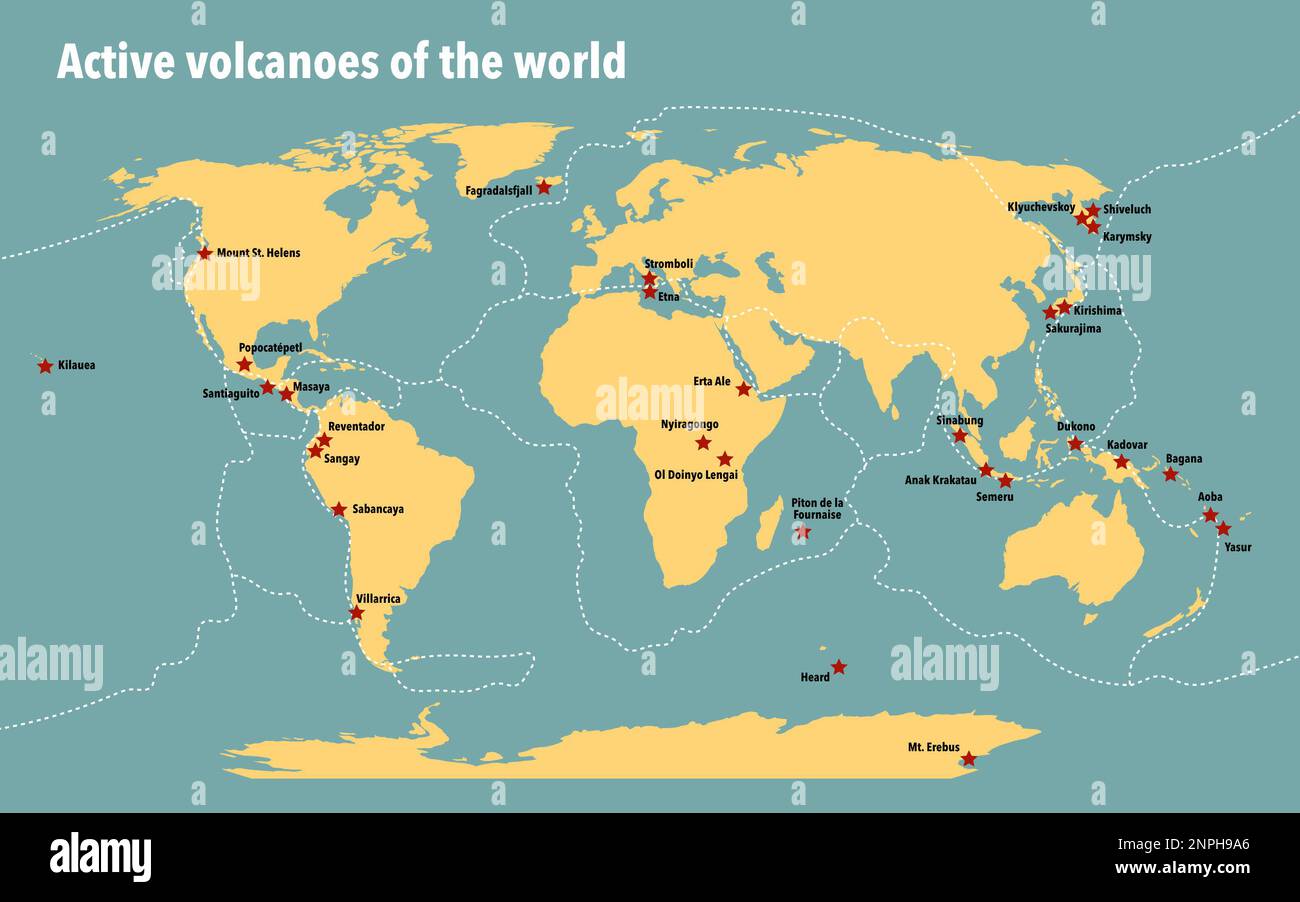
Active volcanoes are vent structures in the Earth's crust that are currently erupting, showing signs of unrest such as seismic tremors and gas emissions, or have documented eruptions within the Holocene epoch—roughly the past 11,700 years. Primary examples include Kīlauea in Hawaii, Mount Etna in Italy, Popocatépetl in Mexico, Sakurajima in Japan, and Mount Merapi in Indonesia.
Contents
What Defines an Active Volcano?
In volcanology, classifying a volcano as active requires assessing historical eruption activity, seismic indicators, thermal output, and ground deformation. The scientific community generally applies three functional statuses to volcanoes: active, dormant, and extinct.
An active volcano is defined as one that is currently erupting or exhibits measurable indicators of potential activity—such as localized earthquake swarms, fumarolic gas emissions, ground inflation, or elevated thermal anomalies. Furthermore, the Global Volcanism Program at the Smithsonian Institution categorizes any volcano with confirmed eruptions during the Holocene epoch (the past 11,700 years of Earth history) as active.
In contrast, a dormant volcano has not erupted in modern historical records or throughout the Holocene, yet retains a viable magmatic plumbing system capable of future unrest. An extinct volcano has broken its connection to its magma supply, showing no activity over tens of thousands to millions of years, and is undergoing permanent erosion.
Distinguishing between dormant and extinct states can be challenging. Volcanoes can remain quiet for thousands of years before reawakening explosively, which makes continuous monitoring essential for human safety and geological risk management.
Prominent Examples of Active Volcanoes Worldwide
Active volcanoes occur across diverse tectonic settings, including subduction zones, mid-ocean ridges, continental rifts, and mantle hotspots. Below are notable examples categorized by geographic region and geological characteristics.
Kīlauea and Mauna Loa (Hawaii, USA)
Situated on the Big Island of Hawaii, Kīlauea and Mauna Loa are classic examples of shield volcanoes formed by hotspot volcanism in the middle of the Pacific Plate.
- Kīlauea: Widely considered one of the most active volcanoes on Earth, Kīlauea features a summit caldera (Halemaʻumaʻu crater) and two active rift zones. It experienced a continuous continuous eruption along its East Rift Zone from 1983 to 2018, followed by recurring summit lava lake activity. Because its magma is low-viscosity basalt, Kīlauea typically displays effusive eruption styles, producing fluid lava flows rather than violent explosive columns.
- Mauna Loa: The largest subaerial volcano by volume on Earth, Mauna Loa spans over 5,000 square kilometers above sea level. It produces high-volume basaltic lava flows during active phases, such as its late-2022 eruption, which erupted lava from its summit caldera and Northeast Rift Zone toward local infrastructure.
Mount Etna and Mount Vesuvius (Italy)
Southern Italy sits at the complex collision zone between the African and Eurasian tectonic plates, giving rise to some of Europe's most famous volcanoes.
- Mount Etna: Located on the eastern coast of Sicily, Mount Etna is Europe's highest and most active stratovolcano. Etna exhibits near-constant activity, alternating between mild Strombolian eruptions (bursts of incandescent cinder and spatter) at its summit craters and flank eruptions that generate extensive basaltic lava flows.
- Mount Vesuvius: Overlooking the Bay of Naples, Vesuvius is best known for its catastrophic Plinian eruption in 79 AD, which destroyed Pompeii and Herculaneum. While Vesuvius has been in a quiescence phase since its last eruption in 1944, it remains classified as an extremely hazardous active volcano due to the dense population of over 3 million residents living within its immediate footprint.
Popocatépetl and Colima (Mexico)
The Trans-Mexican Volcanic Belt stretches across central-southern Mexico, created by the subduction of the Cocos and Rivera plates beneath the North American Plate.
- Popocatépetl: Rising to 5,426 meters, "El Popo" is an active stratovolcano located roughly 70 kilometers southeast of Mexico City. After sitting dormant for several decades in the mid-20th century, Popocatépetl reawakened in 1994. It frequently generates dome-building cycles interrupted by explosive ash emissions, pyroclastic bursts, and persistent gas plumes, requiring continuous alert monitoring by Mexico's National Center for Disaster Prevention (CENAPRED).
- Volcán de Colima: Often referred to as the "Volcano of Fire," Colima is one of Central America's most active volcanoes. It features frequent lava dome growth, block-lava flows, and minor-to-moderate pyroclastic flows.
Sakurajima and Mount Fuji (Japan)
Japan lies along the Pacific Ring of Fire, where multiple oceanic plates subduct beneath the Eurasian, Philippine Sea, and North American plates.
- Sakurajima: Located in Kagoshima Prefecture, Kyushu, Sakurajima is an active stratovolcano that erupts hundreds of times annually. Formerly an island, a major eruption in 1914 produced massive lava flows that connected it to the Osumi Peninsula. Sakurajima's daily activity consists of Vulcanian explosions, casting ash clouds thousands of meters into the air and requiring citywide ash-clearance systems in nearby Kagoshima City.
- Mount Fuji: Japan's highest peak (3,776 meters) is a composite stratovolcano. Though it has not erupted since the Hoei eruption in 1707, Fuji is legally and geologically classified as active. Micro-seismic monitoring and strain meters continuously evaluate its deep magmatic chamber.
Mount Merapi and Krakatoa (Indonesia)
The Indonesian Archipelago sits atop the Sunda Megathrust subduction zone, making it the most volcanically active region on the planet.
- Mount Merapi: Located on the island of Java near the city of Yogyakarta, Merapi ("Mountain of Fire") is recognized as Indonesia's most active volcano. Merapi is notorious for generating rapid viscous lava domes that periodically collapse, sending lethal pyroclastic flows (gembel prospects) down its densely populated slopes.
- Krakatoa (Anak Krakatau): Located in the Sunda Strait, the original Krakatoa underwent a colossal caldera collapse in 1883. The active vent structure, Anak Krakatau ("Child of Krakatoa"), emerged above sea level in 1927 and remains highly active. A major flank collapse in December 2018 triggered a devastating local tsunami.
Erta Ale and Mount Nyiragongo (African Rift System)
The East African Rift System represents an active continental rift zone where the African continent is gradually splitting into the Nubian and Somali plates.
- Erta Ale: Situated in the Danakil Depression of Ethiopia, Erta Ale is a low-lying basaltic shield volcano famous for housing one of the world's few persistent lava lakes, which has remained active for decades.
- Mount Nyiragongo: Located in the Virunga National Park of the Democratic Republic of the Congo, Nyiragongo features an exceptionally fluid, low-silica alkaline lava lake. When its crater walls fracture, as occurred in 1977, 2002, and 2021, the volcano unleashes fast-moving lava flows that threaten the adjacent city of Goma.
Comparative Matrix of Notable Active Volcanoes
The following table summarizes key physical traits, tectonic settings, primary eruption styles, and dominant geological hazards associated with prominent active volcanoes around the world.
| Volcano Name | Geographic Location | Tectonic Setting | Primary Volcano Type | Typical Eruption Style | Primary Geological Hazards |
|---|---|---|---|---|---|
| Kīlauea | Hawaii, United States | Hotspot (Intraplate) | Shield Volcano | Effusive (Hawaiian) | Lava flows, volcanic gas ($SO_2$), tephra fall |
| Mount Etna | Sicily, Italy | African-Eurasian Collision Zone | Stratovolcano | Effusive to Mildly Explosive (Strombolian) | Lava flows, ash fall, pyroclastic spatter |
| Popocatépetl | Central Mexico | Subduction (Cocos under North American) | Stratovolcano | Explosive to Dome-building (Vulcanian) | Ash plumes, pyroclastic flows, lahars |
| Sakurajima | Kyushu, Japan | Subduction (Philippine Sea under Eurasian) | Stratovolcano | Explosive (Vulcanian) | Frequent ashfall, volcanic bombs, pyroclastic flows |
| Mount Merapi | Central Java, Indonesia | Subduction (Indo-Australian under Sunda) | Stratovolcano | Explosive (Dome collapse) | Pyroclastic flows, lahars, ash plumes |
| Erta Ale | Afar Region, Ethiopia | Continental Rift System | Shield Volcano | Effusive Lake Activity | Lava flows, volcanic gases |
| Mount Nyiragongo | DRC, Africa | East African Rift | Stratovolcano | Effusive (Ultra-fast lava) | Rapid lava flows, carbon dioxide emissions ($CO_2$) |
| Anak Krakatau | Sunda Strait, Indonesia | Subduction (Indo-Australian under Sunda) | Caldera / Volcanic Cone | Explosive (Strombolian / Phreatomagmatic) | Ash emissions, flank collapse tsunamis |
How Scientists Classify Volcanic Activity and Eruption Styles
Volcanoes display a wide range of behavior dictated by their magma composition, silica content, dissolved gas volume, and pressure dynamics. Magma viscosity—its resistance to flow—is the single most decisive factor shaping both the volcano’s shape and its eruptive mechanics.
Low Silica / Low Viscosity High Silica / High Viscosity (Basaltic Magma) (Dacitic / Rhyolitic Magma) ---------------------------------------------------------------------------------> Effusive Flow (Hawaiian) ===> Moderate Explosions ===> Catastrophic Columns (Plinian) e.g., Kīlauea, Erta Ale e.g., Stromboli, Etna e.g., Vesuvius, Pinatubo
Magma Viscosity and Silica Content
- Basaltic Magma: Contains relatively low silica levels (less than 52%). It is hot, highly fluid, and allows dissolved volcanic gases (such as water vapor, carbon dioxide, and sulfur dioxide) to escape easily. This results in relatively non-explosive, effusive eruptions featuring moving lava rivers, lava fountains, and broad, gently sloping shield volcanoes.
- Andesitic and Dacitic Magmas: Contain moderate-to-high silica levels (52% to 70%). These cooler magmas are significantly more viscous. Gases get trapped under immense internal pressure until they violently break apart the surrounding rock and molten material. This behavior produces steep-sided stratovolcanoes (composite cones) characterized by alternating layers of ash, spatter, and hardened lava.
- Rhyolitic Magma: Contains high silica levels (greater than 70%). It is extremely viscous and can lead to massive explosive eruptions or slow-moving, thick lava domes.
Eruption Classifications and the VEI Scale
Volcanologists categorize volcanic eruptions into classic eruption styles based on their energy and characteristics:
- Hawaiian: Characterized by quiet, continuous effusive flows of fluid basaltic lava with minimal explosive ash.
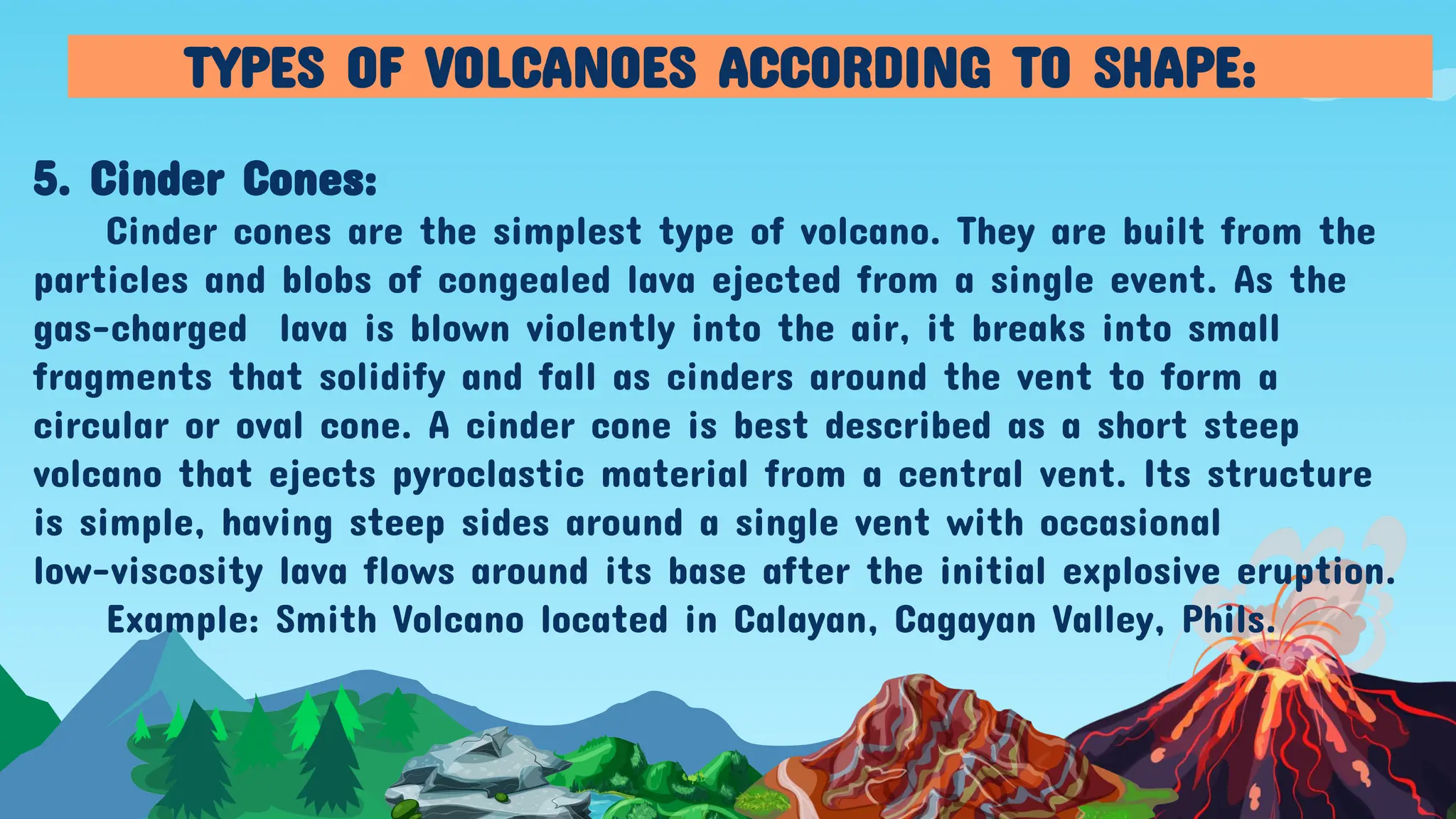
- Strombolian: Marked by rhythmic, mild explosions that shoot incandescent lava spatter and cinders tens to hundreds of meters into the air.
- Vulcanian: Involves dense, ash-laden explosive bursts that clear out hardened lava plugs from a volcano's vent.
- Plinian: The most energetic eruptions, marked by sustained explosive columns that blast ash, pumice, and gas tens of kilometers into the stratosphere.
- Phreatomagmatic: Explosive interactions caused by direct contact between magma and ground or surface water, generating steam-driven ash clouds.
To quantify the magnitude and intensity of explosive eruptions, scientists rely on the Volcanic Explosivity Index (VEI). Ranging from 0 to 8, the VEI scale is logarithmic based on ejected volume, plume height, and eruption duration:
- VEI 0–1: Non-explosive to gentle (e.g., Kīlauea's typical lava flows).
- VEI 2–3: Severe to catastrophic bursts (e.g., typical Strombolian or moderate Vulcanian activity).
- VEI 4–5: Cataclysmic column eruptions (e.g., Mount St. Helens in 1980; Eyjafjallajökull in 2010).
- VEI 6–7: Colossal to super-colossal eruptions (e.g., Krakatoa in 1883; Mount Tambora in 1815).
- VEI 8: Mega-colossal "supervolcano" events (e.g., the Toba eruption ~74,000 years ago).
Volcanic Hazards and Safety Protocols
Living near or visiting active volcanoes requires understanding the primary natural hazards associated with magmatic activity.
Primary Volcanic Hazards
- Pyroclastic Flows: Fast-moving, high-density mixtures of superheated gas, ash, and volcanic rock fragments that sweep down volcanic slopes at speeds exceeding 100 km/h and temperatures over 500°C. They represent the single deadliest volcanic hazard.
- Lahars: Volcanic mudflows or debris flows formed when volcanic ash and unconsolidated rock mix with heavy rainfall, melting ice, or snow. Lahars rush down river valleys, burying infrastructure under heavy sediment.
- Tephra and Volcanic Ashfall: Airborne fragments of pulverized rock and glass ejected into the atmosphere. Ashfall can cause respiratory distress, collapse roofs under heavy accumulation, pollute water supplies, and cripple jet turbine engines in flight.
- Volcanic Gases: Emissions including sulfur dioxide ($SO_2$), carbon dioxide ($CO_2$), hydrogen sulfide ($H_2S$), and hydrogen chloride ($HCl$). Dense gases like $CO_2$ can pool in low-lying depressions, creating localized suffocation risks.
- Lava Flows: Streams of molten rock. While lava flows move slowly enough for humans to evacuate safely in most cases, they destroy standing property, farmland, and utility corridors.
Monitoring and Safety Guidelines
Volcanic risk management relies on continuous observation networks operated by agencies such as the U.S. Geological Survey (USGS), Italy's Istituto Nazionale di Geofisica e Vulcanologia (INGV), and Indonesia's Centre for Volcanology and Geological Hazard Mitigation (PVMBG). Monitoring arrays track four key indicators:
- Seismicity: Seismograph networks map volcanic earthquakes, harmonic tremors, and subsurface fluid movement.
- Deformation: Global Navigation Satellite System (GNSS) receivers and satellite radar (InSAR) track ground tilting, inflation, and deflation caused by rising magma chambers.
- Gas Emissions: Correlation spectrometers and airborne sensors measure changes in gas ratios, such as rising $SO_2/CO_2$ output.
- Thermal Monitoring: Infrared satellite optics track temperature spikes in summit craters and active fissures.
Visitor Safety Recommendations
If traveling to regions with active volcanoes:
- Check Volcano Alert Levels: Verify safety conditions with local civil protection authorities before hiking near active slopes.
- Carry Emergency Gear: Keep a high-filtration respirator mask (N95 or better) and protective goggles in your pack to guard against sudden ashfall or toxic gases.
- Obey Exclusion Zones: Never cross designated safety perimeters surrounding active craters or lava channels.
- Know Evacuation Routes: Identify local hazard evacuation corridors and assembly areas designated by emergency management services.
Frequently Asked Questions
What is the most active volcano on Earth?
Kīlauea in Hawaii and Mount Etna in Italy are routinely cited as the world's most consistently active volcanoes due to their near-continuous eruptive processes. However, volcanoes like Yasur (Vanuatu) and Erta Ale (Ethiopia) have maintained active eruptive states for centuries.
Can scientists predict exactly when a volcano will erupt?
Scientists cannot pinpoint the exact minute or hour an eruption will start, but they can identify clear warning signs weeks or days in advance. Increased micro-seismic activity, ground swelling, and shifts in gas composition allow volcanologists to issue timely evacuation warnings.
How many active volcanoes are there in the world?
There are roughly 1,350 potentially active volcanoes worldwide, according to the Smithsonian Institution's Global Volcanism Program. Around 500 of these have documented historical eruptions, and approximately 40 to 50 are actively erupting at any given time.
Are all active volcanoes located along the Ring of Fire?
No. While roughly 75% of the world's active volcanoes reside within the Pacific Ring of Fire due to concentrated subduction zones, many active volcanoes occur elsewhere. Examples include intraplate hotspots (Hawaii, Réunion Island), continental rifts (East Africa), and oceanic spreading ridges (Iceland).
What is the difference between an effusive and an explosive eruption?
An effusive eruption occurs when low-viscosity, low-silica magma allows gases to escape easily, resulting in steady flows of lava onto the surface. An explosive eruption occurs when viscous, high-silica magma traps gas bubbles under high pressure until they shatter the rock, blasting ash, gas, and pyroclastic debris high into the atmosphere.
Next Steps for Exploration and Hazard Awareness
To monitor live volcanic conditions or explore volcano dynamics further:
- Visit the Smithsonian Institution Global Volcanism Program to read weekly eruption reports for volcanoes around the globe.
- Monitor real-time status updates and alert levels provided by regional agencies like the USGS Volcanic Hazards Program or the European Volcanological Society.
- Review local civil defense frameworks if traveling near active volcanic parks, ensuring access to reliable communication channels and emergency evacuation plans.
Image Gallery