Choosing Between a Baton and a Nightstick: A Professional Guide to Impact Weapons
Choosing between a baton and a nightstick depends primarily on your operational environment and the need for concealability versus immediate structural reliability. For modern patrol and civilian self-defense, the expandable baton is t...
Choosing between a baton and a nightstick depends primarily on your operational environment and the need for concealability versus immediate structural reliability. For modern patrol and civilian self-defense, the expandable baton is the industry standard due to its portability and psychological deterrent effect. However, the fixed nightstick remains superior for crowd control and high-intensity tactical situations where mechanical failure is not an option.
Contents
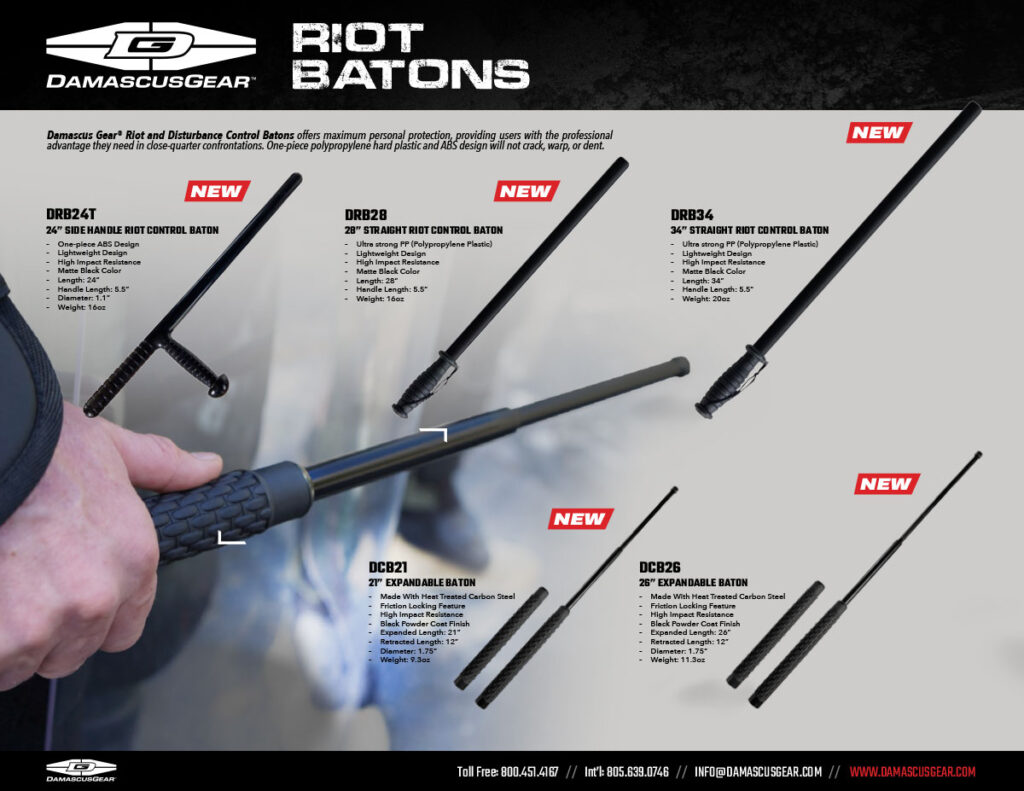
In the professional security and law enforcement landscape of 2026, the distinction between a "baton" and a "nightstick" has become more nuanced, yet the fundamental mechanical differences remain. While many use the terms interchangeably, they represent two distinct philosophies of less-lethal force. A nightstick generally refers to a fixed-length, solid striking tool—often associated with the traditional straight stick or the side-handle PR-24. A baton, in the modern context, almost exclusively refers to the telescopic or expandable variety that collapses into a compact handle.
Understanding which tool fits your specific needs requires a deep dive into the mechanics of impact, the ergonomics of daily carry, and the legal frameworks governing their use.
The Traditional Fixed Nightstick: Stability and Strength
The fixed nightstick is the direct descendant of the wooden truncheons used by early constabularies. By 2026, while wood is still used for ceremonial purposes, most functional nightsticks are constructed from high-impact polycarbonate or heavy-duty polymers. These tools are characterized by their lack of moving parts, which is their greatest mechanical advantage.
Structural Integrity and Reliability
Because a nightstick is a single, solid piece of material, it is virtually indestructible under normal operational conditions. There are no locking segments to fail, no springs to lose tension, and no internal debris that can jam the mechanism. In a high-stress confrontation, the "always ready" nature of a fixed stick provides a level of psychological certainty that an expandable tool cannot match. If you draw a nightstick, it is already at its full functional length.
Versatility of the Side-Handle (PR-24)
A specific sub-category of the nightstick is the side-handle baton, famously represented by the Monadnock PR-24. This tool features a perpendicular handle that allows for advanced blocking maneuvers and "spun" strikes that generate massive centrifugal force. The side handle also serves as an excellent retention aid, making it much harder for a subject to strip the weapon from a glues-on-grip officer. However, the PR-24 requires significant specialized training to use effectively; without mastery, the side handle can actually become a liability or an awkward protrusion.
Limitations of the Fixed Design
The primary drawback of the fixed nightstick is its size. Carrying a 24-inch to 36-inch solid stick on a utility belt is cumbersome. It frequently interferes with sitting in a vehicle, can snag on seatbelts, and is highly visible, which may escalate a situation before a word is even spoken. For these reasons, many agencies have moved away from the fixed stick for standard patrol duties, reserving them for specialized units or riot response.
The Expandable Baton: Portability and Modern Engineering
The expandable baton—often referred to by the brand name ASP (Armament Systems and Procedures)—has dominated the market for over three decades. As of 2026, the technology has evolved from simple friction-lock designs to sophisticated positive-lock (push-button) mechanisms.
Concealability and Ergonomics
The most significant advantage of the expandable baton is its footprint. A 21-inch baton can collapse down to roughly 8 or 9 inches, allowing it to sit high on the belt or even be carried in a pocket or a discreet scabbard. This portability makes it the preferred choice for plainclothes officers, private security, and civilians in jurisdictions where such tools are legal. It allows the user to maintain a "low profile" until the moment the tool is required.
The Psychological Factor
There is a documented psychological effect associated with the "racking" of an expandable baton. The sound of steel segments locking into place is distinct and intimidating. In many de-escalation scenarios, the mere act of deploying the baton can convince a non-compliant subject to surrender without the need for physical strikes.
Mechanical Considerations
Expandable batons are categorized into two main types:
- Friction-Lock: These stay open through the force of the segments wedging together. They are closed by striking the tip against a hard surface. While simpler, they can occasionally collapse if a "stabbing" or "jabbing" motion is used rather than a swinging strike.
- Positive-Lock (Disc/Push-Button): These use internal cams or discs to lock the segments. They are closed by pressing a button at the butt-end. In 2026, these are the preferred professional standard because they can be opened and closed quietly and will not collapse during thrusting maneuvers.
Comparative Analysis: Baton vs. Nightstick
To help determine which tool is appropriate for your specific role, the following table compares the key operational metrics of both weapons.
| Feature | Expandable Baton (Telescopic) | Fixed Nightstick (Straight/Side-Handle) |
|---|---|---|
| Portability | Excellent; collapses for easy carry. | Poor; bulky and interferes with sitting. |
| Deployment Speed | Moderate; requires a flick or pull. | Instant; already at full length. |
| Durability | High (but mechanical parts can wear). | Extreme; solid-state construction. |
| Concealability | High; fits in small pouches or pockets. | Low; very difficult to hide. |
| Maintenance | Requires cleaning and lubrication. | Negligible; wipe down only. |
| Psychological Impact | High (the sound of deployment). | Moderate (visible presence). |
| Blocking Capability | Good for linear strikes. | Superior (especially side-handle versions). |
| Training Curve | Lower for basic strikes. | High (requires specialized techniques). |
Legal and Liability Considerations in 2026
Before choosing between these tools, it is crucial to understand the legal landscape. Impact weapons are generally classified as "intermediate force" or "less-lethal" options, but their use is heavily regulated.
Jurisdictional Restrictions
In many regions, including several U.S. states and various European countries, the possession of an expandable baton by a civilian is a felony or a high-level misdemeanor. Conversely, a fixed "billy club" might be treated differently under ancient statutes. Professional users must ensure their specific tool is approved by their department or agency policy. Using a non-issued side-handle nightstick when only expandable batons are authorized can lead to significant civil liability, even if the use of force was otherwise justified.
Target Zones and Medical Risks
Both tools are designed to target large muscle groups (arms, thighs, calves) to achieve "motor dysfunction." Training programs in 2026 emphasize the avoidance of "Red Zones," which include the head, neck, spine, and sternum. Strikes to these areas with either a nightstick or a baton are considered lethal force in most use-of-force continuums. Because a fixed nightstick often has more mass, the risk of unintended bone fractures is slightly higher than with a lightweight aluminum expandable baton.
Training and Maintenance: Ensuring Operational Readiness
A tool is only as effective as the person wielding it. Both the baton and the nightstick require regular practice to ensure that, under stress, the user can deploy and use the weapon without fumbling.
Training Requirements
- Baton Training: Focuses on rapid deployment, peripheral vision, and the "45-degree" strike. Users must also practice "clearing" the baton if it fails to lock properly.
- Nightstick Training: Focuses on leverage, prying (in a rescue context), and advanced blocking. For the side-handle variety, hours of "spinning" drills are necessary to develop the muscle memory required for effective strikes.
Maintenance Protocols
The fixed nightstick requires almost no maintenance other than checking the grip for wear. The expandable baton, however, is a precision instrument. It must be disassembled periodically to remove dust, lint, and moisture. In 2026, many manufacturers recommend dry lubricants; traditional oils can attract grit which eventually acts like sandpaper on the internal locking segments, leading to "slippage" where the baton collapses unexpectedly during a strike.
Frequently Asked Questions
Is an expandable baton as strong as a solid nightstick?
While modern 4140 steel expandable batons are incredibly strong, they are not as "structurally" strong as a solid polycarbonate nightstick. A fixed stick can be used for prying or as a weight-bearing lever in ways that could permanently bend or break the joints of an expandable baton.
Which is better for home defense?
For home defense, a fixed nightstick or a short "billy club" is often superior. Since you do not need to carry the tool on a belt for hours, the bulkiness of a fixed stick is not a disadvantage. The immediate readiness and lack of mechanical complexity make it more reliable for sudden, high-stress encounters in a residential setting.
Do batons expire or wear out?
Fixed nightsticks do not expire, though wooden ones can warp or crack over decades. Expandable batons have a service life. The friction-lock surfaces can wear down after thousands of deployments, and the springs in positive-lock models can eventually fatigue. Professional users should inspect their batons annually and replace them if the locking mechanism feels "soft."
Can I use a baton for animal defense?
Yes, batons are frequently used by hikers and mail carriers for defense against aggressive dogs. The extra reach provided by a 26-inch baton allows the user to keep the animal at a distance. However, be aware that many park services have specific regulations regarding "weapons" that may include batons.
Final Recommendation: Which Should You Choose?
If you are a patrol officer or a security professional who spends significant time in a vehicle or walking a beat, the expandable push-button baton is the clear winner. Its combination of portability, ease of use, and psychological deterrent makes it the most versatile tool for modern engagement.
If you are involved in high-risk crowd control (riot duty) or require a tool for a stationary post where you may need to perform heavy-duty blocking or prying, the fixed straight nightstick remains the more robust and reliable choice. Its simplicity is its greatest strength in chaotic environments where fine motor skills—like finding a small button to close a baton—may be compromised by adrenaline.
Regardless of your choice, ensure you seek professional certification. An impact weapon used without training is often more dangerous to the user than the assailant.
Image Gallery